While around 70% of UK households have access to an off-street location which can potentially be used for charging an EV, around 30% of UK households (40% in London) do not have a suitable location for home-based, overnight EV charging. This is potentially a significant barrier for EV adoption given the early stages of UK market development.
For EV-owning households with no off-street parking provision, the technical options and level of financial support are limited. While, in principle, local authorities are able to apply for funding to install an on-street charge point close to the EV-owner’s property, recent information from the DfT reveals that only two local councils have opted to provide this type of support.
Given that on-street units are also costly to purchase and install, the challenge therefore is to develop innovative and low-cost EV charging solutions for households and residential areas where no off-street parking/ charging facilities exist.
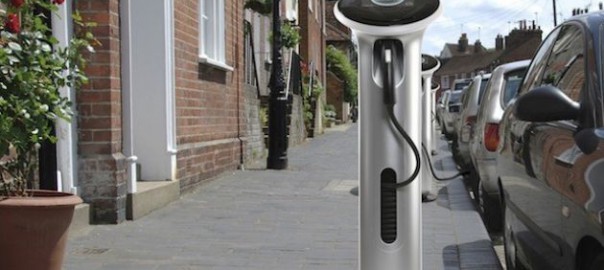
General Electric Watt Station Charge Post (Image: GE)
This white paper therefore outlines five possible alternative options which, depending on context, could provide safe, low-cost EV charging solutions for households with no off-street parking:
1. Cable channels and guides
2. Drop kerbs
3. ‘Pop-up power’ units and ‘power bollards’
4. Street lighting – shared power supplies
5. Shared EV-parking solutions
While, relevant legal and regulatory factors would have to be checked as would electrical safety, insurance and liability issues, it is hoped that the alternatives outlined will provide local authorities with new approaches to supporting the use of electric vehicles within their respective areas of influence.
MILLIONS of drivers could be missing out on savings of around £860 per year in fuel and tax because myths still exist about running electric and plug-in hybrid cars.
The findings are the result of new research released today by Go Ultra Low, a joint initiative by government and the UK automotive industry.
According to the research, around 11.5 million motorists could benefit from the lowest cost, tax-free motoring by switching to pure electric vehicles, because in a typical year they don’t drive further than 80 miles in a single trip.
Millions more could benefit from other ULEVs, which can travel between 150 and 700 miles between charges thanks to range-boosting petrol and diesel assistance.
The Go Ultra Low research shows that 70% of car owners are planning to change their car within the next four years, while three in ten say they have considered purchasing a ULEV. Two thirds of motorists under the age of 24 have considered a ULEV compared to just a quarter of drivers over 55.
The survey also reveals that the majority of motorists still don’t fully understand how electrically-powered vehicles work and believe outdated myths across a number of topics, from range and charging to cost and practicality.
Commenting on the findings, motoring journalist Quentin Willson, said:
“Ultra low emission vehicles make so much sense, they are cheap to run, hugely practical and now almost every major manufacturer has something to offer.
“The Go Ultra Low research shows that a host of misconceptions are hampering consumer uptake, and more needs to be done to educate people about the numerous benefits of these vehicles.”
The survey discovered that a quarter of motorists misunderstand the range capabilities of ULEVs, with 16% believing electric vehicles are unable to travel 50 miles without recharging.
Yet the research also shows that more than a third of drivers said the furthest they drove in a single journey during 2014 was 80 miles or less.
With pure-electric vehicles able to travel up to 100 miles on a single charge and other plug-in ULEVs boasting up to 700 miles’ range, the survey’s authors claim electrically-powered cars are a viable, low cost option for millions of motorists.
Go Ultra Low is a campaign to help motorists understand the benefits, cost savings and capabilities of the raft of new ultra-low emission vehicles on the market.
The collaborative campaign is the first of its kind, bringing together the Department for Transport, the Office for Low Emission Vehicles, SMMT and a consortium of leading car manufacturers: Audi, BMW, Mitsubishi, Nissan, Renault, Toyota, and Volkswagen.
Saudi billionaire businessman Prince Alwaleed bin Talal told me we will not see $100-a-barrel oil again. The plunge in oil prices has been one of the biggest stories of the year. And while cheap gasoline is good for consumers, the negative impact of a 50% decline in oil has been wide and deep, especially for major oil producers such as Saudi Arabia and Russia. Even oil-producing Texas has felt a hit. The astute investor and prince of the Saudi royal family spoke to me exclusively last week as prices spiraled below $50 a barrel. He also predicted the move would dampen what has been one of the big U.S. growth stories: the shale revolution. In fact, in the last two weeks, several major rig operators said they had received early cancellation notices for rig contracts. Companies apparently would rather pay to cancel rig agreements than keep drilling at these prices. His royal highness, who has been critical of Saudi Arabia’s policies that have allowed prices to fall, called the theory of a plan to hurt Russian President Putin with cheap oil “baloney” and said the sharp sell-off has put the Saudis “in bed” with the Russians. The interview has been edited for clarity and length.
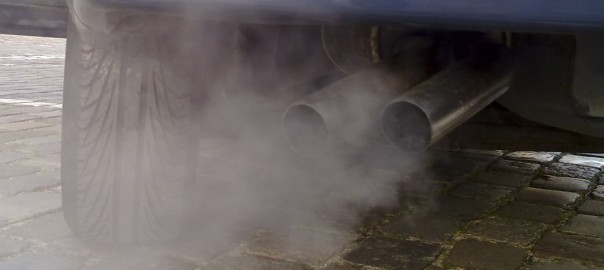
Car exhaust pollution (Image: Wikipedia)
Q: Can you explain Saudi Arabia’s strategy in terms of not cutting oil production?
A: Saudi Arabia and all of the countries were caught off guard. No one anticipated it was going to happen. Anyone who says they anticipated this 50% drop (in price) is not saying the truth.
Because the minister of oil in Saudi Arabia just in July publicly said $100 is a good price for consumers and producers. And less than six months later, the price of oil collapses 50%.
Having said that, the decision to not reduce production was prudent, smart and shrewd. Because had Saudi Arabia cut its production by 1 or 2 million barrels, that 1 or 2 million would have been produced by others. Which means Saudi Arabia would have had two negatives, less oil produced, and lower prices. So, at least you got slammed and slapped on the face from one angle, which is the reduction of the price of oil, but not the reduction of production.
Q: So this is about not losing market share?
A: Yes. Although I am in full disagreement with the Saudi government, and the minister of oil, and the minister of finance on most aspects, on this particular incident I agree with the Saudi government of keeping production where it is.
Q: What is moving prices? Is this a supply or a demand story? Some say there’s too much oil in the world, and that is pressuring prices. But others say the global economy is slow, so it’s weak demand.
A: It is both. We have an oversupply. Iraq right now is producing very much. Even in Libya, where they have civil war, they are still producing. The U.S. is now producing shale oil and gas. So, there’s oversupply in the market. But also demand is weak. We all know Japan is hovering around 0% growth. China said that they’ll grow 6% or 7%. India’s growth has been cut in half. Germany acknowledged just two months ago they will cut the growth potential from 2% to 1%. There’s less demand, and there’s oversupply. And both are recipes for a crash in oil. And that’s what happened. It’s a no-brainer.
Q: Will prices continue to fall?
A: If supply stays where it is, and demand remains weak, you better believe it is gonna go down more. But if some supply is taken off the market, and there’s some growth in demand, prices may go up. But I’m sure we’re never going to see $100 anymore. I said a year ago, the price of oil above $100 is artificial. It’s not correct.
Q: Wow. And you said you are in agreement with the Saudi government to not give up market share?
A: This is the only point I’m agreeing with the Saudi Arabian government on oil. That’s the only point, yes.
Q: Should the Saudis cut production if they get an agreement with other oil producing countries to take oil off the market?
A: Frankly speaking, to get all OPEC countries to approve and accept it, including Russia and Iran, and everybody else, is almost impossible You can never have an agreement whereby everybody cuts production. We can’t trust all OPEC countries. And can’t trust the non-OPEC countries. So it’s not on the table because the others will cheat. The past has proven that. When Saudi Arabia cut production in the ’80s and ’90s, everybody cheated and took market share from us. Plus, remember there is an agenda here also. Although Saudi Arabia and OPEC countries did not engineer the reduction in the price of oil, there’s a positive side effect, whereby at a certain price, we will see how many shale oil production companies run out of business. So although we are caught off guard by this, we are capitalizing on this matter whereby we’ll live with $50 temporarily, to see how much new supply there will be, because this will render many new projects economically unfeasible.
Q: What about the theory of the pressure on the Russians? There’s a theory that the U.S. and the Saudis have agreed to keep prices low to pressure Russia because of what Putin has done in Ukraine.
A: Two words: baloney and rubbish. I’m telling you, there’s no way Saudis will do this. Because Saudi Arabia is hurting as much as Russia, period. Now, we don’t show it because of our big reserves. But I’ll tell you Saudi Arabia and Russia are in bed together here. And both are being hurt simultaneously. And there’s no political conspiracy whatsoever against Russia. Because we are shooting ourselves in the foot if we do that.
Q: You said the price of oil will dampen the shale revolution in America. How?
A: Shale oil and shale gas, these are new products in the market. And we see big ranges. no one knows for sure what price is the breaking point for shale. Wells have a higher production cost. And very clearly these will run out of business, or at least not be economical. At $50, will it still be economically feasible? Unclear. This is a very much developing story.
Q: Some people believe this crash in oil will create a lot of new mergers in the energy industry. Do you agree?
A: No doubt about that. For sure there’ll be a lot of consolidation in the market. Because many small and medium-sized companies can’t afford this. Because they are very much dependent on the price of oil. Big companies like Exxon and Chevron are weathering the oil market crash because they are integrated vertically. But no doubt there’ll be some mergers and acquisitions coming in one to two years.