Daily Archives: November 19, 2014

G20 nations had been spending almost $90bn a year on finding more oil, gas and coal

Fossil fuel promises are being broken, report says

World governments have been breaking promises to phase out subsidies for fossil fuels, a report says.

The Overseas Development Institute says G20 nations spent almost £56bn ($90bn) a year finding oil, gas and coal.

It comes despite evidence that two thirds of existing reserves must be left in the ground if the world is to avoid dangerous climate change.

A government spokesman said the North Sea oil and gas industry “creates jobs and generates investment” in the UK.

The spokesman said the tax regime for oil and gas includes a number of allowances which reduce the tax burden on specific, challenging gas or oil fields.

Allowances did not constitute a subsidy, he added.

The UK government has previously said it was helping firms find fossil fuels within the UK to increase energy security, attract royalties and help with the balance of payments.

Fuel exploration

However, the report said subsidies were irrational, a waste of public money and harmful to the environment.

With rising costs for hard-to-reach fossil fuel reserves – together with falling coal and oil prices – renewable energy was a better way to invest taxpayers’ funds, it added.

The report’s authors said the UK had introduced national subsidies for exploration valued at up to £757 million a year.

Those included tax breaks for North Sea exploration worth £528 million to Total (HQ France), £256 million to Statoil (Norway), £144 million to Centrica (UK) and £45 million to Chevron (USA) between 2009 and 2014.

The report also traced G20 governments’ funding of fossil fuel exploration overseas.

The UK has been spending £418 million annually in public finance for exploration in Siberia, Brazil, India, Indonesia, Nigeria, Guinea and Ghana, it said. The funding was through export finance guarantees.

The USA has been spending £883 million annually in public finance for overseas exploration in Colombia, Mexico, Nigeria and Russia, the report added.

Read more: BBC

See also: Clean Technica: G20 Supporting Fossil Fuels To The Tune Of $88 Billion
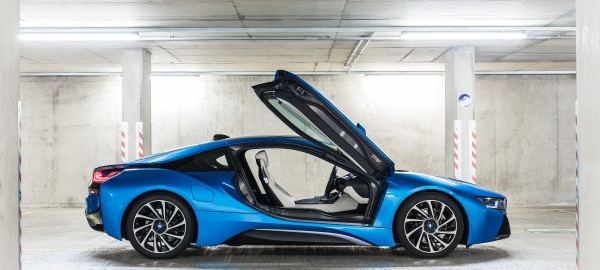
BMW i8 (Image: BMW)

BMW praises British-built i8 engine

The BMW i8 has become something of an iconic car ever since the company showed it off as a concept back in 2009 at the Frankfurt Motor Show.

The car represents the German manufacturer’s first attempt at a pug-in hybrid supercar. The sustainably-focused sports car is part built in BMW’s wind-powered factory in Dusseldorf and has a design focus on using sustainable materials.

However, the car’s engines are produced at BMW’s Hams Hall manufacturing facility near Birmingham. The new three-cylinder engine is capable of powering the i8 from 0 to 60mph in less than 4.5 seconds, all while the vehicle delivers as much as 135mpg.

Transport minister Baroness Kramer said that the engine is a perfect demonstration of the UK’s commitment to the low-carbon transport. She said:

“The British-made engine for this ground-breaking car demonstrates that the UK automotive industry is at the forefront of the production of high-quality, low emission car technology. As our recent commitment to invest £500 million in ultra-low emission vehicle design, production and adoption shows, we want the UK to be a world leader in the global transition to ultra-low emission motoring.”

Read more: Next Energy News

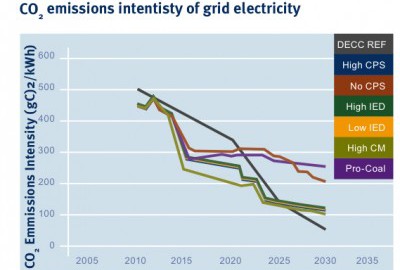
CO2 Emissions Intensity of UK Grid Electricity (Image: Imperial College)

Great Britain Will Likely Miss Its 2030 Climate Goal, New Study Warns

If Great Britain wants to keep its carbon emission reductions on course, it’s going to need to make some significant policy changes.

That’s the word from a new report just released by London’s Imperial College. The researchers ran models of six likely scenarios for how Britain’s economy and carbon emissions could behave under current policy. The country’s Committee on Climate Change (CCC) has recommended that Britain get its emission rate — the amount of carbon dioxide released for every unit of energy produced — down to 50 grams of CO2 per kilowatt-hour (gCO2/kWh) by 2030. But in all six scenarios, the rate remained at or above 100 gCO2/kWh in that year.

The problem is the country’s coal generation. Great Britain has already closed 8 gigawatts (GW) of coal power, leaving 19 GW spread between nine plants. And in every scenario, at least 5 GW of coal-fired power remained in operation in 2030. These coal plants were mostly built back in 1960s and 1970s. They tend to be extremely dirty and inefficient, and rank among some of the biggest carbon emitters in all of Europe. The power sector also accounts for about half of the country’s total emissions.

In 2008, Great Britain passed the Climate Change Act, which established the CCC and legally committed the country to getting its greenhouse gas (GHG) emissions down to 80 percent below their 1990 levels by 2050. Subsequent legislation has created various tools for getting there, and empowered the Secretary of State to lay down an official target for the country’s power sector in 2016. For the moment, however, the CCC’s recommendation is the best goal post available.

The primary policy for hitting it is the European Union’s (EU) Emissions Trading System (ETS), a cap-and-trade program that includes Great Britain. But the country also has a Carbon Price Support (CPS) law, which sets a floor for how low the price of emissions on the ETS can drop within Britain’s market, and which rises over time. There are also regulations on emissions set by the EU as a whole, along with Britain’s own emissions performance standard (EPS) — which sets a rate limit for carbon emissions, but only for newly built power plants.

Read more: Climage Progress

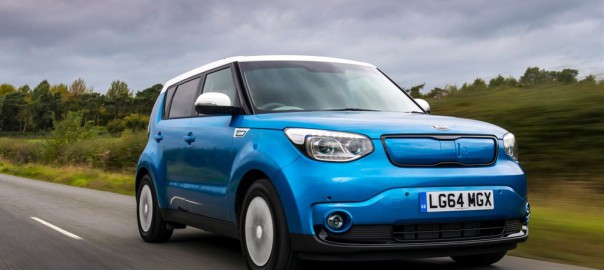
Kia Soul EV

Kia Soul EV arrives in the UK

Kia’s new electric Soul has gone on sale in the UK, priced from £24,995 after a government grant of £5,000.

That places it £3,445 above the price of the range-topping model of the existing combustion Soul range, with the Soul 1.6 CRDi Maxx priced at £21,550.

Despite being one of the least aerodynamic electric cars we’ve yet seen, Kia says its new battery-powered crossover can deliver a range of 132 miles per charge – 8 miles more than the official range of rival model, the Nissan LEAF.

Developed in co-operation with SK Innovations, the Soul EV’s 27kWh lithium-ion polymer batteries are a high energy density solution, delivering 200 watt-hours per kilogram of weight, helping it to deliver that outstanding range.

The Soul EV is also spritely for its vehicle class, with its electric motor developing 81.4 kilowatts – the equivalent of 109bhp in a combustion-engined model – with 285 Nm of torque available immediately upon drive-away.

That gives the car a 0-60mph time of 10.8 seconds and a top speed of 90mph, comparable with the rest of the Soul range.

Recharging takes 10-13 hours for a full charge from a standard UK domestic supply although this can be reduced using a branded wallbox which comes with the Soul EV as standard.

The Soul EV can also be rapid charged in 30 minutes to 80 per cent battery capacity.

To fit in a new battery drivetrain beneath the floor, Kia has slightly compromised the rear-seat legroom by 80mm and lost 31 litres of boot space, bringing its total luggage capacity to 281 litres.

The Soul EV is well equipped though with standard equipment including eight-inch touch-screen with European mapping, reversing camera and charging point locator, automatic air conditioning with the driver-only function, heated front seats, a smart key with a motor start-stop button, projection headlights with LED daytime running lamps, privacy glass on the rear windows and tailgate and 16-inch lightweight alloy wheels.

In-car entertainment includes a DAB RDS radio with MP3 compatibility, steering wheel-mounted controls, USB and AUX ports and Bluetooth with voice recognition and music streaming. Safety is taken care of by Anti-lock Brakes with Emergency Brake Assist, Electronic Stability Control, Vehicle Stability Management, Hill-start Assist, Emergency Stop Signalling, a Tyre Pressure Monitoring system and six airbags.

Kia is likely to supply no more than 200 Soul EVs in the UK, already reporting that supply from its factory in Korea will be ‘extremely limited’.

A network of 13 specially trained UK dealers will sell the Soul EV.

Source: Green Car Website

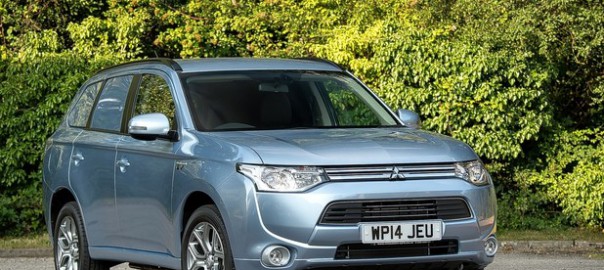
Mitsubishi Outlander PHEV

Mitsubishi Outlander PHEV’s Winning Turn

MITSUBISHI’S hugely successful Outlander plug-in hybrid SUV has picked up yet another trophy after the company was voted the best plug-in hybrid electric vehicle manufacturer at the recent Green Fleet Awards.

The awards recognises the manufacturer of either a commercial or consumer plug-in hybrid electric vehicle (PHEV) that demonstrates the best performance and best suitability for purpose in its class. Short-listed alongside the Mitsubishi Outlander was the Toyota Prius and the Volvo V60.
Advertisement

Clive Messenger, head of corporate sales at Mitsubishi UK said:

“We are absolutely delighted that we have won PHEV Manufacturer of the Year at the GreenFleet Awards. The Outlander is an exciting new vehicle, at the forefront of a new era in fleet and company car use.”

The car is a full-sized family 4×4 SUV that uses both electric and petrol power.

However, it boasts an impressive range in zero-emission mode, being capable of doing more than 32 miles on a charge – more than the average commute. That means if an owner only uses it for shorter trips and tops up the battery overnight at home, in theory, it should be able to run almost without petrol.

Such an impressive electric range gives the vehicle phenomenal environmental credentials. It emits just 44g/km of CO2 and the official combined fuel consumption figure is 148mpg.

Source: Stoke Sentinel

Volvo V60 Diesel Plug-in Hybrid

The benefits of electric and plug-in hybrid company cars

“After experiencing first-hand the savings that my Mitsubishi Outlander PHEV, I would urge any business and company car driver to seriously consider making the change – in my opinion, it is highly unlikely that they will regret it.”

FOR quite some time, electric and plug in hybrid vehicles have been available to companies and individuals across the UK.

However, despite the ever-increasing network of charging points and leasing options that make “green” cars affordable, many businesses are still opting for combustion engined vehicles when it comes to making their choice of company car.

So to perhaps open the minds of staunch petrol and diesel engine buyers, we thought we’d compare electric vehicles with plug in hybrids.

Read more: Business Car Manager