Category Archives: Opinion

The Guilt & Embarrassment Of NOT Driving An EV

For several years now, I’ve felt both guilt and embarrassment for not driving an EV.

I wonder how many other CleanTechnica readers who don’t own an EV yet, who own an ICE (internal combustion engine) car, feel similarly. This article is intended to bring to the surface a possible undercurrent that may exist for many of us who care about the environment, and the climate crisis, and who support EVs.

My next car will be an EV, but mostly for financial reasons (caused primarily by doing a lot of non-paying community volunteer work), I’m not at the moment in a position to buy a new or even a used EV. This bothers me. Every time I go to a gas station and pay money to the oil industry, it bothers me. It bothers me a lot.

Perhaps one might think that the commitment to EVs is shallow. I read CleanTechnica daily, I have for several years, and watch a number of YouTubers who are focused on EVs, including Zac and Jesse of Now You Know, Ben Sullins of Teslanomics, Sean Mitchell of All Things EV, Gali Russell of HyperChange TV, Fully Charged, Tesla Owners Online, Kyle Field, Frugal Tesla Guy, Sandy Munro on Autoline, Tesloop, and E for Electric. I’m a member of the local EV club, and I run a local Green Community Meetup group.

I love new technology, and I’ve attended a local electric utility event where I got to drive a Tesla Model 3, Model S, Nissan Leaf, and Chevy Bolt. There’s another one this weekend that I’ll be attending where I hope I can drive a Model X. I care about the environment, live vegan in part due to environmental considerations, and have studied and written about climate heating here, here, and here.

In short, while I consider myself a well informed and strong supporter of EVs, I still reluctantly drive a gasoline vehicle.

Read more: Clean Technica

Mercedes-Benz EQC (Image: Mercedes-Benz)

Has the country that invented the car fallen behind on tech?

The relief was palpable from Berlin to Munich when Germany – announced its latest GDP figures.

After months of gloom, modest growth of 0.4pc in the first quarter was heralded as a sign Europe’s largest economy might weather the global slowdown better than most experts predict.

For the first time in six months, Germany is growing again, and the figures follow last week’s announcement that exports rose unexpectedly by 1.5pc in March.

That such lean figures are seen as something to celebrate is a clear indication of how Europe’s industrial powerhouse has slowed – and behind the numbers lurk unpalatable truths.

That there is any growth is down to the service sector and a construction boom fuelled by housing shortages.

Mercedes-Benz EQC (Image: Mercedes-Benz)

The manufacturing sector that is the engine of the German economy, in particular its fabled car industry, is in trouble. Automotive orders fell 5.3pc in the first quarter. In mechanical engineering, the outlook is more bleak, with orders down 7.3pc.

But its growth strategy is built around industrial exports, and that has left it exposed. The car industry – the jewel in Germany’s economic crown – has been through a torrid time since the emissions scandal in 2015, when Volkswagen admitted it had installed software in millions of cars to help cheat emissions tests.

This year EU regulators accused BMW, Mercedes-Benz owner Daimler and VW of colluding to block the development and introduction of clean air technology, raising the spectre of multi-billion euro fines.

Already facing expensive recalls, carmakers have run into the growing wave of diesel bans as cities struggle to bring air quality within EU limits. In Germany alone, Berlin, Hamburg, Munich, Stuttgart and Frankfurt have outlawed older diesel cars.

VW announced investment in a new battery cell production plant this week but German carmakers lag far behind US and Chinese rivals in battery technology. The country that invented the car is rapidly falling behind.

Read more: Stuff

Big Oil wants to kill electric vehicles

Big Oil and its front groups want to kill electric vehicles (EVs) under the pretense of fairness.

It’s no secret why. The industry sees that the electric transportation future is coming fast, threatening their polluting profits, and they’re scared. We should double down on electrifying transportation and support an expansion of EV tax credits so we can stop pollution that is driving the climate crisis and making our air healthier for everyone.

Let’s get real about Big Oil: The industry receives over $26 billion in subsidies from American taxpayers and pays nothing for polluting the air we breathe and exacerbating the climate crisis. If there’s any group doesn’t need help from the government, it’s this industry.

Let’s also get real about who suffers the most from air pollution and climate: low-income families and communities of color. Pollution from fossil-fueled transportation is the largest single source of climate pollution in the United States. As we saw when Hurricane Harvey dumped 60 inches of rain on Houston or when Hurricane Maria pummeled Puerto Rico, it’s frontline communities who suffer the greatest losses and are left without the help they need.

The threat and disparate impacts go beyond climate. Transportation pollution is also making us sick. According to new research published in The Lancet Planetary Health, exhaust from cars is responsible for up to 4 million new cases of pediatric asthma each year. Another recent study by the Union of Concerned Scientists shows that African Americans and Latinos are exposed to roughly 40 percent more air pollution from vehicles than white people in California. The same study found that California households earning less than $20,000 per year are exposed to 25 percent more particulate matter pollution (PM 2.5) than California households earning more than $200,000 per year.

There’s a straightforward fix for a good part of this dangerous pollution: electrify the transportation sector. And thankfully, the sector is heading that way fast. For instance, electric vehicle (EV) and electric bus sales, while still a small percentage of overall sales, are growing precipitously. Between 2017 and 2018, EV sales almost doubled, and, in the latter half of last year, a zero-emissions vehicle was the fifth-best-selling passenger car in the United States. Bloomberg New Energy Finance projects that over 80 percent of all new bus sales globally will be electric buses by 2030. These increased sales are driving down costs and making electric transportation affordable for all.

Read more: The Hill

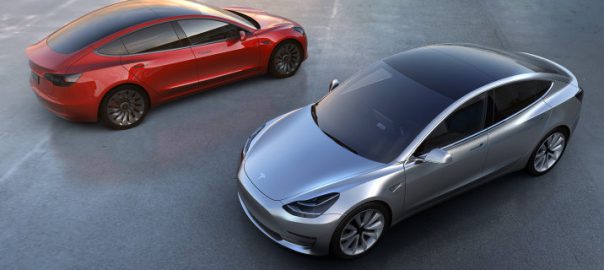
Tesla Model 3 Unveil (Image: Tesla)

How Obsessed Will We Soon Be About Electric Cars?

They are on the cusp of potentially dominating tech era

It’s no secret that the world is heading in the direction of pollution-free electric vehicles with many European and Asian countries already pledging to go electric within the next 20 to 30 years. However, it’s possible that this transition could be fast-tracked by our spending habits and constant need of the latest technology.

This is still the case, despite Tesla going through its fair share of criticisms in recent months. There being dips in sales, issues with their battery providers, controversy through chief executive Elon Musk’s Twitter usage and of course, underwhelming first quarter revenue returns. All of this has caused many investors to lose faith in the company. The only question we have to ask ourselves now is, is this loss of faith justified or a premature bailout during troubled times?

Tesla Model 3 Unveil (Image: Tesla)
Tesla Model 3 (Image: Tesla)

Despite all the criticism involving Tesla, electric cars are still widely considered the future. But before investors or business owners planning to switch to electric could seriously consider anything to do with this so called “future,” we need to consider why electric cars are on the cusp of potentially dominating tech era.

The Changing Times

The last decade was all about the smartphone revolution, and before it was the dotcom era. Now, in 2019, it is believed the smartphone era is ending.

Therefore, we could slowly move our sights on to the next big technological advancement. Already, Uber has invested over $500 million into electric and driverless cars. Just imagine how much money ride-share companies like Uber would save annually not paying drivers.

What’s more, businesses that use many vehicles daily can also potentially save a ton of cash. This is because unlike gasoline cars, electric vehicles require less maintenance. This highlighted on Tesla’s website: “Tesla cars require no traditional oil changes, fuel filters, spark plug replacements or emission checks. As electric cars, even brake pad replacements are rare because regenerative braking returns energy to the battery, significantly reducing wear on brakes.”

In addition, our obsession for revolutionary technology, especially upgrading technology regularly, is something that can really make electric vehicles fast track from the future to present sooner than expected. It has become almost unusual for consumers to allow technology to linger around for too long nowadays.

Read more: Entrepreneur

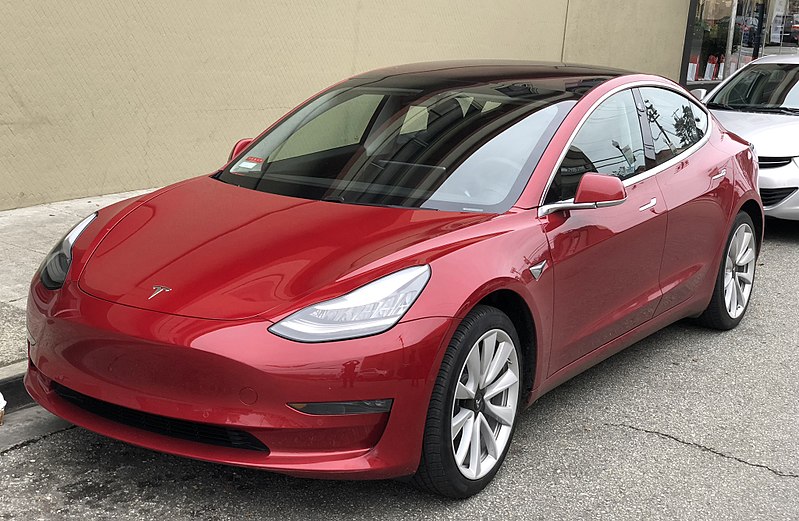
Tesla Model3 (Image: Wikimedia/Carlquinn)

Trump Is Trying to Stand in the Way of Electric Cars. They’re Breezing Right Past Him.

While the president mocks low-emission vehicles, the rest of the country is busy paving the way for their big day.

Can you imagine a congressional bill that would enjoy the fervent support of both General Motors and the League of Conservation Voters? Ford Motor Company and the Union of Concerned Scientists? Nissan and the Natural Resources Defense Council?

It’s almost as unlikely as a bill being cosponsored by Senator Debbie Stabenow of Michigan, whom the National Journal dubbed one of the country’s most liberal senators in 2011, and Senator Lamar Alexander, who has represented the deep-red state of Tennessee since 2003.

Tesla Model3 (Image: Wikimedia/Carlquinn)

And yet, believe it or not, there is such a bill: the Driving America Forward Act, introduced on Wednesday by the aforementioned senators and a small, bipartisan group of their legislative peers. If passed into law, it would protect and even expand the tax credits currently enjoyed by buyers of electric vehicles—tax credits that President Trump, as part of his 2020 budget, has pledged to end. (More on that in a minute.)

This bill is just one of a number of recent signs that the momentum for electric vehicles (EVs) is building toward something like cultural and economic inevitability. Another sign came in late March when Duke Energy, a literal powerhouse that provides electricity to more than seven million Americans throughout the Southeast and the Midwest, announced that it’s planning to invest $76 million in EV infrastructure in its home state of North Carolina. This would in effect double the number of charging stations in the state. The plan is further evidence that utilities are recognizing that the market for EVs isn’t shrinking or even plateauing but growing—and they want in.

Americans purchased more than 360,000 EVs in 2018, representing an 81 percent increase in sales over the previous year. And while the number of EVs currently in the U.S. fleet—about one million—is small relative to the number of gas-powered cars and trucks out there, auto industry forecasters, car companies, and utilities are much more focused on this degree of explosive growth. Analysts at J.P. Morgan predict that, at current rates, EVs will account for more than 38 percent of total U.S. auto sales in 2025. And by 2030, according to a recent Edison Foundation report, there will be 18.7 million of them cleanly cruising down America’s roads.

Read more: NRDC

O-M-G — Get Me Out Of This Gasmobile!

I’m renting a gas car for a few days. I won’t bother naming it, but it’s one of the 10 top selling cars in the USA. (Oh yeah, you can also see it above.) O–M–G, I cannot wait to get out of this car!

For people driving a Tesla, a BMW i3, a Nissan LEAF, a Chevy Bolt EV, or probably any other electric car for a while, I think the feelings they have when driving a gas or diesel car again are highly similar to mine below. Even knowing that, and even experiencing it years before,I couldn’t avoid the visceral shock of this experience.

Initially, I thought, “hey, it will be interesting to experience this car and maybe I’ll find some features I like about it.” Instead, I was quickly reminded of how “1910” gas car technology feels. The first sign (aside from the large grille on the front) was when I sat in the car and couldn’t find the “On” button. “Where the heck is the ‘On’ button in this thing? So many buttons and knobs and I can’t find it anywhere.” Okay, it didn’t take 10 minutes, but there were 30–60 seconds before I realized I had to insert the key into the car and turn it. It was a sign I wasn’t ready for what was about to come.

But the really annoying features are once the car is on. It starts rumbling and grumbling immediately. Like I said, it quickly feels like 1910 tech. It sounds like a monster. Putting the most positive spin on it that I can, it’s like a mild chair massager. 😛 But, yeah, it’s more annoying than relaxing.

Read more: Clean Technica

Here’s Why Grid-Down Preppers Should Buy Electric Cars: Video

Are EVs right for preppers?

The end is near. Will you survive if you own an electric car? For preppers, the end is always right around the corner. Therefore, you should be ready to bug out in the post-collapse world.

Would you better off in an electric car in such a situation. Or is gas the answer? Maybe some other means of transport entirely? Like, say a bicycle.

With the rise of Rivian and its rugged R1T and R1S electric off-roaders, there’s seem to be a new interest in electric vehicles among preppers and for good reason. Most noteworthy, EVs don’t rely on gasoline, which in a grid-down scenario, becomes scarce immediately. Additionally, EVs can be charged by the sun.

Read more: InsideEVs

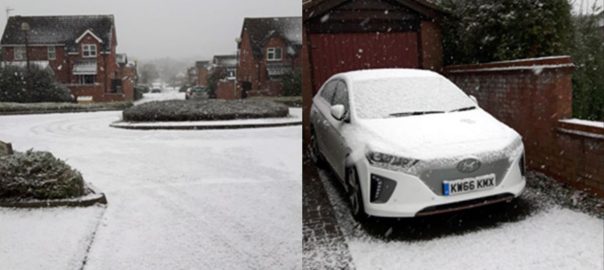
This was the scene when Leighton arrived this morning (Image: T. Heale)

Why Electric Vehicles Are Great Winter Cars

Winter is not the easiest season for getting around.

Electric cars, like cars with internal combustion engines, function less efficiently in the cold. But while we accept and ignore the limitations of traditional vehicles, reports from groups like AAA misrepresent cold weather concerns about electric vehicles, fueling anxiety about vehicle range.

The reality is, electric vehicles are great winter cars.

This was the scene when Leighton arrived this morning (Image: T. Heale)
Hyundai IONIQ in the snow (Image: T. Heale)

Being realistic about range

Cold weather range is becoming less of an issue with the rapid advancement of battery technologies. Every year, electric vehicle ranges get longer.

Take my family’s experience as an example. Our first 2012 Nissan LEAF had only 73 miles of driving range. This year the same vehicle has a battery that offers a 151-mile range and in a couple of months you will be able to get a LEAF with an even bigger battery and a range of well over 200 miles. So, range is becoming less of an issue and truthfully we never had any issues with it. My wife has a 35-mile round trip commute so she could manage it even with the 2012 LEAF, but nowadays with longer range electric vehicles, things are really easy. Battery electric vehicles available in Minnesota this year have ranges between 151 to 335 miles and people who want even more flexibility in their daily driving range should choose one of the plug-in hybrids that can take you up to 640 miles. See all plug-in EV models available in Minnesota here.


Many reasons to love electric vehicles in the winter

The best part of electric vehicles for me in the wintertime is the fast heating system. Many electric cars have a heat pump heating system that works like the traditional AC, but in reverse. This system is incredibly fast in heating up the car. I tried it the first time with our 2016 Nissan LEAF. It was a typical 16 degree Minnesota winter day. I went into our cold garage and reversed the car outside to the alley. While I waited for the garage door to close I wondered why the automatic fan was already running and to my surprise it was already pushing lukewarm air from the heating ducts. I drove less than a block and the air coming out was already hot. I had never experienced this kind of heating performance from any car before.

Another rocking feature is the preheating. These cars have a preheating function that we have set up so that when my wife walks to our cold garage at 7:20 in the morning her car is waiting with a warm interior, hot seat, and even a hot steering wheel. It is a nice way to start the commute to work. Naturally I don’t recommend trying this inside a garage with an internal combustion vehicle, because the exhaust gas emissions could be lethal. This feature also mitigates the effects of cold on the range, since the bulk of the heating was done using grid power. Another perk is that you can do this anywhere you want with your phone app. Whether you are ready to leave work or a restaurant, the only thing you have to do is to take your phone and tell your car to please heat up.

Read more: Clean Technica

Milton Keynes 'Mushrooms' Charging Hub (Image: T. Larkum)

How Cars Like Tesla Model S and Nissan Leaf Disrupt Gas Stations

The disruption of the gas station is looming.

What will the future gas station look like? Cars like Tesla Model S, Model 3, Nissan Leaf and Chevy Bolt will turn the future gas station into a Wall Connector charging your car inside your garage. Most likely it will be two cars load sharing on a charger powered by 14 solar panels.

While we will still have gas stations in 5 years the number of them closing the fuel pumps and turning into convenience stores, such as Walgreens is going to increase dramatically.

Current opportunity

Fueling stations in the past could raise and lower prices seemingly at will, and unless consumers were making their own biodiesel (not recommended) at home they had no choice but to pay high gas prices.

Milton Keynes 'Mushrooms' Charging Hub (Image: T. Larkum)
Milton Keynes ‘Mushrooms’ Charging Hub (Image: T. Larkum)

Recently Tesla increased supercharging prices while Shell has partnered with Greenlots to offer EV charging at Shell Stations. These are moves to profit on the upcoming revolution in powering vehicles. There is profit in DC fast charging because the country needs additional Superchargers and DC fast chargers as the fleet of electric vehicles grows. Although after the initial growth phase of fast chargers this fast charging profit will be limited by common motorist not oil elitist. (Also see why Toyota suddenly partnered with Panasonic on EV batteries).

The Disruptive weapon

Why will the new “energy” pump become such a disruption? The disruptive weapon will become small home and business charging. Common motorist will limit the profit of DC fast charging by simply choosing to charge more at home, and or share charging with friends, families, and small businesses who want your business by allowing free charging. Apps such as PlugShare increase the ability to easily peer-to-peer charge.

Everyone loves free, hence why more commuters at Tesla superchargers are older Tesla models with free supercharging. As free disappear at the superchargers and DC fast chargers increase prices motorist will counter with free home charging. For the most part no one places a gas or diesel fuel pump in their garage. No most motorist can have unlimited and free energy (after the initial investment) for the life of their home.

Read more: Torque News

Hyundai Kona Electric (Image: Hyundai)

Electric vehicles are suitable for higher-mileage drivers, says Arval

High-mileage drivers can use electric vehicles if their daily driving profile is suitable.

Hyundai Kona Electric (Image: Hyundai)
The higher-spec Kona Electric model brings an official range of 279 miles (Image: Hyundai)

So says Arval, adding that the persistent belief that pure electric vehicles are only suitable for low annual mileage needs to be overturned.

According to head of consulting Shaun Sadlier, the myth that EVs are not a suitable choice for drivers covering more than a few thousand miles a year is still frequently bandied around.

He explained:

“This argument is really an extension of range anxiety, the idea that because an EV has a limited range and takes time to recharge, that it cannot cover a longer distance annually.”

However, Sadlier added, the real-world suitability of EVs depends much more on the range of a particular model and each driver’s actual needs on a day-by-day basis.

“If you look at a driver who covers 25,000 miles a year, towards the upper end of the typical fleet spectrum, then the suitability of an EV rests entirely on their daily mileage.

“If that driver covers 246 miles, twice a week, for 46 weeks of the year, then an EV is probably not for them. They are exceeding or getting close to the maximum range of even the best EVs that are now available on the market.

“However, if they drive 110 miles, five days a week, for 46 weeks of the year and this mileage pattern is very predictable, then an EV could absolutely be suitable because it is well within the range for most models and the car can be recharged overnight.”

Sadlier added that there was an argument that the financial model of EVs meant that the higher the mileage, the more cost-effective an EV becomes.

Read more: Fleet World