– First ever electric vehicle (EV) to earn the title of International Van of The Year in 2011, thereby creating a new vehicle category, Renault Kangoo is the segment’s all-time best-selling model
– The Maubeuge factory in northern France has produced more than 90,000 Renault Kangoo & 10,000 partners vehicles fully electric vehicles since 2011.
– Since its launch, the model has served as an ideal testing ground for the brand’s electric vehicles
RENAULT KANGOO, EV PIONEER AND LEADER
Renault Kangoo has played an important and sometimes little-known role in aiding Renault develop expertise in electric vehicles.
One of Felix Project’s Kangoo ZE electric vans (Imaged: Renault)
While Renault began exploring the idea of electric vans back in 1985 with an EV version of the Renault Express running on nickel-zinc batteries, this ambition became a reality in the early 2000s with the Renault Kangoo.
Renault Kangoo served as a testing ground for future electric vehicles and was available in electric (Kangoo Electri’cité) and hybrid (Kangoo Elect’road) versions as early as 2002.
These small-scale runs helped the brand build up real expertise in EV design, industrialization, and especially maintenance. At the time, a team of flying doctors would travel out to each customer to analyse, maintain, and improve those models already in circulation.
In 2011, when it was marketed to the general public, Renault Kangoo Z.E became the first full-electric vehicle to earn the title of ‘International Van of The Year’, thereby creating a segment for electric vans.
If you would like to know more about Solar Panels and the PowerBanx range of home battery systems, and get a free instant quote, please complete our online form:
There might not be a big history of electric vans in the UK, but expect this to change rapidly as the number of battery-powered commercial vehicles is set to grow in the coming years. Here we recommend 5 great electric vans…
While you could count the number of electric vans on one hand in recent times, this will be very different in just a few years’ time.
Electric vans provide the same benefits as electric cars, but there are some additional challenges that private drivers won’t have to factor in. The obvious benefit is the lack of emissions, with EV vans able to drive around without producing any tailpipe emissions. These are the factors to consider when deciding whether an electric van will work for you or not.
ULEZ charges
This means that they aren’t subject to any of the inner-city charges that are either already in place or are planned for the coming years. In London they are exempt from the Ultra Low Emission Zone charge that operates 24 hours a day and costs £12.50.
They are also exempt from the London Congestion Charge (£15.00 a day as of 22 June) although that will end in 2025. As all the current electric vans are classified as light commercial vehicles, they are not eligible for the LEZ that applies to heavy duty vans and trucks. Future charge zones are designed to reduce pollution in urban areas above all else so it is highly likely that electric vehicles will be exempt from charges in other cities for the foreseeable future, too.
Range
The range that a van can travel between charges is the biggest barrier for many, and it is fair to say that a battery-powered van will not be able to replace a diesel model if you are going to do anything other than short-distance urban deliveries or predictable daily routes.
As it stands, the longest official range available in an electric van is 143 miles from the Renault Kangoo Z.E. 33, while many, like the VW e Transporter and Mercedes eVito offer an official range of below 100 miles.
This range will be impacted by how fast you drive, how cold the weather is and, crucially, how much weight you carry in the back. Hauling around a full payload could reduce the range by around 10%, or 10 miles or more, so it is a notable factor.
If you would like to know more about Solar Panels and the PowerBanx range of home battery systems, and get a free instant quote, please complete our online form:
New Business+ trim level now available for popular Kangoo Z.E. range
Added to line-up following increasing demand for zero-emission commercial vehicle
New trim features additional equipment for enhanced driver comfort and convenience
Available in medium and long-wheelbase panel vans, Kangoo Z.E. range now mirrors ICE (Internal Combustion Engine) version
Popularity continues to rise since its launch in 2017 with year-on-year sales increase
Latest selection of finance offers from Renault Pro+ add further appeal to the full electric model
Orders open now, with prices starting at £19,836 + VAT and after Plug-in Van Grant
Renault Pro+ today announces the addition of the feature-packed Business+ trim level to the Kangoo Z.E. electric van range. Based on the existing and popular Business trim, the Business+ brings a host of upgrades and equipment delivering enhanced comfort and convenience for drivers.
Renault Kangoo electric van (Image: Renault)
The Kangoo Z.E. continues to be a hit since going on sale in 2017, with a 217% increase in volume in 2019 compared with the previous year, representing a 30.15% share of the electric van market.
Available in both medium and long-wheelbase panel vans, the Kangoo Z.E. Business+ retains the 33kWh battery and 44kW motor, for the same 143-mile (WLTP) range and zero tailpipe emissions. The Business+ features £1,070 worth of equipment for just £600 compared to the Business version, offering strong value for money.
Sophisticated look and generous equipment list
On the outside, the new Business+ trim benefits from metallic paint with body-coloured bumpers front and rear for a more sophisticated look, while electrically operated and folding wing mirrors are finished in stylish gloss black.
Inside, there’s a comfortable cab environment for the driver and passenger thanks to a central armrest with storage below and an overhead parcel shelf to boost practicality. Further back, the generous load area comes fitted with a practical rubber floor covering.
Making life easier for the driver is standard-fit one-touch functionality for the electric front windows, while rear parking sensors give drivers greater confidence when dealing with tight spaces or difficult manoeuvres.
This all builds on the Kangoo Z.E’s already generous equipment list, payload ranging from 605kg to 640kg and enough space to accommodate a British or Euro pallet. It also benefits from the comprehensive Renault Pro+ three-year/100,000-mile warranty.
If you would like to know more about Solar Panels and the PowerBanx range of home battery systems, and get a free instant quote, please complete our online form:
Renault’s Z.E. range of commercial vehicles win the coveted Green Award in the 2019 Company Van Today Awards
Prestigious title awarded by the expert panel of Company Van Today magazine
Award recognises Renault’s commitment to electric vehicle technology
Master Z.E., Kangoo Z.E. 33 and Twizy Cargo form the UK’s most comprehensive electric van line-up
Renault Z.E. commercial vehicles have scooped the Green Award at the 2019 Company Van Today Awards. Recognising the very best in light commercial vehicles, these awards are decided by the Company Van Today expert editorial panel, which has decades of experience to draw upon. With a focus on the low running costs, high quality, efficiency and great features that fleets look out for, the awards are some of the most prestigious in the business.
Reflecting on the success of the Renault Z.E. range, Tom Webster, Company Van Today editor said: ‘Renault’s pioneering position with electric light commercial vehicles has been enhanced in the past few months with the arrival of the Master van, which sees the brand again break new ground for fleets looking to cut their fleet emissions. No other manufacturer can match the breadth and ability of Renault’s Z.E. powertrains, and the vehicles offer a genuine zero emission alternative for an increasingly wide user base, which is why the brand is a worthy winner of the Green Award for 2019.”
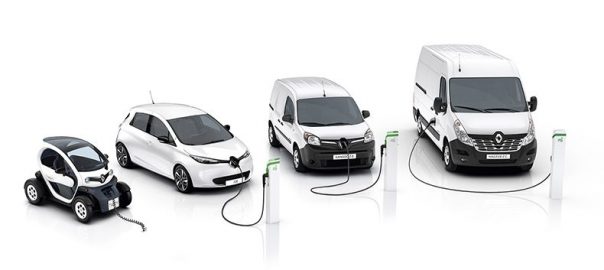
The Renault Electric Z.E. Range (Image: Renault)
On receiving the award Steve Wilson, Range Manager Renault Pro+ and LCV, remarked: “We’re delighted the Renault Z.E. commercial range has been recognised by the judges at Company Van Today. This award both highlights Renault’s commitment to cutting edge E.V. technology and the impressively wide offering of the firm’s commercial vehicle range.”
The Renault Z.E range of electric commercial vehicles is one of the most comprehensive in the UK. At the large end of the scale is the Master Z.E, which is available in three lengths, two heights and two body styles (panel van and versatile platform cab). The powerful 57kW motor gives ample pulling power, even when making use of the 1,128kg payload, while a potential range of up to 124 miles and an 80 percent charge in a touch over four hours, the Master Z.E. delivers class-leading flexibility.
For businesses looking for a more compact zero emissions solution, the Kangoo Z.E. fits the bill to perfection. Available in three body styles (Panel Van, Maxi and Crew Cab) the Kangoo’s load area stretches up to 4.6 cubic metres, depending on the model. Powered by a 44kW motor with a muscular 225Nm of torque and mated to a smooth single speed transmission it’s a top choice for urban and open road deliveries, helped in no small part by a potential range of up to 162 miles.
Completing Renault’s range of Z.E. commercial vehicles is the Twizy Cargo. Ideal for last mile deliveries, inner city couriers and food delivery services, the Cargo gets a useful lockable 180-litre storage area. Powered by a zippy 8kW motor and with a range of up to 56 miles, the Twizy Cargo is the perfect choice for businesses wanting to conquer congested city delivery routes.
Both the Renault ZOE and the Kangoo Z.E. sell like hot cakes
Renault noted a very strong electric car sales results in June 2019, delivering some 6,418 cars (excluding Twizy), which is 45% more than a year ago.
After six months, sales amounted to 30,659 YTD (up 43%):
Renault ZOE (passenger and commercial versions) – 5,309 (up 49%) and 25,686 YTD (up 44%)
Renault Kangoo Z.E. – 1,036 (up 22%) and 4,759 YTD (up 31%)
Renault Master Z.E. – 73 (up 3,550%) and 214 YTD (up 1,845%)
A great June (the third-best month ever) means that the unveiling of the all-new Renault ZOE Z.E. 50 in mid-June didn’t decrease demand for the outgoing generation of ZOE – at least not immediately.
Renault lineup – from left Twizy, ZOE, Kangoo Z.E., Master Z.E.
This past month BEVs accounted for close to 2.4% of all cars sold by Renault globally and 3.9% in Europe (where almost all Renault EVs are sold).
Scottish Water chooses the Renault Kangoo Z.E. 33 for its first-ever electric vehicles
Water Provider’s sampling division to use a specially-converted version across the Highlands
Initial order designed to allow Scottish Water to determine how it can electrify its entire fleet
Zero-emissions-in-use Renault Kangoo Z.E. 33 will assist Scottish Water’s drive to lower its carbon footprint
Kangoo Z.E. 33 was chosen for its environmental compatibility, ease-of-use and versatile load area
Renault Kangoo Z.E. 33 is priced from £18,392, excluding VAT, after the Plug-in Van Grant
A pure-electric Renault Kangoo Z.E. 33 refrigerator conversion is enabling Scotland’s water provider to continue its drive to make the country’s air and water the cleanest it can be.
Scottish Water, which provides drinking water to nearly 2.5 million households across the country, is using the zero-emissions-in-use, refrigerated Renault Kangoo Z.E. 33 to assist with the water sampling undertaken by its Scientific Services team across the Highlands.
Scottish Water Renault Kangoo electric van (Image: Renault)
The introduction of the award-winning light commercial – the first electric vehicle utilised by Scottish Water – will also help the water supplier to determine how it can rollout EVs across its fleet and make a significant contribution to its support of the Scottish Government’s carbon target to reduce carbon emissions by 90 per cent by 2050.
As part of the conversion by Bott Ltd, and which also contributes to the van having minimal impact in terms of noise and pollution on the beautiful landscape of the Highlands, the strikingly-liveried Renault Kangoo Z.E. 33 features roof-mounted 150-watt solar panels to power its onboard refrigeration equipment. The panels charge a 200 amp lithium battery, which in turn powers the 140-litre temperature-controlled refrigerator that is required to keep water samples in optimum condition during transportation.
With a ‘real-world’ range of up to 124 summer miles (75-99 miles in winter) on a single charge, the Renault Kangoo Z.E. 33 is able to comfortably accommodate the routes throughout the Highlands that are regularly completed by Scottish Water’s water samplers. Scottish Water plans to charge the van via 26 charging points that are available at its numerous locations, which include The Bridge, Castle House, Fairmilehead, Juniper House, Gowans Terrace, Henderson Drive, Bullion House and Shieldhall.
Complementing the bespoke conversion is an additional Renault Kangoo Z.E. 33 Panel Van, which will be used by Scottish Water’s maintenance team. Offering a near identical payload to its diesel counterpart, the Kangoo Z.E. 33 Panel Van offers Scottish Water a viable, all-electric alternative to the conventionally-powered compact vans that feature on its fleet.
Scottish Water chose sampling and general cargo vans for its EV trial as these types of vehicle represent the highest proportion of its small van fleet. Sampling vans represent approximately 12 per cent of the total Scottish Water fleet, with general cargo vans accounting for circa 20 per cent.
Working in collaboration with Renault Pro+ Commercial Vehicles on the trial, which has included the manufacturer delivering EV training to Scottish Water employees, Scottish Water opted for the Renault Kangoo Z.E. 33 due to its usable range, versatility and ease of operation.
Renault electric vehicles will continue to play a major role in the day-to-day running of the Eden Project and its drive to educate its millions of visitors on the environmental benefits of EVs after the world-famous attraction took delivery of a new fleet of 100 per cent electric ZOE and Kangoo Z.E models
Comprising of three Renault ZOE hatchbacks and 14 Renault Kangoo Z.E. in Van and Maxi Crew Van Cab specifications, the vehicles replace the Eden Project’s previous Renault EV fleet. The latest vehicles complement Eden’s existing Renault Twizys. The quadricycles’ compact dimensions make them ideal for use across the entire Eden site – even in the narrow pathways through the tranquil, climate-controlled Biomes.
Renault ZOE and Kangoo ZE (Image: Renault)
The usability and high visibility of its previous Renault EVs has allowed the Eden Project to lead by example when it comes to raising awareness of the benefits of electric vehicles in reducing carbon emissions. Compared to equivalent diesel and petrol vehicles, its original Renault EV fleet saved nearly 17 tonnes of CO2 since its inception in 2016, clocking up nearly 94,000 miles in and around its award-winning facility.
The mix of ZOE and Kangoo Z.E. will fulfil a variety of roles across the Eden Project, being used by its maintenance, horticulture, security, live programming and catering teams. A number of the vehicles will also be assigned to help with the provision of onsite medical support and transporting less able-bodied visitors around the site.
With zero tailpipe emissions and being near silent in use, the Renault EVs have little impact on the tranquillity and striking landscape of the Eden Project. Notably, during the last two years the lack of noise has allowed the busy Eden Live Team to work round the clock without affecting the visitor experience, while the fleet has also chauffeured presenters and celebrities to help facilitate the wide variety of filming that the renowned Cornish venue hosts every year.
Groupe Renault, Morbihan Energie, Les Cars Bleus and Enedis have joined forces to create FlexMob’île, an innovative programme aimed at accompanying the energy transition on the French island of Belle-Île-en-Mer.
This smart electric ecosystem is founded on three core activities, namely the sharing of electric vehicles, the stationary storage of solar energy and smart charging.
FlexMob’île sees Groupe Renault continue to develop the principle of smart islands, the first of which was Portugal’s Porto Santo.
Belle-Île-en-Mer (France), September 21, 2018 – In association with its partners the Belle-Île-en-Mer Community of Communes, Morbihan Energies, Les Cars Bleus and Enedis, Groupe Renault – a major player in the world of electric ecosystems – is delighted to unveil a brand new joint project known as FlexMob’île. The aim of this smart electric ecosystem is to facilitate the energy transition on the French island of Belle-Île-en-Mer which lies off the coast of southern Brittany. This initiative follows in the footsteps of the innovative Smart Fossil Free Island programme which has been operational since last February on the Portuguese island of Porto Santo in the Madeira archipelago.
Groupe Renault unveils France’s first Smart Island on Belle-Île-En-Mer (Image: Renault)
For the next 24 months, Groupe Renault and its public and private partners will be developing a smart electric ecosystem that has been conceived to reduce the island’s carbon footprint and increase its energy independence.
“We are thrilled to be collaborating with the Belle-Île-en-Mer Community of Communes, Morbihan Energie, Les Cars Bleus and Enedis on this project which is unprecedented in France. Our goal is the same as with Porto Santo. That is to say the implementation of global solutions that meet local needs using both tried-and-tested and more recent technologies. It will be possible to carry over the Belle-Île-en-Mer system not just to other islands but also to cities and suburban areas,” says Gilles Normand, SVP, Group Electric Vehicle Division.
The Felix Project takes delivery of seven all-electric Renault Kangoo Z.E. panel vans
Donation of vehicles strengthens the partnership between Renault UK and the London-based food charity
New Renaults will allow the Felix Project to grow its collection and distribution operation significantly
The Felix Project’s central London operation fleet will now be 100 per cent electric
Zero tailpipe emissions, ease-of-use and size make the Kangoo Z.E ideal for the charity’s London routes
Renault Kangoo Z.E. is priced from £14,799, excluding VAT, after the Plug-in Van Grant
Renault UK is growing its support of the London-based Felix Project with the donation of a further seven all-electric Renault Kangoo Z.E. panel vans. This will allow the charity to expand its operation to provide the capital’s most disadvantaged inhabitants with fresh food.
The development strengthens the partnership between the manufacturer and The Felix Project, which was established in November 2017 with the initial donation of a single Kangoo Z.E.
One of Felix Project’s Kangoo ZE electric vans (Imaged: Renault)
The additional vans will grow the charity’s fleet by more than 50%, enabling it to significantly increase the 20 tonnes of food they currently deliver each week. This is food which is fresh yet cannot be sold for a number of reasons, that they collect from supermarkets, wholesalers and other suppliers, and distribute free of charge to around 200 charities and schools throughout London. In turn, these organisations then provide meals, snacks or food parcels to those in need, including elderly or homeless people, struggling families, those with mental health issues, refugees and asylum seekers.
All of the vans will initially be based at the Felix Project’s central London operation. Vehicles that are already in-use in the depot will be allocated to the charity’s other sites with the result that the central operation’s distribution and collection service will be 100 per cent electric.
The constant stop/start for collections and drops, average journey lengths and the demanding nature of driving in the capital mean that the Kangoo Z.E. is the perfect vehicle for the Felix Project. Immensely easy to drive with users not having to worry about gear changes and enjoying instant response from the advanced drivetrain, the van is ideal for negotiating the city’s traffic, while also returning a significant saving on fuel costs and being exempt from the London Congestion Charge.
The ease-of-use is especially important to The Felix Project as the latest vans will not be assigned to one driver, but used by a variety of volunteers on evening runs into the capital. The Kangoo Z.E.’s payload of 640kg – near identical to that of its diesel counterpart – also makes it exceedingly versatile, the Felix Project’s existing Kangoo Z.E. is able to accommodate 32 crates of food, which is enough to deliver to four primary schools.
The Felix Project was established in early 2016 in memory of Felix Byam Shaw – the son of one of the charity’s founders – who died suddenly from meningitis in 2014. The idea for the charity was born out of Felix’s compassion for fellow youngsters who didn’t have his advantages and, in particular, after he played in a football match and discovered that some of the opposing team of 10-year-old boys from South London hadn’t had anything to eat that day.
Anne Elkins, Development Manager for The Felix Project’s school programme, said
“The new Kangoo Z.E.s will make a big difference to our operation, allowing us to plan more routes and also collect more donations that are made available on an ad hoc basis and which need to be collected in a short time frame. It’s great to have the extra capacity and the support from Renault.
“Our original Kangoo Z.E is a big hit with our drivers due to its manoeuvrability and being so easy to drive. The van really is a great fit for us as it does everything we need and adds another carbon efficient element to our operation’s ethos on protecting the environment by cutting down food waste and ensuring that good, nutritious food isn’t thrown away.”
Vincent Tourette, Managing Director, Groupe Renault UK, said:
“We’re exceptionally pleased to extend our support of The Felix Project. The charity is passionate in what it does and it’s a privilege for us to play a part in helping them to grow their operation and ultimately supply food to those in the capital who are in the most need. With its latest Kangoo Z.E. the Felix Project can extend their reach but also invest the majority of their current fuel and congestion charge costs back into other areas of the business.”
The Kangoo Z.E.33 has a real-world range of 124 miles and has a load capacity of up to 4.6m³, coupled with diesel-rivalling payload of up to 640kg. Together with the enhanced 33kWh battery, the Kangoo Van Z.E.33 benefits from an upgraded charger that reduces charging times and is twice as powerful as its previous one. The single-phase 7kW AC charger can take the new 33kWh battery to a full charge in just six hours, with the ability to ‘top-up’ the vehicle by up to 21 miles in just one hour. The Renault Kangoo Van Z.E.33 is available in a range of body styles, including Kangoo Van Z.E.33, Kangoo Maxi Z.E.33, Kangoo Maxi Crew Van Z.E.33 and Kangoo Maxi Crew Van Cab Z.E.33.
The automaker and city officials will also collaborate on future mobility services
Many European countries are considering ending sales of new gasoline and diesel cars, but the city of Paris isn’t waiting around. The French capital has already tested a “day without cars,” and has discussed banning internal-combustion cars by 2030. That makes Paris the perfect place to launch an electric car-sharing service.
The Renault Electric Z.E. Range (Image: Renault)
Renault has teamed up with the city government to give Parisians access to electric cars. The automaker hopes the to continue working with Paris officials on future mobility services. For now, Renault is deploying a fleet of electric cars in Paris that residents will be able to access 24/7.
Cars set aside for longer journeys will be kept in designated parking lots and accessed via special stations. Other cars, designated for shorter journeys, will be accessible without the stations. Available cars will include the Renault Zoe hatchback, the Twizy neighborhood electric vehicle, and the Kangoo ZE and Master ZE vans. Renault hopes to have a fleet of 2,000 vehicles in operation by the end of 2019.
As a next step, Renault and city officials will initiate a “working group,” open to other cities and companies, “whose aim will be to think collectively about the integration of changes in mobility in the city,” a Renault press release said. The automaker hopes to involve the C40 network, a coalition of some 100 cities chaired by Paris Mayor Anne Hidalgo.