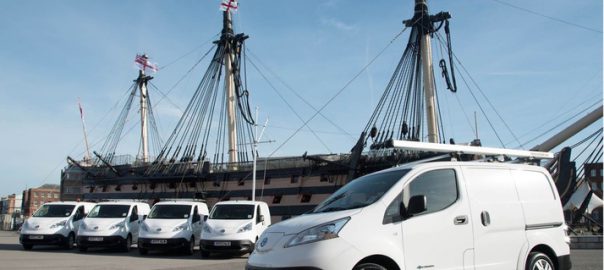
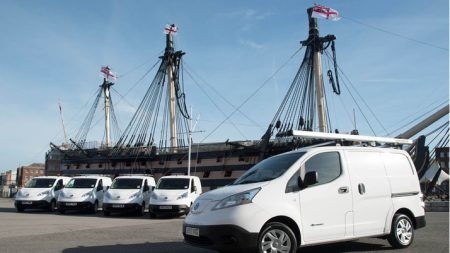
Portsmouth Naval Base will be welcoming a fleet of a different kind this week with the arrival of the first batch of 48 electric Nissan e-NV200 vans to support the Royal Navy’s operations at the base.
The electric vehicles have been ordered by BAE Systems on behalf of the Naval Base Commander as part of his commitment to investing in green energy on the naval base. The vehicles will be used by BAE Systems’ personnel to transfer stores, engineering and load-lifting equipment from warehouses within the Naval Base.
Nissan e-NV200 at Portsmouth Naval Base (image: BAE Systems)
The all-electric Nissan vans will reduce carbon dioxide emissions from the naval base’s vehicle fleet by around 40 per cent.
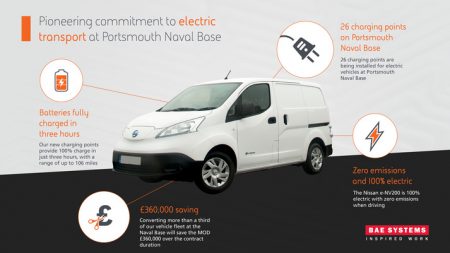
The agreement, which also includes 59 standard diesel vehicles, will save the Ministry of Defence (MOD) an estimated £360,000 in fuel and other costs over the duration of the contract, which runs for two years with an option to extend into a third.
To support the new electric fleet and as part of BAE Systems’ commitment to reduce emissions and increase energy efficiency across the naval base, 26 charging points and 28 designated parking bays for electric vehicles are being installed.
BAE Systems’ agreement with Nissan and fleet management specialists Lex Autolease reiterates the company’s commitment to delivering value for money. It also supports the MOD’s drive to create a more modern and energy-efficient naval base, equipped with innovative technology, fit for the 21st century.
Nissan, e-NV200. Company guide (image BAE systems)
Portsmouth Naval Base Commander, Commodore Jeremy Rigby, said:
“I am very pleased to welcome the addition of these 48 electrical cars to our fleet in the naval base. It’s great for the Royal Navy, great for Portsmouth and great for the environment.”
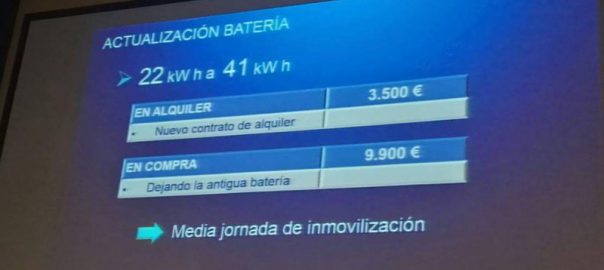
Later this year you’ll be able to upgrade your old ZOE’s battery to the new ZE 40. For customers that are currently leasing the battery the upgrade will cost 3.500 € and a new leasing contract with higher monthly fees has to be signed, however for those who already own the battery the upgrade will cost 9.900 €.
While the battery upgrades for current ZOE’s owners will start in the second semester this year, there isn’t an official date yet. This uncertainty can be related to the LG Chem battery plant in Poland that will start production also in the second semester.
Renault battery upgrade prices
Renault has a clear interest of delaying the battery upgrades and prioritize the selling of new ZOEs.
As equally – or even more – important as the battery upgrade would be if Renault allowed its customers to simply outright purchase the batteries and end the lease if they wanted to.
Currently the only way to do it isn’t very straight forward. It consists in stop paying the monthly battery rental when the contract ends and fully pay what Renault Crédit International (RCI) considers to be the battery’s value. In both 22 and 41 kWh batteries, RCI considers the value to be 7.000 € (without VAT) when new, and they lose 10 % of their value per year.
For example if you have been renting the battery for 3 years, you would have to pay 5.103 € (7.000 € x 0,9 x 0,9 x 0,9) plus VAT to terminate the battery lease contract and keep the battery. I just wished that Renault would make this process simpler. However I’m sure that some friendlier Renault dealers already help you in this process if you need to.
While Renault representatives keep saying that people prefer the battery leasing scheme, we know that this isn’t true, as it suggests a poll that toke place at the French Automobile Propre forum, where only 10 % of the inquired said to prefer the battery rental scheme…
In Portugal for example, Renault gives higher discounts for ZOEs sold with battery rental than with battery included.
An electric van could be the perfect opportunity to cut running costs, but do they make sense for your business? We look at the key issues
There’s something of a revolution going on in the UK van market. While diesel definitely isn’t dead, manufacturers are branching out to provide alternative fuels for buyers. That means petrol vans are making a comeback, while hybrids are in the pipeline, too. But perhaps the most intriguing option that’s available in the UK today is the electric van.
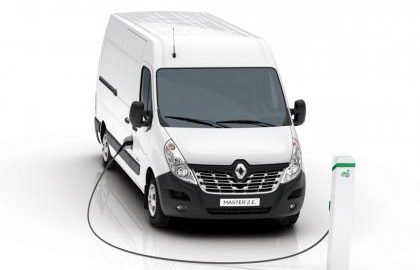
Renault Master Z.E 39
If you need a van to keep your business moving, then the running costs for that vehicle will be a key factor in your monthly outgoings. While the latest diesel vans can deliver running costs on a par with large MPVs that will help to reduce your running costs, there is another way to help slash your outgoings, and that’s by plumping for an electric van.
Battery range
The distance that you can travel on a single charge is going to be a major factor in deciding whether an electric van is right for you. At the moment, the two leading electric vans on sale in the UK are the Nissan e-NV200 and Renault Kangoo ZE. As both models use a similar electric drive system, they both have a claimed range of up to 106 miles.
Charging
The second major factor when evaluating electric van ownership is whether you have the ability to charge it up. The first thing you need is a convenient place to park the van so that you can access a charging point, whether it’s in a garage or an off-street parking space near an electricity supply.
The best way to charge a van is by using a wall box, as this can deliver a faster charge than if you plug into a conventional plug socket. Do this, and whenever you leave your van parked up overnight, you can plug it in and have a fully charged van ready to go in the morning.
Payload
Adding weight to any van has a negative effect on energy consumption, whether it’s powered by a diesel engine or an electric motor. However, just because a van runs on electricity, it doesn’t mean it’s any poorer at carrying big loads.
Price
One area where electric vans are competitive is on list price, and that’s because the Government’s Plug-in Van Grant is bigger than it is for electric cars. You can get £8,000 off the list price of an electric or hybrid van that is able to travel at least 10 miles on zero emissions electric power alone. That means the Nisan e-NV200 starts from around £15,000, which is about £400 less than the NV200 with a 1.5 dCi diesel.
Running costs
Another factor to consider is the overall running costs of an electric van. While you’ll never be at the mercy of fuel station prices, you won’t be accessing free energy. If you’re charging a van overnight, then the cost is estimated to be around £1.50 to fully charge a flat battery. As a rough estimate, you’d need to spend around £15 on diesel to cover 100 miles, so the savings an electric van can deliver are plain to see. If you’re registered as a company, you should also be able to write off some of your household energy bills against VAT, as the energy used to recharge your electric van is a legitimate business cost.
Milton Keynes is definitely an electric vehicle hub, probably the leading EV city in the UK. It has lots of charge points and they are usually at least half full.
However, although you see tons of electric cars around the place, electric vans are still unusual. It was a treat, therefore, to see a Renault Kangoo ZE van delivering to the shopping centre.
As promised, Renault has introduced a new larger battery equipped Kangoo Z.E. with up to 50% more range.
And while we are happy to see the upgraded “ZE 33” model, and its 33 kWh pack (instead of 22 kWh), the vans battery stills looks tiny as compared to the recently updated ZOE with a 41 kWh pack.
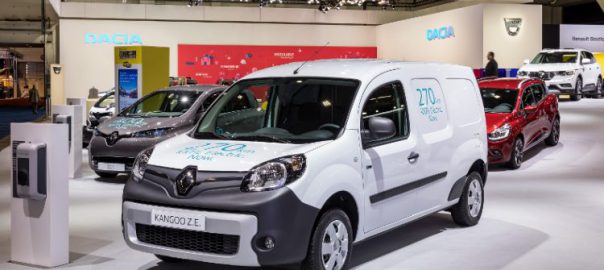
Renault Kangoo Z.E. 33 (33 kWh)
Renault pegs the new Kangoo ZE 33 at a range of 270 km/167 miles under the NEDC rating system, which translates to about 200 km/125 miles in ‘real world’ driving conditions.
The Z.E. 33 is shared with new Master Z.E. heavy commercial van.
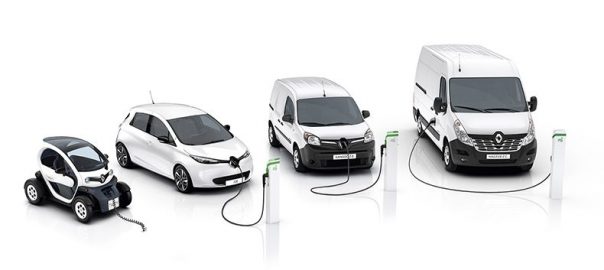
Renault lineup – from left Twizy, ZOE, Kangoo Z.E., Master Z.E.
Renault has also utilized a new electric motor found originally on the ZOE R75/90, rated at 60 hp (44 kW), and has replaced the original (and fairly weak) charging system. The new Kangoo ZE can charge at near twice the rate of the previous version – up to 7 kW.
As you can see, the 7 kW charging capability still isn’t near on par with the 22 kW charging found in ZOE.
Anyway, the new Kangoo Z.E. is still far better then the previous version, so perhaps we should not be too critical. Renault promises the “ZE 33” will be available on the European market from mid-2017.
In the summer we spent the bank holiday weekend at Center Parks Longleat Forest with family. We travelled there and back in the ZOE.
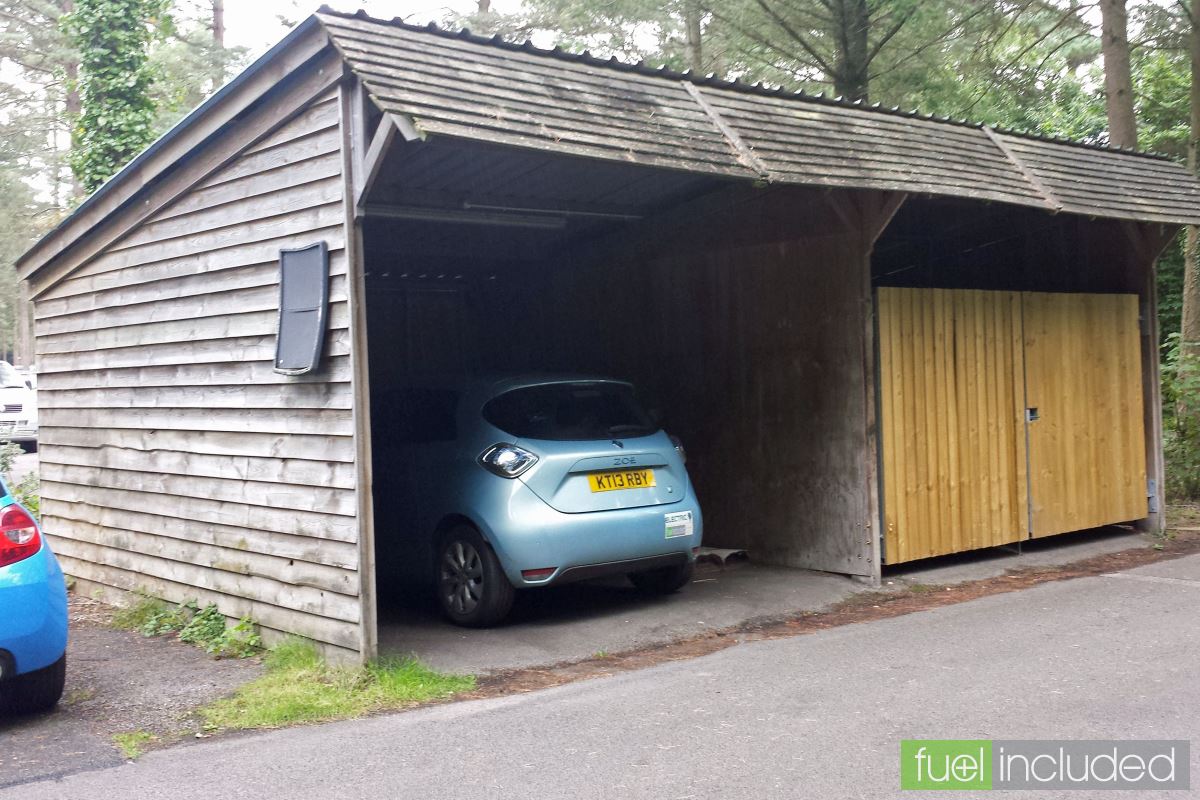
Naturally I hoped to charge while there but it turned out to be problematic. It seemed pretty clear that CenterParks was not setup for EV charging. Initially we were offered the use of a 13A socket in a shed in a far corner of one of the main car parks.
CenterParcs EV Charging Point in a Car Park Equipment Shed (Image: T. Larkum)
I plugged in and charging started fine. However, I was a bit sceptical and went back after a few hours to find that the charging had stopped, seemingly a circuit breaker had triggered. I restarted the charge, but disappointingly, I returned after a few hours to check on it to see that it had failed again.
CenterParcs EV Charging Point: the 13A socket above the bicycle (Image: T. Larkum)
I reported this and that night I was allowed to charge at the external sockets by the main entrance (next to the in and out barriers). However, the same thing happened and I gave up at that point. Instead we charged on our way home. So, overall, we were not too impressed with CenterParks’ provisions for EV charging (though apparently the provision of charge points has improved since).
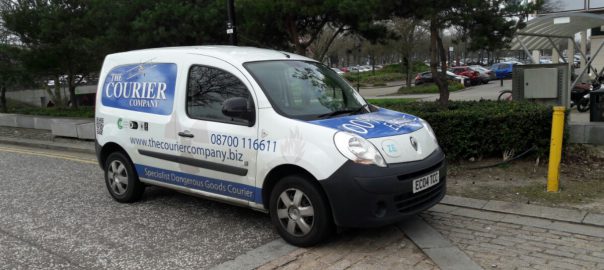
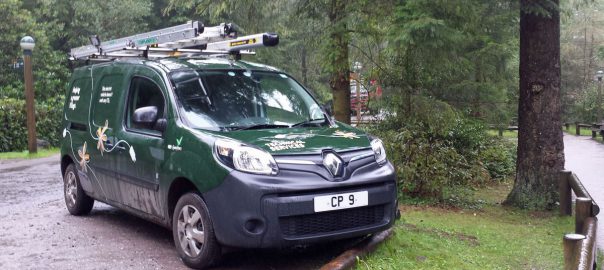
CenterParcs’ All-Electric Renault Kangoo ZE Van (Image: T. Larkum)
On the plus side, we did see that Center Parks were making use of all-electric Kangoo ZE vans for work around the park. And we did enjoy our time there, even if it was a bit pricey.
Through its Renault Pro+ brand, Renault is unveiling an extended custom offering in its zero-emission range at the Brussels Motor Show, with world première appearances for Master ZE and New Kangoo ZE. With these new arrivals, Renault fields a unique line-up of four electric light commercial vehicles.
The Renault Electric Z.E. Range (Image: Renault)
Zero-emission light commercial vehicles addressing the specific needs of business customers
With world première appearances of two new electric vehicles (New Kangoo ZE and Master ZE), Renault, through its business vehicles brand Renault Pro+, proudly announces nothing less than a range of zero-emission light commercial vehicles unique in the world.
Twizy Cargo (the quadricycle with boot launched in 2014) holds irresistible appeal for city-bound business users, while longer-distance travellers will appreciate the company-car version of New ZOE, with its 400 km NEDC* travel range. Then New Kangoo ZE and Master ZE are perfect for business customers needing load volume. All the models in our range of zero-emission light commercial vehicles offer pollution-free peace of mind on the road plus full connectivity capabilities, as with ZE Trip and ZE Pass on New Kangoo ZE, services that facilitate charging at the 80,000 charge stations across Europe. (In 2017, Renault Pro+ business customers will also be getting other connected services, such as Fleet Management and Predictive Maintenance.)
“Renault Pro+ is market leader in electric LCV sales in Europe. With New Kangoo Z.E. and Master Z.E., Renault Pro+ is continuing to expand its tailor made offering dedicated to professional customers, while developing connected services for business users. We are confident that our professional customers will experience our Zero Emission connected vans which will significantly contribute to better business as well as driving experience.”
Ashwani Gupta – Global Head of Light Commercial Vehicle Business
New Kangoo ZE: major innovations
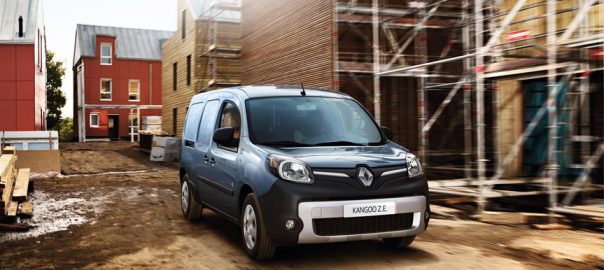
New Renault Kangoo ZE Electric Van (Image: Renault)
Kangoo ZE puts an end to reticence over the use of electric vehicles for longer-distance business uses. Following on from New Renault ZOE, which starred at the Paris Motor Show in the autumn, it’s Kangoo ZE’s turn to get a new battery and power unit, to boast a travel range of 270 km NEDC* instead of the 170 km previously. This is a record on the electric vans market.
The battery takes less than six hours to charge back up to full from a 7 kW Wall Box (that’s less than overnight), or just one hour (that’s a lunch break or the time it takes to load the van for the next delivery round) for a 35 km top-up. It all goes together to make working life easier for business users. For example, another radically new feature on Kangoo ZE is the heat pump that’s tied in with the climate control system to maintain travel range under cold weather conditions. So what was that about electric power being problematic for professionals?
#WelcomeMasterZE: Renault ZE expertise coming to large vans soon
New Renault Master ZE Electric Van (Image: Renault)
Renault, number-one on the European electric vehicle market, announces the world première appearance of Master ZE, further substantiation of the company’s unparalleled electric power expertise. The new Renault van packs the ZE 33 battery (33 kWh) driving the new R75 electric power unit (derived from the ZOE pack). Renault Pro+ is proud to offer business customers a large van with a travel range of 200 km NEDC. It will be in European showrooms from around the end of the year. Like its little sister Kangoo ZE, Master ZE takes less than six hours for a full charge. That all adds up to making Master ZE an unbeatable proposition for last-mile urban delivery fleets and all kinds of local government departments.
Renault Pro+ is to present the all-electric New Kangoo Z.E. on 13 January at the 2017 European Motor Show in Brussels, Belgium.
Renault Pro+ will equip the latest Kangoo Z.E. with a new motor and battery package that will increase the model’s driving range by more than 50 per cent, from 106 miles (170km) to 168 miles (270km) NEDC. That is equivalent to 124 miles (200km) in real world driving conditions.
The New Kangoo Z.E. will offer the longest available driving range in the small van market.
Kangoo Z.E. 2017 electric van (Image: Renault)
The Kangoo Van Z.E. is a completely practical solution for environmentally-conscious business customers who have praised the driving enjoyment it delivers, as well as its carrying capacity and competitive operating costs.
This announcement to increase the range on Kangoo Z.E. follows on from Renault recently launching at the 2016 Paris Motor Show the New Renault ZOE available with a new Z.E.40 battery that increases its NEDC driving range to 250 miles (186 miles in real world driving conditions) – the longest of any mainstream electric car.
Renault is Europe’s leading manufacturer of both all-electric LCVs and passenger cars.
More information about the New Kangoo Z.E. will be provided on 13 January 2017.
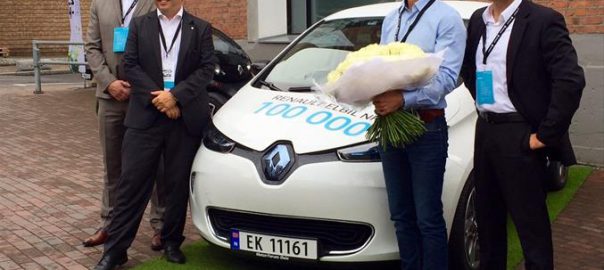
Renault has handed over the keys to its 100,000th electric car, a ZOE, in the Norwegian capital of Oslo, today
A pioneer of all-electric vehicles, Renault is the European leader with 27% market share for electric cars
Five years since the launch of its first electric vehicle, Renault has handed over the keys to its 100,000th electric car customer.
The Renault ZOE – the brand’s all-electric supermini – was sold to 41 year old Norwegian, Mr. Åsmund Gillebo. To truly complement his purchase of a ZOE, he has been presented with five years of Fortim recharging and 100,000 minutes of recharging time from Grønn kontakt, two local energy suppliers.
Renault: the European leader for electric cars
Renault has handed over the keys to its 100,000th electric car, a ZOE (Image: Renault)
In the first half of 2016, Renault sold more than 15,000 electric vehicles (excluding the Twizy), an increase of 32% on the previous year. This success confirms Renault’s status as the European market leader, especially for LCV. Indeed, on European roads, one in every four electric vehicles is a Renault. In France, half of all electric cars are Renaults. Renault’s main markets for electric cars are France, Norway, the UK and Germany. In the UK, Renault Z.E. sales grew to 1,199 in the first half of 2016 – an increase of 26.1 per cent. Of this, 1,069 of the vehicles were the all-electric ZOE – a 39.4 per cent increase on the first six months of 2015. Since the launch of its Z.E. vehicles in the UK in 2011, Renault has sold 5,977 electric vehicles to date comprising of Fluence, Kangoo Van Z.E, Twizy and ZOE.
Eric Feunteun, Director of Renault’s Electric Vehicle Division, said:
“Every year there are more customers for electric cars and Renault is making a major contribution to this with its constant innovation and dedication to developing infrastructure. Our customer satisfaction, which stands at 98% for the ZOE, encourages us to keep pushing onwards”.
Renault boasts the most comprehensive range of 100% electric cars on the market, enabling it to meet a variety of needs. The range is made up of the compact ZOE city car, the Kangoo Van ZE, the compact urban two-seater Twizy (and its utility version, the Twizy Cargo), and the stately saloon the RSM SM3 ZE (the best-selling electric vehicle in Korea).
The ZOE, the best-selling electric vehicle in Europe, dominates the market for electric private cars with over 23% market share. The Kangoo Van ZE, the leading electric LCV in Europe for the third year running, sets the benchmark for professionals and has won a number of tenders, including the French Post Office, and the French electricity provider ERDF in Norway. Lastly, with 17,000 models sold, the Twizy is the trailblazer for new ways to get around all over the world, and is extremely popular in car-sharing initiatives in both Europe and North America.
Renault, a key player in electric innovation
With cutting edge electrical technology, proven by its performance in Formula E, Renault is naturally winning over an increasing number of users. Since it began its electric adventure Renault has adopted a global strategy for electric mobility, and the development of infrastructure in particular. Renault is involved in a number of projects to install public recharge points, working with public bodies and other players in electric mobility like energy technicians. There are currently over 100,000 public recharge points around the world, 80,000 of which are in Europe, and they are constantly growing in number. As an example, Renault supports European Commission projects for the TEN-T fund (Trans European Transport Network), which has installed over 2,300 quick charge terminals along highways and major roads in over 15 countries.
In the UK, the ZOE has won numerous awards including What Car?’s ‘Best Electric Car Under £20,000’ for three consecutive years and was most recently voted second in the 2016 Auto Express Driver Power vehicle ownership survey out of 183 cars – Renault’s best ever ranking in the survey for one of its vehicles.