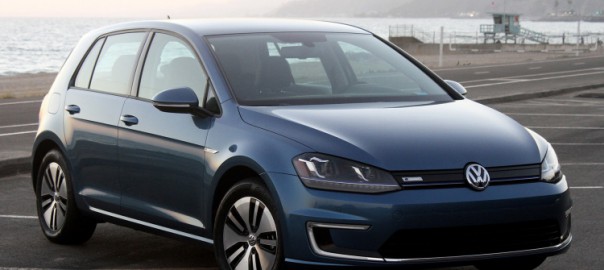
April this year, Kelley Blue Book (KBB) compiled a list of the most efficient stand-out cars of the year that are chosen based on efficiency, price, practicality and powertrain, just in time for Earth Day.
KBB’s “Best Green Cars of 2015″ list includes 10 vehicles, 5 of which are plug-in electric cars.
For 2015, the BMW i3 is the repeat winner. It captured the top spot from KBB last year too.
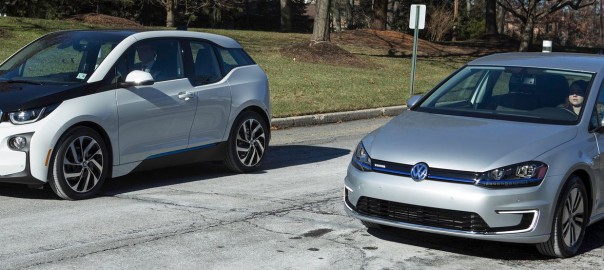
BMW i3 and Volkswagen e-Golf
In #2, we find the Volkswagen e-Golf, followed by the Nissan LEAF in third. The two other plug-ins to make the cut are the Tesla Model S in sixth and the Chevrolet Volt [Vauxhall Ampera] in seventh.
And here’s the ranking:
KBB.com’s 10 Best Green Cars of 2015
Rank 2015 Model-Year Vehicle
1 BMW i3
2 Volkswagen e-Golf
3 Nissan Leaf
4 Toyota Prius
5 Honda Accord Hybrid
6 Tesla Model S
7 Chevrolet Volt
8 Toyota Camry Hybrid
9 Ford C-Max Hybrid
10 Volkswagen Jetta TDI
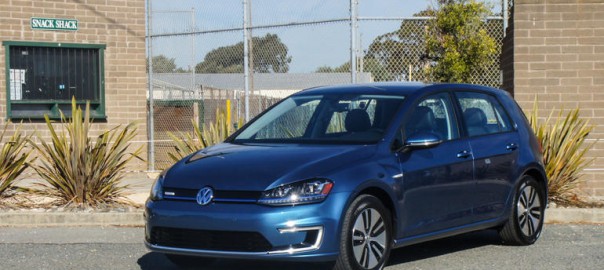
Because I live in California, it seemed only fitting that my first taste of the new Golf arrived in electric form: the 2015 VW e-Golf. (Why e-Golf? Because “Golfe” just sounded silly.) The Golf isn’t just the first Volkswagen EV in the US, it’s also the first VW built on the new MQB platform which promises reduced weight and lower development costs. While MQB isn’t a dedicated EV platform like Nissan’s LEAF, it was designed to support electrification from the start rather than being converted like the Fiat 500e. While that may sound like a quibble, the difference is noticeable as the e-Golf feels like a regular VW that happens to be electric. The e-Golf also demonstrates just how rapidly EVs have evolved since the LEAF launched in 2010.
Exterior
Volkswagen has always been a company that prefers restrained elegance when it comes to design and the new Golf is no different. While some described the look as boring, I generally appreciate design evolution more than design revolution because the latter leads to products like the Aztek. The downside to VW’s design evolution is that the Golf doesn’t look all that different from the last Golf, but VW owners tell me that’s how they like it. Park it next to the last VW hatch and you will notice a difference. The 2015 model is longer, wider and lower than its predecessor with a longer hood and a shorter front overhang. The result is a more grown-up hatch than ever before that also schleps more stuff than ever before.
For EV duty, VW swaps in their first US-bound LED headlamps, and (according to a product announcement released when we had the e-Golf) will swap them back out if you opt for the new starting trim of the e-Golf which is coming soon. We also get a revised DRL strip of LEDs curving around the front bumper that gives the electric version a distinctive look in your rear-view mirror. Finishing off the transformation are blue accents here and there, EV specific wheels and unique badging. From a functional standpoint, the electrically heated windshield (ala Volvo and Land Rover) helps reduce energy consumption by heating the glass directly instead of heating the air and blowing it on the glass.
Interior
Changes to the new interior are as subtle as the exterior. It was only after sitting in a 2012 Golf that I realized that parts sharing appears to be somewhere near zero. Although the shapes are similar, everything has been tweaked to look more cohesive and more up-scale. The console flows better from the climate controls, infotainment screen and knick-knack storage all the way to the armrest. The dashboard design is smoother and more Audiesque and the door panels have improved fit and finish with slightly nicer plastics. Keeping in mind that the Golf competes with the Hyundai Elantra GT, Ford Focus, Mazda3, Chevy Sonic, and Fiat 500L, this is easily the best interior in this class.
When it comes to the e-Golf things get murky. Since most auto companies have just one EV model, the electric Golf competes with a more varied competitive set spanning from the Spark EV and 500e to the BMW i3 and Mercedes B-Class Electric. In this competitive set, the VW still shines with an interior that isn’t that far off the B-Class or the i3 in real terms. The only oddity here is that the e-Golf does not offer leather in any configuration. The new base model gets cloth seats which are comfortable and attractive but the top end trim we tested uses leatherette which is attractive but doesn’t breathe as well as leather or cloth. Breathability is a problem the Spark’s leatherette seats also suffer from and is especially important in an EV where you frequently limit AC usage to improve range. Kia’s Soul EV is a stand-out in this area by offering real leather and ventilated seats which consume less power than running the AC.
Paul Clinton from Automotive Fleet takes the new Volkswagen e-Golf for a spin, providing both a video & article.
Volkswagen e-Golf.
The short video above discusses most of the e-Golf’s features: charging & range, price, etc.
As you will hear in the video, the e-Golf is not available in all 50 states. Why? Wish we knew…It’s time for Volkswagen to stop dragging its feet.
However, for those who live in one of the states where the e-Golf is available, than it definitely should make your list of contenders, as it stacks up well against other short-range BEVs.
AF stated that the e-Golf handles & performs precisely like the Golf’s with gas & diesel engines. That would be because it is the same basic vehicle, but with a different propulsion setup. AF adds this:
“Volkswagen may dominate the diesel passenger car market, but the e-Golf, the automaker’s first fully electric vehicle, could help establish an equally strong and deserved foothold in the electric vehicle market.”
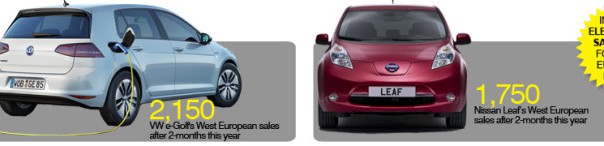
EagleAID thunders that Volkswagen e-Golf dethroned Nissan LEAF as the best-selling electric car in the first two months of 2015 in Europe.
2,150 e-Golfs to 1,750 LEAFs.
Volkswagen e-Golf Knocks Nissan LEAF Out Of #1 Electric Car Sales Spot In Europe (Image: EagleAID)
Seems bold, but data from 17 West European markets is not saying the whole story.
Volkswagen e-Golf is booming in Norway, where they sold 80% of the total – 1,718 registrations.
In the same two-month period, Nissan had 556 registrations of LEAFs in Norway, which must mean that sales are more diversified – or at least that Nissan doesn’t see cramming the country with inventory ahead of the potential tax incentive expiration (at 50,000 EVs sold) a necessity.
On the 16 other markets e-Golf / LEAF ratio is different: 432 / 1,194.
According to the latest report on EV Sales Blog, Nissan sold worldwide almost 7,000 LEAFs in the first 2 months of 2015, while Volkswagen soldjust over 2,350 e-Golfs.
Anyway, competition continues and we now looking forward to March data to see how the situation progressing.
Would you like an overload of info on the new Volkswagen e-Golf? These multiple videos will provide you with more info on the e-Golf than you likely care to know.
The first video discusses different driving and regenerative braking modes.
Check out this e-Golf commercial. e-Golf is 2015 Motor Trend Car of the Year.
https://www.youtube.com/watch?v=LCCHcZabs_s
Like the other BEVs, you can control your e-Golf with a sophisticated smart phone app.
Europe, with over 9,500 plug-in electric car sales in January 2015, far exceeded the US’ result of 5,924.
This year began especially strong for Volkswagen, which seems to now be most popular brand among plug-in electric car buyers.
We are not sure if VW will be able hold onto the #1 spot, but in January the automaker delivered over 2,300 cars (Golf GTE, e-Golf and e-up!) and some 2,800 if we include the whole VW Group (Audi and Porsche).
In second place is Nissan Tesla Renault Mitsubishi! Outlander PHEV had almost 2,000 sales, and with i-MiEV added in the result stood at nearly 2,100.
Nissan, combined with Renault (below 2,000), is at similar level, but only if we include Twizy.
Both BMW and Tesla are down in the hundreds range.
Well, Volkswagen might’ve come to the party late, but as a Group it’s moving forward to quickly become the sales leader in Europe.
After a night charging up in the garage, the 2015 Volkswagen e-Golf’s display showed 108 miles of range when I pushed the start button. After slogging through San Francisco traffic then running down a rain-soaked freeway at 60 mph, covering 12 miles, the range figure was down to 82 miles, suggesting my real-world range from the garage had been 94 miles.
Still, it was considerably better than the EPA range of 83 miles for the e-Golf and illustrated the vagaries of electric car range estimates.
The e-Golf is Volkswagen’s entry into the electric car game, and incidentally broadens the Golf range beyond its gasoline and diesel offerings. As with other electric cars on the market, it could be considered a “compliance car,” necessary to meet zero emission vehicle (ZEV) sales requirements in seven US states that have adopted the ZEV mandate. Despite its limited range, however, I found nothing in the e-Golf to suggest it’s anything less than a fully realized car.
e-Golf is an attractive new electric from VW (Image: CNet)
Some of the e-Golf’s quality driving feel comes down to the base Golf model. Getting a major update for the 2015 model year, the new Golf is built on Volkswagen’s MQB platform, a modular chassis designed to handle a variety of drivetrains. The Golf GTI hot hatch and Golf TDI diesel share that platform and the basic Golf hatchback body with the e-Golf.
For the e-Golf, Volkswagen leaves out engine, transmission and fuel tank, replacing them with an 85-kilowatt motor driving the front wheels with a single reduction gear and a 24.2 kilowatt-hour lithium-ion battery pack. Impressively, this electric driveline gear does not impact the cabin space at all, nor does it unbalance the car. Instead, it gives the e-Golf 83 miles of zero emission driving, according to its EPA rating. The EPA rating of 116 mpg equivalent makes the e-Golf the most efficient compact electric car on the market.
As with electric cars from other manufacturers, Volkswagen offers just one well-stocked trim level. For the US, that means the navigation-equipped SEL Premium, at a price of $36,265 with destination fee. Volkswagen also offers the e-Golf in the UK, again with navigation, for a price of £30,845. UK buyers can shave off £5,000 with a government electric vehicle grant, and US buyers can figure in the government’s $7,500 tax credit.
Until now, the only way you could get the words “electric” and “Golf” so close together was the put the word “cart” after them. Knowing that the e-Golf would be the next step in Volkswagen’s tilt at electrification, the automaker designed the MkVII platform to fit a myriad of drivetrains, none of which would require purchasers to sacrifice the Golf-ness that makes the best-selling car in Europe, not to mention a huge hit here in the States. In the e-Golf that means power electronics underhood and an amoeba-shaped battery that fits in the floorpan, between the axles, where it won’t ooze into the interior space.
We look at the e-Golf as another kind of crossover: traditional cars that just happen to be electric, offering a taste of the new EV religion in soothing, recognizable garb. We had one for a week in its natural habitat, Los Angeles and the surrounding area. We really like the fact that, powertrain aside, it maintains everything we dig about the Golf. The caveat is that this is an EV first and a Golf second – you must first address the EV challenges and live within EV constraints, then you can enjoy the Golf bits. Even so, it’s the electric car this writer would buy once we acquired the lifestyle to make proper use of it.
Volkswagen e-Golf (Image: J. Ramsey/Autoblog)
The most noticeable exterior change to the e-Golf are 16-inch Astana wheels wrapped in 205-series tires that reduce rolling resistance by ten percent. Once you’ve cottoned on to that, the other alterations become apparent: the blue trim strip underlining the radiator grille, the redesigned bumper with the C-shaped decoration LED lights and the full-LED headlamps above them, the little blue “e” in the model name on the rear hatch. You won’t notice the underbody paneling, that the frontal area of the e-Golf is ten percent smaller than that of a traditional Golf, that the radiator is closed off, or the reshaped rear spoiler and vanes on the C-pillars. Volkswagen says this results in a ten-percent drop in drag, getting the coefficient down to 0.281, but the standard Golf is also listed at 0.28. The TSI and TDI are 0.29. No matter those numbers, the point is the e-Golf looks just like… a Golf.
The 12,000-rpm, 85-kW electric motor equates to 115 horsepower and 199 pound-feet of torque, which compares to 146 hp and 236 lb-ft from the 2.0-liter diesel Golf. It takes 4.2 seconds to get to 37 miles per hour, 10.4 seconds to hit 62 mph, and the little guy tops out at 87 mph. That sounds like slacker acceleration, but it never feels that way – you can pull away from a light with the rest of traffic, and any time you need a squirt, 199 lb-ft of instant torque is there to woosh you forward.
Temperatures in the teens and 20s don’t make for ideal electric-vehicle driving conditions, but that was the weather presented during my week in Motor Trend’s electric Car of the Year. How’d it work? Way better than expected in every way except range, which plunged about as much as we were told to expect.
VW rates the e-Golf’s real-world range at 70-90 miles, the EPA says 83, and the range-remaining display generally started out saying 65 miles on these cold mornings, when started in the Normal driving mode. This mode automatically dials up a cozy 72 degrees on the climate control system, which is warmer than I would usually set it, but it refuses to remember my 69-degree setting upon restart. (Eco reduces the climate control power, and Eco+ switches it off, increasing the remaining range.) When I hit the buttons for electric windshield, rear-window, and side-view mirror defrosting, as well as both front-seat heaters, one morning, that range estimate dropped to as low as 48 miles briefly, but minutes later, as I toggled off the high-power glass heaters, the range rebounded to well into the 50s.