Vauxhall is the latest car maker to have tweaked pricing for its electric car range in the wake of the government’s changes to the Plug-in Car Grant.
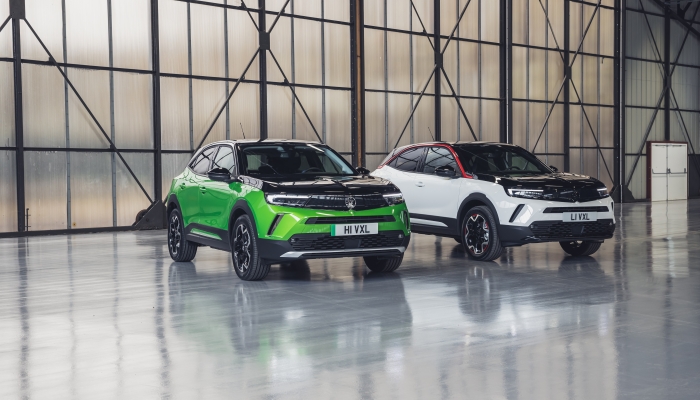
Vauxhall’s new pure-electric Mokka-e in SE Premium trim now starts at £33,040 while the top-of-the-range Launch Edition starts at £34,995.
As for the Vivaro-e Life people mover, prices have been cut by £2,000 so the entry-level Edition model is now £34,995.
The Corsa-e supermini’s pricing remains unchanged as this model falls beneath the new £35,000 threshold.
The price cuts are in response to the government changing the Plug-in Car Grant last week.
Vauxhall Corsa-e (Image: Vauxhall.co.uk)
The grant was first introduced in 2011 as an incentive for motorists to purchase a pure-electric vehicle. But last week the price cap for eligible vehicles was reduced from £50,000 to £35,000, while the discount dropped from £3,000 to £2,500.
Paul Wilcox, Vauxhall’s recently-appointed new managing director, said: ‘At Vauxhall, we believe in making sure our vehicles are as accessible as possible to the greatest number of people, and especially so when it comes to zero emissions-in-use motoring, so I am pleased to confirm that all Corsa-e, all Mokka-e and the new Vivaro-e Life Combi are eligible for the government Plug-in Car Grant.’
The announcement of the changes to the grant came out of the blue and Vauxhall is one of a number of manufacturers who reacted quickly and changed prices for their pure-electric models.
The government’s announcement caught the car industry off guard, with Mike Hawes, SMMT chief saying it was ‘the wrong move at the wrong time’ that ‘moves the UK even further behind other markets’.
If you would like to know more about Solar Panels and the PowerBanx range of home battery systems, and get a free instant quote, please complete our online form:
“The new electric Vauxhall Mokka-e looks great and is designed to feel like a petrol car”
If you were put off the previous Vauxhall Mokka X by its dowdy design and fossil fuel-burning engines, the Vauxhall Mokka-e couldn’t be much more different. Vauxhall now sits alongside a host of marques including Peugeot and Citroen under the Stellantis group umbrella, so it’s time for a fresh look.
The Mokka-e is wider and lower than the old car, instantly giving it a more athletic stance. It also boasts a new family face, called ‘Vauxhall Vizor’ that will soon appear on every new model from the brand. Based on the Opel GT X Experimental concept from 2018, it has a smooth grille designed to house a myriad sensors elegantly and make the car appear wider. Both conventionally fueled and electric versions get a blank grille, so a couple of ‘e’ badges are the only giveaway that this is the EV.
While the standard Vauxhall Mokka has to fend off rivals from nearly every manufacturer, the Mokka-e has far fewer competitors, for now. The Mokka-e is mechanically identical to the Peugeot e-2008 and DS 3 Crossback E-Tense, and undercuts cars like the Hyundai Kona Electric and Kia e-Niro on price. Our favourite small SUVs, the Renault Captur and Ford Puma, don’t offer EV versions. The Mokka-e’s size and style might also lead you to cross-shop it with small electric superminis like the MINI Electric and Renault ZOE.
The Mokka-e manages a 201-mile range, and the battery can be topped up to 80% in just half an hour if you plug it in to a 100kW public charger. We’d imagine most customers would use a 7kW home wallbox more often, which takes around seven and a half hours to fully recharge the Vauxhall’s battery – meaning cheap overnight charges should be easy.
The range is about average for the class – the Mazda MX-30 and Kia Soul EV offer 124 and 280 miles respectively – and its acceleration figures don’t stand out either. Hitting 0-62mph in 8.7 seconds is relatively brisk, just not as impressive as some electric rivals. This, however, is a deliberate tactic on Vauxhall’s part as engineers have set up the throttle response to feel less urgent and more like that of a petrol or diesel car. It means that the Mokka-e might be appealing if you don’t enjoy being pinned back in your seat every time you pull away from the traffic lights.
The interior is all-new, and is what you can expect from the next generation of Vauxhall models. A configurable digital instrument cluster is standard on all but the base model, and it’s joined by a touchscreen that can measure up to 10 inches. Smartphone connectivity is present and correct, while material quality is good in most places – there are soft-touch plastics in areas you’re likely to touch. The car is quite small inside, though, offering more interior and boot space than a supermini but less than many small SUV rivals.
Vauxhall-Mokka-eSUV (Image: media.vauxhall.co.uk)
The Vauxhall Mokka-e doesn’t have a single standout reason why you’d buy one over a Peugeot e-2008, Kia e-Niro or MG ZS EV. But it doesn’t have anything glaringly wrong with it, either. Sitting it right in the middle of the pack with few faults and an attractive design is probably a recipe for strong sales.
Thanks to its shared CMP (Common Modular Platform) with the Vauxhall Corsa-e and Peugeot e-208, the Mokka-e gets the same 50kWh battery. This gives it a range of up to 201 miles in ideal conditions, making it competitive with models like the Peugeot e-2008. However, the Mokka-e doesn’t quite boast the range of the 64kWh Kia e-Niro, which is capable of around 280 miles from a single charge.
An onboard 11kW charger and mode 3 cable allows the Mokka-e to be fully charged in just over 7.5 hours using a home wallbox, or, if you can find a public 100kW rapid charger it can be topped-up from 15 to 80% in around 30 minutes. While 100kW chargers are still fairly rare in the UK, the charging infrastructure is growing rapidly thanks to government funding and investment from private firms like Instavolt, Shell Recharge and BP Pulse.
The charging flap is to the rear of the passenger side c-pillar, rather like a conventional petrol fuel filler cap. It has a series of LED lights that light up to help illuminate the charging port and indicate progress. Flashing green shows charging is in progress, while a solid green light shows the battery is fully charged. A blue light shows charging has been scheduled for later, while red indicates a fault.
The Mokka-e is the best in the range for company-car drivers, as it’ll cost very little in Benefit-in-Kind tax. Meanwhile, the three-year/60,000-mile warranty is similar to rival models, although the battery pack is covered for eight years or 100,000 miles. Vauxhall offers a three-year servicing package – but that may only cover two services as the Mokka-e needs an initial inspection after 8,000 miles or a year, and then needs servicing every 16,000 miles or two years thereafter. Another Mokka-e perk seems to be complimentary roadside assistance for eight years, which could add up to quite a saving.
If you would like to know more about Solar Panels and the PowerBanx range of home battery systems, and get a free instant quote, please complete our online form:
Mirror Motoring’s Colin Goodwin gets his hands on his first car after lockdown – the Vauxhall Corsa-e electric vehicle that sprints to 60mph in 7.6 seconds in Sport mode
The last car that was delivered to me to test before the lockdown was a Renault Zoe, which as you probably know is a fully electric car.
The first car to be delivered in the eased lockdown is a Vauxhall Corsa-e, also an electric car.
So for the limited amount of driving that I’ve done during the last two months, which is mainly going back and forth caring for my 94-year-old mum, all of it has been in an EV.
I’m getting pretty used to this electric business. Wouldn’t say I was at the evangelist stage yet, but I’m warming to it.
The Corsa-e is essentially the same car as the Peugeot e-208 but not quite as good looking. Vauxhall was quick out of the box with this car because there is no fully electric Ford hatchback and very few from other rivals.
Vauxhall Corsa-e (Image: Vauxhall.co.uk)
There’s really only the aforementioned Zoe, the Mini E and Honda E – the latter offering a shorter range and higher price.
The Corsa-e has a 100kW electric motor and a 50kWh battery giving it a range in ideal conditions of 209 miles, which is about 25 miles less than the Renault.
Vauxhall will also give you a wall-mounted fast charger and fit it for free. This is just as well because charging the car from a domestic socket will take up to 24 hours.
Use a public rapid charger and you will be able to bring your Corsa-e’s battery up to 80% charge in 30 minutes.
Slip inside and you’ll see a rather more straightforward interior than the Peugeot’s. No nice piano keys to operate oft-used items like radio and sat nav, no futuristic 3D virtual cockpit and no wacky tiny steering wheel.
But never mind, there’s not much wrong with the Vauxhall’s interior and it’s very well put together.
If you would like to know more about Solar Panels and the PowerBanx range of home battery systems, and get a free instant quote, please complete our online form:
The Corsa’s gone EV with as little risk as possible, and ought to be a doddle to drive every day as a result
Overview
What is it?
Here is a Vauxhall Corsa that’s almost pioneering. And that’s something we’ve never been able to say before. This is the Corsa-e, and it’s a fully electric hatchback that looks just like its petrol-powered base car.
It’s not alone in its offer, nor is it the first of its kind. We did say almost pioneering. Indeed, it’s only come about because Vauxhall’s now owned by PSA and this is – effectively – a Peugeot e-208 in a plainer suit.
Vauxhall Corsa-e (Image: Vauxhall.co.uk)
But this is an electric Corsa long before there’s an electric Fiesta or Polo. For people who like buying badges they know from dealers around the corner, that could be enough to garner rather a lot of sales. Prices start at £27,165 with the government’s current EV grant applied, making it pricier than a base e-208, but it does come with more equipment.
The Corsa-e faces a tough bunch of rivals, launching at exactly the same time as the e-208 as well as the reijgged Renault Zoe and the adorable Honda e and Mini Electric. You won’t be buying this one to make a visual statement – especially among that lot – but perhaps that’s its appeal; electric power without making a song and dance about it.
It uses the same combination of 100kW power and 50kWh battery as the e-208, adding 345kg to a regular Corsa’s kerb weight but keeping it all in the floor. Better for handling, and it means room for people and luggage is mostly unimpeded too. The fully charged range is quoted at 209 miles.
If you would like to know more about Solar Panels and the PowerBanx range of home battery systems, and get a free instant quote, please complete our online form:
The first PHEV to wear the Griffin badge delivers hot hatch pace – but can it match premium competition for ride refinement and interior finish?
What is it?
Meet one half of Vauxhall’s two-step journey towards electrifying its entire passenger car line-up by 2024 – a journey set to make its other significant stride forward in just a few months with the arrival of the Corsa-e electric supermini.
The Grandland X Hybrid4 is the first ever plug-in hybrid to wear a Vauxhall badge, 2012’s Ampera being, strictly speaking, a range-extender electric car rather than a PHEV. With a 13.2kW battery, it can deliver as much as 35 miles of zero-emissions range – enough, says Vauxhall, for 80% of customers to do the majority of their driving on electricity alone. A 7.2kW wall box can then recharge it in under two hours, though only if you pay £500 for the option.
Vauxhall Grandland X Hybrid4 (Image: Vauxhall.co.uk)
Of more interest to the average Autocar reader? That this is also the most powerful production Vauxhall on sale today, a pair of electric motors and PSA’s familiar 1.6-litre turbocharged four-pot petrol engine sending 296bhp to all four wheels. 0-60 takes a claimed 5.9 seconds, or enough to raise the eyebrow of the average hot hatchback owner.
In the UK, the all-wheel drive Hybrid4 starts with with the well-equipped SRi Nav trim, at £41,500. Our test car, a top-spec Ultimate Nav which adds niceties such as advanced park assist, premium audio and bespoke LED headlights, was an altogether more ambitious £46,650. That isn’t too far removed from premium plug-ins from Audi, BMW and Volvo. Fleet customers may be more tempted by the Business Edition at roughly £37,000, but private buyers may want to wait for the less pricey, front-drive only variant set to follow later in the year, with an equally attractive benefit-in-kind tax rate.
If you would like to know more about Solar Panels and the PowerBanx range of home battery systems, and get a free instant quote, please complete our online form:
Mini, Vauxhall Corsa and Fiat 5oo will join rapidly expanding European EV market
Europe’s carmakers are gearing up to make 2020 the year of the electric car, according to automotive analysts, with a wave of new models launching as the world’s biggest manufacturers scramble to lower the carbon dioxide emissions of their products.
Previous electric models have mostly been targeted at niche markets, but 2020 will see the launch of flagship electric models with familiar names, such as the Mini, the Vauxhall Corsa and the Fiat 500.
Vauxhall Corsa-e (Image: Vauxhall.co.uk)
The number of electric vehicle (EV) models available to European buyers will jump from fewer than 100 to 175 by the end of 2020, according to data firm IHS Markit. By 2025 there will be more than 330, based on an analysis of company announcements.
The new supply will cater to a rapidly expanding market as demand for petrol-powered vehicles gradually recedes. UK EV sales will rise from 3.4% of all vehicles sold in 2019 to 5.5% in 2020 – or from 80,000 this year to 131,000 in 2020 – according to forecasts from Bloomberg New Energy Finance. By 2026 electric vehicle sales will account for a fifth of sales in the UK, the forecasts show. Similar predictions from LMC Automotive suggest 540,000 electric cars will be sold across the EU in 2020, up from 319,000 over the course of 2019.
New European Union rules come into force on 1 January that will heavily penalise carmakers if average carbon dioxide emissions from the cars they sell rise above 95g per kilometre. If carmakers exceed that limit, they will have to pay a fine of €95 (£79) for every gram over the target, multiplied by the total number of cars they sell.
The excess emissions bill would have been £28.6bn on 2018 sales figures, according to analysis by the automotive consultancy Jato Dynamics, illustrating the extent of the change required by carmakers over a short period of time. Jato analyst Felipe Muñoz said there will still be large fines, as companies keep selling profitable internal combustion engine cars and struggle to bring down EV prices to parity with their fossil-fuel peers.
If you would like to know more about Solar Panels and the PowerBanx range of home battery systems, and get a free instant quote, please complete our online form:
Experts are predicting that 2020 will be the year of the electric car as sales continue to rise.
Figures released today by the Society of Motor Manufacturers and Traders (SMMT) show that the number of battery-electric vehicles registered in November increased by 228.8 per cent compared to the same month in 2018 – with over 4500 new EVs hitting the roads.
So far this year, nearly 14,000 electric cars have been registered in the UK, compared to 38,500 plug-in hybrids and nearly 80,000 hybrids. Mild hybrids have also seen a dramatic increase in popularity, with registrations of mild-hybrid diesels increasing by more than 450 per cent last month.
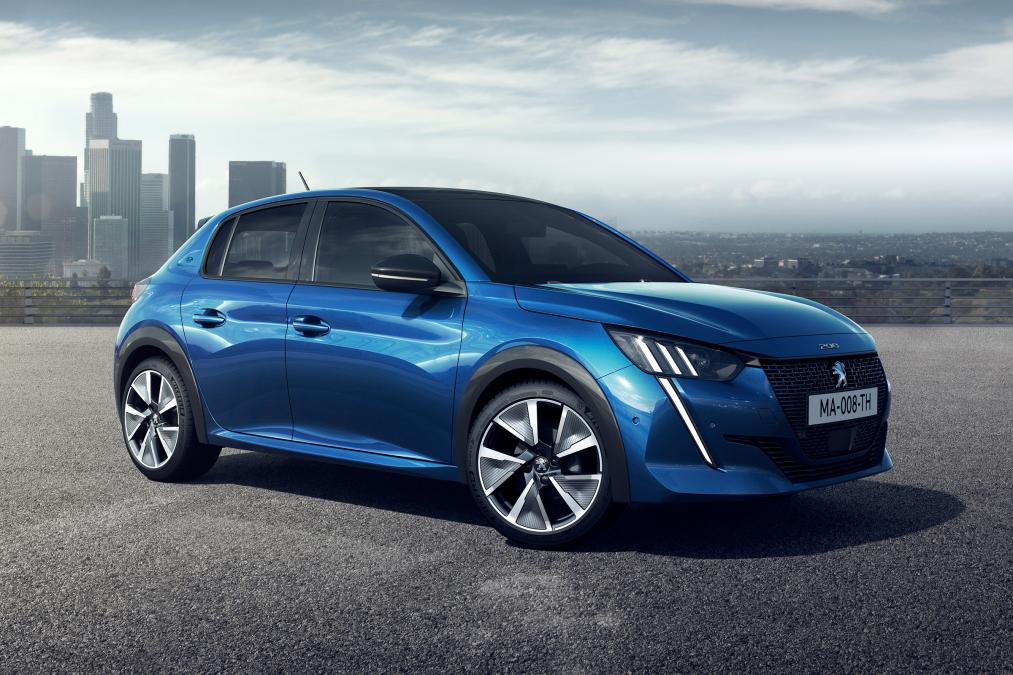
Peugeot e-208 (Image: Peugeot)
Car manufacturers are rushing to launch new electric cars in a bid to meet new emission targets set by European Union legislators. By 2021, they face strict fines if their average CO2 emissions for each car exceed 95g/km. By selling more electric vehicles (with zero tailpipe emissions) and hybrids (with reduced tailpipe emissions), average CO2 emissions will drop.
Kia recently admitted that it has 3000 customers on a waiting list for the e-Niro – something it says it intends to clear in the first half of 2020, despite previously having to halt orders as it couldn’t keep up with demand.
Volkswagen is set to launch its new electric ID range with the ID.3 hatchback, while the Volkswagen Up, SEAT Mii and Skoda Citigo city cars are also going electric-only for 2020. Vauxhall’s new Corsa is available as a pure-electric model, as is the closely-related Peugeot 208.
If you would like to know more about Solar Panels and the PowerBanx range of home battery systems, and get a free instant quote, please complete our online form:
A supermini where 100kW recharging comes as standard
Vauxhall’s new Corsa-e will likely make a lot of friends with impatient types who are open to the idea of an all-electric car, but lack the time or inclination to get its battery charged.
Why? It’s going to arrive in April next year with the capacity for fast DC 100kW charging to replenish the 50kW battery. The feature isn’t an extra either, and it could pull in a lot of people who would otherwise pass on the chore of having to charge a battery over popping into a filling station for fuel.
Vauxhall Corsa-e (Image: Vauxhall.co.uk)
A five-minute pit stop or, potentially, many, many minutes as you wait for those battery bars to replenish is perhaps why so many of us have decided to hang fire on moving over to an electric vehicle. This is still the most frustrating aspect of electric car ownership and it’s mainly about the infrastructure.
Having a car that can be recharged promptly is therefore a definite bonus. And, with its perky recharging potential that could mean the Corsa-e could really hit the right note, assuming you can find a vacant 100kW charging station that is.
In real terms that means you’ll be able to get another 160 miles or so in around half an hour, which is admittedly very handy. Vauxhall also underlines that the Corsa-e boasts a 205 mile range, which has been ticked off via WLTP certification. The car will also come with a rather more sedate 11kW charger, which will get you charged at home in around 7.5 hours using a domestic wallbox.
DETROIT — As their company was swirling around the financial drain in the early 2000s, General Motors executives came up with an idea to counter its gas-guzzling image and point the way to transportation of the future: An electric car with a gas-engine backup that could travel anywhere.
At Detroit’s auto show in 2007, they unveiled the Chevrolet Volt concept car, not knowing yet whether they had the technology to pull off a major breakthrough in battery-powered vehicles.
It took nearly four more years, but the first Volt — a longer-range version of a plug-in hybrid — rolled off the assembly line late in 2010. GM had hopes that customers would be ready for a car that could go 38 miles on electricity before a small internal combustion generator kicked in.
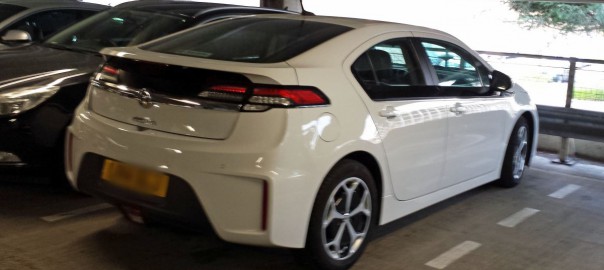
Vauxhall Ampera (rebadged Chevrolet Volt) (Image: T. Larkum)
They weren’t. On Tuesday, the last Volt was built with little ceremony at a Detroit factory that’s now slated to close. Sales averaged less than 20,000 per year, not enough to sustain the costly undertaking.
The Volt wasn’t the first electric car, but it was the first to conquer anxiety over range at a reasonable cost. GM’s limited-range EV1 came out in the 1990s, and Tesla put out its 200-plus-mile Roadster in 2008 for more than $100,000.
The Volt was among the first plug-in hybrids, many of which can go only 20 or so miles on electricity and haven’t gained much popularity among consumers.
Yet the Volt did serve a purpose. It led to advances in lithium-ion batteries similar to those that power smart phones and computers. But such advances ultimately led to the Volt’s demise as GM and other manufacturers developed fully electric vehicles that can go 200 more miles per charge.
“While it was a financial loser, it did what was intended,” said retired GM Vice Chairman Bob Lutz, who shepherded the Volt into production. “We viewed it as a stepping stone to full electrics, which were totally out of reach due to the then-astronomical cost of lithium-ion batteries.”
The company is cutting 15 percent of its workforce and shuttering five plants.
General Motors announced today that is planning to lay off 15 percent of its contract workers, shutter five plants in North America, and discontinue production on six vehicle models next year. The move comes as part of a major restructuring of the car manufacturer that has been suffering from lagging sales. Going forward, GM intends to focus on electric and autonomous vehicle programs, just like basically every other car maker.
As many as 14,000 salaried and contract workers will be out of work as a result of GM’s new roadmap. The company is also “unallocating” resources to plants in Oshawa, Ontario, Canada; Detroit, Michigan; Warren, Michigan; White Marsh, Maryland; and Warren, Ohio. The decision puts the future of those plants in limbo, but they will at least see a decrease in production if not a complete shut down.
Vauxhall Ampera (rebadged Chevrolet Volt) (Image: T. Larkum)
In addition to major slashes to its assembly lines, GM will also cease production on six vehicles, according to USA Today: Cadillac XTS and CT6, Buick LaCrosse and Chevy Impala, Cruze and Volt. The decision to cut out the Volt, a plug-in hybrid vehicle, seems odd given GM’s promise to focus on electric cars. It also marks the death of one of the cars lauded as a success for the company following its bankruptcy in 2009. The decision follows fellow American automaker Ford’s decision to kill off production of most of its vehicles earlier this year.