The Jaguar I-PACE was the best selling vehicle (of any type) in December, while the Tesla Model S was the #1 plug-in vehicle for all of 2018.
December had 6,232 plug-in vehicle registrations in the Netherlands, a four-fold increase compared to the same month last year and the market’s best month since December ’16. The sales total translates into a stratospheric 31% plug-in electric vehicle (PEV) share in December, pulling the 2018 PEV share to 6%, a great result, especially when we realise that BEVs represented 89% of PEV registrations in 2018 and 98% in December alone.
Of course, the higher taxation of expensive BEVs in 2019 is the major reason for this surge, but something tells me (ahem, Tesla Model 3 …) that this exponential growth is set to continue through 2019.
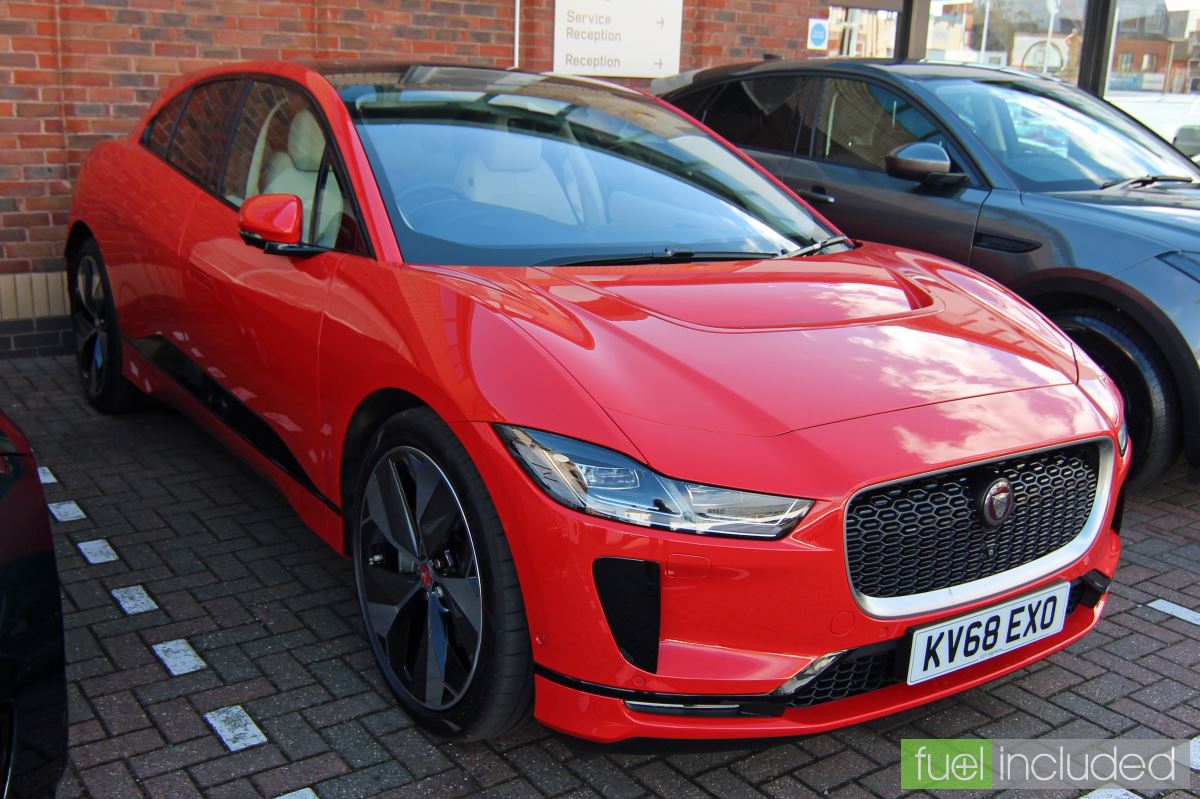
Jaguar I-PACE Electric Car (Image: T. Larkum)
This good market performance was the result of three exceptional individual results, starting with the Best Seller of the Month, the Jaguar I-PACE, which delivered 2,621 units, not only a new all-time record for a BEV, but also the first time that a 100% electric vehicle became the best selling model in the mainstream market.
The Model 3 might still be pricey but there are alternatives.
It’s easy to look at a luxury automaker like Jaguar and declare 2018 the year the automotive industry caught up with Tesla. But like the Model X and Model S, the I-Pace is out of reach for most folks. It’s great that people with large bank accounts can get behind the wheel of a vehicle that runs on electrons instead of dead dinosaurs. What’s better is that 2018 showed that the rest of us can do the same thing.
Elon Musk promised a $35,000 electric vehicle with a range of more than 200 miles. The Model 3 is supposed to be the result of that pledge. But the company has yet to deliver a base-model version of the car. Building cars is hard; building inexpensive cars for the masses is near impossible. But that oath, and the fact that Tesla made electric cars “sexy,” inspired (or forced) other automakers to realize there is a market for electric-powered transportation.
Hyundai Kona Electric (Image: Hyundai)
The result: On the horizon, there’s a wave of electric vehicles truly built for everyone — and that’s where real change comes from. The spark of revolution might begin with a few rich people here and there, but the fire needs to spread beyond the loading zones of private schools and the valet parking of fusion restaurants. The real transformation is parked in front of Denny’s and charging outside Target while the driver is taking care of back-to-school shopping.
It was possible to get behind the wheel of an EV without dropping a huge chunk of cash before now, but it was a hard sell. If you only have the money to buy one vehicle, something with a range of 100 miles seems like a bad investment. Sure you want to save the planet, but you also want the peace of mind of being able to run errands before and after work without worrying about running out of juice.
We started 2018 with a car that was ready to tackle range anxiety while delivering on outstanding value: the Chevy Bolt. It’s on sale right now and is a perfect entry into the EV world. Even if you hadn’t planned on buying an electric car, get behind the wheel and drive it. At that point, you’ll understand just how great an electric car, SUV or even truck can be.
The Tesla Model 3 is now on sale in select European markets, with first deliveries penned in for February 2019
Tesla has outlined European specifications and prices for the Model 3, and first European reservation holders will have been invited to begin placing their final orders.
In the United States, the Model 3 has been on sale for well over a year and deliveries are well underway, with production totalling over 50,000 units in the third quarter of 2018.
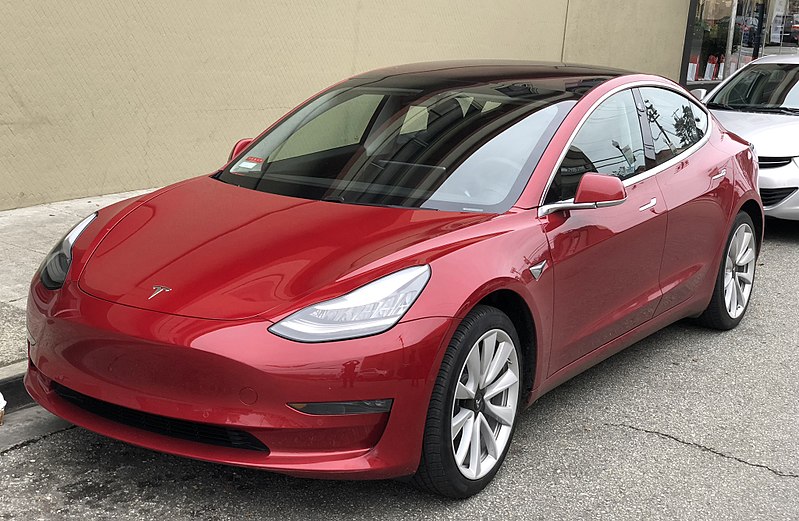
Tesla Model3 (Image: Wikimedia/Carlquinn)
With European sales finally beginning, two configurations of the Model 3 are available from market launch – the Model 3 Long Range Dual Motor All-Wheel-Drive, and the recently revealed, BMW M3 baiting Model 3 Performance.
Both models are expected use a 75kWh battery pack, and have been homologated under the new WLTP testing procedure with an official range of up to 338 miles on a single charge. As for the Model 3 Performance, Tesla claims that the European specification model achieves 0-62mph in 3.7 seconds, with top speed clocked at 155mph. No European performance figures have been published for the regular Long Rane Dual Motor AWD model, but Tesla’s American configurator claims 0-60mph in 4.5 seconds, with a top speed of 145mph.
After decades of ups and downs, electricity is finally emerging as the fuel that will propel the planet into the future as more governments look to address their pollution problems by phasing out vehicles that run on fossil fuels.
As a result, automakers are scampering to flood the market with electric cars, trucks and, especially, SUVs over the next few years.
Nowhere is this more evident than at this year’s Los Angeles Auto Show, which will officially open to the public on November 30. Almost every automaker that is displaying at the downtown convention center, especially in the luxury segment, is looking to discuss its electrification strategy for the next decade with any journalist willing to listen.
Jaguar I-PACE Electric Car (Image: T. Larkum)
Porsche wants 50% of its stable to be electric by 2023. Jaguar Land Rover has announced it will shift production entirely to electric and hybrid vehicles by 2020.
Ford plans to deliver 13 new electrified models over the next five years. General Motors plans to roll out 20 all-electric models by 2023.
BMW will offer 25 electrified vehicles by 2025. Aston Martin expects that EVs will account for 25% of the company’s stable by 2030.
And that’s just the beginning. If projections are correct, there should be 400 electrified models on the road by 2025. That’s 300-plus more EVs and hybrids than are running about today.
As more drivers opt for electric, Zoe Williams takes the Tesla Model S for a spin
This is the most unscientific analogy to use about the most incredibly scientific car, but you know when you’ve been out with, say, three Sagittariuses (Sagittarii?) in a row.
You think, each of those was very delightful in their own way, exciting, adventurous, yada yada, but I would not do a Sagittarius again because they’re just too unreliable.
That’s what I always felt about the electric car. Watching the mileage vanish in a BMW i8, 16 miles of charge left one minute, wham, 50 yards later, you’re down to your last four, with a boot full of shopping and no charger in sight; stranded in a service station, halfway between Oxford and Manchester in a Hyundair Ioniq, staring down the barrel of spending three hours next to a plug, smiling half-heartedly at the people checking their tyre pressure.
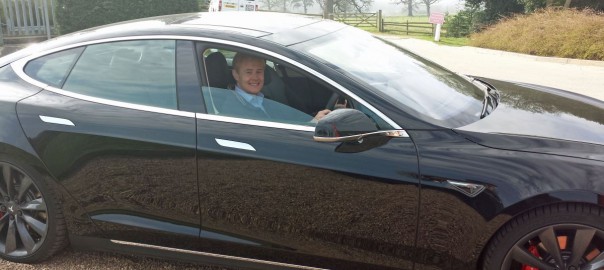
A classic Tesla grin (Image: T. Larkum)
It just isn’t worth it. This may be the future, but thanks, the future isn’t for me.
And then I met the Tesla; and oh my God, I’d fallen for another archer, except this time, it was also Brad Pitt.
Obviously, this car is the brainchild of Elon Musk, and though there are faults to find in Musk’s temperament and these might predispose you against his invention, forget it. Surrender is inevitable.
Third-party CCS fast charging available to all Tesla Model 3 owners with adaptors coming for Model S and Model X owners
European Tesla Model 3s will come with a CCS (Combined Charging System) fast charging compatible port when they arrive in the early part of 2019. That means that, as well as using Tesla’s own Supercharger and Destination networks, the Model 3 will be able to fast charge on third-party networks such as Polar/BP Chargemaster and Ionity.
Owners of Model X and Model S cars will also be able to use third-party CCS chargers by buying an adaptor that can be plugged into their cars’ existing on-board Type 2 sockets. The new adaptors are expected to be priced similarly to existing CHAdeMO fast-charging adaptors, which cost around €500 (£435), yet will be slightly smaller in form.
Tesla Model3 (Image: Wikimedia/Carlquinn)
Speaking exclusively to Auto Express, Tesla’s head of global charging infrastructure, Drew Bennett, said: “There’s a lot of excitement about Model 3 coming to Europe and charging is always part of that conversation.
“We’ll be continuing to invest in our network – that’s a huge part of the ownership experience. But we’ll be enabling our owners to have access to the CCS networks that are starting to grow in Europe, so the Model 3 will have a charge port for the CCS standard and we’ll also have an adaptor for Model S and X.
“All existing Tesla customers will be able to use the Supercharger network still, but these changes will allow people to venture outside the network – this is something that could really help our owners and is really exciting for us to be able to say that about the infrastructure in Europe.
“We’re all about accelerating the advent of sustainable energy and transportation and this is another way to help everybody scale.”
You’re going to be shocked — the electric car that respondents most frequently said they were most likely to buy next (or for the first time in the case of non-EV drivers) was the Tesla Model 3.
Over 100,000 reservations ($1,000 each) were placed for the car in under 24 hours — even before the car was shown. The demand was through the roof and ended up being the single biggest product reveal in history by certain key metrics. So, it is not a surprise in the least that this electric car tops the list of “expected next EV model.”
That said, the Tesla Model 3 didn’t account for the majority of answers, demonstrating that the electric car market is broad and goes far beyond the Model 3. Delving into the less desired models is perhaps more interesting than dwelling on the Model 3’s dominance, since they get much less attention but are still cars that many consumers are eager to place in their garages.
White Tesla Model S (Image: T. Larkum)
As with our first two EV owner reports, one thing that stands out is how loyal many consumers are to the brands and models they are currently driving. Many Volt drivers plan to get a Bolt, many LEAF drivers plan to get another LEAF, and many Tesla drivers are filling out their family fleets with other Tesla models or are upgrading to the latest and greatest versions of the Tesla vehicles they already have.
Tesla’s stock (TSLA) is surging since announcing record profits and the company is now worth more than BMW as the stock of the latter is slipping following disappointing financial results.
The California-based electric automaker’s market cap is now worth over $59 billion while BMW’s slipped below 49 billion euros ($55 billion) yesterday after it announced lower than anticipated profit for the last quarter.
While it’s hard to directly compare Tesla to other automakers because the company is more than an automaker due to its growing energy division, most of its revenue currently comes from its automotive business.
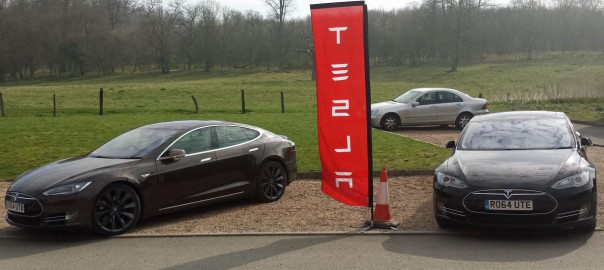
Tesla showroom in Milton Keynes (Image: T. Larkum)
As a premium automaker, BMW is probably one of the best comparisons for Tesla.
But even though Tesla’s production increased significantly this year, the two automakers deal in completely different kinds of volume.
The BMW Group delivers over 2 million vehicles per year between all its brands while Tesla is currently producing vehicles at a rate of about 360,000 unit per year.
Nonetheless, investors are betting on the company’s future and they are encouraged by its growth and profitability over the last quarter.
The Model 3 is already disrupting the midsize premium sedan market, which has been an important market for BMW.
BMW’s sales of midsize sedans have been down in the US, where Tesla is mainly delivering the Model 3, this year.
The German automaker’s BMW 3 Series is seen as one of the biggest losers in the rise of the Model 3.
A new initiative from the Austrian government is set to reward electric car owners with a unique incentive.
On October 25, the Austrian ministerial cabinet announced that it would be adjusting the speed restrictions for electric vehicles traveling in the country’s IG-L-Hundred zone, which covers a total area of 440 kilometers (273 miles). With the updated rules in place, owners of Teslas and other electric vehicles will be allowed to travel up to 130 km/h (80 mph) on the highway, 30 km/h (20 mph) faster than their fossil fuel-powered counterparts.
Austrian Minister of Sustainability Elisabeth Köstinger noted that the speed limit exception for electric vehicles is part of the country’s initiative to encourage the adoption of sustainable transportation. Together with the adjusted speed limits, the Austrian government is also pushing to open bus lanes for zero-emissions cars, and promote free parking programs for electrified vehicles.
“The exception for electric vehicles in the IG-L-Hundred is an advantage that we want to give owners of e-vehicles to internal combustion engines,” Köstinger said.
While the specifics of the speed limit incentive are yet to be fully announced, the Austrian government’s wording on the program suggests that the exception would be tailor-fit for battery-powered vehicles like Tesla’s electric cars. Köstinger, for one, noted that the top speed advantage would be given to EV drivers over drivers in vehicles with internal combustion engines. With this statement in mind, it appears that hybrid vehicles such as the BMW i8, which are equipped with a internal combustion engines and electric motors, would not be awarded the same top speed incentive.
The country’s EV community would likely appreciate a speed limit incentive for electric cars, and if it proves effective in Austria, there is a good chance that the program would be adopted in other regions as well. Electric cars, after all, emit no emissions regardless of their speed, and with the advent of high-performance vehicles like the Tesla Model S, Model X, and Model 3, EVs are now more than capable of maintaining high speeds for long periods of time. With batteries getting cheaper and better, electric cars will soon be able to travel even farther than before as well. With this in mind, even simple perks like a higher speed limit would likely encourage even more drivers to join the growing electric car movement.
SAN FRANCISCO (Reuters) – Tesla Inc (TSLA.O) reported a net profit, positive cash flow and wider-than-expected margins for the latest quarter on Wednesday, delivering on Chief Executive Elon Musk’s promise to turn the electric carmaker profitable as higher production volumes of its new Model 3 began to pay off.
Tesla reiterated that it expected to repeat its net profit in the current quarter, helping drive the company’s shares up 14 percent in after hours trading.
The controversial Musk, who has often set goals and deadlines that Tesla has failed to reach, surprised investors by delivering on his pledge to make Tesla profitable for only the third quarter in its 15-year existence, providing a positive end to a difficult quarter for the CEO whose leadership was openly questioned only weeks ago.
Tesla Model3 (Image: Wikimedia/Carlquinn)
“We can actually be cash flow positive and profitable in all quarters going forward,” Musk said, qualifying that he excluded those in which a big debt payment comes due, such as the first quarter of 2019.
Musk reiterated that Tesla currently does not plan to raise equity or debt.
Tesla said it would begin taking orders in Europe and China for the Model 3 before the end of 2018. Deliveries would begin to Europe in late February or March, and those to China in the second quarter, if not before, Musk said.
Musk said he planned to begin local production in China next year in a ‘capital efficient manner,’ suggesting the company might use a similar tent structure for car assembly that has already been used at its Fremont, California, plant. He gave no further details on plans in China.
Meanwhile, seeking to quell speculation that a large number of prospective buyers had canceled their reservations due to delays receiving their cars, Tesla said only 20 percent of North American reservation-holders had canceled their bookings.
Free cash flow at $881 million was positive for only the third time in Tesla’s history and was helped by a surge of new production of the Model 3, lower capital expenditures, and more efficient use of working capital.
While still below the production target it set for June of 5,000 Model 3s per week, the roughly 4,300 Model 3s the company is now averaging per week were enough to boost results.