Category Archives: Sales

UK motorists now have more than 30 electric models to choose from

UK electric fleet passes 32,500 mark

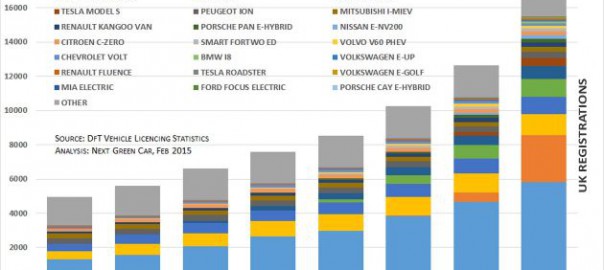
Combining figures from the Department for Transport with new data from the Society of Motor Manufacturers and Traders (SMMT) reveals that the total number of electric cars and vans registered in the UK now exceeds 32,500 vehicles for the first time.

The latest statistics demonstrate the continuing growth in EV sales of high-quality electric cars and vans in the UK. Of the total number of EV registrations, the vast majority (29,979) are electric cars that are eligible for the Plug-in Car Grant. These vehicle comprise fully electric cars such as the Nissan LEAF, as well as plug-in hybrids an exemplified by the Mitsubishi Outlander PHEV.

The other electric vehicles represented by the figures include plug-in vans and cars which do yet yet qualify for the Govt grants. As of the end of December 2014, this group comprised 2,526 vehicles and (based on estimates since then) now number around 2,776 vehicles, the majority being Plug-in Van Grant eligible vans (approx. 1,345).

Given that a large number of successful claims for the Plug-in Car Grants have yet to be translated into registered vehicles, the total UK light-duty electric fleet may already be approaching, or indeed may have already exceeded 35,000 electric vehicles.

Cumulative electric vehicle registrations (UK) 2010-2015 (Image: NGC)

Another indicator that the electric market is growing in strength is the number of fully electric and plug-in hybrid models available in the UK. While only 9 EVs were available for the major manufacturers in 2011, this increased to 18 models in 2013, and now stands over 30 high-quality, fully crash tested cars and vans with more models due for launch in 2015.

Dr Ben Lane, Director of Next Green Car said:

“The number of EVs registered in the UK continues to grow exponentially demonstrating that UK car buyers are continuing to embrace both fully electric and plug-in hybrid power-trains. Reports from EV owners suggest that, rather than just financial benefits, it is the totally new driving experience that is really leading to a change in market preferences and driving the demand for electric vehicles.

“Recent research from Nissan also shows that many EV owners have stated that they would never consider returning to using an ICE car, yet more proof of the fundamental shift in consumer attitudes in favour of electric mobility.”

The latest EV model entrants include the Tesla Model S and Mitsubishi Outlander PHEV which have already made their mark in the UK market. Other high-quality models now available include the Kia Soul EV (which NGC range-tested in December 2014) and the Nissan e-NV200, the latter bringing all the benefits of electric to the small van market.

Source: Next Green Car
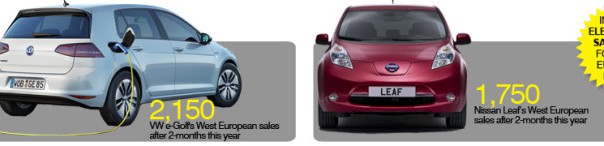
Volkswagen e-Golf Knocks Nissan LEAF Out Of #1 Electric Car Sales Spot In Europe (Image: EagleAID)

Volkswagen e-Golf Knocks Nissan LEAF Out Of Number 1 Spot

EagleAID thunders that Volkswagen e-Golf dethroned Nissan LEAF as the best-selling electric car in the first two months of 2015 in Europe.

2,150 e-Golfs to 1,750 LEAFs.

Volkswagen e-Golf Knocks Nissan LEAF Out Of #1 Electric Car Sales Spot In Europe (Image: EagleAID)

Seems bold, but data from 17 West European markets is not saying the whole story.

Volkswagen e-Golf is booming in Norway, where they sold 80% of the total – 1,718 registrations.

In the same two-month period, Nissan had 556 registrations of LEAFs in Norway, which must mean that sales are more diversified – or at least that Nissan doesn’t see cramming the country with inventory ahead of the potential tax incentive expiration (at 50,000 EVs sold) a necessity.

On the 16 other markets e-Golf / LEAF ratio is different: 432 / 1,194.

According to the latest report on EV Sales Blog, Nissan sold worldwide almost 7,000 LEAFs in the first 2 months of 2015, while Volkswagen soldjust over 2,350 e-Golfs.

Anyway, competition continues and we now looking forward to March data to see how the situation progressing.

Source: Inside EVs

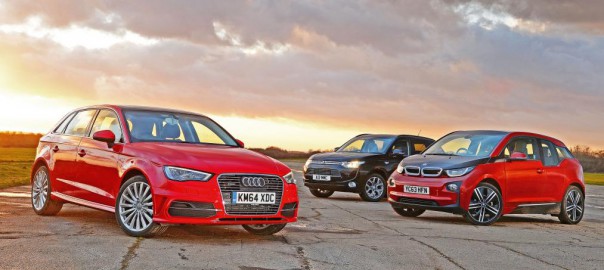
Audi A3 e-tron, Mitsubishi Outlander and BMW i3 plug-ins

Electric vehicles account for over 20% of Norway’s new-car sales

Plug-in electric car sales in Norway continue at just above 20% (21.03%) market share with 2,235 registrations in February 2015. Battery-only electric vehicles now account for 18% of all new-car sales.

The over-all #1 best selling car in Norway for the second month running is the VW e-Golf with 839 units. Sales of the Volkswagen e-Golf in Feb were almost double the top selling fossil fuelled car, the Toyota RAV4 with 450 sales.

The e-Golf accounts for almost 40% of all EV sales in Norway YTD (1,718) selling 3x more than second place Nissan Leaf (556) and 4x more than third placed Tesla Model S (392).

The ICE powered Volkswagen Golf has been one of the best selling cars in Norway for many years but the e-Golf and GTE Plug-in variants now account for 70% of all Volkswagen sales in Norway.

The Norwegian e-Golf sales success sends a clear signal to auto makers that non-quirky, conservative body styling can boost EV market share significantly.

Source: Electric Vehicle News

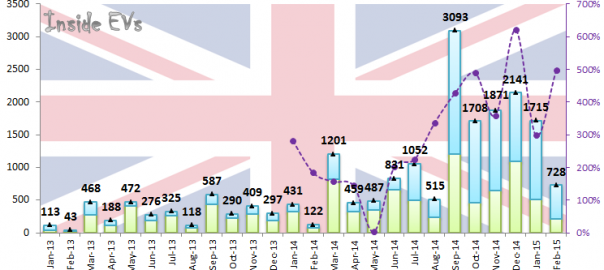
Plug-in Car Registrations in UK – February 2015 (Image: Inside EVs)

Electric Car Sales In UK Up Almost 500% In February

February was the 36th consecutive month of car sales growth in UK – registrations went up by 12% year-over-year to 76,958.

The numbers themselves are low as February is one of the slowest sales months of the year ahead of a number plate change in March.

Plug-in Car Registrations in UK – February 2015 (Image: Inside EVs)

Despite this, electric cars grew like crazy by 497% year-over-year to 728 new registrations. Market share was 0.95%.

There were 216 BEVs (up 167%) and 512 PHEVs (up 1,066.7%).

As previously mentioned, February is a slow month, so now we look forward to what we hope to be a record-setting March. 5,000? Maybe 7,000? We’ll find out soon enough.

Source: Inside EVs

Audi A3 e-tron, Mitsubishi Outlander and BMW i3 plug-ins

Electric vehicles sneaking up in the race for global car dominance

The age of electric vehicles, those quirky cars that have been perennially stigmatized as lacking range, reliability and affordability, is finally here. If you don’t believe that statement, you probably haven’t driven one recently. Or attended a Formula E auto race. Or taken a look at some of the sales numbers.

Or all of the above.

For the first time in a century, the electric vehicle (EV) is on the road to becoming a serious competitive challenge to its petroleum nemesis. That’s not to say that the world’s billion-plus “conventional” cars are ready to be dragged en masse to scrap yards with big cranes and magnets. Nor do a smattering of all-electric Teslas and BMWs suggest that the petroleum industry will easily surrender its headlock on the global transportation market. But at a minimum, today’s EV renaissance does strengthen the case that long-term forecasts for world oil consumption are overstated. And depending on the speed of technological advances in batteries and electric power trains, there are scenarios where EV adoption rates could surprise.

The most exciting place to witness EV advances is at an FIA Formula E racing event. All-electric Formula E (fiaformulae.com) is a newbie on the world racing circuit, but has attracted some of the same legendary names that have made its raucous Formula 1 cousin famous. For example, Williams Advanced Engineering is championing batteries; McLaren is involved with the motors; and founding partner Renault is integrating all the systems into sleek vehicles that look like mechanical doppelgangers for F1 race cars.

A couple of weekends ago, I attended the first North American Formula E race, the Miami ePrix, held just north of Biscayne Bay. Lineups and shoulder-to-shoulder crowds amplified the sense that this fresh event was more than just about seeing who would spray champagne at the finish line. Teal-coloured banners everywhere reminded the crowds that they were there to “Drive the Future.”

Race time arrived. Four o’clock. The announcer called the drivers to their starting positions. No one else seemed to notice, but I smiled at the absence of the obviously antiquated, “Start your engines!” command. Suddenly, off the mark, 10 cars lurched down the caged, 2.2-kilometre circuit with tires squealing. And for the rest of the one-hour race, that was it for loud noise. At every lap, the Formula E cars swished by with a satisfying, almost calming, smooth whine. Unlike a deafening Formula 1 race, a large part of the thrill was not having to silicone my ears shut.

Technological advances from the extreme engineering of the Formula E sphere will trickle down to mainstream cars, just as petroleum-powered cars have benefited from seven decades of F1 racing. To be sure, electric powertrains still need more work before mainstream EVs can be a compelling substitute for gas, gears and grease. But the race is on. EV sales figures from early laps of commercialization show that market penetration is worth a glance over the shoulder – especially if you’re driving for the oil team.

Our feature chart (Figure 1) this week gives an updated monthly sales snapshot of pure battery electric vehicles (BEVs) and plug-in hybrids (PHEVs). The latter still use a small gasoline-powered engine as a blanky for range, but primarily rely on a battery. Gasoline prices are overlain on the chart as a reference for the incumbent competition.

Adoption of EVs in the U.S. market began a steady rise in 2011. Conditions were favourable when average gasoline prices were in the range of $3.75 to $4.00 a gallon. Sales numbers of almost 10,000 a month still pale compared to overall U.S. auto sales of over a million a month; however it’s the uptrend of early adoption that’s noteworthy. Over the past six months, U.S. sales momentum appears to have fallen in tandem with gasoline prices; this is not surprising as there is less incentive for consumers to plug in when the price spread between the pump and the wall socket narrows. But like a race, it’s too early to call a downtrend.

For one thing, don’t confuse adoption with seasonality: EV sales have traditionally had a dip during the winter months; 2014 and 2015 were especially harsh in the eastern US. Globally, sales of EVs – four-wheeled and two-wheeled varieties – are on an upswing in Europe and Asia. The International Energy Agency reports that there are now 230 million electric bikes in China. Global car sales (battery electric vehicles and plug-in hybrid electric vehicles) are tracking 25,000 a month, and growing 50 per cent per year if the trend line is extrapolated.

Diesel- and gasoline-powered cars will still have the pole position for many years to come. Nevertheless, the EVs are off to the races, quietly sneaking up on their competition.

Source: Globe and Mail

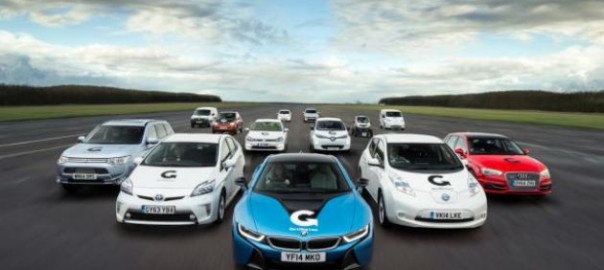
Go Ultra Low members boast 15 ULEVs across a range of segments (Image: OLEV)

Plug-in Electric Car Sales Surge in UK

Plug-in electric car sales have undergone a huge rise in many key European markets according to figures released by the European Automobile Manufacturers Association (ACEA).

The biggest gains came in the UK, where a 300 per cent rise in electric cars has taken place compared to this time last year.

In total 75,331 new electric cars have been registered according to the ACEA, with Norway leading the way with just under 20,000 new registrations.

In Germany electric car registrations are up by 70 percent, while in France they had climbed by almost 30 per cent compared to the 2013 figures.

Read more: Electric Vehicle News

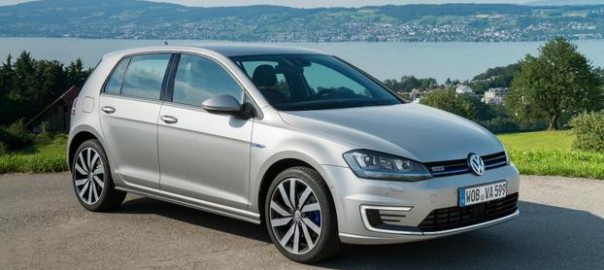
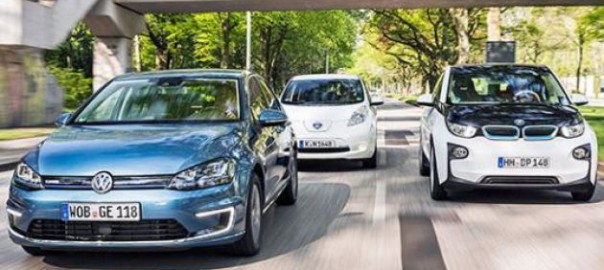
Volkswagen Golf GTE (Image: VW)

Volkswagen Leads Plug-In Electric Car Sales In Europe

Europe, with over 9,500 plug-in electric car sales in January 2015, far exceeded the US’ result of 5,924.

This year began especially strong for Volkswagen, which seems to now be most popular brand among plug-in electric car buyers.

We are not sure if VW will be able hold onto the #1 spot, but in January the automaker delivered over 2,300 cars (Golf GTE, e-Golf and e-up!) and some 2,800 if we include the whole VW Group (Audi and Porsche).

In second place is Nissan Tesla Renault Mitsubishi! Outlander PHEV had almost 2,000 sales, and with i-MiEV added in the result stood at nearly 2,100.

Nissan, combined with Renault (below 2,000), is at similar level, but only if we include Twizy.

Both BMW and Tesla are down in the hundreds range.

Well, Volkswagen might’ve come to the party late, but as a Group it’s moving forward to quickly become the sales leader in Europe.

Source: EV Sales Blog via Inside EVs

UK electric vehicle registrations UK (Image: Next Green Car)

Nissan LEAF most popular electric car in UK

Figures recently released show that the Nissan LEAF maintains its position as the most popular electric car or van in the UK, with at least 5,838 vehicles registered by the third quarter of 2014, representing over a third of all EV sales.

The registration data also shows the new Mitsubishi Outlander PHEV has made a dramatic entry to the UK market; the electric SUV is already in second position with over 2,706 sales less than a year after its UK release.

In third and fourth places are two more established plug-in hybrids, the Toyota Prius PHEV (with 1,226 registrations) and the Vauxhall Ampera (1,039 vehicles). The BMW i3 now ranks fifth with at least 1,029 UK registrations (454 all-electric and 575 range-extender variants).

The Renault ZOE and Tesla Model S are also selling well in the UK with over 775 and 474 sales respectively; the two models in fourth and fifth sales positions across Europe as a whole (YTD October 2014).

UK electric vehicle registrations UK (Image: Next Green Car)

With the recent announcement from OLEV that 23,083 claims have been made through the Plug-in Car Grant scheme, the number of electric cars and vans in the UK now exceeds 24,500 vehicles for the first time.

Another indicator that the EV market is gaining momentum is the number of fully electric and plug-in hybrid models available in the UK. While only 9 EVs were available for the major manufacturers in 2011 (excluding quadricycles), this increased to 18 models in 2013, and now stands at 24 high-quality cars and vans (in 2014) with more models due for launch in 2015.

Dr Ben Lane, Director of Next Green Car said:

“The strong growth of the EV market in the UK as elsewhere provides yet more evidence that the light-duty vehicle market is undergoing a radical change with consumer preferences changing from petrol and diesel models to electric power-trains. With sales growing exponentially, the EVs are set to become commonplace on UK roads within the next few years.”

Source: Next Green Car

Renault Electric Car Sales (Image: InsideEVs)

In 2014, Renault Sold Over 18,000 Electric Vehicles

After a few difficult years, Renault is finally moving upwards with electric car sales. Year 2014, with just over 18,000 EVs (almost 15,700 cars) sold, is still 3% down compared to 2013 (or 0% if we exclude Twizy), although the last couple of months of 2014 were really strong.

December ended with new record of over 3,300 sales (over 3,100 without Twizy) and it’s the very first time when Renault exceeded the mark of 3,000.

Growth year over year in November almost hit 50%, while in December it reached 57% for cars.

Renault Electric Car Sales (Image: InsideEVs)

All the good numbers comes from one car – the ZOE, because the three other models have seen sales going down. Fluence Z.E. almost doesn’t count (out of production), Kangoo Z.E. is struggling to sell at its pace from 2012 & 2013 (28% down year over year), while Twizy again weakened by 20% to 2,450.

ZOE shines at over 11,000 and this makes it the second best selling all-electric car in Europe, just behind the Nissan LEAF.

More than half (probably ~53%) of Renault ZOE sales occurred in France. Total number of ZOEs on the roads is now over 20,000.

We believe that Renault sold over 40,000 electric cars and additionally over 14,500 Twizys for a total ~ 55,000 EVs globally to date.

Source: Inside EVs

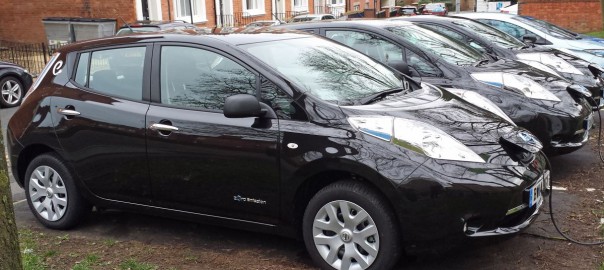
e-Car Club Nissan Leafs outside Northampton Derngate (Image: T. Larkum)

Hybrid sales down, but EVs rise despite lower gas prices

Somewhat surprisingly, hybrids that still use gas, but don’t need recharging, took the biggest hit.

Cheap gas will kill sales of hybrids and electrical vehicles conventional wisdom holds, but a closer look at the numbers through November shows a more complex picture.

Somewhat surprisingly, hybrids that still use gas, but don’t need recharging, took the biggest hit. Through 2014’s first 11 months, gas-electric hybrid sales fell 9% to 418,850, according to hybridcars.com, slipping to 2.8% of the total U.S. light-vehicle market from 3.2% a year earlier.

Plug-in hybrids and pure battery-driven models actually had a strong year. Sales of plug-in hybrids jumped 17% to 51,490 and sales of battery electrics rose 31% to 55,906, of which the Nissan Leaf accounted for nearly half (27,098). Leaf sales were not only up 35% for the first 11 months, they were up 34% in November when gas prices were well into their decline.

e-Car Club Nissan Leafs outside Northampton Derngate (Image: T. Larkum)
Nissan Leaf (Image: T. Larkum)

But alternative propulsion represents a sliver of our automotive landscape. The internal combustion engine, even if the current glut of crude oil vanishes by March, will be the dominant powertrain for years to come.

The Obama administration’s goal of 1 million battery-only and plug-in electric vehicles on U.S. roads by 2015 will not be achieved.

So this may not be the best time to buy your first shares of Tesla Motors, although they have fallen about 25% from an early September peak of $286.

General Motors is to unveil an upgraded Chevrolet Volt at the North American International Auto Show this month into a headwind of the lowest gas prices since the bad old days of late 2008.

But there are still folks out there for whom saving a few hundred dollars a year is not enough. They’re looking to kick the fossil fuel habit altogether and there are more choices for them.

While Volt sales have tumbled 16% from 2013, Ford more than doubled sales of its Fusion Energi plug-in to 10,761. Toyota sold 14% more of its Prius plug-in (12,772 through November).

The less consumers pay at the pump the more likely they are to opt for size and power over fuel economy. Sales of pickups, SUVs and vans outnumbered passenger cars again by 52% to 48% through November. December sales, which automakers will release Monday, likely will show that trend will grow stronger.

Most every new model, regardless of its size, offers significantly better mileage than the one it replaces because of a combination of reduced weight and more-efficient engines.

Even so, the average fuel economy of vehicles sold in the U.S., which had risen 26% over the past seven years, fell to 25.3 m.p.g. for November from 25.8 in August, according to data compiled by the University of Michigan’s Transportation Research Institute.

So the longer gas prices stay low the more difficult it could be for automakers to meet the federal government’s fuel economy standards.

The Obama administration, under a law enacted under the Bush administration in 2007, requires the average fuel economy of cars and light trucks sold in the U.S. to rise annually and hit 34.1 m.p.g. by 2016. The target rises to 54.5 m.p.g. in 2025.

But the law called for a “midterm review” before the 2017 model year to determine whether to ease the standards based on consumer habits, gasoline prices and other factors.

Don’t be surprised if automakers start suggesting soon that such a review be in the direction of a less-ambitious standard.

Source: Detroit Free Press