Category Archives: ZOE

Renault & Eneco collaborate on smart charging solution for electric vehicles

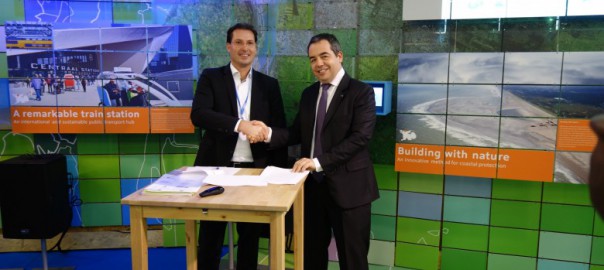
  • Agreement signed between electric vehicle leader Renault and energy supplier Eneco on December 7, 2015 at COP21 Paris conference
  • Eneco will develop smart charging app for ZOE, Renault’s 100% electric compact car
  • Renault ZOE users will be able to charge their car at lower costs using renewable energy
  • Reduced electricity costs for Renault ZOE users in the Netherlands

780x520_electric_vehicles_renault

Eneco subsidiary Jedlix will develop a version of its existing smart charging app, to adapt it to Renault ZOE. This app makes it possible to charge electric cars using renewable energy at times when the market prices are most favourable. Like at night, when the production of sustainable wind energy exceeds demand in most European countries.

Marc van der Linden, member of the Executive Board of Eneco:

“It is expected that there will be three million electric vehicles in the whole of Europe by 2020. To reduce CO2 emissions, it is essential that this vehicle fleet will use green power. It is also important to prevent power grid overloads as a result of peaks in demand if all the cars would be charged at the same time. Our app forms a direct link between the electric vehicle and the supply of sustainably generated energy. Consequently, the energy used for charging is more sustainable, energy supply and demand is balanced and the costs of driving an electric vehicle are reduced because users charge their cars at lower rates.”

Eric Feunteun, Electric Vehicle Program Director at Renault:

“Renault electric cars support the energy transition in the automotive industry as they contribute to the replacement of fossil fuels by renewable energies. With smart charging systems like the one developed by Eneco, Renault electric vehicles make a big contribution to power systems’ stability and reliability: EVs turn into an asset for the grid rather than create overload. They can store and use electricity when it is less carbon-dependent and cheapest for their owners. Our partnership with Eneco is a move towards making driving a Renault ZOE more interesting and affordable and will contribute to an electric vehicles’ scale up”.

A pilot test carried out by Eneco in the Netherlands demonstrates that users can save up to 15% on their electricity costs by using the app. To achieve this, all they have to do is indicate by what time the car must be fully charged and the system will automatically determine the lowest price within this time frame. Van der Linden: “I am very proud that we will be launching this smart service together with a leading party in the field of electric transport.” The app will first be available for ZOE users in the Netherlands and soon be available in other countries where Eneco operates.

The electric vehicle, a solution to counter global warming

The carbon footprint of electric cars is shrinking fast, with the shift already underway toward the use of renewable energies in the overall energy mix in most countries across the world today. Renewable energies feature in 56% of the new electricity power plants built in the world today. In Europe, this figure rises to 72%.

Renault is the pioneer of affordable all-electric vehicles, and the only carmaker to offer a full range. Renault sees the electric vehicle as an eminently viable countermeasure against global warming.

The Renault-Nissan Alliance is an official partner of the COP21 United Nations climate-change summit, providing a fleet of 200 Alliance electric vehicles, including 100 Renault ZOEs, to ferry delegates between Paris and Le Bourget from 30 November to 11 December 2015.

Source: 3D Car Shows

Renault unveils a unique documentary: The Electric People

[Note that although the video is in French, you can switch on Captions and through the YouTube Settings button you can set it to auto-translate to English]

electric_people_doc_renault

From 8 to 28 July 2015, Sandra Reinflet (writer, singer and photographer) and Mathilde Terrier (journalist) took ZOE out on a most unusual Tour de France. The challenge would be to find electricity for charging the car every 150 kilometres along the way, with the help of the growing community of ZOEnautes and other electric car buffs. The three-week adventure gave rise to a documentary portraying this pioneering movement, along with its values and its commitment to progress and the environment.

For COP21, an event on which it is an official partner, Renault is proud to unveil this unique film, which will also be shown at the major climate conference.

Summer 2015, Sandra and Mathilde set out into uncharted territory with their Renault ZOE, roaming the roads throughout the country and knocking on the doors of total strangers, members of the electric vehicle movement. A strong community spirit would ensure there was always a power outlet available for recharging their batteries.

It was an original way to show that you can go far with an electric car, and meet a lot of interesting people along the way.

You can view the whole film on this remarkable journey at www.LePeupleElectrique.fr.

See these videos for more on Renault France YouTube channel:
– trailer: https://youtu.be/9GFz9jmqMl4
– teasers: https://youtu.be/dapVywKyAGQ and https://youtu.be/vp4NGU0ByN8
– film : https://youtu.be/4G-oWvguLig

It paints portraits of these electric vehicle pioneers. They’re all very different, but what they have in common is that they’ve stopped being mere bystanders and decided to take an active part in the shift toward environmental responsibility.

For some behind-the-scenes insights into this unique experience, don’t miss Sandra Reinflet’s talk at the COP21 Solutions exhibition in the Grand Palais, from 11:30 to 12:00 on Saturday 5 December.

Source: Renault Media

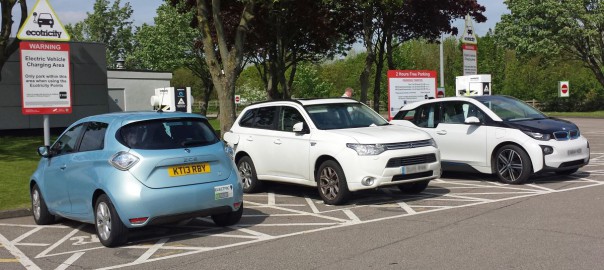
My ZOE plus an Outlander PHEV and i3 charging at London Gateway (Image: T. Larkum)

EV Spotting

I see more electric cars on the road every day now, they are no longer the novelty they used to be. In my area I see many Nissan Leafs and a few ZOEs. And, of course, it seems like the Mitsubish Outlander PHEV is everywhere!

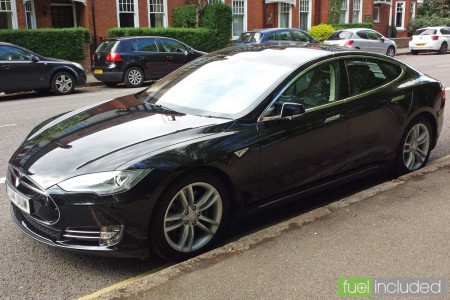
I saw my first Tesla Model S in my hometown of Northampton a few months back – that seems like a milestone of sorts.

Tesla Model S in Northampton (Image: T. Larkum)

A week later I was travelling down to London and called in to the London Gateway services for a charge. By the time I had finished and was packing up to leave I had been joined by an Outlander and a BMW i3, all 3 cars lined up in a row at the chargepoints. Hopefully such a tableau will be commonplace in the future.

My ZOE plus an Outlander PHEV and i3 charging at London Gateway (Image: T. Larkum)

Of course, it did highlight that only the ZOE has its charging socket at the right end!

You can charge a Renault Zoe faster in Germany

Renault Germany entered into a partnership with a company specialized in electric transport solutions to test a system that would reduce the charging time for electric cars.

Renault ZOE
Renault ZOE

Electric cars’ charging times are the main drawback of such vehicles. You have to be really patient when you plug in your car, and when you are in a hurry, such patient does not last for long. Electric car owners appreciate reduced charging times for their vehicles, and even more so reduced charging cost. To test such a system, Renault Germany teamed up with The Mobility House (based in Zurich and Munich), which specializes in electric transport solutions such as smart charge terminals and energy storage systems. The Mobility House (TMH) has developed a technology that substantially reduces the charging cost for the customer, as well as shortening the charge time by an hour. Eleven ZOE owners, working at Renault in Germany, were selected to test the system developed by TMH under real-life conditions.

Once plugged into a special charge station at the ZOE owner’s home, the car communicates its electricity needs via a Renault Global Data Center to TMH, which schedules vehicle charging on the basis of energy cost data. Electricity from the grid costs more during high demand periods and less when demand is low, so the system detects consumption peaks and stops charging until the cost falls. Fast charging then proceeds, at lower cost, until the car batteries are fully charged.

This technology enables electric car owners to optimize their electricity expenses without the trouble of having to calculate peak and trough demand periods themselves. It marks the first stage in forthcoming development of “smart grids”. Renault and TMH are also working together on other solutions for reducing charging costs, and offering electric vehicle owners ways to earn money by generating electricity to be fed into the grid.

Source: IN Auto News

Buying a Renault Zoe

What’s life really like with an electric car? Two years in a Renault Zoe should provide the answers

My name is Jim Holder and I’ve bought an electric car.

Renault ZOE
Renault ZOE

There, I’ve said it. Standing up in front of the autocar.co.uk crowd and saying that feels fairly momentous, because our readers are notoriously divided as to the merits of such vehicles. Some love them, some hate them; please don’t rush to judge me either way.

Anyway, after some earnest shopping around, I’ve laid down a £75 deposit and will lease a Renault Zoe for the next two years.

Both the rational and emotional sides of me couldn’t be happier. Let me explain why.

The Zoe will be mostly driven by my wife, who currently owns a 2007 vintage Ford C-Max powered by a 1.6-litre petrol engine. Despite covering just 100 or so miles per week, the stop-start nature of her travels (school clubs, swim teaching at various locations) means she spends £20-£30 at the pumps every seven days. Now, she will charge the Zoe once a week, at a cost of around £5 – so that’s £100 a month back in the bank.

Likewise, there will be no road tax to pay, no MOT test to cover and, because she is self-employed, there are significant tax savings. Servicing should also be £50 a year cheaper – and without, I hope, the anxious wait to find out what has worn out this time. Furthermore, selling the C-Max should also put £3500 in the bank to accrue some interest, while the ‘free’ charger that comes as part of the deal (but which costs £1000 prior to more Renault and government input) is another bonus.

Read more: Autocar

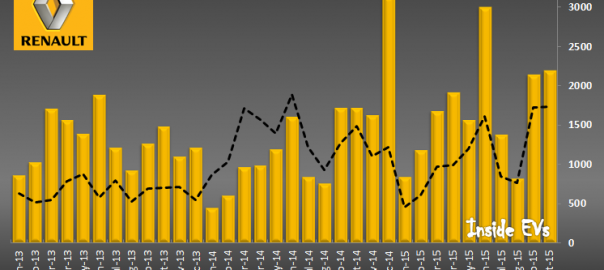
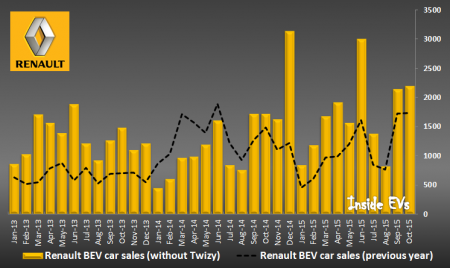
Renault BEV car sales (without Twizy) – October 2015 (Image: Inside EVs)

Renault Electric Car Sales Up 27% In October

Renault electric car sales grew last month by 27% (year-over-year – including the inclusion of the Twizy).

Renault BEV car sales (without Twizy) – October 2015 (Image: Inside EVs)

In total, Renault delivered about 2,200 cars and nearly 290 Twizy (all numbers preliminary).

Growth is fueled by Renault ZOE, which at nearly 1,850 sales not only represents about 84% of Renault’s all-electric car sales, but is moving up fast at up over 39% from over the 1,300 moved a year ago.

Average monthly sales of ZOE this year are over 1,360, which is a decent number, especially considering that sales are almost entirely limited to Europe.

So far this year, the French manufacturer already sold a record ≈16,800 electric cars (all-time record for Renault) and ≈2,000 Twizy.

Source: Inside EVs

RENAULT-NISSAN AND PARTNERS INSTALL 90 NEW EV CHARGE SPOTS AROUND PARIS FOR COP21

  • 90 new charge spots powered by low-carbon electricity will refuel 200 Renault-Nissan EVs during the COP21 climate change conference
  • EV shuttle service is expected to log at least 400,000 kilometers over the two-week summit—without a single drop of oil
  • Many of the most conveniently located quick chargers will remain after COP21 and be available for the public

PARIS (Nov.  19, 2015) — The Renault-Nissan Alliance is installing 90 new charge spots for electric vehicles in and around Paris for the COP21 global summit on climate change.

68937_1_5_Renault

The installation is being done in partnership with French energy provider EDF, Schneider Electric, Aéroports de Paris, Paris City Council and SNCF, France’s national railway company.

The charging stations, several of which will be donated by Schneider Electric, will refuel 200 EVs serving as VIP shuttles for negotiators, delegates and media attending the conference. More than 20,000 U.N. participants from 195 countries are expected to attend the 21st annual Conference of Parties (known as COP21), from Nov. 30 to Dec. 11.

“COP21 is a call to action to reduce the impact of climate change–including global warming resulting from personal transportation,” said Renault-Nissan Chairman and CEO Carlos Ghosn. “Electric vehicles are the only existing, practical and affordable transportation solution to our planet’s environmental challenges – and they are available today. Expanding the EV infrastructure is mandatory for any city or state that’s serious about environmental stewardship.”

The quick and standard EV charging stations will use renewable and extremely low-carbon electricity from EDF, enabling the Renault-Nissan fleet to cover more than 400,000 km in two weeks. The quick charging stations will recharge EVs from 0 to 80% capacity in about 30 minutes.

EVs consume any form of electricity used in the power grid, including hydropower, solar and wind energy. As countries reduce dependence on fossil fuels and increase reliance on renewable resources, EVs become even greener.

Small carbon footprint

The COP21 charging stations in the Paris region will use electricity with a small carbon footprint. The French power grid distributes electricity with a very low average of CO2 emissions per kWh: less than 40 g in 2014, compared to the European average of 325 g of CO2 emissions per kWh. Renewable energy accounted for about 19% of France’s electricity last year.

“EDF supports the development of electric mobility, which is a cornerstone of countries’ efforts to minimize urban pollution. EDF produces extremely low-carbon electricity in France, which enables a significant reduction in greenhouse gas emissions and thus reinforces the favorable ecological footprint of this new generation of transport,” said EDF Chairman and CEO Jean-Bernard Levy.

In addition, EDF is offsetting the remaining CO2 emissions through carbon credits generated by projects certified by the United Nations. That means the Renault-Nissan EV fleet will use electricity considered fully “decarbonized.”

Fourteen of the 27 quick chargers installed will remain after the climate change conference and will be available for the public to use. These include two at Charles de Gaulle Airport, two on the Paris périphérique highway and one at Orly Airport.

France already has about 10,000 quick and standard charging spots. In the Paris region alone, there are more than 4,000 spots, making Paris one of the most “plugged in” cities in Europe.

Source: Renault Nissan Blog

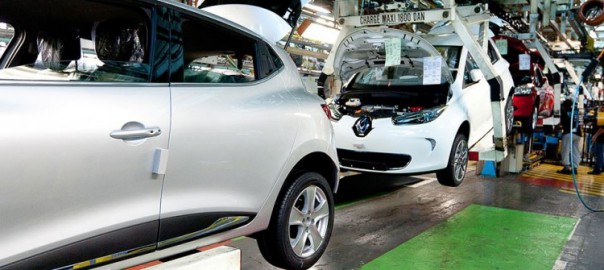
Renault ZOE Rolling Down Assembly Line

Renault To Increase ZOE Production To 150/Day

Renault believes in the strong potential growth for ZOE electric car sales, and as such is gearing up for increased production.

Renault ZOE Rolling Down Assembly Line

The Flins factory (in France) is already producing about 120 ZOE a day (up from 90 in the Spring, when the Superbonus was launched in France).

Now the company says that production will expand again – to 150 units a day by the end of November. The sudden change is probably adjusting for expected growth from the expanded diesel scrapping scheme in France next year and also higher demand throughout Europe.

To date, over 18,000 ZOE were sold in just France alone (nearly 7,000 in the first nine months of 2015) and 32,000 in total worldwide.

At 150/day, Renault would be able to deliver 3,000 ZOE a month (considering the French employees on the single shift working 20 days a month). Annual production would be ~36,000, a level of sales that the ZOE has never experienced such high volumes in the past.

Source: Inside EVs

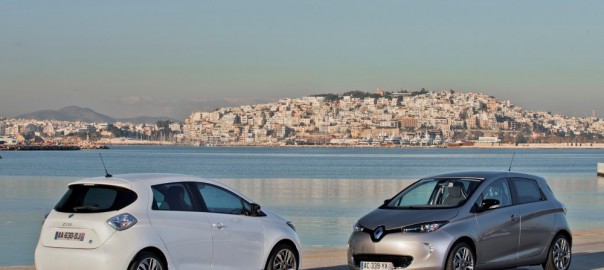
Renault ZOE Sales Top 30,000

Though sales of the Renault ZOE are far below the world’s #1 selling pure electric car (the Nissan LEAF), Renault is proud to report on a milestone achievement of having sold 30,000 ZOEs since it launch in 2012 through September. Actually, our tally had ZOE sales exceeding 30,000 back in August, but now Renault is making it official.

6_Renault_Zoe_unk

Surely sales world be higher if ZOE (or Renaults itself) were offered in the U.S., but for an electric car offered mostly (almost entirely in its early years) under a battery rental program, we consider 30,000 to be an exceptional figure.

The latest ZOE updates add more range to the car and it’s now being offered with the battery included in several countries, so we expect (and have already seen so far this year) a sales surge in the coming months.

Source: Inside EVs

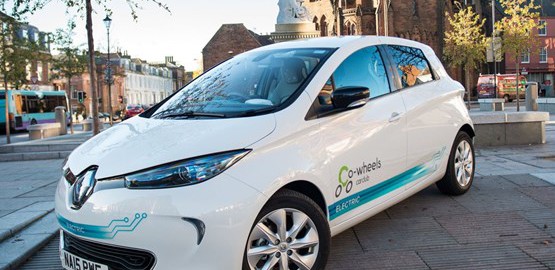
Car sharing club adds 20 ZOEs to Scottish fleet

A 20-strong fleet of Renault ZOEs has been introduced across a number of new sites in Scotland by car sharing company Co-wheels, the most recent being in Aberdeen, Dumfries and Dundee.

chr3748_Renault_ZOE_cowheels

The Co-wheels car club, which provides low emission, hybrid and electric cars on a pay-as-you-go basis for organisations and communities, has further locations for EVs in the pipeline with the ZOE confirmed as its electric car of choice. All of the club’s ZOEs have been bought outright or funded via Government grants.

Co-wheels customers can hire a Renault ZOE for £3.75 an hour or £22.50 for 24 hours. As part of the club’s drive to encourage electric car use, Co-wheels does not make an additional charge for mileage – making the ZOE its most affordable car to hire.

Pierre Fox, Director, Co-wheels, said:

“Feedback to the Renault ZOE has been excellent, customers liking how simple it is to drive and finding the controls to be very straightforward. It’s the ideal size too, and is the perfect vehicle for our car sharing model with 90% of customers’ journeys being local.

“Using the ZOE also fits with us operating as a social enterprise with a commitment to improving society and the environment. We aim to help our members save money, reduce car ownership and create a cleaner environment by making lower impact transport options available, and because we have received grants for some of the cars, we are able to pass this saving onto our customers.

“Everyone who has driven one of our ZOEs has been very positive about the experience, so much so that when it comes to adding more electric cars at new or existing locations, it will be our preferred choice of vehicle.”

Source: EV Fleet World