You are invited to join in driving over Julier- and Berninapass with zero emissions in an all-electric Renault Zoe R240. Enjoy!
Category Archives: Renault

Connected Energy and Renault to collaborate on energy storage and EV charging technology
Renault will provide used EV batteries to Connected Energy Ltd for second-life application in its E-STOR product
Renault is the electric vehicle market leader in Europe
E-STOR is a revolutionary energy storage system that can reduce costs and enable more flexible and efficient use of energy – including high capacity fast charging
E-STOR will be available in the UK from July 2016

Renault and Connected Energy are partnering to develop sustainable and efficient ways of using electric vehicle batteries at the end of their useable in-vehicle life in order to supply innovative and more affordable vehicle charging solutions.
At the end of their useful in-vehicle life, Renault EV batteries still have considerable remaining capacity, which means that they can continue to give great service in other applications before they are ultimately recycled. And with rapidly increasing EV sales – 97,687 EVs were sold in Europe in 2015, up 48% on 2014 – so is the requirement in energy to charge them.
E-STOR: a flexible and environmentally friendly energy management system
Through its award-winning E-STOR technology, Connected Energy is offering a highly innovative solution to this conundrum through use of ‘second life’ EV batteries.
This can be used, for example, to store energy generated from on-site renewable generation resources such as solar panels and wind turbines, and then release it as it’s needed at a later time. The system also allows the batteries to be charged via low-cost off-peak electricity tariffs, enabling users to reduce their energy costs.
The batteries used are Renault EV batteries, chosen by Connected Energy because Renault, as EV market leader with 23,000 units sold in Europe in 2015, has expertise in the technology, its lifecycle and impact on the environment.
The first E-STOR product is nominally rated at 50kW/50kWhr which could typically be used to support one rapid charger or a cluster of fast chargers but the system is fully scalable and higher capacity units will follow.
In practical terms, as well as allowing more efficient use of energy, the system can also enable installation of rapid electric vehicle charging in sites where electricity supply would traditionally only allow slower rates. Instead of charging vehicles via a high-capacity supply directly from the grid, E-STOR allows multiple batteries to be charged at a slower rate over a period of time, ready to release their energy and charge a car when an EV driver needs it.
Renault offers two concrete solutions with its electric vehicles and their batteries through E-STOR. First to the grid, by providing energy storage that prevents power grid overload and balances supply and demand. Second to the environment, because batteries not fitted for automobile use, but that still have considerable remaining capacity, can have a longer life and lower carbon footprint before they are actually recycled.
In June 2015, E-STOR was named winner of the innovation category in the prestigious British Renewable Energy Awards 2015, hosted by the Renewable Energy Association.
Matthew Lumsden, Managing Director, Connected Energy, said:
“E-STOR will enable the more cost-effective roll-out of electric vehicles in commercial and industrial settings, thus increasing the overall sustainability of this clean form of transport. With Renault we have secured the supply of second life batteries for future E-STOR installations.”
Eric Feunteun, Electric Vehicle Program Director, Renault, commented:
“The second life application of Renault electric vehicle batteries supports Renault’s commitment to the energy transition in the automotive industry. Through E-STOR, EV owners can charge their car at reduced costs with electricity that is less carbon-dependent. It makes driving an EV a smart and even more sustainable transportation solution. With this energy management technology, EVs and their batteries become an asset for the grid rather than create overload.”
Renault is a leader and pioneer in the emerging electric vehicle market and has sold electric vehicles since 2011, offering a range of 100 per cent electric cars and vans to suit most requirements. The ZOE supermini sits alongside the fun and distinctive Twizy urban run-around which is also available in a commercial vehicle version with a boot instead of a rear passenger seat – Twizy Cargo. Completing the Renault Z.E (Zero Emissions) line-up is the Kangoo Van Z.E. – the perfect compact van for urban deliveries and tradesmen and is available in a range of bodystyles.
In 2015, Renault was the best performing EV brand in Europe, with sales rising 49 per cent to 23,086 units, with a 23.6 per cent European EV market share. It was a similar story in the UK, with ZOE sales up 102 per cent in 2015 to 2,053 vehicles – significantly outpacing the UK electric vehicle market, which was up 48 per cent on 2014.
Source: Media.Renault.com
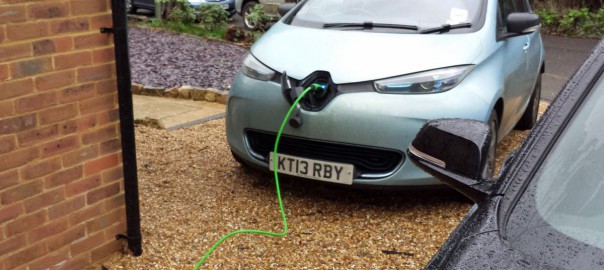
Renault ZOE Charging Curve (2.3kW ‘Granny’ Cable)
Soon after I bought our Type 2 ‘granny’ cable I did some testing to see how long it would take to charge the ZOE (when set to 10 Amps, about 2.3kW). Previously I’ve done some detailed monitoring of charge curves, specifically for 7kW home charging and 43kW rapid charging. Given that I knew this method would take much longer than either of those I chose to not monitor the whole charge, instead just one hour to get an idea of its behaviour.

As before, at regular intervals I noted the percentage state of charge and the predicted time to complete; these are shown in Figure 1 and Figure 2 respectively. With such a short test it is difficult to draw any firm conclusions, but it appears to be safe to deduce:
- The ZOE dash predicts a charge time of about 10.5 hours from a start charge of 46%, so about 23 hours for a complete charge.
- The ZOE is actually charging at about 6% per hour, so it should reach full charge in about 16 hours.
These findings are not inconsistent with each other, and the charge time is probably about 17-18 hours. Firstly, the previous analyses of charging curves show that the predicted charge time decreases over time, so it will likely decrease towards an actual lower charge time. Secondly, the predicted time includes time for battery balancing where the simple linear charge estimation does not, in other words there’s probably an hour or two of balancing ‘charging’ when the charge curve hits 99% – hence the estimation of 17-18 hours.

Of course, it’s obvious that this is a very slow way to charge compared to 3.5 hours on the usual home charge point (or half an hour on a rapid charger). This may be partly due to the charger being a generic, non-ZOE specific one and it may be partly due to the ZOE being an older Q210 model which is well known for inefficient charging at low powers.
So, if any readers are keen to volunteer, it would be interesting to repeat the test on other setups, for example:
- A ZOE Dynamique Nav R240 with the Renault 13A cable
- A ZOE Dynamique Nav Rapid Q210 (or older Intens) with the Renault 13A cable
If anyone sends me the details I’ll post them.
Meanwhile, despite the slow speed of charging, I have made good use of the cable a number of times to grab a ‘top up’ while spending time visiting family.

Most recently it got used on Christmas Eve while visiting the in-laws during one of our regular trips to Oxford.

Then on Christmas Day we visited my brother’s family in Surrey for Christmas dinner, using a new route from Northampton down the A34. This meant using the Ecotricity charge point at the Reading M4 Eastbound services, which worked fine and took less than half an hour.

Returning back, having charged with the granny cable, we skipped using the Reading M4 Westbound services which turned out to be a mistake. The next one at Chieveley was down and we had to retrace our steps to Reading Eastbound – thus a timely reminder to always charge early and have a backup in mind in the direction you want to go.

Anyway, enough about rapid charging. I would recommend that any ZOE owner considers getting a granny cable for home charging. Although expensive they do give some peace of mind, particularly when public chargers can’t be relied on (which has been the case for us at least twice during Christmas holidays).
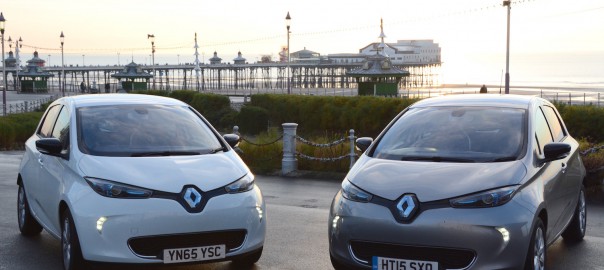
Renault leading electric vehicle market in Europe
- In 2015, Renault was the best performing brand in EV sales in Europe
- Renault’s EV sales rose 49 per cent to 23,086 units in 2015, with a 23.6 per cent market share
- ZOE is the best-selling all-electric car in Europe
- Kangoo Z.E. is the best-selling all-electric LCV in Europe

Renault is the best performing brand in Europe in electric vehicles sales, with a market share of 23.6 per cent (or 25.2 per cent including Twizy) and 23,086 units registered in 2015 up 49 per cent on 2014. One out of five electric cars sold in Europe was a Renault Z.E. vehicle in 2015.
The European all-electric vehicle market stands at 97,687 units, up 47.8 per cent compared to 2014. In Europe, the EV market represents a 0.61 per cent market share (up 0.16 per cent compared to 2014) of the overall car market.
Renault ZOE is the top-selling all-electric passenger car with its market share increasing by 2.2 percentage points to 19.2 per cent and 18,453 new registrations in 2015. It performed particularly well in France, where it recorded a 48.1 per cent market share (versus 41.2 per cent in 2014) and 10,670 units sold, thanks to the “superbonus” incentive set up by the French government in April 2015. More than half of ZOE sales in France benefitted from the incentive.
Renault Kangoo Z.E. is the best-selling electric LCV in Europe with 4,325 units sold in 2015, accounting for 42.6 per cent of the all-electric LCV market.
Renault has sold the most EVs between 2010 – the year the first EV was launched in Europe – and 2015, with a record of 62,228 units sold. Since its launch, 16,331 units of Renault Twizy were sold.
Renault Z.E. models sold in Europe in 2015:
- ZOE, a compact hatchback launched in 2013;
- Kangoo Z.E., the electric version of Renault’s LCV launched in 2011;
- Twizy, an urban two-seater quadricycle, launched in 2012
In the UK, ZOE sales were up 102 per cent in 2015 to 2,053 vehicles, significantly outpacing the UK electric vehicle market, which was up 48 per cent (including Twizy) on 2014. ZOE is the second best-selling electric car in the UK representing one in five EVs sold.
Source: Renault Press Release
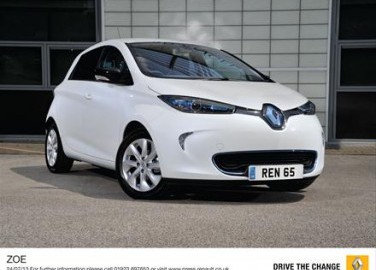
Renault and VW win electric What Car? awards
The What Car? Car of the Year Awards 2016 saw prizes awarded to the Renault Zoe and Volkswagen Passat GTE in the electric car categories.

The Passat Estate GTE scooped the overall Best Electric Car prize, along with winning the Best Buy £20,000-£40,000 category. Meanwhile, Renault’s Zoe Dynamique Nav Rapid Charge took the Best Electric Car for less than £20,000 title for third year running.
The judges said of the Passat GTE:
“This really is the kind of hybrid you could use every day without even thinking of it as an EV. The Passat GTE mixes a 1.4-litre turbocharged petrol engine with an electric motor and VW’s six-speed DSG automatic gearbox, and it shifts between the two power sources smoothly.
“The interior quality is every bit as good as on other Passats, there’s enough room for five adults to sit in comfort, and our preferred edition, the Estate, has a boot that’ll take all but the largest loads. Best of all, the Passat Estate GTE makes a great potential company car choice thanks to its official CO2 emissions of just 39 g/km and a benefit-in-kind tax rate of 5 per cent. It’s easily the best family hybrid we’ve seen to date.”
Commenting on the decision to give ZOE the award for a third consecutive year, Jim Holder, Editorial Director, What Car? said:
“The Renault Zoe was our favourite electric car for less than £20,000 a year ago, and tweaks to the specification and the added ability to go further have only increased its appeal. The Zoe’s main strength is that it feels like a conventional, stylish, nippy small car that happens to cost pennies to run.
“The electric motor has enough shove for the Zoe to lead the charge away from traffic lights, and the cabin seats four in reasonable comfort. Even the boot is larger than you’ll find in many regular small cars – easily big enough for a week’s shopping.”
Read more: Next Green Car
EVChallenge – Renault ZOE
We set three Netmums bloggers challenges to see if ultra low emission vehicles worked for them. In this video, we gave Penny, who blogs at Parent Shaped, a Renault ZOE and asked her to find as many local chargepoints as she could in an hour. Watch to see how easy Penny found it to charge on the go. Watch all our bloggers take the #EVChallenge: bit.ly/1ZMS1CC
https://www.youtube.com/watch?v=k0KUkt_2h68
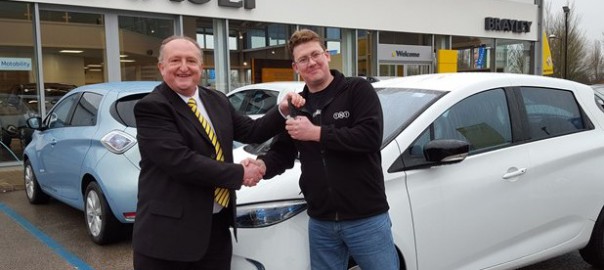
Record sales of electric cars in Milton Keynes
The popularity of more sustainable transport among Milton Keynes residents continues to grow, boosted by record numbers of plug-in electric car sales in the run up to Christmas.
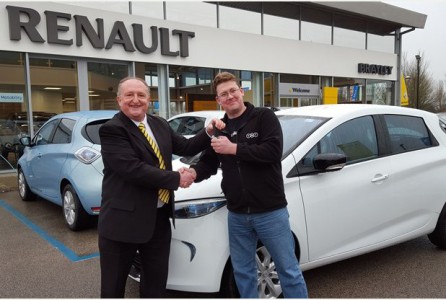
That’s according to Westcroft based dealership, Brayley Renault, which reported more than 30 sales of the 100 per cent electric Renault ZOE in December alone, a record for a single month.
The surge in electric cars on the roads of Buckinghamshire reflects the national demand for more environmentally friendly motoring.
Plug-in electric car registrations in the UK totaled 20,992 units during the first nine months of 2015, consisting of 6,951 pure electric cars and 14,041 plug-in hybrids.
Figures from the Society of Motor Manufacturers and Traders show that total registrations during this period increased by 140 per cent from the same period in 2014, with all-electric car registrations growing 55 per cent year-on-year.
One of eight national pilot projects set up by the Government to explore and encourage the take-up of electric vehicles, the Milton Keynes Plugged-In Places Scheme now consists of more than 200 charging points in Milton Keynes and across the county.
A quarter of these are rapid charging stations, enabling a full charge in just 20 minutes. A number of local rail stations have also installed charging points and offer discounted parking fees for electric vehicles.
Paul Brayley, managing director of Brayleys Cars, said:
“Our Renault dealership in Westcroft has seen significant growth in enquiries and sales of all-electric vehicles as people become more aware of their environmental credentials, low running costs and excellent driving characteristics.”
Source: One MK
RENAULT ZOE REVIEW
The recent Volkswagen emissions scandal has highlighted the issue of local air quality. The emissions from diesel cars impact badly on local air quality; petrol cars aren’t as bad, but they still have emissions. However pure electric cars have zero tailpipe emissions, and so are ideal for use in our congested urban areas. The Renault ZOE is also a compact size for city driving – so surely it must be the perfect city car?
The ZOE is a stand-alone model that’s only available as a pure EV. Although it’s a compact five-door supermini, it still has five seats – and a decent boot. The rear seats even fold flat to provide an increased load space. We think it looks good, inside and out; it’s simple, stylish and modern. With many functions controlled by the touchscreen, the dashboard has the minimum of fuss.
In terms of the technical stuff, the ZOE has a 400V, 22 kWh capacity lithium ion battery (which weighs 290kg) and a 65kW (88hp) synchronous electric motor. It also has a ‘Chameleon’ charger, allowing the ZOE to be charged at different power levels using the same socket, enabling drivers to take advantage of a wide range of charging points. Charging time from a 3 kW (single-phase 16 A) wall box is around 9 hours. If three-phase charging is available, then a 32 A 22 kW charge point can provide an 80% battery charge in one hour, or a 43 kW 63 A charge point can give an 80% battery charge in just half an hour.
Read more: Green Car Guide
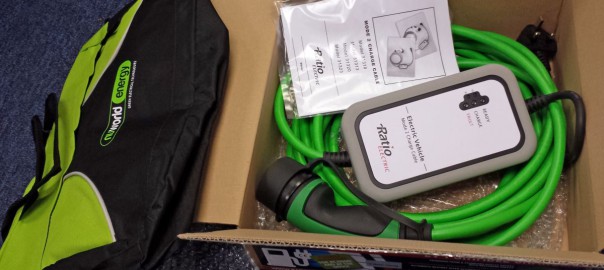
Electric Vehicle Home Charge ‘Granny’ Cable
The Renault ZOE is unusual amongst electric cars in that it doesn’t come with a 13 Amp home charge lead as standard, a so-called ‘granny cable’. There are two likely reasons for this: firstly, the ZOE’s on-board Chameleon charger is less efficient at lower powers, which is the reason Renault insists on only funding higher power home charge points (32A rather than 16A). Secondly, it’s a simple fact that the ZOE’s 13A lead is rather pricey – at about £500 for the official Renault cable.

I didn’t order one originally with my ZOE and for a long time was rather sceptical of the benefit of it (I guess ‘you can’t miss what you haven’t had’). It takes a long time to charge (8-10 hours), more than twice as long as the home charge point, so I could never see myself getting much use from it. However, bad experiences with using public charge points when away from home, particularly a fateful Christmas Day, changed my mind. I eventually bought one ‘just in case’ and have had some good use out of it when spending long periods with relatives, in particular while visiting parents and in-laws.
I bought mine from nuWorld Energy (trading then as nuCharge, now as ChargedEV). It is a standard Type 2 cable so as well as the ZOE it should fit most non-Japanese (i.e. non-Type 1) electric cars such as the Volkswagen e-Golf, BMW i3, etc. There were two options: 5m long for £372 or 10m for £414. I went with 10m to make it easier to reach a socket when visiting relatives, and also bought a storage bag. They claimed 5 working days for delivery, though I had to wait more than a month for mine due to supplier issues.
The cable turned out to be a Ratio Electric product; it has a Type 2 connector at the car end, a three-pin ‘13A’ plug at the house end, and a waterproofed electronics box a short distance from the house end. It has the flexibility of being able to charge at 6A, 10A or 16A, with the selection made by a button on the side of the electronics box. The cost of this flexibility is that you need to manually set your preferred charge rate (up to the level available from the socket you use). The ZOE appears to start charging at 6A but in fact the battery level never goes up – it needs to be set to at least 10A to work.

This means that sometimes you have to awkwardly plug in at the house end, plug in to the ZOE, then dash back to the house to select the 10A setting before it times out and tries to charge at the default of 6A. Another awkward thing is that the electronics box is rather heavy, so when using any socket a distance off the floor it hangs down and can exert a significant force on the plug.
However, despite these minor issues, it has never failed to charge when connected to a good supply, and I have no regrets about purchasing it. Further, the 10m length option – something not available from most suppliers – has been a godsend. It doesn’t just allow for reaching sockets that might otherwise be unobtainable, but also provides the simple convenience of charging on a drive while parked behind the homeowner’s car (and so not requiring it to be moved out the way).
I have now used the cable a number of times, and I intend to write further about it (and give more details of the rate of charge).
(Update: next part here)
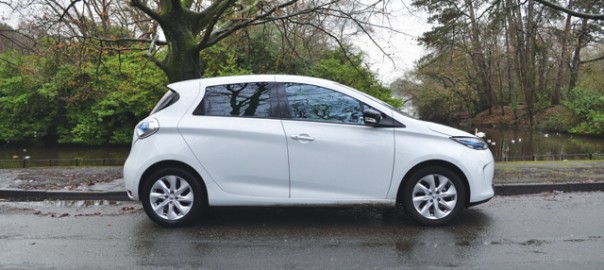
Renault ZOE R240, VAB Family Car of the Year 2016
In the 29th Family Car of the Year Awards run by the Belgian automobile association VAB, journalist and family juries voted Renault ZOE R240 top in the electric vehicles category.

For the 2016 edition of its Family Car of the Year Awards, the Belgian automobile association VAB specified a 30-kilometre increase in the minimum “electric power” range required for vehicles in the “electric” category.
As well as running against other all-electric vehicles, Renault ZOE R240 was also competing with plug-in hybrid vehicles and electric vehicles with range extender.
With both juries (25 motoring journalists and 78 families) giving the car top ranking, ZOE R240 finished with 159 points in all, ahead of the Mercedes B250e (with 154 points) and Kia’s Soul (with 147).
The professional jury of motoring journalists praised ZOE’s “roomy interior, bold design and unbeatable price”, noting that “affordable pricing and long range are making Renault electric vehicles an attractive proposition for more and more people”. The family jury expected “a real breakthrough for ZOE R240, a truly affordable vehicle” and saw it as “an eminently practical choice of second vehicle, with its extensive equipment and large boot”.
The unofficial children’s jury appreciated “the neat bodywork, the smooth ride, the comfortable rear seats, and the pretty lights”.
Renault ZOE R240
Powered by the R240 unit, Renault ZOE boasts a range unparalleled in the all-electric segment: 240 km (NEDC standard), which is 30 km more than with the Q210 power unit. Renault engineers have improved the motor efficiency by optimizing the electronic control system. Higher efficiency means lower electricity consumption with no performance penalty.
The R240 power unit also brings a 10% reduction in ZOE’s charge time under most usage conditions. As well as extending the ZOE range, Renault engineers also upgraded the Caméléon charger to reduce the low-power charge time. The new Caméléon charger is especially efficient on charging stations from 3 to 22 kW, which account for more than 95% of the vehicle charging infrastructures currently in operation.
Source: Automotive World