Category Archives: Electric Cars

News and reviews of the latest electric cars (full electrics and plug-in hybrids).

Nissan Leaf in one of the OU electric vehicle scheme parking spaces (Image: T. Larkum)

Open University Electric Vehicle Research Study

EV Study venue, the OU Berrill Building (Image: T. Larkum)

In November I was invited to attend an Open University Electric Vehicle Research Study. I came across it online, plus friends who know I am an EV driver had also told me about it.

The study is being conducted by researchers from the Open University’s Ubiquitous Computing and Sustainability Lab, part of the OU’s Centre for Research in Computing. Their aim is to design interactive in-home technologies to help people better understand and manage energy issues of electric vehicles. In particular this study will investigate how an electric vehicle can fit among household energy practices and activities.

The first stage of this study is an interview, and I was happy to visit the OU campus at Walton Hall in Milton Keynes. There in the Berrill Building we talked about my experiences with an electric car, and having solar panels on my home, and my general energy usage/behaviour.

Nissan Leaf in one of the OU electric vehicle scheme parking spaces (Image: T. Larkum)
Nissan Leaf in one of the OU electric vehicle parking spaces (Image: T. Larkum)

While there I noticed that there were electric vehicle charge points in the car park outside, and one was occupied by a Nissan Leaf. However, they are part of an EV Membership Scheme and are not directly associated with this study.

I wish the Lab good luck with this project, and will report on its results when they are published.

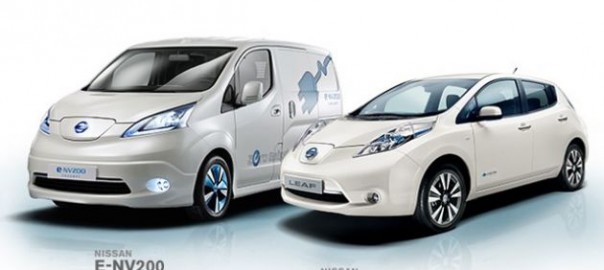
Nissan e-NV200 electric van and Leaf electric car (Image: Nissan)

Nissan – ULEV manufacturer of the year

Nissan has been named Ultra Low Emission Vehicle (ULEV) Manufacturer of the Year at the Energy Saving Trust’s Fleet Hero Awards.

The brand picked up the honour for its ongoing leadership of the ULEV sector in the face of growing competition from other carmakers.

The awards judges were impressed that the pioneering 100 percent electric Nissan LEAF – the world’s bestselling electric car – is becoming ever more popular with fleet operators and business car drivers everywhere.

And they applauded Nissan’s continued commitment to electric vehicle technology with the launch earlier this year of the all-electric e-NV200 van, a vehicle with the potential to revolutionise the commercial vehicle sector.

Next Green Car were equally impressed with the e-NV200 which won the Next Green Car Awards LCV category earlier this year.

Philip Sellwood, chief executive of the Energy Saving Trust, said:

“The Fleet Hero Awards is one of the key events on the sustainable transport calendar and they go from strength to strength each year.

“This year’s winners show just what is possible for running efficient fleets and supplying innovative products and services. They are the pioneers setting the standards for others to follow.”

Receiving the award at a ceremony at the Institute of Directors in London, Barry Beeston, Corporate Sales Director at Nissan Motor (GB), said:

“We are absolutely delighted to have been honoured in this way by the Energy Saving Trust.

“The LEAF and the e-NV200 have picked up dozens of industry awards between them but this award is particularly special as it recognises the contribution Nissan has made to the success of electric vehicles in the UK and our ongoing commitment to providing the fleet sector with desirable and practical vehicles which offer a simple and cost effective solution to lowering emissions.”

Source: Next Green Car

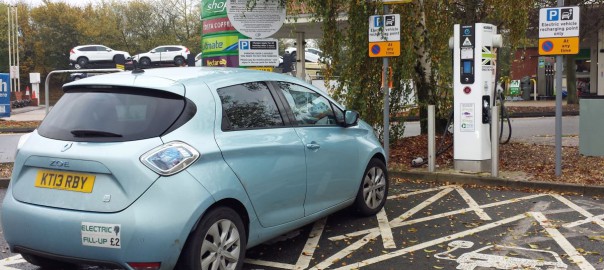
ZOE rapid charging at Chieveley Services (Image: T. Larkum)

300 Miles in a Day

ZOE rapid charging at Chieveley Services (Image: T. Larkum)

In October I managed, for the first time ever, to drive 300 miles one day in my Renault ZOE. I like to think that puts me in the ‘elite club’ of long distance electric car drivers!

Of course, I’m not the first ZOE owner to join – at least two other members of the MyRenaultZOE forum (Timbo and Surya) beat me to it. Nonetheless, I consider it an important personal achievement, more significant than my previous record of 360 miles in a weekend.

It’s not just that it was a good distance but that it was actually done on a business trip. With an electric car I travelled half the length of the country, arrived on time for a series of business meetings beginning at 1030, and drove back home afterward. All without drama – though undoubtedly with a debt of gratitude to the excellent rapid-charging infrastructure we have in England.

Itinerary on Google Maps (Image: T. Larkum)

I left home in Northampton at about 6.30am (marked ‘A’ on the map) and the first stop was at Stony Stratford (‘B’) near Milton Keynes to pick up a colleague. We headed south down the M40 then A34 towards our destinations in Southampton and Portsmouth.

I had originally planned to charge at Peartree, near Oxford, on the A34 but it was out of action so we went to Plan B and carried on to Chieveley Services (‘C’). Filling up took no longer than a typical coffee and loo stop and we were on our way again.

I had hoped to charge again before Southampton but time was tight so we went straight to our first meeting (‘D’), and then on to another meeting in Portsmouth (‘E’). Rather than risk a drama heading back up low on charge, I decided to top up at IKEA (‘F’) in Southampton.

Pluggin in at IKEA Southampton (Image: T. Larkum)
Plugging in at IKEA Southampton (Image: T. Larkum)

This turned out to be the only pain of the day – by this time it was evening rush hour and we wasted a lot of time stuck in traffic on the way there. Having charged, however, it was then just a simple case of retracing our steps back up north. We did another coffee and loo stop at Chieveley, then we drove to Stony Stratford, and then I drove the last leg back to Northampton.

Sharing Chieveley with a Nissan Leaf (Image: T. Larkum)

I got back home having driven about 280 miles. Following some local errands and other driving I finally put the car back in its garage, and on charge, having driven nearly 303 miles since leaving earlier that day.

303 Miles in a Day (Image: T. Larkum)

It was great to have driven so far in one day on electricity, and producing no emissions, for a fraction of the cost of a fossil fuel car. The initial charge was on Economy 7, and all the public charges were free courtesy of the Ecotricity network. Even better, all the electricity used was renewable, again courtesy of Ecotricity.

Best of all, I was able to claim a mileage allowance for the business trip from my employer. I was paid at a standard rate of 40p per mile, so actually received £112! A good day all around.

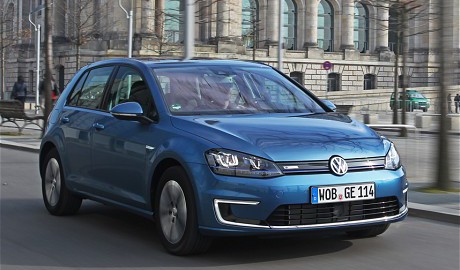
VW e-Golf (Image: Telegraph)

Volkswagen e-Golf versus Golf GTE

Volkwagen’s attempt to take on electric car rivals comes in the form of the e-Golf and Golf GTE

Electric cars remain a hot topic, so the chance to drive VW’s battery-electric e-Golf and its plug-in petrol/electric hybrid, the Golf GTE hot hatch, was interesting on several fronts.

There’s a crushing logic behind both of these eco cars, which is that the Volkswagen Golf has been Europe’s best selling car for the last two years. In 2013 the Golf’s 470,229 sales beat the second-placed Ford Fiesta by more than 60 per cent. So why fiddle with a winning formula for an electric future, when you can just pop in an alternative hybrid or battery electric driveline?

So the e-Golf and Golf GTE look like a standard Golf and mostly drive like one too. In the e-Golf you climb into a remarkably standard-looking cabin, engage Drive on a familiar looking gearstick, and stare at a standard-looking instrument binnacle, with a circular battery-usage meter in place of a rev counter. There’s a bit of creep built into the drivetrain to help when parking, but VW claims creep reduces overall range by between 1.2–3.1 miles, so it cuts out for prolonged brake stops or at speeds over 6.2mph.

Regenerative braking is not handled by the steering-column paddles as it was on the prototype we drove last year, but instead on the gearlever, which is neither as responsive nor as “special” as those paddles, which were dropped for cost reasons. So regen braking is shifted in four stages, with the ultimate, “B”, making the car drive like BMW’s i3 with full brake regeneration when you lift off the throttle – the brake lights go on in all but the mildest regen setting.

There are three main modes of travel: standard Drive, Eco and Eco+, which progressively limit the engine’s power, dull the throttle response and limit the air-conditioning. In standard mode and in the city, the e-Golf feels brisk enough (although the GTE is a lot faster). The ride on Berlin’s streets is mostly supple although the low rolling resistance tyres smash through potholes and there’s a bounding eagerness about the chassis over bumps. The steering is light and inert and the air-con is perfectly adequate although it eats into the range.

The GTE rides a little more harshly, but that fits its sporting credentials since this petrol/electric plug-in hybrid makes a combined 201bhp/258lb ft, which makes for a pretty quick car – 0-62mph in 7.6sec and a top speed of 138mph. Fuel consumption is quoted at 188mpg, but think 150mpg in urban use where the braking energy is saved in the battery; less on a long run.

The six-speed DSG transmission feels responsive, the steering is better weighted and the ride is more consistent than the e-Golf, but you do feel the 1.5 tons kerb weight of both cars as you turn into corners.

The interior is pretty much as the standard Golf GTI with blue instead of red flashes. Electric-only operation has a range of just 31 miles, the standard petrol/electric mode has a quoted range of 580 miles and there’s also a GTE setting on the dash, which sharpens throttle response and gives a more fruity exhaust note.

As well as its electric motor, the Golf GTE uses a petrol engine

It’s a pretty straight forward choice if you only have one car in the household: go for the hybrid GTE. It has good real-world performance and economy and a quoted range of 580 miles. It takes just 3.5 hours to recharge and your fleet manager and benefit-in-kind tax bill will enjoy its 35g/km CO2 emissions. And, since this driveline is already used by Audi and will be by Seat and Skoda, it should be reasonably reliable and economical to maintain.

Where the battery e-Golf scores is if you need a second or third car for mainly urban use and have access to charge facilities at home and at work. Recharge times are long off a household supply and the range is limited, but as an urban runaround it’s convincing, if not overwhelming.

Source: Telegraph (April 2014)

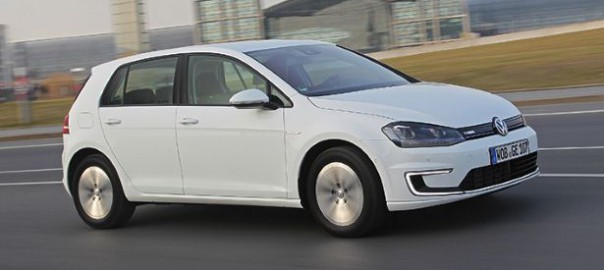
VW e-Golf (Image: Top Gear)

First drive: VW e-Golf

We take a spin in VW’s all-electric hatch. Is this, finally, an EV that makes sense for normal people?

What is it?

It’s the first-ever Golf to entirely do away with that old-school notion of an internal combustion engine. The e-Golf is instead propelled solely by an electric motor, fed by a battery pack, sending 113bhp to the front wheels. It’ll get from zero to 37mph in 4.2 seconds, to 62mph around six seconds later, and top out at 87mph. Prices start at £25,845 (including government EV subsidy) when it lands in the UK this summer.

It doesn’t sound very fast.

Honestly, in real-world driving, the e-Golf feels not only faster than those figures would suggest, but fast full-stop. There’s a fabulous slug of torque available from standstill – 199lb ft, no less – which gives the e-Golf a proper kick away from the lights. There’s so much twist on tap, in fact, that it’ll even spin its wheels if you get too lairy on the throttle.

Speaking of throttles, VW says its electric motor will turn your twitch-of-right-foot into torque at the wheels five times faster than a conventional petrol engine. Which means this thing has seriously pokey responses. Spot a gap, prod accelerator, be there. It’s not quite driving as we know it, but it’s rather lovely all the same.

Does it have that weird regen braking?

Yes, but you can alter the aggressiveness of the energy capture system, from almost non-existent to hauling you to a pretty rapid standstill as soon you lift off the throttle. The latter mode requires something of a recalibration of your brain and right foot, but once you’ve acclimatised it makes a lot of sense around town, and means you virtually never have to actually hit the brake pedal.

But if you don’t like it, you can dial out the effect of the regenerative braking, at which point the e-Golf feels like, well… like every other Golf: refined, solid, nice to steer, with all the VW nav/music/interior goodies we’ve come to expect. And, of course, it’s incredibly quiet, the only peep from the drivetrain a faint sci-fi whine at motorway speeds.

How far will it go on a charge?

VW quotes a range of 118 miles – claiming that its Golf is around 30 per cent more energy efficient than competitors such as the Nissan Leaf – but as ever with EVs, it depends how you drive.

In a mix of passably sensible urban and dual-carriageway stuff, we got just under 100 miles from a charge. Crank up the air con and attempt a triple-digit autobahn charge and you can half that figure. But that’s rather what the e-Golf does, in a gentle, non-sanctimonious way: makes you question exactly how much energy you really need to munch through.

Do you actually need full-blast air con (minus 15 miles from your range), or could you just open a window? Do you need the full 113bhp on tap when you’re crawling through traffic, or could you drop your Golf into ‘Eco’ or ‘Eco+’ mode, dialling down the power and increasing range yet further? It’s not how TG has traditionally sought its thrills, but it’s strangely addictive nonetheless.

On the subject of range, tell me about the battery.

It’s a posh lithium-ion job, with a 24.2kW capacity and a weight 318kg. That mass has no ill effect on handling, however, as the battery pack is tucked down between the axles, effectively under the passengers’ feet.

Doesn’t that mean there’s nowhere to store your feet?

No, legroom is identical to that of the normal-engined Golfs. Space for a battery pack was engineered into the MQB architecture from the start, so there’s no compromise to package the e-Golf’s electric gubbins. As you’d expect from VW, this is no bodge-job: every one of the Golf’s components has been optimised to consume as little energy as possible. It’s slippier, too, than the standard car, with a drag coefficient of 0.28 against the diesel Golf’s 0.31.

So should I buy one?

As ever with EVs, it depends what you need from your car. A realistic range of 100-odd miles is far more than enough for most day-to-day commuting needs, and equates to some dirt cheap motoring. VW reckons that, with the right energy tariff, you’ll pay around 5p per mile for your electricity: if TG’s maths is correct, a petrol car averaging 30mpg will cost you around 15p per mile at current UK fuel prices.

But if you’re regularly schlepping from Birmingham to Cornwall, the e-Golf won’t work for you: though it can be 80 per cent fast-charged in just 30 minutes, you’ll need 13 hours to brim the battery at home. And, of course, that requires a driveway, or at least a parking space with convenient power socket: your local constabulary might not be too happy about you dangling a flex from your third-storey flat to the street below.

But if the glove fits, by all means wear it. The e-Golf is an EV that works not just for urban statement-makers, but for most of us, most of the time. With the possible exception of the Tesla Model S – which is aimed at a very different end of the market – it’s the most convincing electric car ever made.

Source: Top Gear (March 2014)

Electric Car Recharging

How Much Range Do Electric Cars Need?

Car buyers consider many factors before making a purchase – including comfort, style and efficiency. If they were honest and realistic about how much they drive, a majority of consumers inclined to purchase electric vehicles would choose battery-powered cars that can travel fewer than 100 miles on a full charge, new research finds. And according to the same study, that statistic isn’t likely to change unless battery costs drop dramatically, despite the drastic change that represents from gas-powered vehicles.

Tesla’s Model S has a range of up to about 300 miles on a fully charged battery, and a luxury car price to boot, but most electric-car models can travel no more than about 100 miles on a full charge. The new research finds that most customers will find the 100-miles or less category adequate to meet their daily driving needs, given battery costs now and in the likely near future. This is based on data that shows how far people actually drive each day.

Customers may prefer cars that are capable of driving hundreds of miles without stopping, but they may only rarely need that extra range. It may be more cost-effective to use one car for daily commutes and rent another vehicle for long trips.

However, a sticky question remains: Can car companies count on customers to purchase cars based only on economics-based considerations? Probably not, say other researchers. And, based on plans made available publicly, car manufacturers appear to agree with them.

Zhenhong Lin, a senior researcher at Oak Ridge National Laboratory in Tennessee, was trained as an engineer and now analyzes the economics and public policies related to transportation energy. His study in the journal Transportation Science, released in August, explored the multiple factors behind customer choices, including how far people actually drive on a daily basis, the variation in their driving patterns and how battery costs would have to decrease to promote electrically powered vehicles with longer ranges.

Range Issues

With gas-powered cars, driving range isn’t really an issue. A car that gets 30 miles per gallon and has a 14-gallon gas tank can go over 400 miles without refueling. And if you are about to run dry, it’s easy to find a place to fill up.

Electric vehicles don’t use gas at all – unlike a traditional Toyota Prius or other hybrid, in which various energy-capturing technologies charge an electric battery that then applies that energy to help move the car. Nor do electrics have backup gas engines like plug-in-hybrids do – this category includes one version of the Toyota Prius, the Chevrolet Volt (= Vauxhall Ampera), and others. For plug-in hybrids, the gas engine usually kicks in after a battery powers the first several to couple of dozen miles, depending on the particular model.

The longest range for an electric car is the 400 miles reported for the $100,000-plus Tesla Roadster, after a recent battery update. Most mass-market electric vehicles usually start at about $30,000. Rebates from both the federal and state levels can reduce the cost by thousands. Most of these cars boast ranges of fewer than 100 miles, including the Nissan Leaf, among others. Electric vehicles cost more than their gas equivalents, and there are far more gas stations than electric-charging stations if a driver needs to stop to top up the car’s battery. Most hybrids and plug-in hybrids have ranges similar to cars powered entirely by gas.

Read more: Inside Science

Renault ZOE: Commuter Road Test – Eddie

  Eddie Pictured standing in front of the Renault ZOE

Eddie Pictured standing in front of the Renault ZOE

Retired accountant Eddie Dewson knows how to crunch numbers and make them add up, which is why he was first attracted to the Renault ZOE. A £5000 Plug-IN Car Grant from the government means the ZOE is more affordable than many of its petrol- and diesel-powered rivals, so the cost of the ZOE was already appealing to Eddie.

When Eddie then looked at the standard specification of the ZOE Dynamique Intens, it didn’t take a calculator to work out how much better kitted out the Renault is next to its rivals for the same price. He notes: ‘The ZOE has a very high spec, which includes a reversing camera and air conditioning that is excellent thanks to the powerful fan – something you need for driving in and around London.’

However, 71-year old Eddie isn’t so easily swayed by the equipment list and wasn’t a senior accountant for a global company without looking at all of the facts and figures before making his decision.

‘I was really intrigued by the possibility of charging the ZOE at home,’ says Eddie. ‘We’re lucky to have a driveway and off-street parking at home in Reigate, so having the Wallbox fitted for free made complete sense. When you look at the cost of charging the ZOE overnight with off-peak electricity, it really starts to make a big difference to running costs.’

This is a big consideration for Eddie and his wife Marie. As very active and involved grandparents, they spend a lot of time driving into London to see their kids and many of their 10 grandchildren. Initial worries about the range of an electric car were soon dismissed by Eddie as he started to drive the ZOE and he found the range on a full charge was more than enough to drive into and around London and then back home on a single charge.
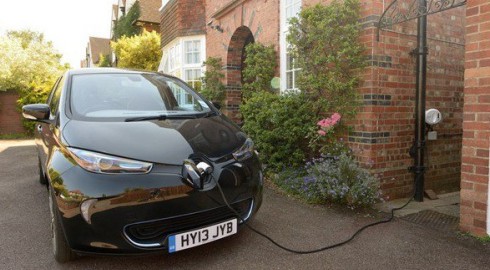
A shot of the Renault ZOE charging in front of houseA shot of the Renault ZOE charging in front of house

Eddie says: ‘Charging the ZOE couldn’t be simpler at home. Just plug in the socket and the car does the rest. In the morning, it’s ready to go and it’s great being able to step into a car that’s already at the right temperature to cope with the weather, hot or cold, thanks to the pre-conditioning offered with the ZOE.

‘I also found the range wasn’t affected much by using the air conditioning, so trips into London are easy. If I do need to top up the charge, there are loads of charging points all over London and the Renault’s R-Link made it easy to find them.’

As a keen driver, Eddie enjoyed the ZOE’s zesty performance and comments: ‘There’s surprisingly strong acceleration off the mark and the Renault is happy to cruise on the motorway too. You certainly don’t notice any lack of an engine other than how quiet the ZOE is compared to other cars. Even using the performance, though, the battery doesn’t run down and with the regenerative braking that gets a lot of use in London traffic it’s easy to maintain the range of the car. It’s also fun to drive the ZOE in any kind of conditions and on any road, so it just works as a great car regardless of what sort of power it uses.’

With the performance to Eddie’s liking, how does it fair with his grandchildren? ‘They loved it,’ smiles Eddie. ‘Not just because it’s different but because it looks good and there’s plenty of space in the back seats and boot. It’s easy to fit three kids in the back seat safely, which is perfect for taking the grandchildren out.’

Eddie also notes the ZOE’s doors open far wider than most superminis’ and says: ‘The doors are a generous size and give a large opening. This is important for me as I have restricted movement in one knee, so it’s great to be able to get in and out of the ZOE so easily.’

Along with the practical side of the ZOE, Eddie returns his accountant’s mind to the financial element: ‘When you factor in the ZOE can travel into the Congestion Zone for free, it makes a big difference to the running costs.’

Compare the ZOE to a Volkswagen Polo 1.2 TSI BlueMotion five-door, which is a car any accountant would consider a solid financial bet, the ZOE soon emerges as the winner. Using the HonestJohn Fuel Calculator for Eddie’s 10,000-mile per year driving, we can see the more expensive Polo would cost more than £2000 per year more than the ZOE with the cost of paying the Congestion Charge included. Even without this cost, it would take the Polo 18 months just recoup its higher list price next to the ZOE’s.

Those are just the sort of figures to make any accountant smile, but what really impressed Eddie the most was the overall ability of the ZOE. When it comes to the crunch, the Renault ZOE adds up.

New car road test: Renault ZOE

Renault’s ZOE aims to provide an affordable solution to those who quite like the idea of a practical electric car. Andy Enright reports (August 2014).

BACKGROUND

IF you’ve ever hankered after an electric car, there might have been a few impediments to an impending purchase. The first wave of electric cars looked nothing more than mobility scooters. Never a good look. Then came a second generation of vehicles that looked more like cars but which carried price tags that read like a bad joke. Electric cars were either cheap and horrible or expensive and barely adequate. Renault, with its fun Twizy lightweight city car, the Fluence Z.E. saloon and even a battery-powered Kangoo van, is looking to change that. Other manufacturers may offer an electric model, maybe two, but Renault is going all-out on this one. The best and most relevant of the lot so far looks to be its ZOE supermini.

DRIVING EXPERIENCE

The ZOE is designed for city driving so the steering has been geared to offer a smooth, effortless feel. Likewise, the throttle pedal doesn’t offer too much in the way of resistance but the brake responds to a good hoofing, which seems a little odd at first. Like all electric cars, the ZOE feels eerily quiet as it pulls away, with no discernible engine noise other than a faint whine. This usually means you’ll hear every bump and thump from the road, though Renault has done a good job on chassis refinement and the ride quality is excellent. To prevent pedestrians waltzing out in front of its silent approach, the ZOE emits a sound at low speeds but you can barely hear it at all inside the vehicle. This “Z.E. Voice” can be switched between three different sounds or completely switched off.

Handling is as good as you’d imagine for a car with such a low centre of gravity. The synchronous electric motor with rotor coil has a power output of 65kW, equivalent to 88hp, and instantly delivers maximum torque of 220Nm. Acceleration and pull-away are responsive from low speeds, while its top speed is limited to 84mph.

DESIGN & BUILD

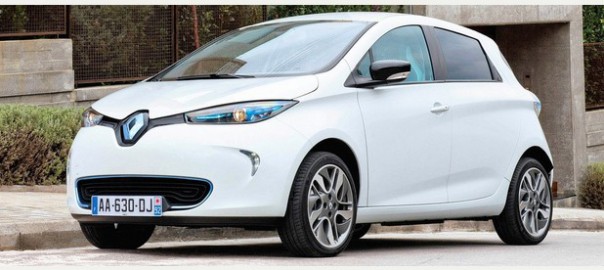
Remember this moment, because it might just be the time that electric car technology finally flirted with the mainstream. Most people would walk past the ZOE and not take it for anything other than Renault’s latest cute little car. Rather refreshingly, its design inspiration doesn’t appear to be a Jolly Cab from Total Recall.

Instead, it’s pertly styled with a large underbumper that some have compared to the protruding lip of a surly toddler, but with its curvaceous flanks and neat one-box shape, it’s quite a good-looking thing.

The fascia is decidedly futuristic with a digital strip in place of the traditional clocks and a moulded centre stack dominated by a large colour touch screen. Some of the plastics aren’t going to give Audi designers anything much to think about but being built down to a price is very much the point of this car. It’s no bad thing. The view out is extremely good as you sit rather high but a lack of seat height adjustability might prove an issue for taller drivers. As with most superminis, space in the back is more mini than super but access is good thanks to the standard five-door layout and there’s more than enough room back there for the kids. One substantial plus point is the 338-litre boot, which extends to 1,225 litres by folding the one-piece rear bench.

MARKET & MODEL

The ZOE is offered in three trim levels – Expression, Dynamique Zen and Dynamique Intens – and all feature the multimedia system, R-Link, as standard. Drivers can control its functions without taking their eyes off the road via a 7in display, steering wheel-mounted controls and voice recognition. It also delivers integrated connectivity with motoring services and applications available from the R-Link Store.

Programmable pre-conditioning heats or cools ZOE’s cabin when the vehicle is charging, so when the driver gets into the car, the cabin is just the right temperature and battery charge is saved. As a further neat touch, this can be activated remotely via the owner’s smartphone on Dynamique Zen and Dynamique Intens versions.

The base ZOE Expression comes with an on-the-road price of around £14,000, after the Government Plug-in Car Grant deduction, while the Dynamique Zen and Intens versions cost just over £15,000. You’ll need to add battery hire to that, which comes in from around £70 per month.

Standard equipment on the Expression includes R-Link voice-controlled TomTom satellite navigation, USB input, AUX-in, SD multimedia and Bluetooth, climate control, cruise control, a Renault keycard and speed limiter function. The Dynamique Intens and Dynamique Zen models get automatic lights and wipers, a better stereo, leather trim for the steering wheel, electric rear windows and rear parking sensors. The Intens gets a rear parking sensor and a dark interior finish, whereas the Zen gets a pale interior with Teflon-coated upholstery and an active scent diffuser.

COST OF OWNERSHIP

Once you’ve paid the upfront cost of the car, you’ll still need to budget around £70 per month for the hire of the battery. This covers you for 36 months and up to 7,500 miles per year and adds just over £2,500 to the three-year costs of running the ZOE. This brings with it a bunch of its own calculations. Add the £2 per day additional electricity costs and this would buy you maybe 750 miles of travel per month in a diesel supermini, or to put it another way, more than your ZOE battery hire agreement is buying you.

Renault quotes a 130-mile range but in real-world conditions that will shrink to around 60 miles in cold weather and 90 miles when it’s a bit warmer. Three key technologies assist in giving the car a respectable range; bi-modal regenerative braking, a heat pump and Michelin Energy E-V tyres. Customers also get the clever Chameleon charger. Patented by Renault, it is compatible with all power levels from 3kW up to 43kW. Charging batteries at a charging station can take between 30 minutes and nine hours, with 80% of full battery power achieved within 30 minutes using a Rapid Charger 43kW AC power source.

Where the ZOE scores a knockout blow is if you need to travel into congestion zones. London offers 100% exemption while Westminster Council offers four hours’ free parking and a number of charging points. Renault still hasn’t fully got round the issue that most urban drivers have to leave their cars parked on the street so have no way of recharging from a home power point.

SUMMARY

The Renault ZOE is another step towards the electric vehicle becoming a genuinely practical mode of transport for the average motorist. There are still a number of caveats but most of these are due to the inherent nature of electric vehicles themselves rather than any flaw in the ZOE, which is a likeable little thing and might just be the most attractive electric vehicle currently on sale.

The ZOE is capable of most average commutes but the arithmetic still works out in favour of small diesel superminis on a pure costs basis. The gap is small, though, and many drivers will be willing to pay a small premium for the ZOE’s smooth ride, silent acceleration and feel-good vibe. If it works for you, why not?

Source: Derby Telegraph

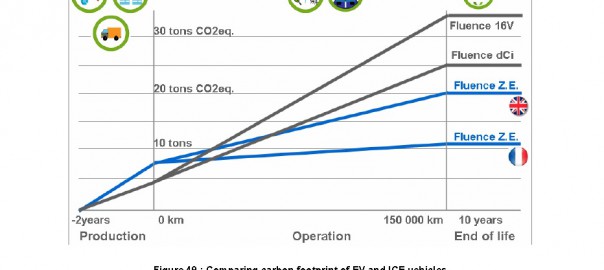
Fluence Emissions (Image: Renault)

Electric Car Life-Cycle Analysis

Renault Fluence ZE Vs Diesel, Gas Models

Fluence Emissions (Image: Renault)

The environmental impact of plug-in electric cars is a source for much debate these days. They use less energy on a wells-to-wheels carbon basis than the vast majority of new cars sold in North America, even if they’re recharged on coal-heavy electric grids.

But the manufacturing impact is greater–and the degree to which that is the case has been hotly debated for several years now. Proper life-cycle analyses of electric cars are hard to do, and expensive.

They require a great deal of careful investigation into the sources of the materials, the transportation of the raw materials and parts before they reach the assembly plant, and then the carbon impact of that assembly process.

Now, however, thanks to a tip from a reader, we’ve got a nice model of a comprehensive lifecycle analysis that compares the electric version of a car to its non-electric counterpart.

The car is the Renault Fluence ZE, the electric conversion of a French compact sedan not sold in North America. That analysis, titled “Fluence and Fluence ZE: Life Cycle Assessment” (PDF) is now three years old, but it remains an excellent model for looking at gasoline versus electric propulsion.

The Fluence ZE was developed specifically for the now-defunct Better Place project in Israel, which proposed to sell electric transportation by the kilometer, just as mobile-phone service is sold by the minute. That project collapsed into bankruptcy for a number of reasons, and the Fluence ZE is essentially a defunct model – although it lived on for a while longer in Korea as a Samsung vehicle.

But the analysis done by Renault concludes that the Fluence ZE has lower lifetime carbon emissions than either a diesel or a gasoline Fluence, not only on the French grid (which is substantially nuclear) but also the coal-heavy U.K. grid.

While the Fluence ZE is now gone, its legacy lives on in the form of an analysis – one that other automakers would do well to emulate.

Source: Green Car Reports