Category Archives: Electric Cars

News and reviews of the latest electric cars (full electrics and plug-in hybrids).

European Buyers To Skip Over Hybrids, Go Straight To Plug-Ins

While hybrid cars have had a good 10-year run in North America as the most fuel-efficient alternative, Europe never warmed to hybrid-electric powertrains.

With roughly half the passenger cars sold in the European Union being powered by more efficient diesel engines, the difference between hybrid and diesel economy figures was much lower than in the U.S.

While the industry consensus even five years ago was that all makers would have to offer hybrids in notable volumes to achieve carbon-reduction and fuel-efficiency goals, that appears to have changed.

An article in trade journal Automotive News Europe notes that in just four years, European buyers are likely to purchase more plug-in hybrids than conventional (non-plug-in) gasoline-electric vehicles.

Japan’s Toyota still owns more than half of the world’s total hybrid market, led by its instantly recognizable and well-known Prius lineup.

In order, the next high-volume hybrid makers are Honda and Ford, followed by Korea’s Hyundai-Kia and a number of vastly smaller players.

Among those smaller players are virtually all European makers, who have issued small numbers of hybrid variants, only to cancel many of them after only a few years.

Those include hybrid versions of the Mercedes-Benz S-Class, starting in 2009, followed by the BMW 7-Series and then the BMW X6 and Mercedes-Benz ML-Class SUVs.

Today, the only European hybrid model on the U.S. market is the Volkswagen Jetta Hybrid, which sells in far lower numbers than its diesel-engined TDI counterparts in the lineup.

Instead, both European makers and their buyers seem to have concluded that the advantages of plug-in hybrids are far greater.

Read more: Green Car Reports

Inconveniences of Gasoline 1: Gas Station (Image: Clean Technica)

Big Oil To ‘Lose Control Of Auto Industry’

It’s not uncommon for media commenters to look at electric-car sales numbers, only to conclude that the segment is teetering on the brink of death.

Electric cars will never become mainstream, they argue, because of fickle consumers who base their-car purchases on what the price of gas happens to be the moment they walk into a dealership.

Yet while the media engages in a tug of war over gas-price analysis, there are encouraging signs pointing to continued growth of electric-car adoption.

Sales have steadily increased since the Chevrolet Volt and Nissan Leaf first went on sale in December 2010, and the cost of the batteries that power these cars is decreasing.

Those trends inspired the provocative title “Big Oil Is About to Lose Control of the Auto Industry,” for a recent article by Bloomberg (via Charged EVs).

The article promotes the Bloomberg New Energy Finance (BNEF) conference held two weeks ago, where optimism about electric cars was in abundance.

Read more: Green Car Reports

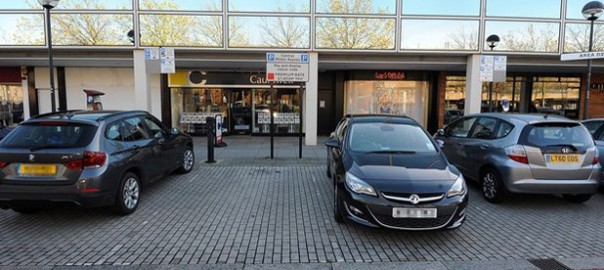
Businesses in Milton Keynes are being given the opportunity to test out electric cars

High demand for free electric car loan to Milton Keynes businesses

After Milton Keynes Council’s electric vehicle partner Chargemaster Plc announced that it was offering a free electric vehicle loan service to Milton Keynes businesses – the company has seen a surge of interest, with the vehicles now being in ‘high demand.’

Chargemaster has a small fleet of electric vehicles (EV) that can be loaned to companies (and their staff) within Milton Keynes to allow them to experience an electric vehicle for themselves and to see what the benefits of electric motoring are.

A Renault Zoe and two Nissan Leafs are available for loan to MK companies. No charges are levied and companies have the free use of over 200 charging points in the Milton Keynes area including 56 rapid chargers which recharge these cars in less than 30mins.

Businesses in Milton Keynes are being given the opportunity to test out electric cars

Loan cars are available typically for two weeks at a time and are subject to availability on a first come first served basis.

Chargemaster require copies of drivers’ driving licences but otherwise there is no formal paperwork to complete.

This is a great way for companies to sample the benefits of EVs for themselves without having to buy a vehicle first.

With over 20 electric cars on the market from manufacturers such as BMW, VW, Audi, Renault and Nissan, there is a lot more choice within the EV market.

Over the next five years it is predicted that EVs are likely to become the mainstream vehicle with virtually every car manufacturer producing either plug-in hybrids or pure electric EVs with increasing range of over 150 miles.

Electric vehicles provide huge benefits such as low fuel costs, quieter engines and low emissions which will improve air quality in the city.

There are also considerable economic benefits for both companies and employees with very low benefit in kind taxes.

For further information contact Trevor via email (sales@fuelincluded.com).

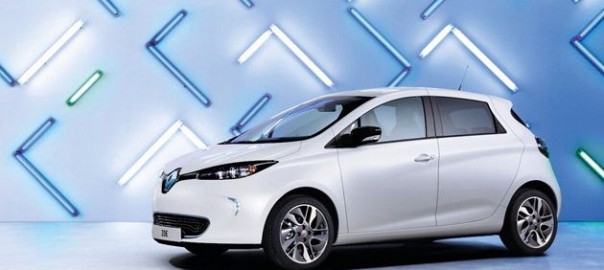
The Renault ZOE will benefit from a 35% discount from 1st April 2015

Renault Cléon announces 100 new jobs to accompany the launch of the alliance’s new electric engine

The Renault Cléon plant will create 100 jobs with open-ended contracts in 2015 as part of a plan announced by Carlos Ghosn on February 12. The plan involves the hiring of 1,000 people in 2015, including 500 in French plants.

More than 50 years after it was built in 1958, the Cléon plant is taking on the production of the all-Renault electric engine, the R 240. Combined with optimised battery management, this engine extends the ZOE’s range to 240 kilometres[1] – a boost of 30 kilometres.

To enable the launch, €50 million were invested from the €300 million earmarked for the plant in 2011. This new technology is part of the Alliance’s electric strategy and will also benefit Renault partners.

100 jobs created

By creating 100 new jobs, the Cléon plant is reinforcing its skills to meet high commercial demand from the Alliance partners. These permanent positions will go to candidates in a range of occupational categories and having varied qualification levels, from vocational training certificates to two-year post-baccalauréat diplomas.

This job creation program follows a training plan developed in 2012, which features approximately 6,000 hours of training in preparation for the production of the R 240. The plan includes general theoretical training on the electric engine for all players involved in the project as well as technical training on the machines, in cooperation with the suppliers, for operators and maintenance staff.

Renault’s acquired electrotechnical expertise serving the alliance

Cléon has been leveraging its experience for a little more than two years with the production of the ZOE Junction Box, the system developed by Renault Technocentre engineers that manages the car’s energy transfers. The Cléon plant has mastered the assembly of electronic modules and gained invaluable experience for the production of the powerful R 240 electric engine. This expertise has made it possible to extend the ZOE’s range to 240 kilometres[1] – a boost of 30 kilometres – and will also benefit Alliance partners.

For the comparable common components of Renault and Nissan engines, the engineering and operating teams drew inspiration from Nissan’s experience in producing the LEAF engine. Cléon also gained from the expertise of local businesses that manufacture electric engines for other purposes.

Recognised industrial activity

The engines and gearboxes produced at the Cléon plant have been a true success which, in the first quarter of 2015, translated into an overall increase in activity and proportionally more business from partners (Nissan, Dacia, Samsung, Daimler, General Motors). These partners accounted for 43% of the plant’s engine and gearbox production in Q1 2015 compared to 37% at end-2014.

In addition to this burst in activity to meet high demand from Renault, Nissan and Daimler, the Cléon plant is also gearing up for several launches. The plant, which already supplies engines and gearboxes for the Trafic, recently delivered the first engines for the Opel version of the van. New vehicles in the Renault range such as the Espace and the Kadjar also benefit from powertrain components produced at Cléon. And the ZOE already features the Alliance’s brand new electric engine, the R 240. These recent and upcoming launches should help increase the site’s manufacturing volumes.

“This is fantastic news for the Cléon plant. These new hires will reinforce Renault’s skills in terms of designing and manufacturing electric vehicles. This activity in France, at the heart of the European market, is part of the Alliance’s electric strategy and will benefit its partners as well.” Stefan MUELLER, SVP Operations, Europe Region.

Key 2014 figures for Cléon:

  • More than 1 million engines and gearboxes manufactured
  • 14,537 tonnes of aluminium parts cast
  • 65% of production exported
  • 63% of production for Renault, with
  • 37% going to other Group, Alliance and partner brands
  • Nearly 20% of production for Nissan.
  • 44% of production for passenger cars and 56% for LCVs

[1] Range measured in accordance with standards in force

Source: Renault Press Release

VW Golf GTE Driven: Is It Really The GTI’s Hybrid Brother?

Imagine the lovechild of a Golf GTI with the all-electric e-Golf and you would be right on the money. The VW Golf GTE is exactly that car, offering a plug-in hybrid powertrain and the thrills of a GTI combined, at least on theory.

What’s what

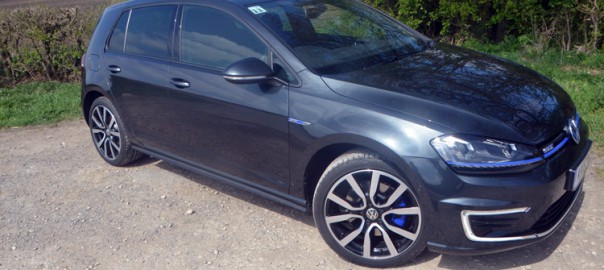
As a true lovechild of its parents, the Golf GTE combines the C-shaped LED daytime running lights from the e-Golf with the GTI’s horizontal fins at the front with every detail painted blue instead of the GTI’s red, even on the iconic tartan pattern of the seats. A standard set of 18-inch wheels dressed with 225/40 tyres complete the sporty appearance of this tech-infested Golf.
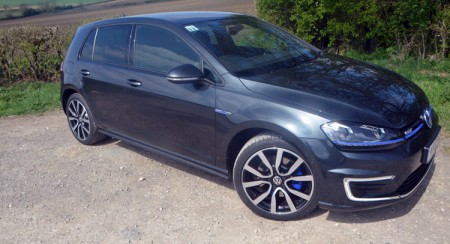
1625_2015-VW_GolfGTE_Carscoops

Under the bonnet we find a turbocharged 1.4-litre 148hp (150PS) TSI engine paired to a 101hp (102PS) electric motor integrated into the specially developed for hybrids six-speed DSG transmission. The combined output reaches 201hp (204PS) and 258lb-ft (350Nm) of torque which propel the VW Golf GTE to 62mph in 7.6 seconds and on to 138mph. But the most impressive figures claimed are about the efficiency of it: 166mpg UK (with the use of the battery, naturally) on the combined cycle and CO2 emissions of just 39g/km.

Plugged-In Details

The 8,7kWh lithium-ion battery is mounted underneath the rear seat and needs three hours and 45 minutes to be fully charged from a domestic mains outlet or two hours and 15 minutes from an optional fast charge wallbox. Depending on conditions, the all-electric range can reach up to 31 miles with the top speed limited to a more than sufficient 81mph.

The driver can choose from five different modes: E-mode, Hybrid Auto, Battery Hold, Battery Charge and GTE. As you might have guessed, the latter is the most aggressive of them all, tuning the powertrain for the best possible performance, while the Hybrid Auto mode proves to be the golden ratio between efficiency and performance.

Just Like A Tesla (Sort of)

When in E-mode, the Golf GTE feels brisk enough to tackle the usual city driving; put your right foot down and the 101hp electric motor pulls strongly the GTE in total silence, thanks to its instant torque reserves which are rated at a maximum 243lb-ft (330Nm) from a standstill with a continuous 125lb-ft (170Nm) on offer. Combine this with the direct steering and you have a fun zero-emissions car around the city. The real-world electric range is closer between 20 to 25 miles with the petrol engine stepping in when the battery levels are running low.

It’s when you take it outside the city limits that you start to really notice how smooth the driveline and how refined the collaboration between the two motors is, that makes the Golf GTE feel almost conventional, despite the crazy tech that goes under the skin. And that’s a compliment.

During our short drive on a mix of country roads and city driving we managed an average of 74mpg UK (equal to 61.6 mpg US and 3.8l/100km), which is a long way from the 166mpg UK (138mpg US or 1.7l/100km) official figure, but still remains an impressive result.

Does It Drive Like a GTI?

Not quite. Although it gives you the same, great confidence Golfs are known for, the GTE is unfortunately not the hybrid alternative of the GTI, but that’s not necessarily a bad thing. You can drive it fast and have a good time behind its wheel, especially with the GTE-mode engaged, enjoying the most balanced Golf chassis of the range due to the rear-mounted battery pack but the handling never comes close to that of the GTI’s. And there is one good reason for it: weight.

There is no escape from the inertia created by the GTE’s 1599kg kerb weight (including a 75kg driver). The battery pack alone adds 120kg to the sum, albeit it sits low in the chassis. But for the nature of it, the Golf GTE is a fun car to drive, certainly the most entertaining of the hybrids, with direct steering, solid performance and a nice ride too. You even get a miniature rev-counter for the petrol engine inside that always weird tachometer which shows whether you are draining or charging the batteries, going up and down like crazy during spirited driving.

To Sum Up

If you are looking for the same driving thrills of the Golf GTI, you’d be disappointed, but that’s more the marketing’s fault than the model itself. Because the VW Golf GTE offers one of the most capable hybrid powertrains in this price bracket, coupled with top levels of refinement and solid performance. It makes a great choice for those who want to try an electric vehicle but don’t want to suffer from the inevitable range anxiety and the usual bluntness. The main negative point is the price, with the VW Golf GTE starting at £33,085 in the UK which goes down to £28,035 after the £5,000 UK Government’s grant for plug-in vehicles and comes packed with kit, including adaptive cruise control, a 5.8-inch multimedia system and LED headlights.
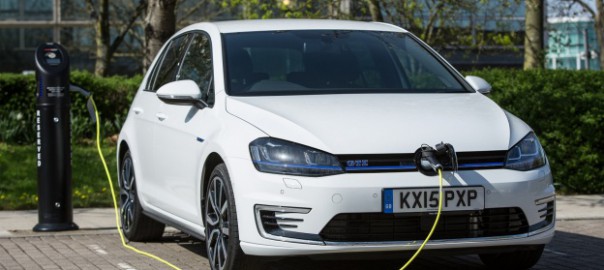
This car uses green technology, not just to reduce emissions, but to go faster

Driving the hybrid Volkswagen Golf GTE

Volkswagen finally makes a hybrid, but will it electrify you?

The Pitch

The Golf GTE is Volkswagen’s first – ha-ha! – charge into hybrid driving, a short 18 years after Toyota’s Prius first apologised onto our streets. They’re late to the party, certainly, but with a compelling sell.

The GTE pairs an 8.8kWh lithium-ion battery powering a 102PS electric motor (bolted cleverly inside the gearbox housing) with a 1.4-litre, 150PS TSI direct-injection petrol engine. Together this somehow adds up to a combined power of 204PS – hmmm – and a theoretical range of 580 miles.

The Battery

Giving a relatively titchy range of 31miles, the battery is charged via a nubbin under the front badge and should take around 3.75 hours from a domestic mains outlet, or 2.25 hours from a bespoke wall box. And here’s the big ticket number: 166. Volkswagen claims a combined cycle figure of 166mpg, while CO2 emissions should be zero in all-electric mode and 39g/km all round, so it’s expected to be exempt from VED and the Congestion Charge.

VW is desperate to position this in the same bracket as its GTi hot hatch. Hence the G and T up front. Indeed, they’re so serious about its GTi credentials they’ve even tailored the seat cloth with the brand’s iconic tartan bum-fondlers. Only in blue. Because blue’s “electric”, right?

This really is the best of all worlds: an electric runabout that’ll whizz you silently and cheaply to work – if you work reasonably nearby – while also an immensely fun hot hatch a spit off GTi performance when you marry the two engines. Wrapped in VW comfort, design skills and build quality. If the complicated engineering combination boasts VW’s legendary reliability, this is an enormously compelling vehicle.

Plus, with a £5k government electric vehicle rebate it’s £4,435 cheaper than a GTi. We know which one we’d rather have.

Read more: T3

10 Best ‘Eco Friendly’ Cars Of 2015

The 10 best ‘eco friendly’ cars of 2015 — as determined by the editors over at the noted vehicle valuation and information source Kelley Blue Book — were recently outlined in an interesting new list.

The top spot for the year was (not completely surprisingly) nabbed by BMW’s all-electric i3 model — following on the i3 grabbing other such honors elsewhere as well, and sitting at the top of all cars in the US in terms of “fuel” efficiency.

image24-e1429804688958_Green_Cars_Kelley

The new list from Kelley Blue Book is part of its yearly practice of compiling a ranking of the most efficient vehicles for the year, across all price ranges and power train variabilities.

“The list of ‘green’ vehicle standouts continues to blossom, and with strict Corporate Average Fuel Economy (CAFE) requirements coming down the pipeline, auto manufacturers are making stronger advancements each year in creating more environmentally friendly vehicles,” stated Jack R Nerad, executive editorial director and executive market analyst for Kelley Blue Book’s KBB.com.

“Topping this list for the second year in a row is the BMW i3 – an electric car that can sprint to 60 mph in just over 7 seconds, and is made in a factory powered entirely by four wind turbines. And if 81 miles of electric range doesn’t work for you, the i3 can be had with a small gas generator that lets you go as far as there are gas stations.”

Other vehicles that were ranked highly by the list include: the Volkswagen e-Golf (2nd); the Nissan Leaf (3rd); the Toyota Prius (4th); the Honda Accord Hybrid (5th); the Tesla Model S (6th); the Chevy Volt [Vauxhall Ampera] (7th); and onwards through the rest of the top 10.

Overall, a pretty ‘safe’ ranking arrangement — the e-Golf, the Leaf, and the i3 all got due recognition, as many other lists have been providing them. I suppose you could always contest Tesla’s position further on down the list, but all things considered, I’d say it’s probably fair. Myself, I’m heavily biased towards the Leaf, and would have placed it higher.

Source: Clean Technica

EVs could help reduce driving stress

According to new research, 70% of motorists believe that a quieter cabin would help improve their mood and reduce stress during the time they spend in the car.

The findings suggest that making journeys in an electric vehicle – renowned for the quietness of their interiors compared with road cars powered by internal combustion engines – can help keep driver and passengers happier.

The findings are the result of new research released today by the Go Ultra Low campaign, set up by the UK automotive industry and the public sector to highlight the benefits of ultra low emissions vehicles (ULEVs).

Tests performed by car manufacturers in the Go Ultra Low consortium showed that interior noise levels of electric vehicles and their conventionally-powered equivalents can vary by up to 6dB(A) – a significantly audible difference.

The new research also found that 74% of the UK’s car-driving population above 30 years-old desire “more ‘quiet time’ in everyday life”, with 83% of the same group believing that “Britain is a much noisier place compared with 10 years ago”.

Commenting on the findings, motoring journalist Quentin Willson said:

“When you start driving an electric vehicle the first thing you notice is the quietness of the cabin. Rather than it being a novelty, this can have a positive effect on your well-being. We all know how stressful car travel can be – I’ve found the electric motor can turn journeys into a zen-like experience!”

According to noise experts, fluctuations in sound levels can have a real impact on our emotions.

Professor Duncan Williams, psycho-acoustician at Plymouth University, said:

“Many of the sounds people find most annoying and stressful are dynamic – this is no surprise as humans are neurologically ‘hard-wired’ to respond to such noise. What makes this annoying is when the noises are beyond our control – they are basically unwelcome intruders into our personal space.”

While the research found that the ability to enjoy a ‘quiet’ car journey is important to the majority of motorists, eight out of 10 participants also believed that a reduction in car engine noise would allow them to hold better conversations with passengers and increase their enjoyment of music.

“Music has been shown to be a great mediator of moods,” added Professor Williams. “It has a clear effect on the brain, and is often prescribed in therapeutic contexts.”

Source: Newspress

Tesla Model S Test Drive

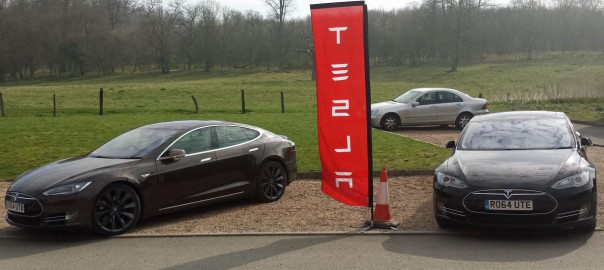
In April we organised a test drive of the Tesla Model S for a group of drivers. There was a Tesla Event scheduled for Warwick so we booked in for that. On the morning of the big day we headed over there in my ZOE.

Our very own Tesla Model S – for a while anyway (Image: T. Larkum)

We arrived a little early and they were still setting up so we waited with a coffee and Danish pastry before having a brief presentation on the Model S. Then we headed out with our guide, Adrian. We each took a turn of 10-15 minutes driving before swapping over, and overall took in a large loop around the local area.

The Model S touchscreen system (Image: T. Larkum)

I was very impressed with the car, both with the driving and the technology. It really does accelerate very hard and fast, yet quietly and smoothly. It feels a little unnerving, a bit like holding a loaded gun, as it can just take off at any moment. And this was only a standard performance model, the P85, not the new higher performance 4WD version, the P85D.

The boot – with the lift-up panel for the rear jump-seats just visible (Image: T. Larkum)

I very much liked the media system with its large 17” touchscreen. It seemed very futuristic, and was intuitive to use. Certainly I can appreciate the attraction of having such a large display for your satnav, or the option of the satnav and media player each having half the screen.

The famous ‘frunk’ (front trunk) since the motor is between the rear wheels (Image: T. Larkum)
The famous ‘frunk’ (front trunk) resulting from the motor being between the rear wheels (Image: T. Larkum)

The time to return the car came only too quickly. After a quick debrief we headed back to Northampton in the ZOE. I very much enjoyed the test drive, and I know it definitely opened the eyes of a group of petrol-heads to the possibilities of driving on electricity – the Tesla grin was evident. One of the drivers has since bought a Leaf. Roll on the UK launch of the more affordable Tesla Model 3!

A classic Tesla grin (Image: T. Larkum)

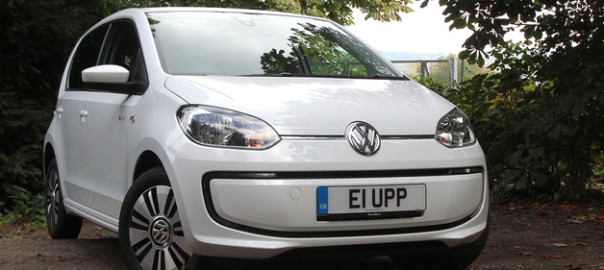
Volkswagen e-Up! review: Up against it

Say it quickly: “ee-up”. That Volkswagen feels happy to call its smallest electric car after the Yorkshire phrase for “hello” shows that Germans do truly have a sense of humour. We jest, of course – Yorkshiremen and women don’t say “ee up”, they say “ay up” – as Volkswagen’s press sheet for this car wryly points out.

Yorkshire greetings aside, the e-Up! poses a question: should you go electric? It’s been difficult to make a like-for-like choice between petrol, diesel and electric models, as most electric cars to date have tended to be standalone – the Nissan Leaf, BMW i3, Tesla Model S are all electric-only models. You can’t have a petrol version.

However, a few ranges are starting to appear which offer like-for-like choice – and Volkswagen has recently added electric versions of both Up! and Golf to its range. Bar some badges and wheel trims, you really won’t be able to spot the difference between them and their internal combustion-powered counterparts, so they could be the perfect option for electric car fans who don’t want to shout about their propulsion choice.

But taking the electric plunge will take some getting your head around, especially when it comes to price. At £19,270 – and that’s after the £5,000 UK government rebate – the e-Up! is one pricey small car. By way of comparison, the higher trim level version of the petrol Up! – on which the e-Up! is based (and that’s enough of the unwarranted exclamation mark after its name, by the way) – starts at £11,760 in five-door form, and although Volkswagen would point out there’s a host of extra kit that comes with the electric version, you’re still looking at the chunky end of a seven grand premium just to go battery powered. Perhaps more troubling for VW will be the fact that the larger, stand-alone Renault Zoe kicks off at a little over £14k.

So even before you’ve got in the driver’s seat, the e-Up is, er, up against it. Is it really worth so much cash?

Electric benefits

To save that seven grand you’re going to have to be doing an incredible amount of driving over the car’s life – at current prices, 10,000 miles in a petrol Up is likely to cost you about £1,000 in fuel.

Either that, or be extremely committed to the green cause, which isn’t entirely clear cut – electric cars aren’t truly zero emission because their electricity is most likely produced by a gas or coal power station.

From our perspective then, where the e-Up is going to make most sense is in the experience it provides. If it provides something better, extra or different over a petrol Up, then you shouldn’t rule it out.

And after jumping into the car and heading off down the road, there are some obvious benefits: the most obvious being performance. We love the 3-cylinder petrol engines in the regular Up, but they’re never what you’d call fast. And while the e-Up is still no race-car, step out of the petrol version and it does feel like a rocket.

In part that’s to do with the characteristics of the electric motor, which can deliver its full quota of torque from zero rpm. So it rips off the line and zips into gaps. In the context of city driving, which where we’d expect most e-Ups to spend their lives, it makes for a really great ally. It’s relaxing and easy in traffic – and really quite zippy and fun if you get the bit between your teeth.

Read more: Pocket Lint