John Curtis of GreenFleet Scotland test drives the Kia Soul EV:
Category Archives: Electric Cars
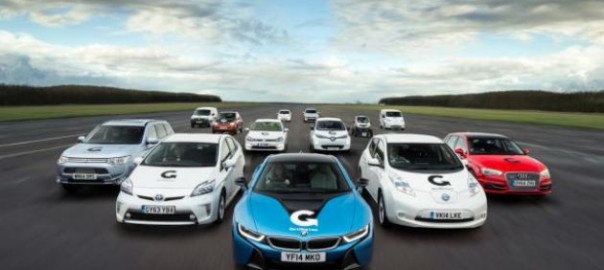
Renault Zoe & Mitsubishi Outlander Plug-In Lead The Pack
[From 31 May] Electric vehicle (EV) sales figures for the European market during the month of April 2015 are now in, and things are looking good. The continent had its third best month ever with regard to total EV sales — seeing a 40% growth rate as compared against April 2014.
Altogether, roughly 11,500 electric vehicles — this includes plug-in hybrid electric vehicles (PHEVs) of course — were registered during the month of April in the European market. This means that EVs now make up roughly 1% of the total new vehicle market. Not bad. EVs and PHEVs certainly have come quite some way over the last few years. It’s hard to say for sure, but they certainly do seem to be on the verge of a breakout from niche status — though perhaps those sorts of changes are more a generational thing, and still a few years off?
EV Europe Sales April 2015With regard to April 2015 sales, the Renault Zoe and the Mitsubishi Outlander Plug-In were nearly tied at the top of the units sold list — with 1,728 units sold and 1,700 units sold, respectively. Following quite a ways behind those two was the Volkswagen e-Golf — with 1,022 units sold. In fourth, the Nissan LEAF was still going strong — with 978 units sold. Tesla did pretty well as well, with sales of 856 units during April.
Read more: Clean Technica
Rapid solar vehicle charger installed in Poole
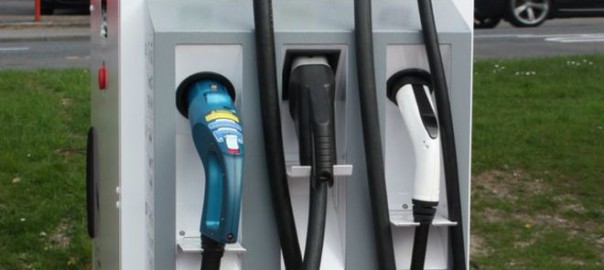
A solar powered rapid charger which can recharge an electric vehicle in 40 minutes has been installed in Dorset
The unit at Poole Civic Centre is the first of its kind in the UK to be installed by a council as part of a government scheme.
It draws its power from solar panels and is faster than standard chargers which take 8-12 hours.

Eighteen chargers are to be installed in Dorset following a £900,000 Department for Transport grant.
During daylight hours, the rapid charger with three standard charging points is powered by a 135kWp solar panel installation on the roof of a nearby multi-storey car park.
Ian Potter, the council’s cabinet member for transport, said: “We hope other organisations will follow our lead and install solar panels on their buildings to generate carbon free electricity.”
Six of the rapid chargers are set to be installed in Poole, five in Bournemouth and seven in the rest of Dorset.
Source: BBC
‘Electrification’ of UK road network continues
The ‘electrification’ of the UK’s road network is continuing at a rapid rate, with one of the latest projects involving the deployment of rapid charging units in a popular tourist region.
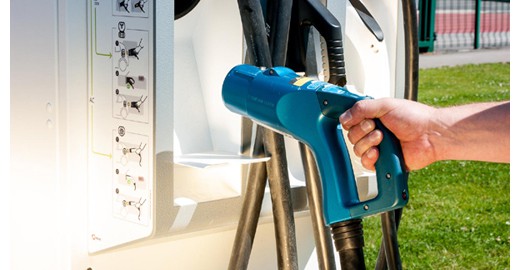
Siemens has supplied and installed two triple-outlet, multi-standard rapid charging points in two towns for Cotswold District Council (CDC), providing fast top-ups for visitors and residents with electric vehicles (EVs) travelling within and through the region. Using grant funding from the Office for Low Emission Vehicles (OLEV), the charging points have been installed in Cirencester and Moreton-in-Marsh, where users will be charged £4 (US$6) via a telephone call or cell phone application, covering the energy used and an hour’s worth of parking.
CDC’s cabinet member for enterprise and partnerships, Chris Hancock, commented,
“The new technology will provide an important strategic link between existing charging points on the M4, M5 and M40, encouraging more drivers to stop off in the Cotswolds. We are always looking for innovative ways to harness technology that reduces our carbon footprint, and the installation of EV chargers in both towns will be seen as a very positive step forward.”
Siemens is a major supplier to the country’s growing EV infrastructure market, with a range of charging equipment that includes both modular DC and AC variants for all charging standards, including CHAdeMO and CSC COMBO 2. The company has won a significant number of new contracts for EV rapid charging technology in recent months.
In Manchester, it has supplied and installed four multi-standard triple-outlet rapid chargers, including one on the approach to Picadilly station for Manchester’s first 100% electric bus. Installation of a network of new rapid charging points for EVs is also well underway in the towns of Poole and Bournemouth, Dorset, as part of a complete EV package with three years’ maintenance support provided by Siemens. The company is responsible for the project management, installation and commissioning of a network of its QC45 rapid chargers. The project will be the first rapid charging network installed and operating with fully integrated bay sensors, providing real-time information on bay availability and detection of non-EVs for onward notification to parking enforcement teams.
New rapid charging projects in Scotland include five new multi-standard chargers installed and commissioned for Scottish Borders Council and a further two new chargers in Stirling. The Scottish Government is delivering a network of public charging points for EVs across the region. The scheme, which includes Transport Scotland grants through the Energy Saving Trust, will deliver charging points within every 50 miles (80km) on trunk roads and an integrated network will join EVs with public transport.One of the company’s largest EV projects to date is in Bristol and Gloucestershire.
The delivery of a complete EV charging system includes 15 multi-standard triple-outlet rapid chargers with connection to the Pay As You Go national network provided by Charge Your Car. Project management, site design, civil and electrical works, installation and commissioning, and three years maintenance managed by the company’s field services team is also included.
Source: Traffic Technology Today

A Petrol Pump is the Filthiest Thing We Touch
Warning: This story might make your skin crawl.
A new study has found that the gas pump is the germiest, filthiest thing we touch in everyday life. That’s according to Dr. Charles Gerba of the University of Arizona — and he should know. A microbiologist, he’s known by the nickname “Dr. Germ.”
The research results released Tuesday found that 71% of gas pump handles and 68% of corner mailbox handles are “highly contaminated” with the kinds of germs most associated with a high risk of illness. The study by Kimberly-Clark Professional, and reported on in USA Today, says that 41% of ATM buttons and 43% of escalator rails are similarly teeming with germs.
Other highly contaminated places that many people probably never considered before, and now might fear using, are parking meters and kiosks, about 40% of which are fouled by germs. Crosswalk buttons and vending machines were tied at 35%.
As part of the study, hygienists swabbed suspected germ hotspots and then analyzed the findings. They used general industry sanitary standards as their benchmark.
Gerba analyzed the results for Kimberly-Clark’s Healthy Work Place Project, a subsidiary of the manufacturer of tissues, hand sanitizer and the like. (The project’s website says sick employees cost the average business about $1,320 per employee.)
So what are we supposed to do? Apparently, it’s all about “hand hygiene” — washing your hands throughout the day — and wiping down your work station with a cleaning product (naturally) because a desktop, keyboard and computer mouse can be a breeding ground for germs, says Gerba and the folks at Kimberly-Clark.
“As your computer boots up, wipe down your desk and mouse,” Brad Reynolds, leader of Kimberly-Clark’s Healthy Workplace Project, said in the USA Today article. He also advised swabbing conference tables between meetings.
Source: LA Times

Renault-Nissan Alliance official COP21 passenger car partner with zero-emission fleet
- Alliance to provide 200 pure electric vehicles to 2015 Paris climate conference
- The first fully electric shuttle service for United Nation’s climate conference
- Fleet to include Renault ZOE and Kangoo Z.E, Nissan LEAF and e-NV200
- More than 50 charging stations powered by renewable energy to be established in and around Paris.
PARIS (May 27th , 2015) — The Renault-Nissan Alliance, the world leader in zero-emission mobility*, will provide a fleet of 200 all-electric vehicles as the official passenger-car provider for the United Nation’s COP21 climate conference in Paris later this year.
The partnership agreement was signed today between the Renault-Nissan Alliance and the General Secretary in charge of the preparation and organization of the 21st annual Conference of Parties (better known as COP21). The fully electric car fleet will shuttle delegates during the event from Nov. 30 to Dec. 11.
More than 20,000 U.N. participants from 195 countries are expected to attend the annual climate summit. It will be the first time the U.N. will use a zero-emission fleet for its entire passenger car shuttle at a COP event.
The goals of the Paris summit are to have a new global climate-change agreement in place by the end of 2015 and to have the Climate Green Fund, established to help developing countries adapt to climate change and reduce emissions, start allocating funds.
“We are delighted to announce that the Renault-Nissan Alliance is an official partner of COP21 in Paris. Thanks to the Alliance’s fleet of 100% electric vehicles, it will contribute to our goal of achieving a carbon neutral event. The technology of electric vehicles helps reduce greenhouse gases in the transportation sector efficiently,” said Laurent Fabius, Minister of Foreign Affairs and International Development, President of COP21.
“Electric vehicle technology is an efficient solution for a practical and affordable mode of transportation. This solution has a positive impact on the climate and air quality in our cities,” said Carlos Ghosn, Chairman and CEO of the Renault-Nissan Alliance. “It’s time to accelerate the shift to zero-emission mobility by working together with all parties concerned.”

The COP21 car fleet will feature the Renault ZOE subcompact car, the Renault Kangoo Z.E. van, the Renault Fluence Z.E. sedan, the Nissan LEAF compact car and the 7-seater Nissan e-NV200 van. The vehicles will be available to shuttle delegates 24 hours, seven days week to key venues around the conference, as a complement to public transportation.
The Renault-Nissan Alliance will work with companies in France to set up a network of more than 50 quick and standard charging stations powered by 100% renewable energy in strategic locations. The quick charging stations will be able to charge the EVs from 0 to 80% capacity in about 30 minutes.
Source: Media.Renault.com
Evening Standard Comment: Time to transform London’s air quality
[From 26 May] Today this paper launches a new initiative to encourage Londoners to adopt, develop and promote the kind of green technology that could help clean our air. It is backed by the chairman of the Committee on Climate Change, Lord Deben, who urges us to embrace change: there are, he says, “a whole lot of things we can do which mean that we can live exactly the same lifestyle at half the impact on the environment”. Electric cars are one example; remote-controlled heating systems are another.
Meanwhile, the Mayor has announced £8 million support for pioneering schemes to improve air quality, such as pollution-absorbing walls and zero-emission car clubs. This coincides with a World Heath Organisation meeting today in Geneva to combat air pollution.
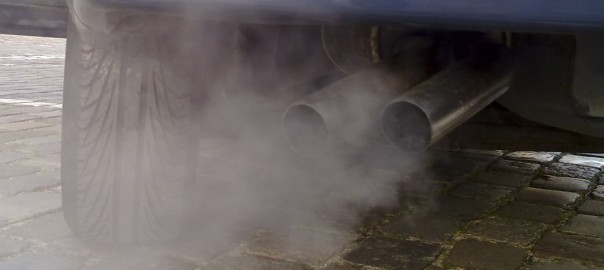
These are excellent moves and signs of hopeful change. Yet they come less than a month after the Supreme Court ordered ministers to come up with a new plan for tackling air pollution. Britain is in breach of EU-mandated pollution levels for both nitrogen dioxide and PM10 diesel particulate (the tiny particles of soot emitted by diesel exhausts). Our filthy air is estimated to cause around 29,000 premature deaths a year in the UK and is a major contributor to lung diseases such as asthma.
London’s problem is how to clean up its air at the same time as meeting the demands of transport in Europe’s largest and busiest city. Despite increasing numbers of Londoners cycling, and increased passenger numbers on public transport, pollution from road transport remains well above EU limits. The Mayor’s long-term solution is the Ultra Low Emission Zone, which aims to encourage drivers of the most polluting vehicles to change their vehicles by charging a new daily levy for those entering the congestion charge zone from 2020.
Yet this represents a watering-down of the Mayor’s original plans in this respect: critics charge that it is too little, too late. Clearly air pollution is no respecter of land boundaries like those of the congestion charge zone. Air pollution readings from test sites outside the central zone — for instance in Brixton — are worryingly high. Other European cities are pressing ahead with more drastic plans for eliminating the biggest culprits in air pollution, diesel engines. Refitting existing bus engines would help too. Above all, the problem simply needs to be given a much higher political priority than it has to date. Air pollution kills: London needs to tackle it urgently.
Source: London Evening Standard
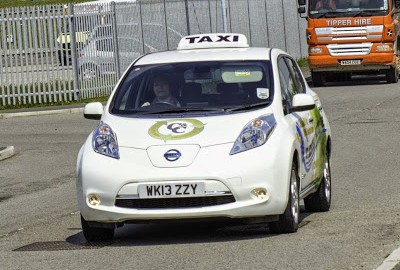
Nissan Leaf Taxi passes 100,000 miles and still on 1st set of brake pads!
A Nissan LEAF taxi in Cornwall has clocked up its 100,000th mile (160,000 km) since entering service with C&C Taxis in 2013.
‘Wizzy’ as it was named by operators at St Austell-based C&C Taxis, hit the milestone in the course of more than 25,000 pure electric paying fares and having been rapid charged over 1,700 times yet retains near full battery health and is still on its first set of brake pads.
Inspired by Wizzy’s performance, C&C Taxis now operates five 100% electric Nissan LEAFs and an all-electric Nissan e-NV200 van.
Mark Richards, fleet manager at C&C Taxis, estimates that each vehicle saves the business around £8,500 per year in fuel bills and maintenance costs.
“When we speak to other taxi operators they often tell us range and battery life are the biggest factors preventing them from considering an electric taxi,” he said. “Then, when we tell them Wizzy’s done 100,000 miles and still has full battery health, they’re left speechless.”
“It’s no exaggeration to say Wizzy has transformed our business. We took a gamble when we bought her but she’ll have paid for herself in just 24 months and the savings we’re now making across the fleet are phenomenal,” he added.
Source: Electric-Vehicle News
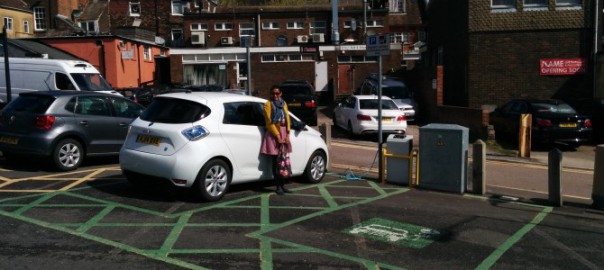
Driving from the UK to Belgium in a Renault Zoe electric car
Last year I asked if 2014 was the year to buy an electric car. Despite some reservations about cost and range, we did finally take the plunge in November and bought ourselves a lovely little Renault Zoe.
We have absolutely loved the car and found it perfect for our daily use. We actually kept our diesel car for three months in case we needed to make a long journey, but it didn’t happen. So we sold the other car and haven’t needed it since, but the one thing that was bothering me was the idea that we could no longer drive to mainland Europe on holiday, which we absolutely love doing.
Driven by this inner frustration, something snapped in my brain recently and I convinced myself that we could drive to Ghent in Belgium, one of our favourite cities. I had seen a post on the website My Renault Zoe about Surya, who drove from Belgium to the UK in a Zoe, so I thought it must be possible the other way.
Planning our first long distance electric journey
A bit of research showed me that there are a lot of charge points in Belgium, especially Type 2 Mennekes chargers that the Renault Zoe uses. The question then was whether we could actually use the chargers and whether they were located conveniently for our route.
A bit like the UK, I found that Belgium has several charging networks that each have their own membership schemes. However, I found a Dutch network called The New Motion that has partnerships with many of these networks and whose members can therefore charge throughout Holland, Belgium, Germany and beyond. I phoned them up to ask about membership and they told me that I could not get a membership card because I would need a Dutch or German bank account to register on my account. However, they suggested contacting Charge Your Car in the UK.
I didn’t have a Charge Your Car (CYC) membership card but when I went on their website I saw that their latest news article was announcing their two way partnership with The New Motion. I emailed them to ask if this was already in action and they confirmed, so I applied for the membership card.
This should have been enough, but to be honest I was really getting worried that our car would be stranded in Belgium if the CYC card didn’t work, especially because The New Motion is a Dutch network and so by going to Belgium we would be using chargers operated by partners of a partner of CYC. I needed a backup plan!
First, I asked our friend Dan if we could borrow his Granny cable, which he kindly agreed to. This should mean that we could charge from a regular wall socket in a worst case scenario, so long as the Granny cable worked with a European plug adapter fitted. Secondly, I found a German network called PlugSurfing that also covers much of Belgium, and would hopefully work as a fall back if the CYC card didn’t work. I also made a long list of chargers near our route in case any were out of action, including Renault dealers in western Belgium that have charge points. If all else fails, surely Renault can charge us up!
The journey to Belgium
We headed towards Dover and charged up at the Ecotricity point at the service station in Maidstone. However, it is 34 miles from Dover and I wanted to have as much range as possible when we got off the other side in Dunkerque. We therefore made what was supposed to be a quick stop in Ashford to use the 22kW charger in the Vicarage Lane car park. The charger worked perfectly and we were back to 99% in 20 minutes, but finding the car park took us ages!! Let’s just say that Ashford’s town planners are very creative!
Read more: Live Wholesome
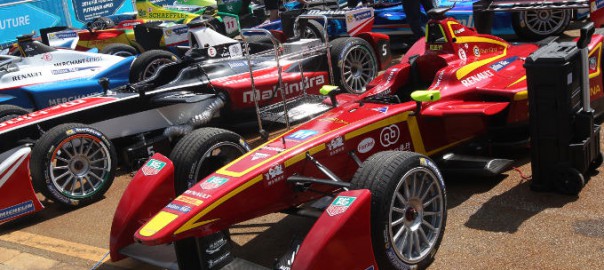
From Formula1 To Formula-E: Car Racing Goes Electric
Jeremy Clarkson may have something to say about it, but the testosterone and fossil-fueled sport of Formula 1 is apparently going green. The former Top Gear presenter would undoubtedly defend a sport in which 8,000 liters of fuel is burnt in a weekend, but as it turns out, Clarkson and other F1ers are dinosaurs: Formula 1 now has competition from Formula E, where, you guessed it, E is for electric.
It doesn’t take a marketing genius to assume that, to a generation brought up with Al Gore’s Inconvenient Truth, 20-odd combustion-engine cars whizzing around a track sucking gas at 375 km/h (233 mph) might appear, well, unseemly. Now there is actually an alternative. Today’s EV technology has reached a point where electric cars are more than just fancy rides for planet-saving celebrities or those who can afford a Tesla.
While F1 cars have effectively been hybrids since 2009, in 2014 new rules were put in place that cut the amount of fuel used by a third, prompting changes in design. Last year the first Formula E championship kicked off in Beijing, the first of 10 cities to host races featuring high-performance EVs.
The teams, backed by “green” celebrities like Leonardo DiCaprio and Richard Branson, race Spark-Renault SRT_01E Formula E cars using technology from F1 teams McLaren and Williams. Unlike regular Formula 1, the cars do not refuel in pitstops; rather, the drivers swap vehicles due to current EV battery limitations. The cars all have an identical chassis and drivetrain, as well as a huge lithium-ion battery that makes up a third of the car’s weight. The familiar roar of F1 engines is replaced by a high-pitched whistling sound, “a bit like a dentist’s drill” described one journalist, covering the first Formula E race in the United States this past March in Miami.
Formula E cars reach a maximum speed of 150 mph, and drivers change vehicles half-way through when the battery in the first car starts to run out.
The greening of motorsport isn’t just confined to electric vehicles, either. In 2008 the world’s first zero-emissions motorcycle race took place on the Isle of Man, UK, featuring electric bikes. A few years earlier, Dutch entrepreneurs built the world’s first fuel-cell-powered go-kart, then raced it in the 2008 Formula Zero Championship, a race series consisting of six universities that competed on a 2-mile mobile race track.
Meanwhile NASCAR, yet another symbol of the combustion engine at the apex of its power, has made strides in making the sport more politically palatable. According to NASCAR Green, the sport has cut its carbon emissions by 20 percent through the use of biofuels, and a “significant number” of NASCAR tracks rely on solar power as an energy source. These include the 3MW solar farm at Pocono Raceway and a 9MW solar facility at Indianapolis Motor Speedway.
Technologies developed for Formula E are also finding their way into mainstream applications, possibly even a supermarket near you. Williams F1, the British Formula 1 motor racing team and constructor, in April “unveiled plans to fit aerofoils developed from racing cars to supermarket fridges so as to save energy, while a fuel-saving F1 flywheel is being tried out in buses. It is even supplying ecologically- correct supercars for the next Bond film,” reported The Telegraph.
The aerofoils redirect the flow of air to stop cold air from escaping from supermarket refrigerators into the aisles. Sainsbury’s, the UK supermarket chain, has used the aerofoils to cut energy use by 30 percent, according to the Telegraph.
Whether Formula E garners the same global following as Formula 1 remains to be seen, but it is clear that the greening of motorsport is aimed at a new demographic where “green is sexy” and new, sustainable technologies are the way of the future. As Alain Prost of e.dams Renault put it,
“F1 is for people over 40.”
Source: Oil Price