Why are you reviewing a normal-looking BMW 3-series?
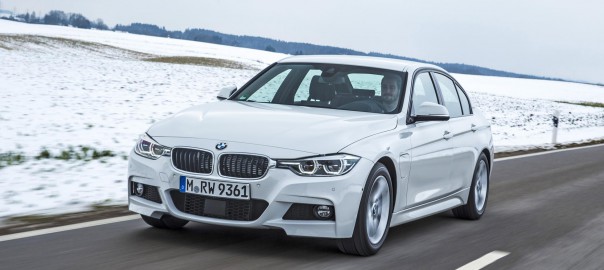
BMW 330e PHEV (Image: BMW)
Because it’s got a plug-in hybrid drivetrain, that’s why. But it’s not like the 225xe people carrier, which is a natively front-driven car. That car’s hybrid system adds an electric motor at the back for the bonus of 4WD.
This 330e, on the other hand, is natively rear-drive. It uses a motor hooked directly to the flywheel driving through the regular automatic gearbox, so it’s still rear-drive only. So closer to BMW’s tradition.
OK, got it. Any numbers for me?
It uses a four-cylinder, 2.0-litre petrol engine with 184bhp. Add the e-motor to the equation, and you have 252bhp in all. Because the electric motor is geared one-to-one with the engine, its contribution is there for you all the time (the 225xe’s rear motor has a single-speed transmission and its effort falls away to nothing at motorway speed). So the 330e has the poke of a 330i petrol, and gets to 62mph in 6.1sec. Hot hatch quick.
Does it feel as lively as the numbers suggest?
Pretty much. There’s a smooth urge at mid revs thanks to the ever-alert electric torque. The petrol engine is quiet, but its tone is boring and grumbly. But nothing like as loud as the diesel engine you’d be buying instead.
In town, you’re often propelled by uncannily smooth and silent e-drive. Provided the battery has charge, the electric motor, at 88bhp, is plenty powerful enough for urban use without troubling the engine at all.
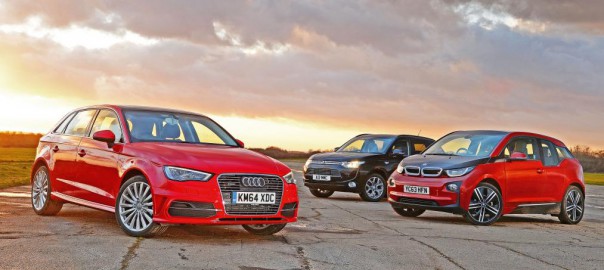
Plug-in electric vehicles are on the rise, with the Audi Q7 e-tron joining the A3 Sportback e-tron and R8 e-tron – taking the German maker’s count up to three. There’s clearly momentum behind electric, thanks to its efficiency, environmental and fuel-saving implications.
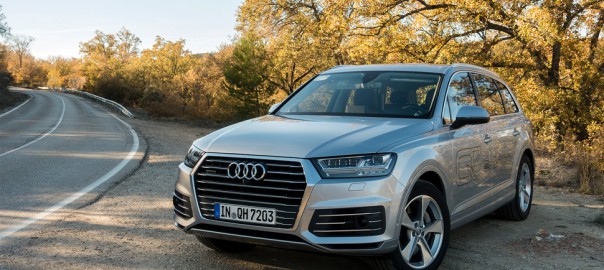
Audi Q7 e-tron PHEV
But going green might put you in the red. The Q7 e-tron’s anticipated £65,000 starting price is a good £15k more than the combustion-only model – the one we took for a spin back in the summer of 2015 – which is a sizeable premium for this sizeable SUV. Is it worth it? We took the e-tron electric hybrid on the road to see what we made of it.
Audi Q7 e-tron first drive: It’s a 5-seater
First thing’s first, if you’ve thought about buying an SUV then the Q7 really ought to make your shortlist simply because it’s a good looking driving machine that avoids being too tank-like in its ways.
But – and it’s a critical one – if your eyes have veered over to the e-tron version, hand on environmental heart, then you’ll need to consider the space implication of the batteries. They’ve got to go somewhere, after all, and in the case of the Q7 e-tron that means it can only be a five seater, not a seven seater (which may sound at odds with its name, but that’s that way it is).
Audi Q7 e-tron first drive: Electric range
But the obvious trade-off between seating arrangements is that the Q7 e-tron can scoot along happily using only its electric motor – which with 94kW of output, translates to 128bhp – for up to a 35-mile range per charge. That might sound quite conservative, but let’s not forget this is a 2.5-tonne vehicle (it’s 450kgs more than the standard Q7), so perhaps that’s no surprise.
If you’ve got a commuting route with a charger at the other end (7.2kW charging means a refill in 2.5-hours; at-home means 8-hours per recharge), then you’ll quickly save on those pricey diesel top-ups over the course of time.
Vehicle leasing providers are encouraging those looking at plug-in hybrid vehicles to place their order as soon as possible to make the most of the current UK Government Plug-in Car Grant (PiCG) scheme.
With the grant system set for a shake-up from Tuesday 1st March 2016, there are only a few weeks left to get orders in before the level of government subsidy halves for PHEVs – the fastest growing alternative-fuel car market.
New rules for the PiCG see three categories come into force with only pure electric vehicles (EVs) eligible for the full £4,500 subsidy. These are models that emit less than 50 g/km CO2 and have a zero-emission range of at least 70 miles.
Categories 2 and 3 involve less than 50 g/km CO2 models with a zero-emission range of 10-69 miles and 50-75 g/km CO2 vehicles with a zero emission range of at least 20 miles respectively. These two categories will receive grants of £2,500 off the price of a car, rather than the current £5,000.
It is unclear what manufacturers will do once the new PiCG levels kick in, with some manufacturers potentially set to absorb the additional expense in the list price. There is no requirement for them to do this though so the car that you are looking at now could end up a few thousand pounds more expensive in a month’s time.
Next Green Car’s leasing partners GKL Leasing forecast that businesses will see increases in premiums of at least £90+VAT from 1st March and are encouraging customers to make the most of these savings by placing orders before the end of February.
Sam Young, Low CO2 Business Development, Westward Leasing (GKL Bristol), said:
“If you are even considering one of these vehicles this year then you need to act now. These cars are never going to be any less than now. With the delivery window so long and with the ability to pre-order for dates later in the year then the time to act is now to make things as cost effective as they will ever be.
“If you have cars doing less than 20,000 miles per year the savings available from tax benefits, urban fuel use and the great environmental benefits and image for a business makes this type of car an essential part of any fleet. So don’t get left behind and end up paying more when you realise it’s what you should have done before.”
MW’s 3 Series gets more economical with plug-in hybrid powertrain
Verdict: 4 stars
As hybrids grow in popularity, the BMW 330e is likely to become a fleet favourite among company car drivers – and deservedly so. It joins the Mercedes C 350e in moving the game on from the comparatively thirsty (and non plug-in) Lexus IS 300h. It looks and drives like a 320d, but costs a fraction of the price to run and is utterly silent around town. Audi will feel a desperate rush to get its upcoming A4 e-tron to market, and double quick, too.
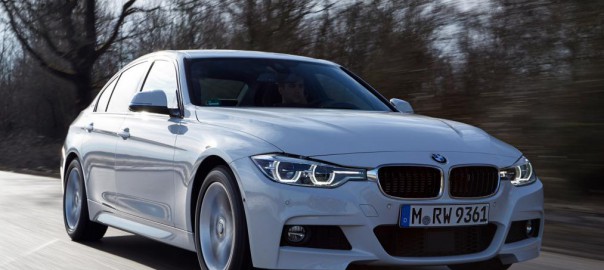
BMW 330e plug-in hybrid
BMW wants a 10 per cent share of the electric car market worldwide by 2020. The success of models like this 330e will be key, and with plug-in versions of the 2 Series, 7 Series and X5 all on their way – it doesn’t look an impractical goal.
While the company is a long way from ditching its fast but frugal diesels, it is looking to the future with its expanding range of plug-in cars. The 330e gets an all-electric range of around 25 miles, which BMW says offers “the right solution” for its customers.
From the outside, it looks much like any other 3 Series. There is a pair of badges on the rear wings, as well as the tell-tale 330e moniker on the back – but save the additional charge port ahead of the front-left wheel, there’s no distinguishing this from the already fleet-friendly 320d.
Inside, it’s much the same story. So much so, in fact, you’d be hard pushed to tell this example is capable of as much as 148mpg. There is a small ‘eDrive’ button by the gear lever, but aside from that it’s business as usual.
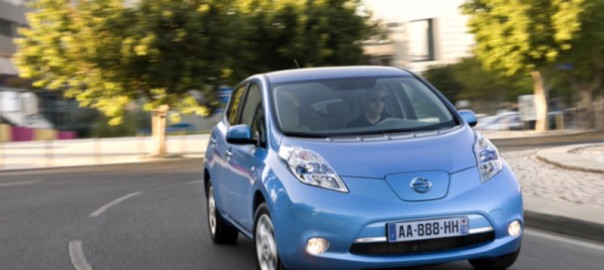
Next Green Car was invited along to the UK launch of the Nissan Leaf 30kWh at Silverstone yesterday (Tuesday 26th January), giving us another chance at an early test for the new longer-range model.
The Leaf 30kWh has an official range of 155 miles – with 124 miles of real world range
With around 12,000 UK sales, the current Leaf is the best selling electric vehicle (EV) on the market and has played an important part in increasing the growth of plug-in vehicles in the country. Since its UK launch in 2011, the Leaf has been been joined by the likes of the Renault Zoe, BMW i3, and VW’s e-Golf and e-up! in terms of pure-electric models, and a number of plug-in hybrid vehicles also to increase ultra-low emission vehicle (ULEV) sales dramatically in the last five years.
As a market leader then, Nissan is keen to maintain its position as a familiar EV manufacturer to the general public, and this new version of the Leaf shows its commitment to improving the offering available to consumers.
The previous generation of Leaf – the 24kWh battery model – had a quoted range of 124 miles, and a real world ability to cover around 99 miles on a single charge. The 30kWh model extends that official range to 155 miles which, although it is highly unlikely that drivers will ever achieve this figure, the real world range only drops to 124 miles – or the official range of the previous model.
When we attended the European launch towards the end of last year, we had an extended and challenging test route set up which took us up into the Alpes Maritime, with some long climbing making the range plummet before a downward section that saw us recuperate a large amount of energy. This tested the Leaf’s range to extremes and it coped very well, averaging some impressive figures. However, it was worth seeing how well the new Leaf would do on a cold and wet January morning in Britain, with muddy surfaces, pot-holes and a wide range of different roads available to deal with.
In terms of testing the biggest change to the Leaf – the increased range – the Nissan again performed well. The route was less obviously demanding, there are no mountains to climb in Northamptonshire after all, but conditions and roads represented a far more typical journey.
The car we were allocated came with a full charge and an indicated 99 miles worth of range. This low figure was explained by both a cold night and, of greater impact, the fact that the car had been used for press images the previous day, with the Leaf having weighted its indicated range to some spirited driving.
Deciding to treat the Leaf without any deference normally due to an EV, we set off on the route and drove exactly as if we were in a petrol or diesel model. The only difference was the use of the Leaf’s Eco button once acceleration was completed and we were largely up to speed. This meant sitting at around 70 mph on dual carriageways and motorways for about a third of the 55 mile route.
Nissan LEAF sales in the UK continued their fast rise last year — with 5,236 registrations of the popular electric vehicle being reported in 2015.
That means that Nissan LEAF sales in the UK rose roughly 29% in 2015 — as compared to 2014’s sales of the all-electric (EV) car.
According to company reps from Nissan, that means that the LEAF outsold other all-electric vehicles in the UK in 2015 by a more than 2-to-1 margin. The Nissan LEAF has now been the top-selling all-electric vehicle in the UK for the last 4 years — a winning streak that looks likely to continue for at least one or two more years.
“This record year for Nissan highlights once again the importance of our investment in the UK and commitment to electric vehicles,” stated James Wright, Nissan Motor GB Managing Director. “We’re proud to be leading the industry when it comes to 100% electric vehicles and with our new longer range LEAF and e-NV200 there are options available to everyone.”
Also worth noting here is that Nissan’s partnership with the renewable energy electricity supplier/utility company Ecotricity has been going well, and that EV charging stations are now spread across over 95% of the UK’s highway (motorway) system.
MILTON Keynes has been named as one of several UK cities to receive funds worth millions of pounds to promote electric cars.
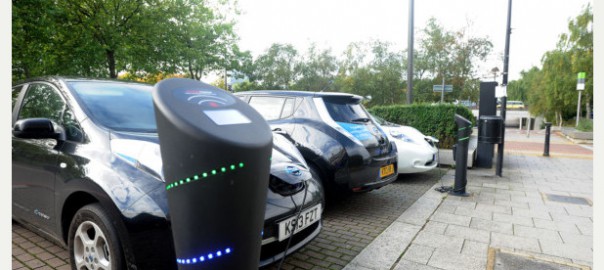
Electric cars charging in Central Milton Keynes
£9million has been allocated to MK to construct a Electric Vehicle Experience Centre that promotes electric cars and can arrange short-term loans. Funds will also be used to make the city’s 20,000 parking spaces available for all electric cars, and to allow them to use bus lanes in the city, which will be re-designated as “low-emissions lanes”.
Transport Secretary Patrick McLoughlin made the announcement earlier today, which is part of a £40million scheme.
He said,
“These Go Ultra Low Cities have proposed exciting, innovative ideas that will encourage drivers to choose an electric car. I want to see thousands more greener vehicles on our roads and I am proud to back this ambition with £40 million to help the UK become international pioneers of emission cutting technology.”
At present, a number of parking areas in Central Milton Keynes are designated for electric vehicles, and charging points have become an increasingly common site in the city. Milton Keynes will also pay host to a trial for driverless vehicles.
The other cities to receive a share of the money are London, Bristol and Nottingham/Derby, while further funds have been established for new projects in Dundee, Oxford and North East England.
Poppy Welch, who is the head of advocacy group Go Ultra Low, said,
“We’re excited to see the innovative ideas put forward by each of the winning Go Ultra Low Cities become reality over the coming months. The £40 million investment by government, combined with funds from each winning area, will transform the roads for residents in and around the 4 Go Ultra Low Cities.”
Soon after I bought our Type 2 ‘granny’ cable I did some testing to see how long it would take to charge the ZOE (when set to 10 Amps, about 2.3kW). Previously I’ve done some detailed monitoring of charge curves, specifically for 7kW home charging and 43kW rapid charging. Given that I knew this method would take much longer than either of those I chose to not monitor the whole charge, instead just one hour to get an idea of its behaviour.
Figure 1: ZOE 2.3kW Charge Curve (Image: T. Larkum)
As before, at regular intervals I noted the percentage state of charge and the predicted time to complete; these are shown in Figure 1 and Figure 2 respectively. With such a short test it is difficult to draw any firm conclusions, but it appears to be safe to deduce:
The ZOE dash predicts a charge time of about 10.5 hours from a start charge of 46%, so about 23 hours for a complete charge.
The ZOE is actually charging at about 6% per hour, so it should reach full charge in about 16 hours.
These findings are not inconsistent with each other, and the charge time is probably about 17-18 hours. Firstly, the previous analyses of charging curves show that the predicted charge time decreases over time, so it will likely decrease towards an actual lower charge time. Secondly, the predicted time includes time for battery balancing where the simple linear charge estimation does not, in other words there’s probably an hour or two of balancing ‘charging’ when the charge curve hits 99% – hence the estimation of 17-18 hours.
Figure 2: ZOE Charge Completion Prediction (Image: T. Larkum)
Of course, it’s obvious that this is a very slow way to charge compared to 3.5 hours on the usual home charge point (or half an hour on a rapid charger). This may be partly due to the charger being a generic, non-ZOE specific one and it may be partly due to the ZOE being an older Q210 model which is well known for inefficient charging at low powers.
So, if any readers are keen to volunteer, it would be interesting to repeat the test on other setups, for example:
A ZOE Dynamique Nav R240 with the Renault 13A cable
A ZOE Dynamique Nav Rapid Q210 (or older Intens) with the Renault 13A cable
If anyone sends me the details I’ll post them.
Meanwhile, despite the slow speed of charging, I have made good use of the cable a number of times to grab a ‘top up’ while spending time visiting family.
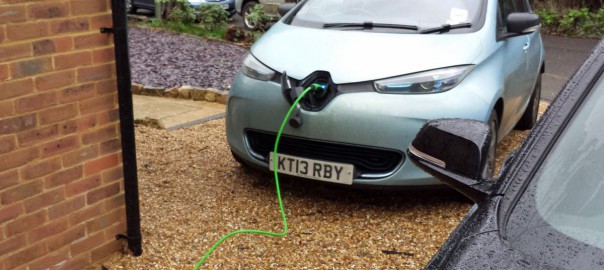
Figure 3: Green granny lead just visible going from front of ZOE under black car to garage (Image: T. Larkum)
Most recently it got used on Christmas Eve while visiting the in-laws during one of our regular trips to Oxford.
Figure 4: Charging on Christmas Day (Image: T. Larkum)
Then on Christmas Day we visited my brother’s family in Surrey for Christmas dinner, using a new route from Northampton down the A34. This meant using the Ecotricity charge point at the Reading M4 Eastbound services, which worked fine and took less than half an hour.
Figure 4: Another view, showing the benefit of a 10m rather than usual 5m cable (Image: T. Larkum)
Returning back, having charged with the granny cable, we skipped using the Reading M4 Westbound services which turned out to be a mistake. The next one at Chieveley was down and we had to retrace our steps to Reading Eastbound – thus a timely reminder to always charge early and have a backup in mind in the direction you want to go.
Figure 5: Charging on the Ecotricity rapid charger at Reading Eastbound services (Image: T. Larkum)
Anyway, enough about rapid charging. I would recommend that any ZOE owner considers getting a granny cable for home charging. Although expensive they do give some peace of mind, particularly when public chargers can’t be relied on (which has been the case for us at least twice during Christmas holidays).
From street lights that charge your car to ULEV-only spaces, the UK is about to get even more EV-friendly
https://youtu.be/Z_2KbeWTrSA
[From 26 January] Figures show low-emission transport in the UK is already on the rise, but the government has given it a £40 million helping hand. Yesterday, the transport secretary Patrick McLoughlin announced cities including Nottingham, Bristol, Milton Keynes and London will get a total of £40 million to help encourage drivers to use ultra-low emissions vehicles (ULEVs). The prize fund came courtesy of the Go Ultra Low City Scheme, a competition that awarded grants to cities with the most eco-friendly proposals.
Although Go Ultra Low has awarded £40 million to eight separate cities, the money won’t be shared equally. So what is each city doing with the money?
London plans to use its £13 million share to help form “Neighbourhoods of the Future”, a multilateral programme that intends to prioritise ULEVs over traditionally-powered vehicles. Hackney will dramatically increase its charging infrastructure by building power points into existing street lights, while Harrow will offer priority traffic lanes and parking spaces to those in low emissions vehicles.
Milton Keynes will use £9 million to open an advice and loan centre, meaning prospective buyers can get advice about ULEVs – and even test-drive selected models. The city will also make its 20,000 parking bays free for EV-owners.
Bristol is set to use £7 million of the fund offer three ULEV-only lanes, and 80 additional charging points.
Finally, Nottinghamshire and Derby will use £6 million to install 230 charging points – as well as giving ULEV owners cheaper parking and access to selected bus routes.
ONE HUNDRED new charging points will be created in residential streets in Oxford to make electric vehicle ownership possible for 16,000 extra homes.
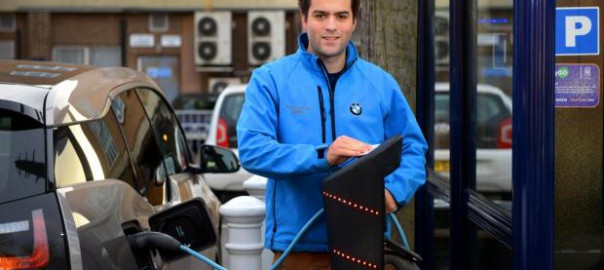
James Brown, from BMW I sales, with a BMW i3 electric car at a charging point at the Tesco car park off Cowley Road
The largest pilot of its kind in the world will begin when 30 trial points of various kinds are installed in pavements and lampposts by the end of this year.
The most successful types of charger points will then be rolled out in 100 residential streets around the city, probably from 2018.
Oxford City Council and Oxfordshire County Council hope to encourage thousands more people to buy electric cars to help cut emissions in the city.
City executive board member for climate change, John Tanner, said:
“Climate change and poor air quality are two of the biggest issues facing Oxford and we all need to do everything we can to cut vehicle emissions.
“However, for people living in Oxford’s beautiful but narrow terraced streets, charging an electric car is a real problem. This project aims to remove that barrier.
“By installing 100 electric charging points, we are going to turn the Oxford into a city filled with electric avenues.”