Category Archives: Electric Cars

News and reviews of the latest electric cars (full electrics and plug-in hybrids).

The possible irrelevance of oil

The average price of a barrel of oil has plummeted from over 120 USD / barrel to about 30 USD /barrel in the last three years. There may be a lot of geopolitical reasons why this has happened. There is also an analysis of how long this will persist. Relations between Saudi-Arabia and Iran, the situation in Iraq, OPEC relations and shale-oil boom in the US all play a part in this. But there may be another aspect of this situation which may be more relevant and inevitable than most of us may believe at the moment.

1461131183-8625_the-possible_irrelevance-of-oil_unk

There have been many “industrial disruptions” in the last few decades that most of us never really saw it coming. Products and companies which were household names have disappeared into the oblivion. For example Kodak was a company that was synonymous with photography. The brand was so well know that fifteen years ago when a family got together or there was a good photo opportunity it was popularly referred to as a “Kodak” moment. The company does not even exist now. Not because they were not performing well, but because the product that they were making suddenly became irrelevant. Similarly cassettes and VCRs are gone and children growing up today will only know them as novelties from the past.

An industry disruption, according to an expert in this field from Stanford University in the United States, Tony Seba, is when a new industry or product “disrupts” a previously well-established product or industry. If you look at what happened to Kodak, people did not stop taking pictures, but the way it was being done completely changed. Similarly, music is still popular, but the cassettes and VCRs have been replaced with new and more convenient devices.

A similar disruption is possibly taking place in the automobile industry, at this very moment. Automobiles need petrol or diesel as fuel to function. In fact, more than 50% of crude oil produced gets converted to fuels used by automobiles. But the new generation of cars may not need petrol or diesel at all to function. These may not contain the traditional internal combustion petrol or diesel engine.

A few years ago, nobody had heard of a car company called Tesla Motors. The company was founded by a charismatic US based entrepreneur named Elon Musk, in 2003. The cars made by this company are fundamentally different from cars being produced by other large automobile companies like Toyota, Volkswagen and GM. Tesla cars don’t have a petrol or diesel engine but contain electric motors and batteries. The basic concept is simple. The battery is charged like how one charges a mobile phone or a laptop and the power stored in these batteries is then delivered by electric motors to the wheels. The most amazing thing is that the final product is not an experimental or a concept vehicle anymore, but is a thoroughly acclaimed luxury car which is now being compared to the likes of best traditional cars in the business such as Mercedes Benz S class.

Read more: Nation
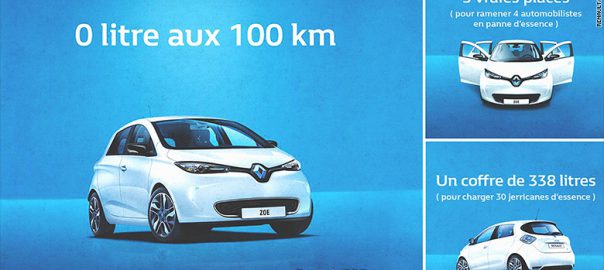
A look at Renault's new marketing campaign for the Zoe model in France

When’s the best time to advertise electric cars? The middle of a gas shortage.

Strikes have brought parts of France’s oil industry to a standstill this week. Gas stations are running dry, lines are building at the pumps and people are hoarding fuel. The only people smiling? Electric car owners.

A look at Renault's new marketing campaign for the Zoe model in France
A look at Renault’s new marketing campaign for the Zoe model in France

And electric car makers have been quick to seize the golden marketing opportunity.

France’s Renault (RNLSY) launched a campaign this week to boost the visibility of its top selling electric car, Zoe, with multiple posts on Facebook (FB, Tech30) and Twitter (TWTR, Tech30) and advertisements in three French newspapers.

“In France, we don’t have any more petrol but we do have Zoe,” tweeted Renault. Its Facebook posts quickly received thousands of ‘likes’ and ‘shares’.

Renault said the campaign had led to a 50% spike in calls from drivers seeking information about the Zoe model. It also prompted electric car owners to post carpooling offers online to help other drivers who had run out of fuel.

Read more: CNN Money

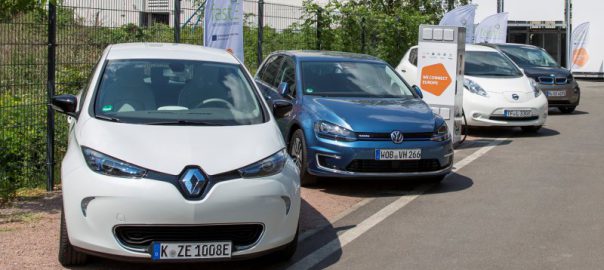
Renault is a partner of the European fast-charging project Fast-E in Germany (Image: Renault)

Renault is a partner of the European fast-charging project Fast-E in Germany

  • Official launch of Fast-E project co-financed by the European Union and nine companies, including Renault, in Berlin and Brussels.
  • 241 charging stations installed in Germany and 37 in Belgium by the end of 2016.
  • A sister project between the Czech Republic and Slovakia adds another 30 charging stations.
Renault is a partner of the European fast-charging project Fast-E in Germany (Image: Renault)

The 278 charging points set up every 80 km along Germany and Belgium’s main motorways, will allow drivers of electric vehicles to “refuel” and extend their car’s range. The total investment of the EU-funded cooperation is approximately €18 million.

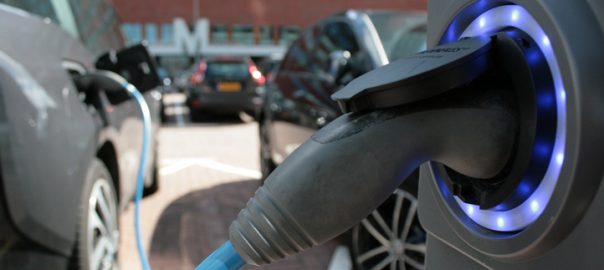
Every one of the multi-standard fast-chargers spread out over four countries have AC and DC connections, allowing drivers to charge their vehicles’ batteries easily and quickly. Electric vehicles can be charge up to 80% on the charging stations within an hour.

RENAULT IS NUMBER ONE IN ELECTRIC VEHICLES IN EUROPE

Renault sells more electric vehicles in Europe than any other car manufacturer and had a market share of over 23 percent in 2015. Indeed, nearly one out of every four electric vehicles sold in Europe comes from the French manufacturer. The Renault electric vehicle product range includes the compact five-door hatchback ZOE, the Kangoo Z.E. and Kangoo Maxi Z.E. vans, the agile two-seater Twizy and the compact carrier Twizy Cargo.

About Fast-E:
Under the leadership of the charging station operator Allego, the project Fast-E brings together nine companies in the industry, including three charging station operators (RWE Effizienz, enviaM and Allego) as well as four car manufacturers (Volkswagen AG, BMW AG, RENAULT SAS, NISSAN CENTER EUROPE), DB Energie GmbH, a subsidiary of DEUTSCHE BAHN and the Hamburg-based company hySOLUTIONS, which, as a competence centre in several charging infrastructure projects, is responsible for the integration of new drive technologies in urban transport. The quick-charging stations installed as part of the project employ the Combined Charging System (CCS) and CHAdeMO, each with up to 50 kW power output, as well as a type 2 connector with 43 kW power output. The project is expected to end in December 2017 with the completion of the accompanying studies; the charging infrastructure will continue to operate commercially thereafter.

About Allego:
Allego operates a charging infrastructure network for electric vehicles in Germany, the Netherlands and Belgium. The company, headquartered in Arnhem and having subsidiaries in Germany and in Belgium, has a neutral market position as a pure operator and is independent from suppliers in regards to charging technology. This helps Allego ensure maximum flexibility and a high degree of reliability in the availability of charging facilities. The special focus in the development and operation of charging technology for electric vehicles lies in the creation of a comprehensive network of normal and quick chargers. For this purpose, the company has already installed 86 quick chargers on Dutch, German and Belgian motorways.

Source: Renault Media

Electric cars dominate Driver Power 2016, the UK’s biggest car satisfaction survey

Tesla Model S tops Driver Power 2016 with highest-ever satisfaction rating, with Renault ZOE in second and four hybrids in the top ten

dpbest_cars_toowngraphic_autoexpress

British car owners who’ve taken the plunge and bought electric cars are raving about them, according to Driver Power 2016. This year’s car ownership survey – now in its 15th year – is dominated by electric and hybrid vehicles, with Tesla’s Model S taking first place in seven out of ten categories as well as the overall number one position.

The survey covers the issues that really matter to motorists with owners rating their vehicles over ten categories including reliability, running costs, practicality and in-car tech. This year, Driver Power received nearly 50,000 responses, with 32 makes and 150 models ranked.

This year’s winner, the Tesla Model S, received a highest-ever satisfaction rating of 97.46%, which included a 100% satisfaction rating in the Ease of Driving category – the first time any model has received full marks in the history of the Driver Power survey.

Brian Walters, Director of Research and Insight at Driver Power, said:

“With seven individual category wins it’s hard to dispute the appeal of the Tesla. This is the first time this manufacturer has appeared in the Driver Power survey, but with results like these I’m certain we’ll see more of it in the future.

“The in-car tech has raised the bar for other manufacturers, and the growing network of rapid-charging points that are free for owners to use makes it the number one for running costs as well. The only area for concern is build quality, but if Tesla can sort this out then I think it’s going to be a tough brand to beat.”

As well as the ZOE in second place, Renault took third spot with the new Kadjar SUV. Last year’s number one brand, Lexus, took four of the top ten positions with its IS, GS and RX (marks two and three) models.

Read more: AutoExpress

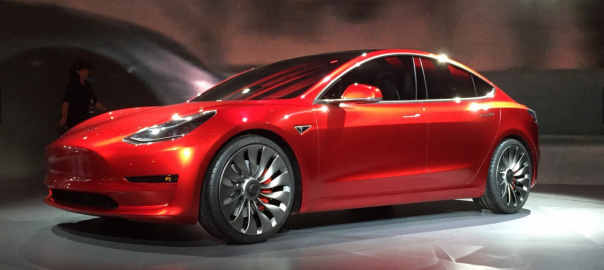
Tesla Model 3 (Image: Green Car Reports)

How do we jam the roads with Teslas by 2030? Just ask Norway

Last week, I explained a dismaying reality for planet-savers everywhere: Not even mega-blowout sales for Tesla’s new Model 3 sedan are enough to substantially green and decarbonize our global transportation system. There are simply too many cars on the road and too many new cars sold each year — the vast majority of which run on gasoline, not electricity, and will for some time.

Tesla Model 3 Unveil (Image: Tesla)

What this means is that we’re probably now at the beginning of a gradual, rather than rapid, electrification of the transportation sector. Yeah, it’ll help out when it comes to greenhouse gas emissions — especially as the electricity that powers Teslas and other electric cars also becomes greener — but it probably won’t do so fast enough to save us in the critical two decades or more when all the big decisions about the planet’s future need to be made.

So how is it possible to scale up faster? Well, one answer may come by looking at the example of a country that has already done just that: Norway, where electric vehicles were fully 18 percent of new cars sold last year.

In a new paper in Applied Energy, Måns Nilsson of the Stockholm Environment Institute and Björn Nykvist of the KTH Royal Institute of Technology in Stockholm examine the policy moves that made this kind of high growth possible, using Norway and several other examples from around the world to drive their analysis.

The gist? You essentially need two things — public policies that address the current higher cost of these vehicles (through tax breaks or rebates) until those costs decline, and then other public policies that do something else: Get past people’s psychological blocks when it comes to driving electric vehicles. That’s a very big issue when people are used to pumping gas rather than charging, and so develop ‘range anxiety’ — the fear that their EV will run out of juice far from a recharging station.

“When you start to change some of the economic incentives, you get the first movers,” says Nilsson. “But then what we have seen is this norm change, that it’s like a cultural shift in certain pockets, typically certain communities, it could be certain suburbs, certain cities, where the electric car becomes the norm.”

Read more: Washington Post

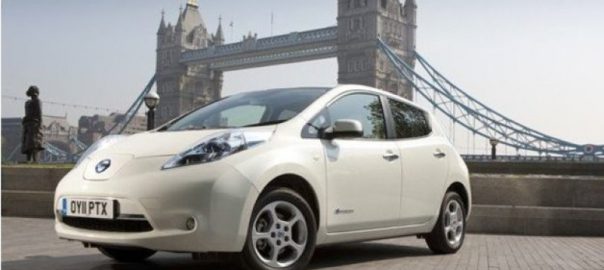
Nissan Leaf by Tower Bridge, London

Electric vehicles are selling in record numbers in the UK

EV sales in the UK are up 23 percent this year.

Nissan Leaf by Tower Bridge, London

One right-hand-drive nation is going in the right direction when it comes to sales of electric vehicles. The UK recorded 10,496 electric vehicle sales during the first quarter of 2016. This was a quarterly record and a 23 percent jump from last year, according to Autocar Professional. March accounted for 7,144 of those vehicles, a monthly record in itself.

In these sales increases we can see the UK government’s efforts to spur plug-in vehicle demand via its Plug-In Car Grant finally taking effect. Enacted in 2011, that grant reimburses electric-vehicle buyers for up to 35 percent (with a max of 4,500 pounds, or $6,400) of the price of a plug-in car. The UK has set a goal of having every light-duty vehicle on its roads be “ultra-low emission” by 2040.

The UK’s new quarterly sales number is pretty impressive considering there were about 17,000 battery-electric vehicles sold in the first quarter in the US, where there are about five times as many residents. Demand in the UK, which accounts for about a fifth of the European Union’s electric-vehicle sales – second in the EU only to the Netherlands – also appears to be a departure from the rest of Western Europe, where plug-in vehicle sales surged in 2015 but are more mixed this year. Autocar Professional’s sales statistics come from Go Ultra Low and the UK’s Society of Motor Manufacturers and Traders (SMMT). They did not break out sales of any particular EV models.

Still, we do know that Western European sales for the Renault Zoe and Nissan Leaf are up, Tesla Model S demand has grown little, and Volkswagen e-Golf sales are down, according to the European Alternative Fuels Observatory (EAFO). Last year, things were a bit more uniformly positive, as 2015 plug-in vehicle sales jumped more than 80 percent to about 184,000 units.

Source: Autoblog

Renault ZOE R240 Battery Capacity – 23.3 kWh Usable, 26 kWh Total

From time to time the question about the real Renault ZOE battery capacity pops up, especially after the French company introduced new longer range R240 version in parallel with previous Q210 edition.

Renault stated that the range (under NEDC) increased from 210 km (130 miles) to 240 km (149 miles) thanks to new in-house developed drivetrain. In real world terms the new R240 ZOE will go a little over 100 miles, whereas the Q210 was more like 88-90 miles.

Basically, range increased by some 14%, but there was no word about battery capacity changes.

Thanks to one of our readers (hat tip to Alex) in a recent story about strong ZOE sales in March, we got a hint about a video with Masato Origuchi from Renault (formerly at Nissan) who revealed battery capacity change at one of presentations in late 2015.

The first generation Renault ZOE had 22 kWh usable energy from the battery, while the new R240 is able to use 23.3 kWh out of nearly 26 kWh. Increase of usable capacity is 5.9%.

In other words, the new, more efficient electric motor wasn’t the only cause of longer range.

Battery cells for Renault ZOE are supplied by LG Chem. Those are 36 Ah, 3.75 V.

Renault enables (like all other manufacturers) only part of the full battery for usage (less than 90%), to extend the durability of the pack.

Source: Inside EVs

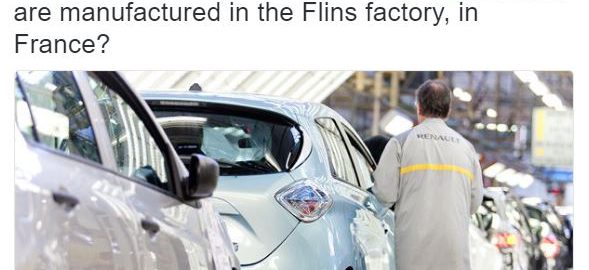
Renault ZOE Production

Renault Says ZOE Production Is At 160 Units Per Day

The Flins factory in France is the sole location for production of the Renault ZOE and we’ve now learned that each and every day approximately 160 ZOEs roll off the Flins assembly line.

Renault ZOE Production

If we assume Renault means 7 days a week, 365 days a year (that’s probably not what Renault intends to mean in its Tweet), then annual production for ZOE would stand at 58,400 units. A rather impressive figure.

However, it’s more likely that Renault’s Tweet is implying a typical five-day work week, with various break here and there for factory overhauls, holiday shutdowns, etc.

In that scenario, the implication would be approximately 200 days per year at 160 units per day, or 32,000 ZOEs produced annually…still a rather decent amount of EVs per year.

Renault itself has previously stated that its production goal for ZOE is 35,000 units this year, up from 20,000 produced last year.

Source: Inside EVs

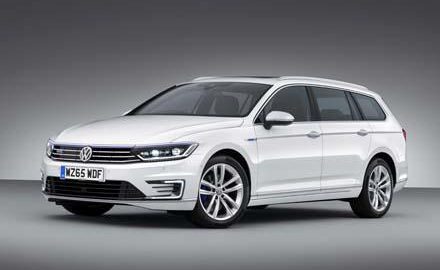
Volkswagen Awards Success – Passat GTE

Volkswagen is beginning 2016 with victories in a brace of influential industry honours.

news_c-passat-estate_gte_vw

Today (13 January) Volkswagen is receiving two trophies at the renowned What Car? Awards in London with success for both the Passat Estate GTE (Best Electric Car) and new Touran (Best MPV). Meanwhile, the Volkswagen up! takes a ‘price point’ honour in the publication’s Best City Car class.

The class wins in the respected automotive awards – now in their 39th year – continue a positive start to the New Year for the brand in the UK which began with a category victory for the Golf R in The Sunday Times’ Top 100 Cars.

Scoring a win in the Electric Car ‘Best Buy £20,000-£40,000’ category, as well as taking overall honours in the Electric Car class, the expert What Car? judges said of the Passat Estate GTE:

“This really is the kind of hybrid you could use every day without even thinking of it as an EV.

“The Passat GTE mixes a 1.4-litre turbocharged petrol engine with an electric motor and VW’s six-speed DSG automatic gearbox, and it shifts between the two power sources smoothly. The interior quality is every bit as good as on other Passats, there’s enough room for five adults to sit in comfort, and our preferred edition, the Estate, has a boot that’ll take all but the largest loads.

“Best of all, the Passat Estate GTE makes a great potential company car choice thanks to its official CO2 emissions of just 39g/km and a benefit-in-kind tax rate of 5%. It’s easily the best family hybrid we’ve seen to date.”

Awarding the Passat Estate GTE overall honours in its class, the judges added:

“It feels like the sort of executive car that you could drive to and from work on electric power, then turn into a carry-all family car to travel the length of the country at weekends. It has space, a beautifully finished cabin, and succeeds in integrating its technology so well that you needn’t even be aware that it’s there.”

Source: VW

The researchers claim there is now urgent need for a higher qualified workforce to avoid further skills shortages across the electric vehicle sector

Electric cars worth £51bn to UK economy ‘if Government acts now’

The UK Government will lose out on major economic benefits unless it makes a significant investment in upgrading the nation’s electric vehicle (EV) charging infrastructure and upskilling the motor industry, an independent academic report will warn this week.

The report, commissioned by the Institute of the Motor Industry (IMI), concludes that the overall economic and social benefit of EVs, connected and autonomous vehicles could be in the region of £51bn per year by 2030, with the potential for 320,000 newly-created industry jobs.

Researchers will present the report’s findings to a cross-party group of MPs on Wednesday (13 April), calling on the Government to focus on protecting the economic growth of the motor industry by acting strategically to make charging low emission cars more convenient for drivers, and ensuring that there are enough skilled technicians to service and repair them.

Loughborough University professor Jim Saker, who will host Wednesday’s Parliamentary meeting, said:

“The UK, by the nature of its size and geography, has a natural advantage in the rapid adoption of vehicles with the new power train technologies, but it is dependent on Government investment to pump prime this initiative.

“Without proper regulation, a skills gap will emerge with only a limited number of technicians working in the franchised sector being able to service and repair new technology vehicles. If this trend is found to be true then it is likely that the independent sector of the retail automotive sector will decline. This will mean that the market will fail to open up and develop to the benefit of the UK economy.”

Read more: Edie.net