Category Archives: Electric Cars

News and reviews of the latest electric cars (full electrics and plug-in hybrids).

How I’m saving a small fortune on my commute with an Electric Car

Receiving my monthly bill from Chargemaster makes me happy. Let me explain….

Chargemaster Plc is the company that provides the majority of Milton Keynes electric car charging points and since I only charge publicly I am billed by them for all of my ‘fuel’ consumption.

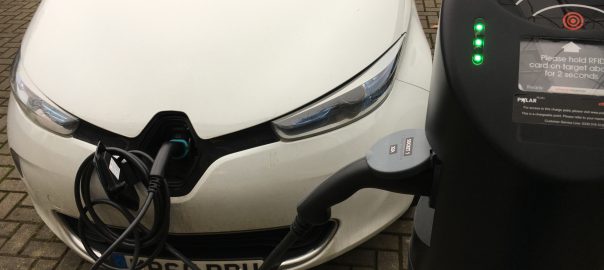
Working in Central Milton Keynes, I am lucky to have a vast network of charging points available to me, I charge mostly during my working day, as and when I need to. I also benefit from free parking under the Green Permit Scheme which covers all standard bays (purple) and some premium bays (red), both can be found across the city centre area.

Last month’s bill really did highlight to me the huge cost savings owning an Electric Car has given me, and why every commuter in Central Milton Keynes should consider getting one.

Check this out…

Petrol Car

Electric Car

Fuel cost per day

£3 (approx.)*

£0.71**

Parking

£18 (£2 per hr x9)

£0

Total cost per day for parking & fuel

£21

£0.71

Total for the period

(11 working days)


£231

Estimated

£17.20

Actual cost billed by Chargemaster PLC

(inclusive of Polar subscription fee)

Averaged over a working year (261 days)

£5,481

£408.11

*Based on my 15 mile round trip commute @ 20p per mile.

** Averaged daily cost from bill, includes ALL mileage not just commutable distance.

f

Hitachi Starts U.K. Project to Mix Clean Power and Electric Cars

Hitachi Ltd. will work on a smart-grid project in Southwest England that seeks to combine renewable energy, battery storage and electric vehicles to balance power output and usage.

Hitachi’s European unit will develop a so-called Internet-of-things platform for the 10.8 million-pound ($13.13 million) project in the Isles of Scilly, in Cornwall, according to a statement Wednesday. It’s partly funded by the European Union’s Regional Development Fund.

Electric cars can be a very effective way to save you money on motoring (Image: Go Ultra Low)
Electric cars (Image: Go Ultra Low)

PassivSystems Ltd. will supply home energy management systems, and Moixa Energy Holdings Ltd. will contribute systems that allow home and electric vehicle batteries to respond to changing demand.

“This is a key investment area for Hitachi Europe Ltd. and puts us in an ideal position to build IoT engineering capabilities in the U.K. to deploy digital solutions globally,”

Andres Larriera, head of Hitachi’s smart cities energy group, said in the statement.

Source: Bloomberg

Kia launches two new PHEV models at Geneva

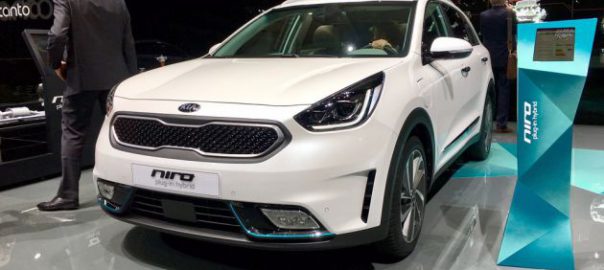
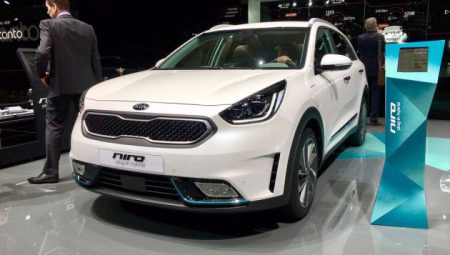
Kia unveiled two new plug-in hybrid models at the Geneva Motor Show in the shape of the Niro and Optima Sportswagon, further strengthening a green car line-up that has grown dramatically over the past couple of years.

The Niro Plug-in Hybrid uses the same foundations as the hybrid crossover, though has a much larger battery and improved economy figures. Now with an 8.8 kWh battery pack, compared to the Niro hybrid’s 1.56 kWh, the Niro Plug-in Hybrid also uses a more powerful 44.5 kW electric motor to support the 1.6 litre Kappa petrol engine.

Kia Niro Plug-in Hybrid_Geneva 2017 (image: Next Green Car)

This will result in official efficiency figures of less than 30 g/km CO2, though the car has yet to be formally tested, and Kia expects an all-electric range in excess of 34 miles.

As an extra incentive to potential buyers, Kia will also offer an optional towing pack. This will allow braked loads of up to 1,300kg to be towed, a very rare option for hybrid cars.

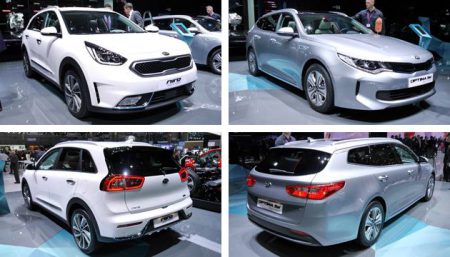
Kia Niro & Optima, Plug-in Hybrid. Geneva 2017 (image: Next Green Car)

Also announced was Kia’s Optima Sportswagon Plug-in Hybrid. Using a similar electric powertrain to the saloon version of the Optima Plug-in Hybrid, but with a larger battery – now 11.26 kWh – and a 50kW electric motor. Kia again hasn’t got official efficiency figures available, but expects 34 g/km CO2 and 188.3 MPG to be achieved, along with an electric range of more than 37 miles.

The two new announcements mean Kia will have five electrified models in its fleet, adding to the Niro, Optima Plug-in Hybrid, and Soul EV. Considering that the Hyundai-Kia group also has the likes of the Hyundai ix35 Fuel Cell and three car Ioniq range to offer too means that the company quickly become one of the market leaders in electrified fleets.

Source: Next Green Car

Wireless electric cars about to hit the road

Imagine charging your electric car as easily as you charge your electric toothbrush.

Or, your car charging itself as it drives down the road.

Those scenarios are not as far-fetched as you may think. Indeed, a group of tech gurus who gathered last month in San Diego discussed how a wireless electric vehicle is about to become a reality.

“This is definitely coming,”

said Jesse Schneider, chairman of the wireless task force for the Society of Automotive Engineers, or SAE, an international group working to develop common standards to make sure the sector’s competing technologies work together.

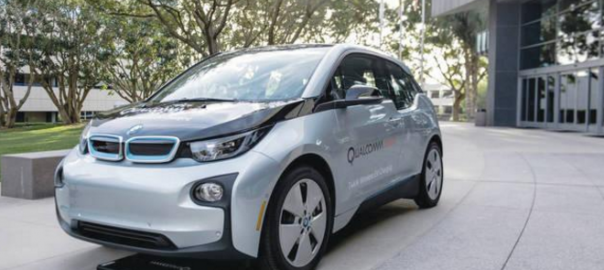
Qualcomm Halo, wireless charging (Qualcomm/ TNS)

Car buyers are familiar with plug-in hybrids and all-electric vehicles, but companies such as Qualcomm seek to jump-start the transition from internal combustion to zero-emission cars with “inductive” charging.

Instead of charging a vehicle with a plug or cable, the driver using a wireless system aligns the car over a charging pad and an electromagnetic field does the rest.

“Customers wait for the green light and then walk away, knowing when they come back they will be more fully charged or fully charged, depending on how long they were away,”

said Schneider.

“You can actually just park over the wireless charging system and everything is done automatically after that.”

The technology has been talked about for years but, starting with the hybrid version of the 2018 Mercedes-Benz S550e, wireless vehicle charging technology will make its debut. The German automaker reached an agreement with Qualcomm to use the San Diego-based company’s Halo technology as a feature on the luxury car.

Read more: Courier Tribune

Renault ZOE battery upgrade conditions

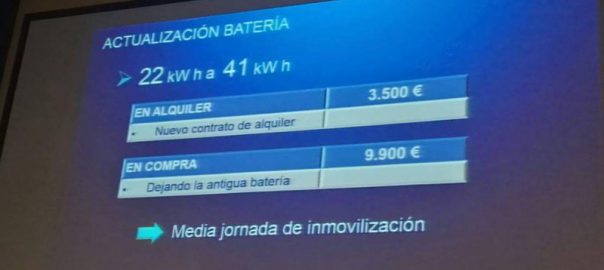
Later this year you’ll be able to upgrade your old ZOE’s battery to the new ZE 40.

For customers that are currently leasing the battery the upgrade will cost 3.500 € and a new leasing contract with higher monthly fees has to be signed, however for those who already own the battery the upgrade will cost 9.900 €.

While the battery upgrades for current ZOE’s owners will start in the second semester this year, there isn’t an official date yet. This uncertainty can be related to the LG Chem battery plant in Poland that will start production also in the second semester.

Renault battery upgrade prices

Renault has a clear interest of delaying the battery upgrades and prioritize the selling of new ZOEs.

As equally – or even more – important as the battery upgrade would be if Renault allowed its customers to simply outright purchase the batteries and end the lease if they wanted to.

Currently the only way to do it isn’t very straight forward. It consists in stop paying the monthly battery rental when the contract ends and fully pay what Renault Crédit International (RCI) considers to be the battery’s value. In both 22 and 41 kWh batteries, RCI considers the value to be 7.000 € (without VAT) when new, and they lose 10 % of their value per year.

For example if you have been renting the battery for 3 years, you would have to pay 5.103 € (7.000 € x 0,9 x 0,9 x 0,9) plus VAT to terminate the battery lease contract and keep the battery. I just wished that Renault would make this process simpler. However I’m sure that some friendlier Renault dealers already help you in this process if you need to.

While Renault representatives keep saying that people prefer the battery leasing scheme, we know that this isn’t true, as it suggests a poll that toke place at the French Automobile Propre forum, where only 10 % of the inquired said to prefer the battery rental scheme…

In Portugal for example, Renault gives higher discounts for ZOEs sold with battery rental than with battery included.

Source: PushEVs

IEA: 7 out of 10 cars must be electric to limit global warming to 2⁰C by 2050

With CO2 emissions frequently discussed in the automotive industry, it is useful to view this in a broader context.

The International Energy Agency (IEA) reports that global CO2 emissions held at the same level in 2016 as in the previous two years. But to limit global warming to no more than 2°C above pre-industrial levels, which is the critical target for global climate policy, ‘would require an energy transition of exceptional scope, depth and speed, including a doubling of annual average energy-related investments from current levels’ according to the IEA.

The IEA attributes the stability in emissions to increased use of renewable energy, a shift from coal to natural gas and improvements in energy efficiency as well as structural changes in the global economy. However, to achieve long-term targets, the IEA also states that

‘emissions need to peak before 2020 and fall by more than 70% below today’s levels by 2050.’

So what does this mean for the automotive industry?

The IEA suggests numerous measures that are required to bring global emissions down to the target level by 2050. These include 95% of electricity being low-carbon, retrofitting building stock and a $3.5 trillion annual investment in the energy sector. The IEA believes that fossil fuels will still be needed but would only account for 40% of demand, half of their share today.

Crucially, to help reduce the reliance on fossil fuels, the IEA says

‘7 out of every 10 new cars would need to be electric, compared with 1 in 100 today.’

This relates to the share of electric vehicles in new registration figures globally, which is currently estimated at about 1%. However, the electric share of the parc is naturally significantly lower.

Read more: Autovista Group

Charging at Sedgemoor Services on the M5 (Image: T. Larkum)

BMW set to launch biggest ever model offensive and second wave of electrification

BMW sold 2.25 million cars across all its brands – BMW, Mini and Rolls-Royce in 2016.  But for the first time in eleven years sales at the core BMW brand fell below rival Mercedes-Benz. It is looking to transform and revitalise the company by focusing on new launches, particularly electric vehicles (EVs).  At the annual press conference it announced plans to launch no less than 40 new and revised models.

Charging at Sedgemoor Services on the M5 (Image: T. Larkum)
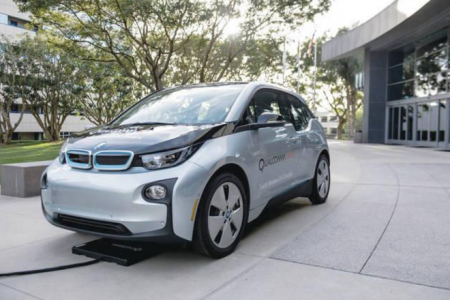
BMW i3 (Image: T. Larkum)

CEO Harald Krüger said:

‘We are launching the biggest model offensive ever… We have started a transformation unlike anything our company has seen before.’

By 2025, BMW aims for electric and plug-in hybrids to account for 15-25% of overall group sales.  In the short term it is targeting sales of 100,000 EVs by the end of the year.

BMW’s electrification offensive will see a major expansion of its electric base, with the launch of eight plug-in hybrid model options from summer this year. Krüger said:

‘The drive of the hour is the plug-in hybrid.’

Hybrids are widely expected to be needed as a bridge technology to reach CO2 fleet limits alongside all-electric cars.

On the all-electric front, it will continue to focus on its current best-seller the i3 and also new launches for Mini and BMW X3 based on new technological advances since the i3.

Ultimately BMW aims to complete its electric realignment strategy in earnest in a second wave starting from 2019, when it will finally offer its entire catalogue of series models as pure electric cars – in time for incoming EU (and Chinese) regulations.

Source: Autovista Group

Clean disruption of energy & transportation

The industrial age of energy and transportation will be over by 2030. Maybe before.

Exponentially improving technologies such as solar, electric vehicles, and autonomous (self-driving) cars will disrupt and sweep away the energy and transportation industries as we know it. The same Silicon Valley ecosystem that created bit-based technologies that have disrupted atom-based industries is now creating bit- and electron-based technologies that will disrupt atom-based energy industries.

Clean Disruption projections (based on technology cost curves, business model innovation as well as product innovation) show that by 2030:

– All new energy will be provided by solar or wind.
– All new mass-market vehicles will be electric.
– All of these vehicles will be autonomous (self-driving) or semi-autonomous.
– The car market will shrink by 80%.
– Gasoline will be obsolete. Nuclear is already obsolete. Natural Gas and Coal will be obsolete.
– Up to 80% of highways will not be needed.
– Up to 80% of parking spaces will not be needed.
– The concept of individual car ownership will be obsolete.
– The Car Insurance industry will be disrupted. The taxi industry will be obsolete.

Read more: Tony Seba


Electric Cars (Image: Autocar)

Car tax to be scrapped for electric vehicles

Car tax is set to be overhauled this April, so what’s changing?

From 1 April 2017 the way car tax is figured out is set to change for any vehicles registered after this date. The change could be seen as good news for owners of electric or hybrid vehicles.

How will the new tax rates affect me?

While measures are being put in place to curb congestion and reduce air pollution with the investment of millions in congestion-cutting technology, could increasing the number of electric cars on the road be the solution?

The government seems to think so as it is introducing a change to the road tax system.

As it stands all vehicles, except for pedal bicycles, are subject to Vehicle Excise Duty (VED), also known as road tax. It is split into several bands, based on CO2 emissions but as of 1 April, all electric vehicles will move into band A, which means drivers of electric vehicles will no longer pay road tax.

If this news has you thinking electric cars could be for you but aren’t quite sure which kind to buy, it’s worth noting  plug-in hybrids are also exempt, but not pure hybrids. This is because they still produce emissions, and only vehicles that produce either no emissions or emissions less than 100g/km are exempt from VED.

Further changes to the vehicle tax rates will take effect in April. The tax payable on a new vehicle for the first twelve months will be calculated based on its emissions – the higher the emissions, the higher the tax. This only applies to new vehicles registered after 1 April 2017. All vehicles registered between March 2001 and April 2017 will pay tax based on the old rates.

How can I save money on an electric car?

Buying an electric car can be quite expensive – something which will hopefully change as their popularity increases – but the good news is the plug-in vehicle grant has been extended to March 2018. This gives motorists money towards the cost of an electric vehicle, up to 35% of the cost of the vehicle. The maximum amount given is £4,500.

What it means for owners of diesel and petrol vehicles

It may still be expensive to purchase an electric vehicle, but they are expected to become cheaper over time. According to predictions by analysts at Bloomsberg New Energy Finance, the drop in battery costs could result in them being cheaper overall than petrol or diesel models by as early as 2022. Being exempt from VED will certainly contribute to this.

If you’re looking to buy a petrol or diesel vehicle, you could start paying up to £450 per month in tax. New vehicles worth over £40,000 will be taxed at the new rates for the first twelve months, after which, petrol and diesel owners will have to pay an additional rate of up to £310 per month.

Expensive as electric vehicles can be, their owners could potentially save money in the long run. Not only will you no longer have to pay expensive fuel prices, but you may well pay absolutely nothing in road tax and could qualify for the plug-in vehicle grant.

Source: Admiral Insurance
Money Box Live: The Cost of Buying a Car

There was an interesting programme on Radio 4 yesterday, it was Money Box Live on the topic of ‘The Cost of Buying a Car’. It’s well worth a listen – there’s a link below, plus the programme summary below that.

It starts with the impressive statistic that 2.7 million cars were sold in the UK last year. It then explains and discusses the various options for financing a new car, particularly PCP and PCH (lease). Some interesting facts were that 70-80% of sales were on PCP, and that 80% of those who take a PCP give the car back at the end.

There are then brief items on used cars (from 18.5 minutes), and on the poor outlook for diesels.

Finally there is a discussion on electric cars (from 20 minutes), with a contributor from the Next Green Car website covering the benefits and savings of going electric – including the tax changes from 1st April.

Overall an interesting and pretty will balanced programme.

iPlayer Radio – Money Box Live

“Louise Cooper looks at the finances of buying a car. New or used? Finance or cash? Electric or hybrid? What do we really need to know about payment plans, motoring costs, and how to buy safely?

The Society of Motor Manufacturers and Traders (SMMT) reported record sales of new cars in 2016, boosted they say by strong consumer confidence, low-interest finance deals and the launch of several new models. Fleet vehicles accounted for much of the increase with sales to consumers falling for three out of four quarters.

Consumer confidence might be boosting sales but around 86% of private buyers rely on finance agreements to make the purchase, over £18bn was advanced to consumers for new car purchases and a further £13bn for used cars last year say The Finance and Leasing Association. So how does car finance work and how easy is it to compare the actual price of a car with so many different offers, interest rates, deposits and final payments in the mix?

Could you be tempted by the grants and lower mileage costs of running an electric or a hybrid model? Sales of alternatively fuelled vehicles rose by 48.9% in February with 3,308 new registrations. If you’ve switched from petrol or diesel to a low emission car let us know how it compares.

And is it better to buy online, from a dealer or privately? How can you check the history of the car you want to buy?”