Category Archives: Electric Cars

News and reviews of the latest electric cars (full electrics and plug-in hybrids).

Solar panels, EV chargers required in new homes in Fremont, CA

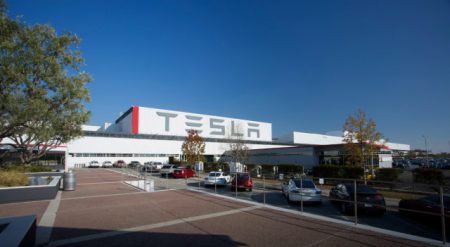
Half a century ago, the General Motors assembly plant was the largest employer in Fremont, California, and the town was known for its dragstrip.

Today, that plant makes Tesla electric cars and Fremont is a part of the San Francisco Bay Area’s Silicon Valley, creating advanced technology for the world.

Tesla Factory, Fremont, California

The city has now taken another step into the future, requiring that all new houses be delivered ready for the installation of electric-car charging stations.

According to the East Bay Times, the city of Fremont has announced that any new housing project must include both solar panels and the electrical wiring required for the installation of a charging station.

The town, across the bay from Palo Alto—where a similar regulation was adopted in 2013—prides itself on being the ZIP Code with the highest concentration of electric-car owners in the state.

That makes it likely to have the highest such concentration in the U.S.

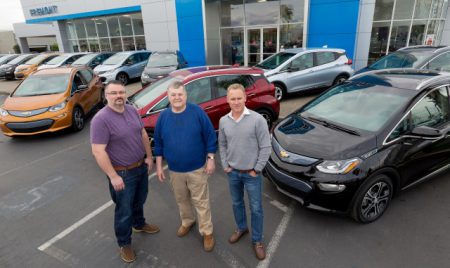
First 2017 Chevrolet Bolt EV Buyers, Fremont, California: Bobby Edmonds, Bill Mattos and Steve Henry

When the first 2017 Chevrolet Bolt EV electric cars were sold in December, Fremont Chevrolet was the site—because it sells more Chevy Volt plug-in hybrids than any other dealer in the country.

It’s exactly 3 miles from the dealer to the Tesla factory, formerly the GM-Toyota joint venture known as New United Motor Manufacturing Inc. or NUMMI.

The required coverage of the solar panels will be determined by the size of the new project.

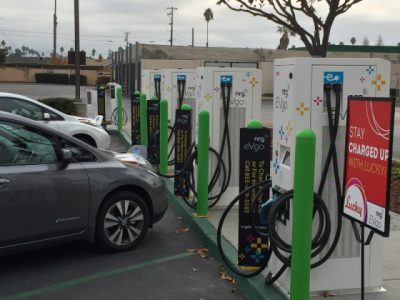
EVgo DC Fast-Charging Site in Fremont, California.

As for the charging stations, the wall hardware itself will not be mandatory.

New buildings will, however, have to be equipped with the electrical setup needed for later installation.

For commercial or multifamily projects, the ruling goes even further, requiring that at least 10 percent of the parking spaces have charging stations installed

Read more: Green Car Reports

Runaway Adoption of Pure Electric Vehicles: Multiple Triggers

It has long been speculated that electric vehicle adoption may have a sudden tipping point of adoption. IDTechEx pointed out that incentives help as does reaching lower cost of ownership but lower up-front price is the killer blow.

We noted how that has happened with small vehicles such as gasoline-assisted bicycles and golf cars becoming more expensive than pure electric alternatives, this resulting in runaway adoption of electric. Ten years ago, IDTechEx correctly predicted that this will progress to ever larger vehicles with on-road small cars in line for being cheaper as pure electric from 2020 onwards.

On cue, several car makers have now said they will be offering pure electric versions at no price penalty in that timeframe. That is more dramatic than it sounds, because maintenance of the much simpler pure electric powertrain and the cost of the electric “fuel” are tiny compared to conventional and vehicle life is often to be longer too.

Domino effects

There will be a domino effect. Take diesel. Many cities have set dates when they will ban diesel vehicles and some countries are contemplating such legislation. Globally sales of diesel vehicles are dropping due to the Volkswagen scandal, purchasers fearing that resale prices may collapse. In European countries sales of diesel are essential to gasoline stations: for example, in the UK, they represent 65% of fuel sales. There, the number of such “forecourts” is one sixth of what it was and the few remaining ones will be very tempted to grab the hefty increased property value and let someone turn them into apartments or, since they are shopping locations already, as supermarkets.

Ironically, shutting down gasoline stations is encouraged by the fact that you cannot make significant money out of EV chargers on your forecourt. Legislation is going through in the UK that gives the government the right to force the larger forecourt owners to provide EV charging.

Other unintended consequences

The unintended consequence will be extra journey time and hassle for drivers seeking petrol, not just diesel. Suddenly it is the internal combustion engines that become a pain to refuel whereas EVs are charged at home and at destination, a convenience not possible with the conventional vehicle.

This will make petrol vehicles undesirable even before cities and countries ban them and they become overpriced as they become more complex to meet 2025 and 2030 carbon dioxide laws intended to reduce global warming and a raft of acid gas restrictions, diesel being hit by particulate restrictions too.

Multiple hits

We face multiple hits on conventional vehicles all the time now, another example being linkage between diesel and breast cancer, depression and more, not just lung and heart disease.

As causality is proven and the true scale of injuries is revealed, people will be more and more cautious of putting money that way and that includes investors, so modernisation of facilities, reduced emissions and competitive pricing of conventional vehicles becomes more and more difficult.

Fuel cell tipping point

With runaway adoption of battery electric vehicles, even the grants for these non-green fuel cell vehicles are under threat, creating a self-fulfilling prophesy and boosting pure electric.

IDTechEx correctly forecasted the realisation that fuel cell vehicles will never be mainstream but, like all forecasters, we are struggling to predict accurately when the tipping point of pure electric cars will come.

Read more: IDTechEX

Fleet News Awards 2017: Best Plug-in Car (1-50g/km) – BMW i3 Range Extender

BMW has got all the ingredients right for it i3 electric car, despite its quirky looks.

Transport minister John Hayes CBE hands the award to BMW Group general manager, corporate sales Steve Oliver.

Although the fully electric version lost out to the more affordable Hyundai Ioniq in the zero tailpipe emissions category of our awards, members of our judging panel had plenty of praise for the Range Extender (REX) version of the i3, which has a small motorcycle engine to charge the battery when the plug-in range has depleted.

Made available with revised battery chemistry last year to boost its range, the i3 can now reach up to 195 miles on the official test cycle, or up to 243 miles with the Range Extender.

The i3 has played its part in the past three years to draw greater attention to EVs and make them desirable and aspirational. By far the most powerful compact EV on sale with 172PS, and using carbonfibre construction to minimise weight, the rear-wheel drive i3 has been very much the driving enthusiasts’ choice among plug-in cars.

Finalists

  • Audi A3 e-tron
  • BMW i3 Range Extender
  • BMW 330e
  • Mercedes-Benz C350e
  • Mercedes-Benz E350e
  • Volkswagen Golf GTE
  • Volvo XC90 T8

Judges’ comments

Practical and with a striking design, the i3 Range Extender offers a decent range with the added security of the range-extender petrol engine. It is great to drive and has competitive running costs thanks in part to the clever use of carbon fibre technology for low-cost repairs.

Award winner video

Source: FleetNews

Renault Zoe Named A Game Changer At Awards

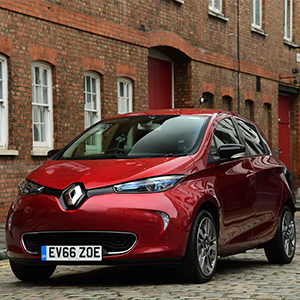
The Renault ZOE has received the ‘Game Changer’ award by Autocar judges at the world’s oldest motoring magazine’s annual awards ceremony at Silverstone.

The Renault ZOE, fitted with the new 250-mile range (NEDC) Z.E.40 battery, has been recognised at the Autocar Awards 2017 as a true innovator in the ever-growing electric vehicle market. The Renault ZOE’s new Z.E.

Renault ZOE ZE40

40 battery delivers almost double the range of the previous battery, providing motorists with an electric vehicle option that is better suited to many lifestyles with the average daily commuting distance being well within the ZOE’s capabilities.

Renault, as Europe’s best-selling electric vehicle manufacturer, believes in giving the customer confidence in their use of electric vehicles by estimating ZOE’s real-world range as 186 miles.

Renault, as Europe’s best-selling electric vehicle manufacturer, believes in giving the customer confidence in their use of electric vehicles by estimating ZOE’s real-world range as 186 miles.

Commenting on the decision to award the ZOE Autocar’s ‘Game Changer’ award, Mark Tisshaw, Editor, Autocar said:

“The new Renault ZOE is an important step in bringing affordable electric motoring to the masses. An already good car has been improved further, now coming with a real-world range that extends close to 200 miles to make it a more viable everyday proposition for more people. We commend Renault for that, and

An already good car has been improved further, now coming with a real-world range that extends close to 200 miles to make it a more viable everyday proposition for more people. We commend Renault for that, and recognise the ZOE as a trailblazer for electric cars.”

Vincent Tourette, Managing Director, Renault UK, said of the result:

“The Renault ZOE has always excelled at providing motorists with a stylish, comfortable and practical electric car at an affordable price tag. The 2017 ZOE with the Z.E.40 battery, as well as interior and exterior upgrades, builds on this success and now delivers the longest range of any mainstream electric vehicle.”

Read more: Fleet Point

Qualcomm can charge EVs while they’re moving

A new track can simultaneously charge two cars driving in opposite directions.

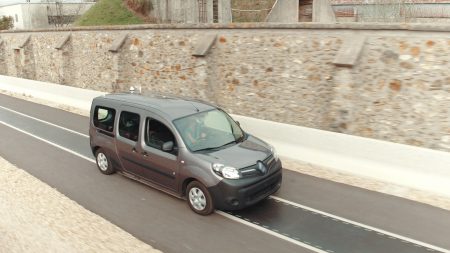
Renault Kangoo EV used in Qualcomm’s tests. Qualcomm

Forget about better batteries, what if you could just drive your EV forever? Qualcomm just showed off technology called dynamic electric vehicle charging (DEVC) that juices an EV via road-embedded wireless charging hardware while you’re driving. During the demonstration, two Renault Kangoo vehicles equipped with Qualcomm’s “Halo” DEVC receivers were charged simultaneously while moving down a 100 meter test track.

Based on Qualcomm’s wireless electric charging (WEVC) tech, the track can charge vehicles driving at highway speeds in both directions (both in forward and reverse) at 20 kW max. If it works, the tech could be used in a system that lets you call a car using a smartphone, get picked up where you are and be whisked to your destination autonomously (as shown in the animated video, below).


Qualcomm will now hand its DEVC charging system to Vedecom, which

“will evaluate the operation, safety and efficiency of energy transfer to the vehicles for a wide range of practical scenarios, including vehicle identification and authorization on entering the track, power level agreement between track and vehicle, speed and alignment of vehicle along the track.”

Read more: engadget

Five ways that autonomous electric cars will change your life

Here are five ways that autonomous cars will change our lives for ever – and much sooner than we think. Is this progress or decadence (or just sheer nonsense)? You decide:

image: comingtozero

Mobile homes. With real estate becoming ever more expensive, there is a case for owning a permanently-mobile home. With the low per-mile cost of electric driving, balanced against the sky-high price of real-estate, a fully autonomous electric home can take its owner to a quiet location at night, or even just drive at low speeds throughout the night, and still be a fraction of the cost of a land based home. Pre-set destinations and recharge automation will mean the vehicle can recharge as required, and arrive at the residents needed location at just the right time the following morning.

image: solar alley

Cash generating asset. If the budget runs low, then simply connect your vehicle to the grid at a fixed location for a few days and let the battery earn you some revenue as part of a grid-balancing aggregation program.

image: vetse news

Party heaven. For those of us that enjoy a drink, there is no longer a need for a designated driver. The car will always be sober and safe. However, what does this mean for public health? Is alcohol going to become a greater problem for more people without the ‘excuse’ of driving to have a night off?

The weekend starts here. After a Friday night-out with work friends, you can sleep it off as your car heads off overnight to your weekend destination.

The car is THE venue. Whether for business meetings or small social gatherings, the interior of an autonomous car no longer needs to be designed for the purpose of driving and so can become a location in its own right with more comfort and leg room and inward facing seats. With the expected safety improvements of autonomy, seat belts will no longer be a necessity. Imagine a lunch meeting with friends where the food is pre-ordered and picked up by the car before it collects your group. The car gives a tour of London’s most picturesque sites while you eat and relax.


For more information on autonomous driving,  visit our searchable news blog here or check out a couple of specific articles: MIT have ideas on technology for autonomy and people are talking about the effect on people.

Ford replaces CEO with head of ‘mobility’ and appoints new exec for electric vehicles

Ford had a massive leadership shakeup today that saw CEO and longtime executive Mark Field ousted and replaced by Jim Hackett, the head of the automaker’s ‘Smart Mobility’ division.

Mark Fields, Former Ford Motor Company president and CEO has been replaced.

The company also appointed a new executive in charge of “strategy and business model development for electrified vehicles and autonomous vehicles.”

In a press release, Ford gave some bullet points on the leadership changes:

  • Jim Hackett named as Ford Motor Company president and CEO, succeeding Mark Fields, who is retiring. Hackett, who will report to Executive Chairman Bill Ford, is recognized as a transformational business leader
  • Hackett led Steelcase Inc.’s turnaround to become the world’s No. 1 office furniture maker, served as interim Athletic Director at University of Michigan and has led Ford Smart Mobility LLC since March 2016. He served on Ford’s board from 2013 to 2016
  • Hackett, together with Bill Ford, will focus on three priorities: Sharpening operational execution, modernizing Ford’s present business and transforming the company to meet tomorrow’s challenges
  • Ford also named leaders to three new roles under Hackett. Jim Farley is appointed executive vice president and president, Global Markets, Joe Hinrichs is appointed executive vice president and president, Global Operations, and Marcy Klevorn is appointed executive vice president and president, Mobility
  • Mark Truby is appointed vice president, Communications, and elected a company officer.  He succeeds Ray Day, who plans to retire from the company next year and will provide consulting services until then
  • Paul Ballew is appointed vice president and Chief Data and Analytics Officer

In his new role as executive vice president and president of Global Markets, Jim Farley will be the executive in charge of Ford’s electric vehicle plans.

Read more: Electrek

cheapest electric car UK

Cheapest Electric Car UK

Cheapest Electric Car in the UK

A lot of people are searching for ‘cheapest electric car UK’ at the moment. We can help with that, though it can be difficult to say what’s the cheapest electric car in the UK because it depends on what you mean by ‘cheapest’. Let’s dig a bit deeper.

cheapest electric car UK

The most popular electric cars, are as follows:

Cheapest Electric Car UK (Image: Fuel Included)
Cheapest Electric Car in the UK (Image: Fuel Included)

Cheapest Electric Car UK: Monthly Cost

Of these the cheapest on a monthly basis are consistently the Nissan Leaf and the Renault ZOE. Typical starting prices are as follows (June 2017):

Those are great prices considering they include fuel (charging) plus with an electric car road tax is free, congestion charging is free, parking is often free, and servicing is cheap.

Clearly, though, this provides an answer to the original question. The Cheapest Electric Car UK (on monthly cost) is the Nissan Leaf.

Cheapest Electric Car UK: Cost Per Mile of Range

However, that’s not the end of the story. Electric cars are better than conventional cars in virtually every respect (performance, noise, smoothness, pollution, etc.). They do, however, typically have shorter ranges. Therefore it is usual to pay a premium for longer range electric cars (the Tesla being a well-known example, though it’s out of the reach of most people).

Let’s consider the question of range then. We’ll use the official NEDC (New European Driving Cycle) ranges, though we’d be the first to say these should be taken with a pinch of salt. In the real world you’ll only get about 75% of the NEDC range. However, they do give us a consistent metric for comparison purposes.

The NEDC ranges are as follows:

  • Nissan Leaf (30kWh battery): 155 miles
  • Renault ZOE (44kWh battery): 250 miles

If we take these into account we can work out the monthly cost per mile of range:

  • Nissan Leaf (30kWh battery): 155 miles for £255 = £1.65 per month per mile of range
  • Renault ZOE (44kWh battery): 250 miles for £309 = £1.24 per month mile of range

And so we have a new answer to the original question. The Cheapest Electric Car UK (cost per mile of range) is the Renault ZOE. And it’s that unprecedented range in a small, affordable and stylish electric car that explains why it’s so popular. See our Renault ZOE prices here.

Cheapest electric car uk

To see how much an electric car could save you, use our total cost of ownership calculator.

To find out which electric car would suit you best, just ask.

Why The Renault ZOE Is Europe’s Killer EV Right Now — And Could Stay That Way Too

Forget about the Tesla Model S, Tesla Model X, or Tesla Model 3. Renault’s unassuming ZOE electric hatchback is currently undergoing a massive rise in sales across Europe, making it the most popular plug-in car across the continent for the first quarter of this year.

Despite being nearly as old as the Nissan LEAF in terms of its design, the Renault ZOE recently gained a massive battery pack upgrade, going from 24 kilowatt-hours of capacity to a whopping 40 kilowatt-hours.

And that, as we explain in the video above, has changed things forever for the four-seat plug-in.

Source: Transport Evolved


Plugging into a better future | 2018 BMW 530e iPerformance First Drive

The Germans often stumbled during their first forays with plug-in hybrids. They were so fixated with not being the Toyota Prius, they overcompensated and stuffed big engines under the hood that weren’t all that efficient, even with electrified assistance. BMW in particular tried to convince the world hybrids were still enjoyable to drive.

To some extent they were, but BMW missed the point. Many consumers actually did want range and fuel economy, and Bimmer watched as its competitors rolled out efficient small displacement plug-in hybrids. With the 2018 530e iPerformance sedan, it looks like the company is finally getting it.

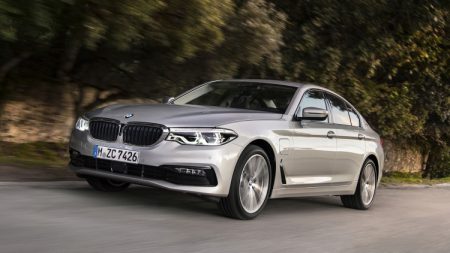
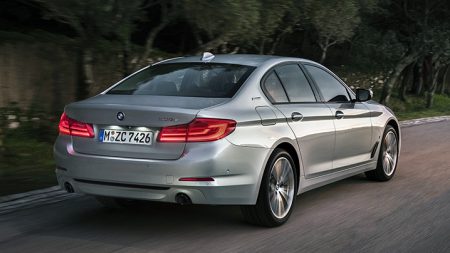
BMW 530e iPerformance

The sedan achieves up to 31 miles on electricity and the total range is claimed at 404 miles. Power comes from a 2.0-liter twin-scroll turbocharged four-cylinder with variable valve lift, which teams with an eDrive AC synchronous electric motor for a total output of 248 horsepower and 310 pound-feet of torque.

Perhaps the car’s coolest trick is its new wireless charging system, which BMW developed with Daimler-Benz. It will charge the battery at a rate of 3.2 kilowatt hours (one-third of total capacity) within 3.5 hours. With BMW Connected on the center screen, the car ‘sees’ the 2-foot square charging pad via a wireless network. The driver is guided with a set of blue lines on the screen over the pad with an accuracy of 2.8 inches from side to side and four inches from front to back.

Inside you’ll find a familiar 5 Series setup: austere, profoundly practical, and classy. Start her up and nothing happens except some wildly swinging needles in the instrument panel and enough blue light to think you’ve been transported to a Berlin nightclub. There’s an eDrive (displaying battery charge, range, etc.) on the right side and a simple speedo on the left.

There are several main modes of operation: auto eDrive, where the car chooses which power unit to use for maximum efficiency, with EV mode available up to 56 mph; max eDrive, where the car favors electric power with EV mode up to 87 mph; and battery control, where the gasoline engine will charge the battery pack and power the car.

BMW 530e iPerformance

It’s worth recalling that just over five years ago, BMW launched its first hybrid, the Active Hybrid 5, in which the engine was a 3.0-liter straight-six, the electric motor was a sort of volt-fueled supercharger and the realistic gas mileage didn’t approach the claimed sticker. Fast-forward half a decade, and the company is far more evolved and in-step with consumer tastes, as the 530e demonstrates. It isn’t brilliant to drive, but it does save gas. Munich engineers have finally gotten the point.

Read more: Auto Blog