Category Archives: Nissan

News and reviews of Nissan electric cars (including plug-in hybrids).

Electric Car Recharging

Is now the time to buy an electric or hybrid car?

Best cars and options explored

The future of driving appears to be electric, with Formula E in full effect, supercars adopting hybrid drive systems and range getting further all the time. Fuel powered engines may have their days numbered. But is it time to make the change to electric?

Now that the big car manufacturers are creating hybrid and electric cars we can be assured that it’s the future. And thanks to infrastructure improving all the time for charging stations range isn’t becoming such a big issue. But last year’s Tesla owners won’t get updated with the latest self-driving tech of this year’s Tesla, not a very nice reward for early adopting.

So is it still too early to adopt? Are batteries in cars suddenly going to improve to make current models a joke? We’ve looked at what going on to help give you a clearer idea of what to do.

Pure electric cars right now

The selection of pure electric cars right now isn’t huge, but it’s more than ever before and range is now good enough for day-to-day use. Prices, in the UK at least, are kept reasonable thanks to government assistance taking £5,000 off the price and offering free tax. If you offset petrol costs too you’re saving even more.

At the top end there’s Tesla with its Model S boasting all wheel drive and self-driving smarts starting at around the £50,000 mark. But this is in a league of its own with sports car performance, plus the latest model is not actually going to be in the UK until July 2015, even if you can buy yours now.

Then there are established brands like BMW, Ford, VW, Nissan and Renault all making fully electric cars at affordable prices right now.
Range, charging times, price and power

When going electric most people will be juggling these few key numbers: range, charging time, price and power.

PRICE: Firstly there’s price, at which the Renault Zoe wins by a fair margin starting at £14,000. Nissan’s Leaf can be bought from £16,500, Kia’s Soul EV is £25,000, the VW e-Golf is from £26,000, and BMW with its i3 is from £31,000.

RANGE: The range winner, from the reasonably priced cars, is the Kia Soul EV with 135 miles. In close second is the Nissan Leaf with 124 miles. Coming in behind them is the BMW i3 with a 118 mile range along with the VW e-Golf also sporting a 118 mile range, followed by the Renault Zoe with 93 miles.

Of course if you include the Tesla Model S that wins with its base model eeking out an impressive 240 miles on a charge and its top end offering 312 miles a go. But you get what you pay for.

CHARGE: This is a fairly even playing field with the cars all offering a rapid charge to 80 per cent in half an hour. Across the board it’ll cost you to upgrade your home charger for faster charging but this can result in as fast as a 3-hour charge to full.

POWER: Electric cars deliver all their torque instantly and the engine directly powers the wheels, this means they feel really nippy pulling away. The Nissan Leaf utilises 107hp to do 0-60mph in just 7 seconds making it the quickest of the lot off the mark.

The BMW i3 has 170hp for a 0-60mph time of 7.2 seconds, the Renault Zoe has 83hp for a 0-60mph time of 8 seconds, and the VW e-Golf manages 0-62mph in 10.4 seconds thanks to its 114hp motor. In last place is the Kia Soul EV with its 108bhp delivering a 0-60mph time of 10.8 seconds.

So for price the Renault Zoe wins it, but for range and power the Kia Soul EV comes out on top.

Plug-in hybrid electric cars right now

Hybrids have been around for years with the Toyota Prius leading the way with its dual-drive system. These are now more common than ever with Uber drivers using Prius as the car of choice.

But the market has grown, especially recently, with plug-in hybrids that allow drivers to charge at home so they may never need to use the fuel engine, instead reserving that for long distance journeys only.

From the Volvo V60 Plug-in and Ford Mondeo Titanium Hybrid to the Golf GTE or the BMW i3 with range extender, hybrids are fast becoming viable alternatives to single engine cars. The extra you may spend on the new technology can soon be made back in the petrol and tax savings they offer.

Range, charging times, price and power

Plug-in hybrid cars mean less of a worry about range than pure electric while also offering power and a reasonable price.

As with the Tesla we’re not going to include the likes of the McLaren P1, BMW i8, Porsche 918 and Ferrari LaFerrari as they’re all reserved for the super rich. And we’re only using plug-in hybrids as straight hybrids are fast becoming outdated in favour of the electric only options and extended range of plug-in hybrids.

PRICE: The plug-in hybrid range have all arrived at a similar time with manufacturers savvy to the government’s £5,000 contribution. For this reason they’re all very similarly priced.

The winner, by a narrow margin is the Ford Mondeo Titanium Hybrid from £25,000, with Mitsubishi PHEV GX3h from £28,250 in second and closely followed by the Toyota Prius Plug-In Hybrid from £28,395.

Then we have the Vauxhall’s Ampera from £29,000, Audi A3 Sportback e-tron from £35,000, BMW i3 Range Extender from £34,000 and Volvo V60 Plug-in hybrid from £45,000.

RANGE: Winning with an impressive 967 mile range is the Ford Mondeo Titanium Hybrid but it only manages around 20 miles on electric alone. Closely behind that is the BMW i3 with range extender that offers a 930-mile top end with pure electric for 105 miles, making it overall cheaper to run than the Ford. The Toyota Prius Plug-In Hybrid can manage up to 700 miles in one journey but loses on electric alone with just 15 miles on a charge.

Audi’s A3 Sportback e-tron can last for 585 miles with 31 of those miles on electric alone. Despite its size the Mitsubishi PHEV GX3h manages 500 miles with 32 on electric alone. Vauxhall’s Ampera eeks out 310 miles with between 20 and 50 of those miles on battery.

CHARGE: As in pure electric cars this is a fairly even playing field with the cars all offering a rapid charge to 80 per cent in half an hour. Across the board it’ll cost you to upgrade your home charger for faster charging but this can result in as fast as a 3-hour charge to full.

POWER: The Audi A3 Sportback e-tron, as the name suggests, wins this with a 0-62mph time of 7.9 seconds thanks to 204hp. The BMW i3 Range Extender model is second offering 170hp for 0-60mph in 7.9 seconds.

The Vauxhall Ampera does 0-60mph in 8.7 seconds with 148hp, despite having 178hp the Ford takes 9.2 seconds to get from 0-62mph, the Toyota Prius Plug-In Hybrid gets from 0-60mph in 11 seconds from 134hp, the Mitsubishi PHEV GX3h does 0-60mph in 11 seconds and has 186hp.

The winner for price is the Ford Mondeo Titanium Hybrid but the BMW i3 takes it for range with the Audi offering the most power.

Future electric and hybrid cars

The future of electric cars and hybrid machines is looking positive. Charging infrastructure is cropping up all over the country with Tesla’s Elon Musk promising to install his Supercharger network UK wide by the end of next year.

Crucially, right now, it’s possible to drive pure electric all the way from the top of Scotland to the bottom of England thanks to fast chargers along the way. It might take a little longer than petrol cars since you have to stop for half an hour to recharge, but it won’t cost as much by a long shot. So adopting right now, especially if you’re going for a hybrid, isn’t as risky as it once was.

Another issue is batteries. Developments are being made more and more regularly as car manufacturers pour money into research. But worrying about having an older battery shouldn’t be an issue as, hopefully, manufacturers will be able to swap out old for new future-proofing any car you buy now.

Next year Tesla hopes to offer a car which is nearly completely self-driving. But since that’s out of the price range of most people current electric car offerings are plenty futuristic.

If you’re already driving a car and the cost of petrol and tax are proving too much then electric or hybrid could be your way out.

Source: Pocket Lint
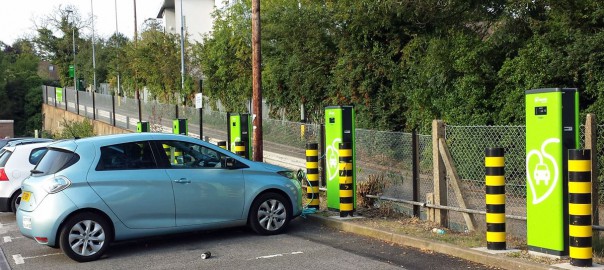
Fast charging at one of the dozen rapid chargers at Stanmore (Image: T. Larkum)

People’s Climate March – Part 3

[Part 1]

[Part 2]

Once the Climate March was over I expected the return journey to be straightforward, but it wasn’t to be. I knew that there was extensive engineering work underway on the London Underground but it did not impact directly on the route I intended to use back from Westminster to Kentish Town.

However, early in the journey it became clear there was another problem. Announcements over the tannoy system indicated that a significant part of the northern section of the tube was experiencing a temporary closure. The reason given was that there was a person on the line, and the implication seemed to be that there had been a suicide attempt.

Nissan Leaf on charge in Highgate (Image: T. Larkum)

Anyway, after a number of changes of route and failed redirections I got back to Camden Town and decided to walk from there, even though it was further than I would have liked. At least, I felt, my progress was under my control.

On the way I spotted another electric car, this time a Nissan Leaf. It was plugged in and charging in the compound of a civil engineering firm off Highgate Road – an encouraging sign, I thought, a commercial company using an EV.

I got back to my car, unplugged and drove off without incident. I was actually still doing quite well for time so decided to take a detour. In planning the trip down I had considered parking at Stanmore Underground Station as I had read that it was equipped with a dozen fast chargers – an unprecedented concentration that doesn’t exist anywhere else in the UK, so far as I know.

Fast charging at one of the dozen rapid chargers at Stanmore (Image: T. Larkum)

Finding the chargers was tricky as they were in a car park beside the station with a virtually concealed entrance. However, plugging in and charging was easy – there were half a dozen bright green charge points, each with two connectors, and no other cars charging.

I didn’t really need the charge, of course, since I was fully charged when I left Highgate – I just wanted to assure myself I could make use of them next time I came down to London. In fact, on this day I had made the right choice as – due to engineering works – there was only a replacement bus service from Stanmore.

The rest of the trip home went fine. I went at a steady pace and was able to go all the way to Northampton without needing to stop. I had enjoyed the day – my first time as an ‘activist’ – and committed myself to get more involved in climate change activities in the future.

Northampton e-Car Club Nissan Leafs

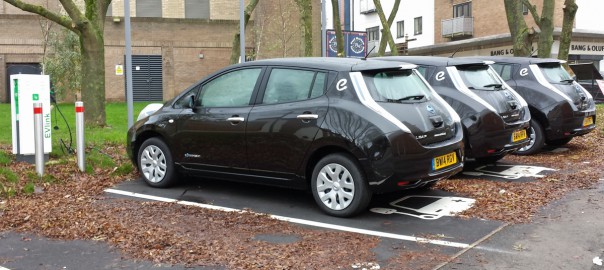
A few weeks ago I spotted a set of electric cars parked up near the town centre in Northampton. Today I parked up nearby on my way to picking up my girls from choir and had the opportunity to investigate further.

There are three 2014 Nissan Leafs in a row, all black and marked ‘www.e-carclub.org‘ on the boot. They are parked in specially marked bays by the Derngate theatre, and just next to a recently installed pair of EVlink fast chargers.

Clearly they belong to the E-Car organisation, but I have not yet learned anything more about them. There is a passing reference in a news release from another company, but clear there has not yet been an official launch of this E-Car site.

I’ll post more news as I get it.

Update: there has since been a press release about it.

Fleet World MPG Marathon - Nissan Leaf

EVs successfully complete MPG Marathon with less energy & no pollution

The electric vehicles taking part in this year’s MPG Marathon demonstrated how cost effective and reliable they were by completing the course in virtually the same time as their competitors – but by using less energy and with no pollution.

Three electric vehicles took part for the first time in the 23-team eco-driving event, which was again sponsored by ALD Automotive and TRACKER and was won by Honda engineers Fergal McGrath and James Warren, driving a Honda Civic Tourer and recording an outstanding 97.92mpg.

The electric vehicles taking part, two Nissan LEAFs and a Renault ZOE, attempted the same two-day course as the line-up of conventionally powered diesel and petrol cars and light commercial vehicles.

Like their competitors, they had to stop at set checkpoints en route, but were allowed to take scheduled rest time at recharging stops. This meant that careful route planning was essential to avoid range anxiety and ensure they had enough power to complete the course.

Ultimately it was a very close run thing and there was a photo-finish for first place with all three electric vehicles producing very similar results in terms of overall energy usage.

Read more: Fleet World

Nissan Leaf (Image: Nissan.co.uk)

Test Drive: Nissan Leaf

First thing before work this morning, my wife and I travelled to the Glyn Hopkin Nissan dealership in Watford to test drive a Nissan Leaf. We had booked the test drive online (you can book a full week test drive, but need to have a recent certificate for your domestic wiring to qualify).

Glyn Hopkin Nissan Watford (Image: GlynHopkin-Nissan)

We were horrified to hear that the dealership had no record of the booking. However, our sales advisor saved the day by nipping off and borrowed the service vehicle which is a Nissan Leaf Accenta, their mid-range model.

Both my wife and I had a go driving this car, and were surprised by the performance of what is essentially a family car. Rapid acceleration, silent running and an active and responsive steering and braking feel made this a great drive.

Perhaps more impressive is that our sales assistant drives one, and loves it. This made for a very informed test drive. He has a long commute, and actually saves more money on petrol than he paid for the new car.

I think this will be the car for us; able to replace our car on almost all our driving and so pay for itself in fuel saving.

Image: courtesy Nissan.co.uk.

BMW, Nissan, Renault And Volkswagen Join Forces For EV Charging

UK Rapid Charge Network

UK Rapid Charge Network (RCN) project, through the European Union’s Trans-European Transport Network (TEN-T) program, attracted four automakers – BMW, Nissan, Renault and Volkswagen, which will join forces to build a network of a multi-standard fast chargers in Ireland and Europe.

According to the latest news, 10 out of 74 of the multi-standard chargers are already installed and a further 28 have been commissioned.

All of them will be 44kW CCS, 44kW CHAdeMO and 43kW AC systems, so no EV will be left without a charge option.

“Nissan is joined in the project by BMW, VW and Renault: it’s the first time leading BEV companies have united to accelerate the growth of EV charging infrastructure, seen as a key enabler towards making zero-emission mobility a market reality. The project, managed by Zero Carbon Futures in Sunderland also draws on the network expertise of ESB, one of Ireland’s foremost energy company and leader of a previous TEN-T project completed this summer, and Newcastle University.”

“When complete, the UK Rapid Charge Network (RCN) will comprise more than 70 multi standard rapid chargers covering some 1,100km of major trunk routes and providing EV-friendly links to five seaports and five international airports.”

“Running on two priority road axes on the mainland of the UK, the RCN will link major ports and cities including Stranraer, Liverpool, Holyhead, Birmingham, Felixstowe, Leeds and Kingston upon Hull. There will also be networks embracing Dublin, Ireland and Belfast, Northern Ireland.”

“The UK RCN is part of the European Union-financed Trans European Transport Network (TEN-T) and represents a substantial partnership investment of €7,358,000, half of which is being funded by the EU.”

Baroness Kramer, UK Minister of State for Transport stated:

“We are serious about plug-in vehicles and have a comprehensive package of measures to help consumers and industry make the switch to electric. The UK now has the best rapid charging network in Europe. Projects like this highlight how industry is showing its confidence in the rapidly growing market.”

Source: InsideEVs

Renault-Nissan Alliance and Orange to Expand Electric Vehicle Partnership

Renault ZOE and Nissan Leaf in Orange livery (Image: Renault-Nissan Alliance Blog)
  • Renault-Nissan to supply 200 electric vehicles to Orange in France by 2015, mostly for car-sharing purposes 
  • Fleet will comprise Renault ZOE, Renault Kangoo Z.E., Nissan LEAF and Nissan e-NV200
  • Agreement expected to help contribute to Orange’s commitment to reduce its CO2 footprint by 20% by 2020

PARIS (Sept. 3, 2014) –The Renault-Nissan Alliance has signed an agreement with Orange, one of the world’s largest telecommunications operators, to supply it with a fleet of 200 electric vehicles for its needs in France.

Renault-Nissan, the global leader in sustainable mobility, will provide the 100% electric vehicles to Orange by 2015. Orange will use the electric vehicles mostly for car-sharing purposes between its buildings and installations in France. Orange currently has about 2,000 pool vehicles in France with about 100 cars (hybrid, electric, diesel, etc.) available for car-sharing purposes. Using the Orange Auto Partage application, employees can book a car for professional or personal use online or via a smartphone.

The Renault-Nissan electric fleet will comprise the Renault ZOE subcompact, the Renault Kangoo Z.E. van, the newly launched Nissan e-NV200 van and the Nissan LEAF, the world’s best-selling electric vehicle ever. Orange already owns a fleet of about thirty tandem 2-seat Twizys it has acquired from Renault since 2012.

Read more: My Renault Zoe