Category Archives: Leaf

MINI Electric

How much does an electric car cost? Why switching to an EV can save you money, from cheap charging to road tax

With fossil fuel cars on the way out, battery-powered alternatives are not only cleaner but can also be cheaper to run

With the cost of petrol soaring and the potential benefit to the environment becoming ever more apparent, electric vehicles (EVs) are becoming an increasingly attractive option for many drivers.

Registrations of new battery EVs grew at a record rate of 49.9 per cent in the past year, according to the Society of Motor Manufacturers and Traders (SMMT), even as the car market lagged due to supply issues. One in 10 new cars sold is now powered by electricity rather than fossil fuel, up from just one in 100 in 2015.


Nissan Leaf (Image: Qurren/Wikipedia)

That uptake is only likely to increase as the Government’s 2030 ban on sales of new petrol and diesel vehicles looms. A poll of drivers by Moneysupermarket found that of those considering a new vehicle this year, 28 per cent were thinking of buying an electric car and 27 per cent were considering a hybrid.

But EVs are generally more expensive than their equivalents: as of August 2022, the UK’s most popular car model (according to SMMT data), the Vauxhall Corsa, would set you back £17,330 for a petrol model, against £27,055 for the Corsa-e.

Read more: inews

It’s Time to Go Green!

If you would like to know more about Solar Panels and the PowerBanx range of home battery systems, and get a free instant quote, please complete our online form:

Five reasons to buy an electric car

Taking the jump to buy an electric car can be daunting, so we’ve listed five good reasons why you will enjoy owning an EV.

The benefits of electric cars go much further than just a lack of harmful exhaust emissions – although that is of course a huge boon, and the main reason governments around the world are pushing for the full transition from internal-combustion to battery power to happen as soon as possible.

Knowing they’re not contributing to local air pollution certainly makes people feel better about using their car to get around, but as most owners of electric vehicles have come to realise, there are myriad other advantages that zero-emissions cars have over their petrol and diesel counterparts.


Nissan Leaf (Image: Qurren/Wikipedia)

Here, we’ve summarised the main plus points that come with owning and driving an electric car.

1. Electric cars are simpler and more reliable

Gone are the days of oil stains and petrol fumes from under the bonnet. Electric cars don’t need an engine that uses combustion to produce power, so it’s a completely different ballgame when it comes to motivation for the wheels.

This means an electric motor and battery used in an electric car is much simpler and has far fewer moving parts than a conventional petrol or diesel engine. This means there’s a lot less that could potentially go wrong and much less maintenance and replacement of parts needed due to wear-and-tear. Electric cars often don’t need to be serviced as frequently as combustion-engined cars, keeping running costs low for owners.

Read more: autodaily

It’s Time to Go Green!

If you would like to know more about Solar Panels and the PowerBanx range of home battery systems, and get a free instant quote, please complete our online form:

Charge Of The “LEAF Brigade” Kept Small Towns In The Philippines Connected After Super Typhoon Rai

In December of 2021, super typhoon “Odette” (international codename Rai) battered many provinces in the Visayas, the second largest cluster of islands in the Philippines, as it made landfall on and first ravaged the tourist town of Siargao, known for its pristine beaches and surfing. Rai devastated many other provinces in the region including the province of Tacloban, Leyte, still recovering 7 years after the onslaught of Typhoon Haiyan (local codename “Yolanda”), and the chocolate capital of the Philippines, Bohol.

As Odette rumbled through the Visayas, it took particular interest in Bohol and Cebu. And as it intensified into the equivalent of a Category 5 hurricane, with sustained winds of some 100 miles per hour (160 km per hour) sweeping across an area some 600 miles on both sides. By the time it exited the Philippines a day later, it had destroyed over 80,000 homes and displaced some 481,000 people in Cebu alone. In total, some 992,000 homes were damaged and 368,000 completely destroyed in the whole region, according to the Philippine Disaster Risk Reduction and Management Council (PDRRMC).

The most immediate requirement was shelter, power, and water. For power, the most immediate solution was solar power kits which could run one household each. Big business and several non-government organizations and church groups chipped in for most of the needs.

Read more: CleanTechnica

It’s Time to Go Green!

If you would like to know more about Solar Panels and the PowerBanx range of home battery systems, and get a free instant quote, please complete our online form:

Nissan Leaf 3.Zero e+ (Image: Nissan)

If We Want More EV Acceptance, Manufacturers Have to Think Small

If manufacturers are truly serious about widening the appeal of electric vehicles, the market could use more Nissan LEAF and Hyundai Kona electrics. Remember, our current dependence on the automobile was built on the back of everyman’s Ford Model T and not the wealthy’s Cadillac.

Many of the makers committing themselves to a major shift toward electric vehicles are mostly luxury brands. And, as we’ve so far seen, volume manufacturers introducing electrics seem to be skewing their efforts toward a more well-heeled clientele. Given the higher costs of current electric vehicle technology, it’s understandable.

Hyundai Kona Electric (Image: Hyundai)

Still, within recent launches of high-dollar electric cars, trucks and SUVs are echoes of the large, flashy cars with big fins and massive chrome bumpers that marked the end of the 1950s. It wasn’t until an imported air-cooled economy car called the Volkswagen Beetle with an ad tagline suggesting that we “Think Small” that affordability took center stage.  Perhaps manufacturers need to take a step back and think small to provide electric alternatives for average car buyers.

The key to affordability is to get over the relentless push to increase range to 600 miles or more on a charge. Unlike a traditional car, where you can make a tank bigger at minimal costs (in fact, on gas cars it’s more a question of space than cost), increasing range from bigger batteries comes at a huge cost in electric vehicles.

Read more: autoevolution

It’s Time to Go Green!

If you would like to know more about Solar Panels and the PowerBanx range of home battery systems, and get a free instant quote, please complete our online form:

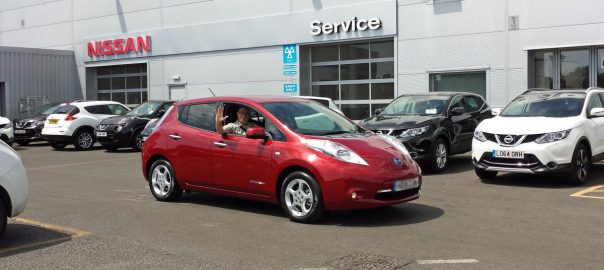
Nissan Leaf collection in St Albans (Image: T. Larkum)

What’s the best electric car for keeping it simple?

The original Nissan Leaf is a glorious bridge between the analogue and digital ages

In this brave new age of smartphone dependence we’ve probably all found ourselves having sunk several weeks of our lives into a time dump of a game that sucks your attention into it and gives nothing back. Like the most recent obsession, a strategy thing where you send trucks back and forth between places carrying stuff. No more sophisticated or interesting than that, but boy was it addictive.

Until it was updated, presumably by someone who never opened the app before, let alone played it. One eight-second download and suddenly the game was rendered unplayable and useless. Sure, it enjoyed a smart new look, some spiffy graphics and a bit of jaunty new in-game music, but the very basic functions had been changed in a blink and it was impossible to work out how to do them. So… deleted.

Charging with an Ohme smart charging cable

But what happens when they do that to your car? Manufacturers are cock-a-hoop about over-the-air updates and the boundless potential of what they can do. Polestar recently did an update that made its cars drive longer distances, Volkswagen did one that meant they could charge harder for longer.

Read more: TopGear

It’s Time to Go Green!

If you would like to know more about Solar Panels and the PowerBanx range of home battery systems, and get a free instant quote, please complete our online form:
Nissan Leaf 3.Zero e+ (Image: Nissan)

‘Informed consumers are vital to a mature electric car market’

Andy Palmer thinks motorists need to learn more about electric cars with the 2030 petrol and diesel new car ban looming on the horizon

Over a decade ago, when I began developing what became the world’s first mass-market electric car, the Nissan Leaf, it was considered an oddity. EVs back then were treated with scepticism and intrigue in equal measure. Why? Largely because the understanding of what they were, how they were made and how they benefit motorists (and the planet) was non-existent. In fact, one rival auto exec said I was crazy for pioneering an electric vehicle and I may as well have taken the cash invested in it and chucked it into the Pacific. Thankfully, I didn’t take his advice.

Nissan Leaf 3.Zero e+ (Image: Nissan)

Today, we are a better-informed audience. But by how much? There are around 395,000 battery electric vehicles on UK roads right now. That’s certainly a lot more than when I first began work on the Leaf, but compared to the 32.7 million total passenger cars on the road, it still barely registers. I have no doubt that’ll change and that in the near future, there will be more EVs than combustion engine vehicles. It’s as inevitable as death and taxes. But to get to that point and for the market to truly mature, we need an informed audience of motorists.

Read more: AutoExpress

If you are interested in learning what it would cost to charge an electric car, try GoCompare’s Charging Calculator.

It’s Time to Go Green!

If you would like to know more about Solar Panels and the PowerBanx range of home battery systems, and get a free instant quote, please complete our online form:

Nissan Leaf (Image: Qurren/Wikipedia)

How Much Range You Really Need in an Electric Car

Stop trying to re-create your gas engine car from electricity and the answer will become clear.

If you’re considering an electric vehicle, don’t make the mistake of buying one with too much range. Unlike combustion engine cars with virtually unlimited range, electric cars make the most sense when they have the right amount of range, not a surfeit of it.

There are several reasons to temper your instinct to get the most range possible.

Nissan Leaf – a Perfect Family Car

Cost

Range costs a lot of money. For example, a Nissan Leaf with 226 miles of range costs $6,600 more than the same trim level with 149 miles of range.

There is no real parallel with combustion cars as their cost of range is in the price and consumption rate of fuel, not the vehicle’s MSRP. You can argue that an EV earns back its overall cost premium in per-mile energy savings, but a long-range electric car will need many more of those low-cost miles — and probably years of covering them to do so.

The cost of EV range can make buyers recoil from one without knowing that their perception of sufficient range, not cost, is the real problem.

Weight

Longer range versions of a given electric car have larger, heavier batteries. Unlike a tank of gas that weighs about 100 pounds and gets lighter as it’s used, an EV battery can easily weigh 1,000 pounds and stays just as heavy as it is “emptied,” increasingly becoming dead weight the remaining amount of charge must lug around.

The long range Tesla Model 3 (358 miles of range) weighs 172 pounds more than the RWD version’s still-generous 272-mile range, a weight difference equal to the entire payload a car will most often carry: the driver. The difference is even more pronounced when comparing a long range Model 3 to a comparable conventional BMW 3 Series, which is about 475 pounds lighter.

Read more: RoadShow


It’s Time to Go Green!

If you would like to know more about Solar Panels and the PowerBanx range of home battery systems, and get a free instant quote, please complete our online form:

Nissan Leaf (Image: Qurren/Wikipedia)

E-transport is a game changer

Our company car is eight years old this month.

We purchased it secondhand just over five years ago. It’s a Nissan Leaf. All electric.

We purchased it in the days when people used to say ‘we haven’t got the infrastructure’ or ‘where are we going to get all the energy from?’ or ‘they don’t have the range’.

I let the wife conduct the research, just so she could build up her range anxiety until we saw an affordable great little car on sale from Stebbings on Hardwick Narrows.

Since we have had the car we have never used a public charge point, of which there are six times as many as there are petrol pumps in the UK and growing by around 200 a week on top of the hundreds of home chargers installed daily. No, we just use the ‘granny charger’ which is basically a three-pin plug charger, like your mobile phone. It uses about half the energy a kettle uses and stays on for an hour here and an hour there to keep us topped up.

A showroom tour of a Nissan Leaf (Image: T. Larkum)

Read more: Lynn News


It’s Time to Go Green!

If you would like to know more about Solar Panels and the PowerBanx range of home battery systems, and get a free instant quote, please complete our online form:

Nissan Leaf (Image: Qurren/Wikipedia)

Long distance driving in an electric car

Planning for a long-distance drive in your electric car doesn’t have to be a headache. Here’s everything you should consider before you set off.

While petrol and diesel drivers have recently faced fuel anxiety, the range anxiety that comes with driving an electric car has been around much longer and is still a real concern for many, whether they own an electric car or are simply contemplating one.
Range anxiety can be conquered though, so let’s break down what needs to be considered to keep your mind at ease if you’re planning a long-distance drive in a plug-in car.

How far can you travel on a full charge?

Nissan Leaf (Image: Qurren/Wikipedia)
The first thing to consider when planning a long-distance journey in an electric car is how long the battery will last on a full charge.
Of course, the ideal scenario would be to make the journey on a single full charge and recharge overnight while you catch some Zs but, if your range doesn’t quite cut it, you’ll be able to plan out where to make that tactical first stop to recharge and how many times you’ll need to stop along the way to your destination. Depending on the make and model, weather conditions, and your driving style, you can expect to have a range of anywhere between 100 and 300 miles from a fully charged electric car. The UK’s best-selling electric car this year is none other than the Tesla Model 3, having sold over 22,000 units by 1st December and topping the best-selling car list back in September. This sought-after beauty comes with a range of 360 miles, which could get you from Cambridge to Edinburgh on a full charge, so depending on where you’re heading, you wouldn’t have to make many stops, if any at all!
Read more: AutoTrader

It’s Time to Go Green!

If you would like to know more about Solar Panels and the PowerBanx range of home battery systems, and get a free instant quote, please complete our online form:

OVO Vehicle-to-Grid (V2G) charging (Image: T. Larkum/Fuel Included)

Electric Nissan Ariya goes on sale in the UK as Nissan finally delivers a new EV to market

The new electric Nissan Ariya goes on sale in the UK from £43k, as Nissan finally delivers a new EV to the market, 12 years after the Nissan LEAF arrived.

Nissan has become synonymous with EVs ever since the electric Nissan LEAF arrived back in 2009, but despite that early lead in electric cars it’s failed to deliver anything really new to the market since.

OVO Vehicle-to-Grid (V2G) charging (Image: T. Larkum/Fuel Included)


But that changed last year with the arrival of the Nissan Ariya, an all-new electric Nissan Crossover / SUV, which we’d expected to have gone on sale at the start of 2021.

But ‘Covid and Chips’ put paid to an early arrival for the Ariya, but now Nissan is ready to take orders for the Ariya in the UK – with first deliveries in summer 2022 – with prices starting from £41,845.

Offered with a choice of front or four-wheel drive, and two battery capacities, the Ariya sits on the new CMF-EV Platform, with the range kicking off with the FWD Ariya Advance with 215bhp and 65kWh battery, good for 0-62mph in 7.5 seconds and range of 233 miles.

Read more: Cars UK

It’s Time to Go Green!

If you would like to know more about Solar Panels and the PowerBanx range of home battery systems, and get a free instant quote, please complete our online form: