Category Archives: Leaf

New battery for Nissan Leaf to deliver 155-mile range

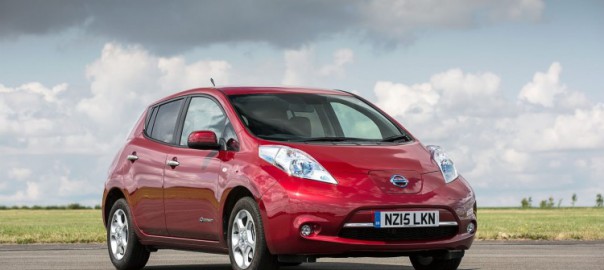
A new 30kWh battery in the Nissan Leaf will go on sale in December, delivering a claimed range of 155 miles.

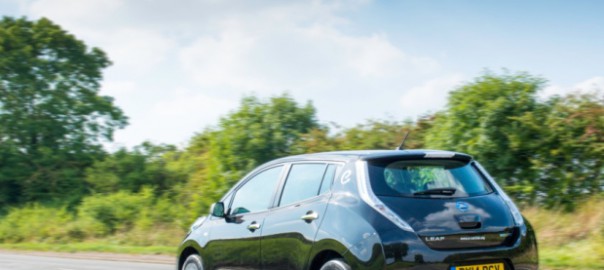
iaa-2015-0493_Nissan_Leaf_Autocar

It will go on sale alongside the 24kWh unit but will only be available in Acenta and Tekna trim, priced from £24,490 to £27,940 including the UK government’s £5000 Plug-in grant, which was recently extended until February 2016.

Nissan is also increasing its warranty for the 30kWh unit to an eight-year, 100,000-mile warranty.

The new battery brings an increase in range of around 25% over the alternative 24kWh unit, according to Nissan. It has the same dimensions as the lesser-powered unit but is 21kg heavier. The manufacturer says this longer range is the result of the introduction of carbon, nitrogen and magnesium to the electrodes in the new unit.

Nissan expects the real-world range of the new battery to be around 12-15% less than the claimed 155 miles, representing a similar loss to the 24kWh unit. This would put the new battery’s real-world range at around the 135-mile mark.

In Acenta and Tekna trims, the 30kWh Leaf comes with a 7.0in touchscreen and the smartphone-compatible Nissan Connect EV infotainment system, which allows users to check the charge status of the car and remotely control features such as the air-con. The system the previous Car Wings set-up.

The new infotainment package includes a charging map that can show which charging points are available and which are being used. It also delivers maintainance alerts and a car-finder facility.

Exterior alterations are minimal and include a new roof-mounted aerial as well as the choice of a new bronze colour.

“It’s a game changer for Nissan,” said EV director for Europe Jean-Pierre Diernaz. “This increased range will have an impact on the perception of our electric vehicles and will open it up to a wider market.”

Diernaz also added that the Leaf range could expand in the future to new electric models.

“It’s possible,” he said. “We will take this technology, improve it, and we are looking at putting it wherever it is relevant for us as a line-up expansion, and where it is releveant for a consumer.

“This new battery is just the beginning of something bigger,” he added. “The next milestone is a range of over 180 miles.”

Earlier this year Nissan expanded the Leaf trim range with a new Acenta+ version, sitting between Acenta and range-topping Tekna priced at £24,740 including the plug-in grant.

Source: Autocar
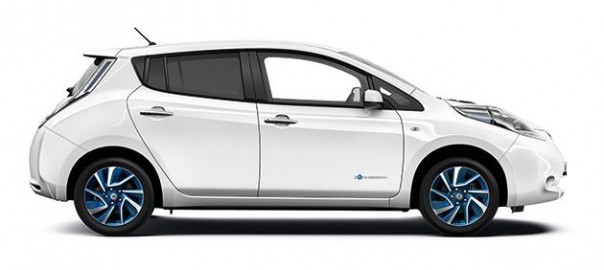
Nissan Leaf

Most reliable cars of 2015 include Nissan Leaf

Not a great surprise to Leaf owners!

Carbuyer released its list of the top 10 most reliable cars from superminis to SUVs. The list was compiled according to information and statistics from the the 2015 Auto Express Driver Power Survey.

Nissan Leaf
Nissan Leaf

The annual questionnaire, filled out by around 61,000 car owners, shows that in reliability category, there are no competitors for Japanese and Korean brands (9 out of 10).

“This year’s car reliability ratings reflect well on Japanese manufacturers, with a special mention going to Lexus. The brand has three cars in this year’s Top 10 and the IS saloon took the coveted number one overall slot on the customer satisfaction survey.

Insights from the survey also showed that drivers are more satisfied with their car in general than ever before. More hybrid and electric cars are on the list than in previous surveys too. Motorists in London are the hardest to please on average.”

Top 10:

  1. Toyota iQ city car
  2. Lexus NX SUV
  3. Lexus IS saloon
  4. Hyundai i10 hatchback
  5. Honda Jazz hatchback
  6. Lexus GS saloon (2005-2011)
  7. Toyota RAV4 SUV
  8. Nissan Leaf hatchback
  9. Kia Picanto hatchback
  10. SEAT Leon hatchback

Among 200 models, there is one electric in the top 10 – Nissan LEAF at eight.

Read more: Inside EVs

Electric vehicles offer big savings on servicing

At last some data to confirm what most EV owners already suspected

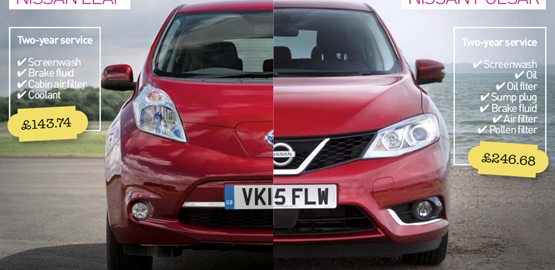
When fleets compare electric vehicle (EV) costs with diesel, most of the emphasis is put on the P11d price and fuel. However, there are also significant differences in service and maintenance costs. Put simply, servicing and maintenance of a fully-electric vehicle is estimated to cost between 25% and 40% less than that of a petrol or diesel car.

“There are fewer parts that will require maintenance in an EV,” explains Chris Chandler, principal consultant, fleet consultancy, at leasing giant Lex Autolease.

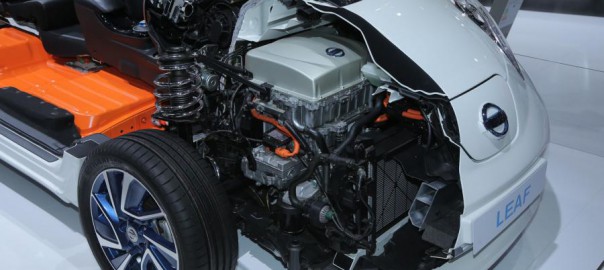
Unlike petrol or diesel vehicles, which have dozens of moving components in their engine and transmission, EVs have a simple drivetrain, typically consisting of just three parts: an on-board charger, inverter and motor.

When Ford unveiled its Focus electric car in America in 2012, it listed more than 20 items used in petrol and diesel cars but not in EVs that require inspection, maintenance or replacement over a vehicle’s 10-year/150,000-mile life.

These included the alternator, power steering fluid (it uses electrical assistance), radiator and assorted pipework, spark plugs, starter motor, thermostat, timing belt and a water pump.

screenshot140_w555_h555_unk

This makes an EV cheaper and means there are fewer moving parts to go wrong, resulting in improved reliability and on-road times.

On top of this, EVs require no oil changes, spark plugs, air filter, transmission fluid, exhaust pipe or radiator hoses, all of which can add to the service, maintenance and repair (SMR) costs of a petrol or diesel vehicle.

The relative simplicity of an EV’s drivetrain is reflected in its SMR costs, according to Nissan. It says that both the Leaf and Nissan e-NV200 cost “considerably less to service and maintain than diesel or petrol alternatives”.

Read more: Fleet News

NHS Electric Vehicle Schemes in Northants

Northampton provides rubbish support for electric vehicles – maybe this is the start of a change

Six new electric vehicles are to be put in place at Northamptonshire Healthcare NHS Foundation Trust sites across the county.

They will be at three trust premises, Berrywood Hospital in Duston, Northampton, Campbell House in Northampton and St. Mary’s Hospital in Kettering.

Each of these locations will have two permanently-based EVs; one of which will be used exclusively by the trust during business hours (and made available to the public at evenings and weekends) and the other which will be available for private use at all times.

2134229022_Nissan_Leaf_eCar

Electrical hook-ups are also available at Isebrook Hospital in Wellingborough, Willowbrook Health Centre in Corby and Manfield Campus in Northampton.

By operating a fleet of vehicles which omit zero carbon, they are able to conduct business travel in a way which has no negative effects on local air quality, and by reducing the need for pool cars or staff use of their own vehicles, they’re also taking cars off the road which has a positive impact on congestion and parking pressure throughout the county.

Chairman of the trust Paul Bertin, said:

“I am absolutely delighted that we at Northamptonshire Healthcare have taken this significant step forward and are the first NHS trust in the county to provide such a service for our staff and the public.

“As a trust we have made a commitment to reduce our carbon footprint by 28% by 2020 and by encouraging our staff to park up their own vehicle and use an electric vehicle for business travel will help us move towards achieving this target. Looking after the environment is everyone’s responsibility. Providing such a countywide service for our staff and the Northamptonshire public will further raise the profile of sustainability and how we can all do more for our environment.”

Read more: Northants Telegraph

The new Acenta+ will come with a 6.6kW on-board charger as standard (Image: Nissan)

Nissan adds Acenta+ to LEAF range

This should be a popular move as most people are interested in fast home charging

Nissan is celebrating the continued success of its 100% electric LEAF model with the introduction of an Acenta+ grade.

The new Acenta+ sits between the Acenta and range-topping Tekna model and enjoys a significant specification boost over the standard model.

On sale from July 1st, the Acenta+ is equipped with a 6.6kW on-board charger as standard, along with a Mode-3 32amp (EVSE) cable. Previously available only as an option, the 6.6kW charger allows owners to perform a 0-100% charge in just four hours using a fast charger.

Priced at £24,740, including the £5000 Government grant, it offers an official range of 124 miles (NEDC) and running costs from 2p per mile.

Commenting on the addition of the new Acenta+ to the UK LEAF range, James Wright, Managing Director, Nissan Motor GB said:

“We’re delighted to add a new member to the LEAF family in the UK. More than 9,500 LEAFs have already been sold here and Nissan is the undisputed leader in the EV market. This new model delivers exceptional value and showcases the LEAF’s incredible technology and engineering.”

Source: Next Green Car

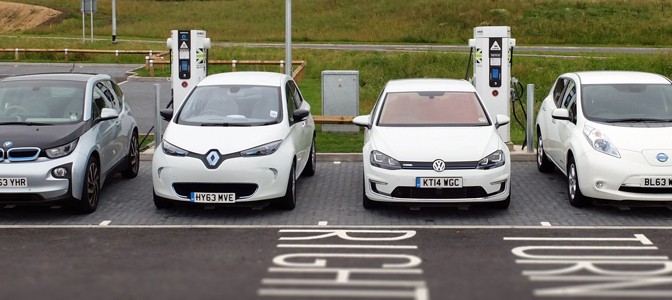
Electric Cars Fast Charging (Image: BusinessCarManager.co.uk)

On the brink of an electric car revolution?

Electric car sales have fallen short of predictions, but the global push to cut carbon emissions and improved techology could see them poised to hit the mainstream, says Renault-Nissan’s head, Carlos Ghosn

Carlos Ghosn, the fast-talking head of the Renault-Nissan alliance, is not keen to be drawn on targets for electric car sales. A 2011 prediction of 1.5m Renault-Nissan electric vehicles by 2016 turned out to be wildly optimistic. The group just passed the 250,000 mark.

Ghosn was not alone. President Barack Obama predicted 1m electric cars in the US by 2015: in January the total was 280,000. Virgin boss Richard Branson, adept as ever at grabbing headlines, said this week that “no new road cars will be petrol driven” within 20 years, calling combustion engines “complicated and antiquated”.

Unlike Branson, Ghosn does not want to stick his neck out. But as head of the companies which sell more than half the electric cars in the world, what Ghosn thinks about how fast the market will grow matters.

Transport contributes 23% of global greenhouse gas emissions, so the fundamental driver will be the ambition of the world in tackling climate change, Ghosn told the Guardian in an interview. “When we know exactly where the EU, US, China will be heading in 2030, I can tell you exactly how much electric cars will be needed,” he says, referring to a crunch UN summit in Paris in November.

Read more: The Guardian

250k electric vehicles sold by Renault-Nissan Alliance

  • Historic EV milestone reached in early June
  • Alliance sells half of all EVs globally
  • EV sales up nearly 15 per cent through May vs. same period last year
  • Nissan LEAF remains world’s best-selling EV
  • Frenchman from Bordeaux bought 250,000th Alliance EV: a Renault ZOE

PARIS/YOKOHAMA (June 24th, 2015)—The Renault-Nissan Alliance, the world’s leader in zero-emission mobility, has sold its 250,000th electric vehicle: a white Renault ZOE sold to a French engineer.

The Alliance reached the historic milestone in early June, four-and-a-half years after the launch of the Nissan LEAF, the world’s first mass-market zero-emission vehicle. The Alliance today accounts for half of the electric vehicles sold worldwide. Nissan LEAF remains the best-selling electric vehicle of all time, with more than 180,000 units sold.

From January through May, the Alliance sold about 31,700 EVs — up nearly 15 per cent over the same period of last year.

“Demand for our electric vehicles continues to grow thanks to government incentives and the expanding charging infrastructure,”

said Carlos Ghosn, Chairman and CEO of the Renault-Nissan Alliance.

“The positive response of our customers is also driving demand.These vehicles enjoy some of the highest levels of satisfaction rates from our customers around the world.”

Frenchman from Bordeaux takes delivery of 250,000th EV

The 250,000th owner is Yves Nivelle, a computer engineer, who traded in his 21-year-old diesel car for the subcompact Renault ZOE. Nivelle bought his EV after the French government introduced an environmental bonus in April to allow owners of older, polluting diesel cars to trade them in and get a rebate of €10,000 on a new EV.

“The government’s environmental bonus was a big factor in my decision to get an EV,” Nivelle said. “But I have to say, I was convinced the first time I drove the car. It’s a real pleasure to drive and it feels good to do my part for the environment.”

Alliance has full range of six 100% EVs; Renault leads in Europe

With six models on the road, the Renault-Nissan Alliance is the only global car group with a full range of 100% electric vehicles. In addition to the LEAF, Nissan also sells the e-NV200 van, which has been on sale in Europe and Japan since last year. In addition to the ZOE, Renault also sells the RenaultKangoo Z.E van, the SM3 Z.E. sedan and the Twizy, a two-seater urban commuter vehicle.

Yokohama, Japan-based Nissan has sold 185,000 electric vehicles worldwide since December 2010, when the Nissan LEAF went on sale. LEAF has collected numerous industry honors, including the 2011 World Car of the Year, European Car of the Year 2011, and Car of the Year Japan 2011-2012. The LEAF is sold in 46 markets. Nissan’s top EV markets are the United States, with about 80,000 sales since LEAF’s launch, Japan with about 53,500 units, and Europe with about 41,500.

Renault, based in Boulogne-Billancourt, France, has sold 65,000 electric vehicles worldwidesince its first model, the Kangoo Z.E., went on sale in October 2011. Kangoo Z.E. was voted International Van of the Year 2012.

Renault was the No.1 EV brand in Europe for the last two months, with a market share of 26 percent. Renault’s top markets are France, the United Kingdom, Germany and Norway. In France, where ZOE is the most popular EV with almost half the market, the government’s environmental bonus allows drivers to lease the ZOE, including the battery, for as little as €99 a month.

The Renault-Nissan Alliance was recently chosen as the official passenger-car provider for the United Nation’s COP21 climate conference in Paris from November 30th to December 11th. The Alliance will provide a fleet of 200 EVs to shuttle delegates to the annual conference.It will be the first time the U.N. will use a zero-emission fleet for its entire passenger car shuttle at a COP event.

Renault-Nissan Alliance official COP21 passenger car partner with zero-emission fleet

  • Alliance to provide 200 pure electric vehicles to 2015 Paris climate conference
  • The first fully electric shuttle service for United Nation’s climate conference
  • Fleet to include Renault ZOE and Kangoo Z.E, Nissan LEAF and e-NV200
  • More than 50 charging stations powered by renewable energy to be established in and around Paris.

PARIS (May 27th , 2015) — The Renault-Nissan Alliance, the world leader in zero-emission mobility*, will provide a fleet of 200 all-electric vehicles as the official passenger-car provider for the United Nation’s COP21 climate conference in Paris later this year.

The partnership agreement was signed today between the Renault-Nissan Alliance and the General Secretary in charge of the preparation and organization of the 21st annual Conference of Parties (better known as COP21). The fully electric car fleet will shuttle delegates during the event from Nov. 30 to Dec. 11.

More than 20,000 U.N. participants from 195 countries are expected to attend the annual climate summit. It will be the first time the U.N. will use a zero-emission fleet for its entire passenger car shuttle at a COP event.

The goals of the Paris summit are to have a new global climate-change agreement in place by the end of 2015 and to have the Climate Green Fund, established to help developing countries adapt to climate change and reduce emissions, start allocating funds.

We are delighted to announce that the Renault-Nissan Alliance is an official partner of COP21 in Paris. Thanks to the Alliance’s fleet of 100% electric vehicles, it will contribute to our goal of achieving a carbon neutral event.  The technology of electric vehicles helps reduce greenhouse gases in the transportation sector efficiently,” said Laurent Fabius, Minister of Foreign Affairs and International Development, President of COP21.

Electric vehicle technology is an efficient solution for a practical and affordable mode of transportation. This solution has a positive impact on the climate and air quality in our cities,” said Carlos Ghosn, Chairman and CEO of the Renault-Nissan Alliance. “It’s time to accelerate the shift to zero-emission mobility by working together with all parties concerned.”

The COP21 car fleet will feature the Renault ZOE subcompact car, the Renault Kangoo Z.E. van, the Renault Fluence Z.E. sedan, the Nissan LEAF compact car and the 7-seater Nissan e-NV200 van. The vehicles will be available to shuttle delegates 24 hours, seven days week to key venues around the conference, as a complement to public transportation.

The Renault-Nissan Alliance will work with companies in France to set up a network of more than 50 quick and standard charging stations powered by 100% renewable energy in strategic locations. The quick charging stations will be able to charge the EVs from 0 to 80% capacity in about 30 minutes.

Source: Media.Renault.com

Nissan Leaf Taxi passes 100,000 miles and still on 1st set of brake pads!

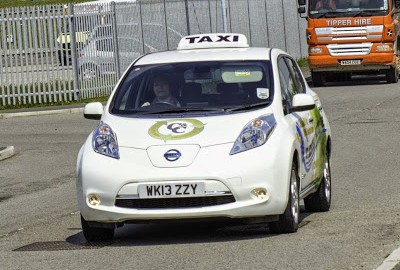
A Nissan LEAF taxi in Cornwall has clocked up its 100,000th mile (160,000 km) since entering service with C&C Taxis in 2013.

‘Wizzy’ as it was named by operators at St Austell-based C&C Taxis, hit the milestone in the course of more than 25,000 pure electric paying fares and having been rapid charged over 1,700 times yet retains near full battery health and is still on its first set of brake pads.

Inspired by Wizzy’s performance, C&C Taxis now operates five 100% electric Nissan LEAFs and an all-electric Nissan e-NV200 van.

Mark Richards, fleet manager at C&C Taxis, estimates that each vehicle saves the business around £8,500 per year in fuel bills and maintenance costs.

“When we speak to other taxi operators they often tell us range and battery life are the biggest factors preventing them from considering an electric taxi,” he said. “Then, when we tell them Wizzy’s done 100,000 miles and still has full battery health, they’re left speechless.”

“It’s no exaggeration to say Wizzy has transformed our business. We took a gamble when we bought her but she’ll have paid for herself in just 24 months and the savings we’re now making across the fleet are phenomenal,” he added.

Source: Electric-Vehicle News

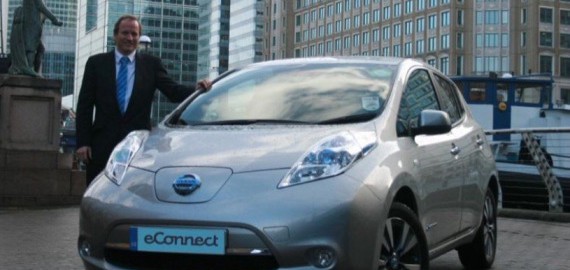
Nissan Leaf taxi (Image: eConnect)

Paddington Trainriders Now Have Option Of EV Taxis

Those that often take the train from Paddinton (in London) now have a new means of getting to and from the stations — and a new, electric means at that — according to recent reports.

Thanks to a new partnership between the taxi service eConnect cars and First Great Western services, travelers will now be able to pre-book taxi transfers to + from the train stations in a Tesla Model S or a Nissan LEAF.

For those that can’t afford to actually own a Model S, but still love the things, this might be a good way to get your fix, I suppose.

“This is the first time a train operator has partnered with an electric vehicle operator in London to create a transport solution that truly represents smarter, greener travel for those coming to and from London,” stated Alistair Clarke, owner and managing director of eConnect cars.

For a bit of background here, eConnect cars was established just last January (in 2014) in London, and has, to date, provided more than 10,500 customers with taxi service and traveled over 93,000 miles doing so. All in electric vehicles of course.

According to the company, the use of an all-electric fleet for such service resulted in the prevention of 40 tonnes of carbon dioxide emissions last year.

All in all, if I take that route anytime in the near future, I think that I’ll probably have to give the service a try. Probably beats a gas taxi pretty handily.

Source: EV Obsession