Category Archives: Hyundai

Hyundai Kona Electric (Image: Hyundai)

Hyundai’s Kona Electric tops ‘real range’ test for zero emission cars

Hyundai’s Kona Electric achieved a ‘real-world’ range of 259 miles on a single charge during a What Car? Real Range test – the highest of any vehicle tested.

The compact SUV, which Hyundai says has a range of up to 300 miles, was one of 13 electric cars tested, with the brand’s Ioniq achieving the highest energy efficiency and lowest cost per mile.

It covered 3.9 miles per kWh – 11% further than any model from a rival brand. It achieved a real-world range of 117 miles. Hyundai says its range is 174 miles.

Hyundai Kona Electric (Image: Hyundai)

Tony Whitehorn, president and CEO of Hyundai Motor UK, said: “The results of the What Car? Real Range tests are a terrific endorsement of our zero-emissions models.

“Achieving not only the highest ‘real-world’ driving range, but also the best efficiency and lowest cost-per-mile figure of any brand is testament to our commitment to reducing the environmental impact of our vehicles.

“These cars are a compelling proposition for both fleet and retail customers, and we’re confident that Kona Electric and Ioniq Electric will continue to attract praise from media and motorists alike.”

Read more: Fleet News
Hyundai Kona Electric (Image: Hyundai)

The 258-Mile Hyundai Kona Electric Sets the New Standard for EV Range

The U.S. Environmental Protection Agency last week announced that the 2019 Hyundai Kona Electric is rated to provide 258 miles on a single charge.

That’s a huge deal. It’s important not because the Kona crossover displaces the Chevy Bolt as the leader in range among affordable electric cars. There are only 20 miles that separate the range of the Kona Electric and the Bolt—a difference that’s inconsequential for daily driving.

The Kona EV’s 258-mile official range is a big deal because it’s the new benchmark for all carmakers to meet when introducing an electric car. Chevy, Nissan, Toyota, and BMW are now all on notice to put up bigger range numbers.

Hyundai Kona Electric (Image: Hyundai)

Of course, the king of range remains the expensive Tesla Model S and Model X. Most EV fans expect a 300-ish range from vehicles that commonly sell for six figures (and have a Tesla badge). The major shift that’s underway is the availability of cars that sell closer to $40,000 and exceed 250 miles on a charge—a level that will likely grow to 300 miles or more in the next couple years.

The Tesla Model 3, which was supposed to be the breakthrough car for long-range affordability, has not been the model to deliver on that promise. Don’t get me wrong. It’s a fantastic electric vehicle. However, recent surveys indicate that the only Model 3 version available today—the 310-mile variant—has an average sales price of around $60,000. Again, we expect Tesla to produce outrageously cool long-range EVs.

The End of Long-Range Excuses

But what is cooler still, and more novel, is an out-of-nowhere, no-buzz Hyundai crossover that sets a new standard for affordable EV range—at a price that beats the Chevy Bolt. The Kona Electric’s price has not yet been announced, but Hyundai could really shake things up if it lands near $30,000.

The Kona will have the same zippy driving character of many other small EVs. Its 201-horsepower electric motor, driving the front wheels, matches the Chevy Bolt’s 200-hp motor—and beats the Nissan LEAF and BMW i3 with 147 and 170 horses respectively. All of them scoot from a standstill to 60 miles per hour in around seven seconds.

Read more: Plugin Cars

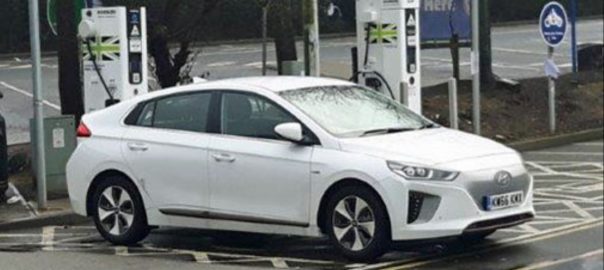
Charging at Cherwell (Image: T. Heale)

New Hyundai Ioniq Plug-in 2017 review

Hyundai isn’t the first manufacturer to offer pure-electric and hybrid technology, but there’s no denying the Korean brand is working hard to catch up.

Charging at Cherwell (Image: T. Heale)

Its Ioniq range of eco-focused cars includes a hybrid and a pure-electric version – but in the middle of the pack, there’s a plug-in model designed to offer the best of both worlds. We tried it in Italy back in April, but now we’ve had a chance to get behind the wheel of the car in the UK.

The PHEV version isn’t just a carbon copy of the regular Hybrid with an extra power socket. Although the normally aspirated 1.6-litre petrol engine has the same output as in the non-plug-in car, the electric motor gets a small boost. And while the maximum combined power figure is still 139bhp, it’s ever-so-slightly faster from 0-62mph – completing the sprint two tenths faster than the standard Hybrid car.

The ability to charge the larger battery at a wall socket (it takes about two and a half hours) really helps the Ioniq’s CO2 emissions, though; this car emits just 26g/km, compared with the conventional hybrid’s 79g/km.

As with most other PHEVs, the Ioniq is a car that is at its best when making relaxed progress. Treat the throttle with respect and it with gather speed smoothly and with little intrusion from the petrol motor. Stamp on the right pedal and things quickly deteriorate, though; the six-speed dual-clutch transmission isn’t the quickest or smoothest-shifting unit out there, and the petrol motor, while fluid enough, is pretty audible if its revs are sent rocketing.

You can run the plug-in Ioniq in a couple of modes. Most of the time will be spent in the car’s hybrid setting, where the system mixes electric and petrol power as it sees fit. It’s worth noting, though, that as with the Prius and Prius Plug-in, the Ioniq PHEV is keener to stick with pure-electric motoring than its conventional hybrid stablemate.

Read more: AutoExpress

Hyundai Ditches Hydrogen Fuel Cell Technology For Now, Pivots to Electric Vehicles

The Korean automaker finally puts its focus on batteries, rather than hydrogen, to power the car of tomorrow.

Hyundai has often proclaimed that hydrogen will power future generations of cars, even as other manufacturers believe that it is too early to make such claims, especially since the rise of electric cars has come to pass. Despite recently announcing a new hydrogen fuel cell vehicle, BBC reports that Hyundai has decided that it needs to pivot in order to remain competitive in the electric market during the coming years.

The Korean manufacturer is no stranger to electric cars, though its current long-range offering, the Ioniq, only delivers around 124 miles of range. This sandwiches its EPA-rated range between the BMW i3’s 114 miles and the Volkswagen e-Golf’s 125 miles. Though it may be ideal for the urban commuter, this is hardly long range when compared to equivalent gasoline-powered vehicles. If Hyundai wants to remain in competition with the next generation of EVs, they will need to work on matching the range of the Tesla Model 3 or Chevy Bolt.

Hyundai can’t be happy that their plans for a hydrogen-powered future seem to be falling short. The company put forth plenty of effort marketing their hydrogen fuel-cell Tuscon, including elaborating on the shorter fill-up time compared to an EV, as well as the potential for longer range. Its downfall, however, isn’t necessarily due to the price or uncommon nature of the fuel cell, but rather the availability of hydrogen fill-up stations. In fact, the United States Department of Energy only charts 38 hydrogen fill-up stations in the entire country, primarily localized in California.

Source: The Drive

Hyundai launches SUV, electric assault to overtake Toyota in Europe

Hyundai has announced it is to place electric vehicles (EVs) at the centre of its product line-up going forward, which alongside sister brand Kia, will total eight battery-powered vehicles and two hydrogen cars by 2020.

The Hyundai brand will also double its Europe SUV offering to four models by 2019, plus further bolstering of its crossover range, as it looks to ride the wave of these growing segments to meet its target of overtaking Nissan and Toyota to become the best-selling Asian brand in Europe by 2021.

The electric assault will be led by a premium long-range EV aimed at targeting upmarket leaders including Tesla and models launching from other rivals. This electric sedan will be launched under its high—end Genesis brand in 2021 with a range of 500km (310 miles) per charge – matching models launching from Volkswagen Group around this time.

Hyundai Executive Vice President Lee Kwang-guk said on Thursday: ‘We’re strengthening our eco-friendly car strategy, centring on electric vehicles,’ underscoring the realistic, mainstream promising nature of the technology.

Hyundai and Kia, together fifth in global sales volumes, said they would add three plug-in electric vehicles to their plans, surging their total line-up to 31 models by 2020 – including eight-battery-powered and two hydrogen models. This is a dramatic shift in plans from only three years ago, when in 2014 they had planned 22 models, with only two being battery powered.

It is also planning its first dedicated EV platform, allowing the company to build multiple EV models with longer driving ranges. While it launched its first all-electric volume car the IONIQ last year, its driving range was uncompetitive with those from Tesla and General Motors (Ampera-e).

Read more: Autovista Group

EV triple test: Hyundai Ioniq Electric v Renault Zoe v Nissan Leaf

With the announcement of the 2040 ban on all new petrol and diesel cars, we get behind the wheel of three electric vehicles to see if the future really is green.

(L to R) Nissan LEAF, Hyundai IONIQ, Renault ZOE

WHAT’S NEW?

Since the announcement of the 2040 ban on new petrol and diesel cars, all you read in the news is about how we’re all going electric. So if that’s the case, which is the best electric car to buy? We chose three to test – a Renault Zoe, Hyundai Ioniq and Nissan Leaf.

The Hyundai Ioniq is by far the newest and in our opinion one of the best-equipped. The Nissan and the Renault have both been around for some years now, and the Leaf is actually due to be replaced by a new model next year.

The Ioniq is Hyndai’s first attempt at making an all-electric car, and it’s very good.

Inside, the cabin feels solidly built and very comfortable. It also has lots of kit including, on our car, heated and cooled electric seats.

Next is the Renault Zoe, a great-looking little car with bags of character on the exterior alone. Step inside and it’s also a funky place to be. It also features the best-claimed range of the three EVs, with 250 miles on the NEDC cycle thanks to its new ‘Z.E. 40’ battery.

Finally, we have the Nissan Leaf, the oldest of the three in terms of design and this shows in its rather ungainly styling and outdated technology. It also has the lowest theoretical range with just 155 miles.

LOOKS AND IMAGE

This is where the Nissan Leaf falls down – massively. It is not appealing at all on the outside with its bulbous rear-end and huge headlights. This continues inside where it can best be described as dull and old-fashioned.

The Hyundai is in a different league. It looks fresh, funky and modern. Add a touch of colour and you have a car that will be very enjoyable to own. This continues inside too where it feels light and airy with a very easy to use dashboard and centre console.

The Renault is the best looking of the bunch. Its chic Parisian styling blends well with modern life and makes it look more premium than it actually is. However, this doesn’t quite continue inside. Although the cabin looks chic, it feels cheap, with the plastics belonging in a cheap supermini.

SPACE AND PRACTICALITY

In terms of space, all three are roughly the same, offering ample leg, head and luggage space and a plethora of cubbyholes throughout the cabin.

The Hyundai feels a tad better than the other two, and has a fairly decent-sized boot at 350 litres – enough for some suitcases or a weekly shop. You can probably fit the family dog in there too.

The Zoe feels slightly smaller in comparison, but is more of a hatchback compared to the Ioniq’s saloon looks. It has a marginally smaller boot at 338 litres, but this would definitely be enough on a daily basis.

The Nissan Leaf boasts the largest boot at 370 litres. It also has a fairly large cabin, which can easily accommodate four adults.

Read more: Aol.

HYUNDAI IONIQ NAMED ‘BEST GREEN TECHNOLOGY’ IN TOP FLEET AWARDS

A panel of fleet industry experts has named the Hyundai IONIQ as the ‘Best Green Technology’ for businesses. Judges of the 2017 BusinessCar Fleet Technology Awards – the ‘Techies’ – said the choice of three electrified powertrains for fleets was the most significant factor in giving it the top prize.

Hyundai IONIQ

The Hyundai IONIQ is unique in offering separate hybrid, full electric and plug-in hybrid powertrains within one body type. It enables business car decision-makers to specify the IONIQ that best meets the needs of their drivers, depending on driving style, travel frequency, and the distances typically covered.

The capabilities of the zero-emission IONIQ Electric are perfect for fleets focused on their carbon footprint or the lowest BIK rates for users. Completing the line-up of powertrain choices in 2017 is the IONIQ Plug-in Hybrid, offering ultra-low CO2 emissions of just 26g/km and a BIK rate of just 9% for 2017/18. Users can experience up to 39 miles of pure electric driving, with a total range of 680 miles.

Hyundai Motor’s Fleet team worked hard to ensure the IONIQ is as competitive as possible for fleets. The IONIQ Electric is best-in-class for service, maintenance and repair costs, with the lowest prices at both the 3yr/30,000-mile and 5yr/50,000-mile points. Vehicle benefit tax for the pure-electric model is just 7%, which means the cost for company car users starts from £405 per year – just £33.75 per month.

The innovative use of ecologically sensitive materials in IONIQ’s cabin adds to its green credentials for environmentally-conscious fleets. Recycled plastic is combined with powdered wood and volcanic stone for the interior door covers, providing the same quality appearance as conventional oil-based plastics.

Debbie Wood, BusinessCar’s editor, said; “Environmental concerns around transport have never been so topical and fleets are constantly on the lookout for greener solutions to help reduce their overall carbon footprint. This years’ Green Techies award proved to be a fiercely competitive category – but the Hyundai Ioniq emerged as the clear favourite.

Read more: The Leader

Hyundai Ioniq Plug-In Hybrid UK pricing revealed

Hyundai has confirmed pricing and specification details for the plug-in hybrid version of its Ioniq family car. It will launch in the UK on 13 July and it starts pricing at £24,995 after taking into account the government’s plug-in car grant (PICG).

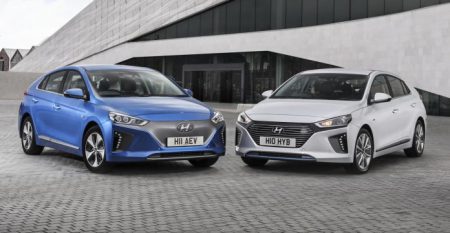
The Hyundai Ioniq is a practical, low-emissions hatchback which is already available with a conventional hybrid powertrain and a fully-electric powertrain too. With the arrival of the plug-in hybrid, the Hyundai Ioniq becomes the first production car to offer three different types of electrified powertrain at the same time.

There are two trim levels available with the Ioniq Plug-In, but whichever you pick the car utilises a 104bhp 1.6-litre GDi petrol engine combined with a 44.5kW electric motor and six-speed dual-clutch automatic gearbox to deliver 139bhp and CO2 emissions of just 26g/km.

According to official figures, the Hyundai Ioniq Plug-In can travel for up to 39 miles on purely electric power and the total range possible is 680 miles.

Hyundai IONIQ Plug-In Hybrid 2017

The entry-level trim is called Premium and as standard it comes with 16-inch alloy wheels plus an eight-inch infotainment system with sat-nav, Bluetooth and Apple Car Play and Android Auto all supported. Other standard features include wireless phone charging, a rear parking camera, lane keep assist and autonomous emergency braking.

Above Premium is the Premium SE trim, which starts from £26,795 when factoring in the plug-in car grant. This version adds the likes of leather and ventilated front seats, heated rear seats, alloy pedals, rain-sensing wipers, blind spot detection and front park assist.

The Ioniq Plug-In has one free exterior paint job – Polar White – while other finishes which include Phantom Black, Platinum Silver, Marina Blue, Phoenix Orange and Iron Grey are £565 options.

Source: Carkeys

Plug-in hybrid completes Ioniq trio

The plug-in hybrid uses a 105hp 1.6-litre petrol engine in conjunction with a 61hp high-efficiency electric motor driven through a six-speed dual-clutch transmission. This produces a combined output of 141hp and CO2 emissions of 26g/km, thereby attracting a zero-rate Vehicle Excise Duty for the first year.

Hyundai has completed the line up of its Ioniq with a plug-in hybrid model.

Hyundai claims that its new PHEV is capable of up to 39 miles of pure electric driving and a total range of 680 miles.

The Ioniq PHEV can be plugged into a domestic three-pin outlet when no dedicated charging points are available. For an additional £300, a 7kW charger and wall box can be supplied and installed at a customer’s home.

The standard paint finish is Polar White, though customers are able to specify from Phantom Black, Platinum Silver, Iron Grey, Demitasse Brown, Marina Blue and Phoenix Orange. Two trim levels, Premium and Premium SE, are available.

The Ioniq PHEV goes on sale this month with UK pricing starting from £24,995, including a £2,500 Plug-in Car Grant.

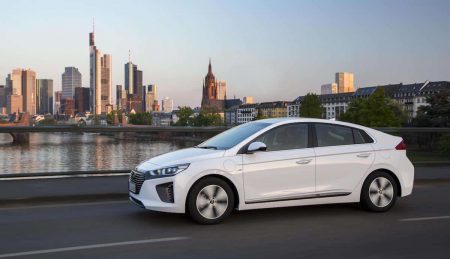
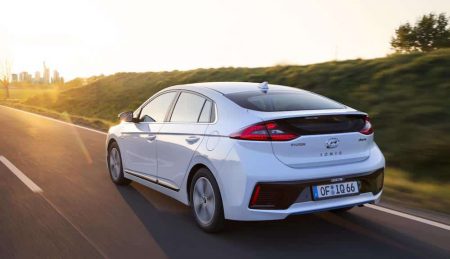
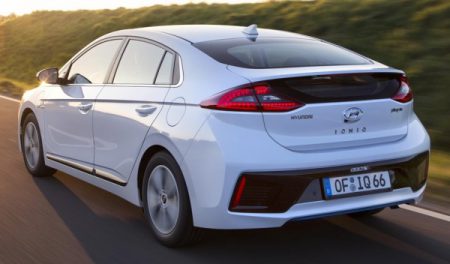
Polar White is the standard paint finish for the new PHEV

Source: The Car Expert

Hyundai IONIQ Plug-in Hybrid Goes on Sale in UK

The much publicized and hyped Hyundai IONIQ Plug-in Hybrid is gearing up to hit the British market later this month with a starting price of £24,995. It’ll be interesting how the IONIQ will do in terms of sales, especially as cars with all-caps names rarely become big hits. We have to say though, things are looking pretty good for this green Hyundai on paper.

The 2018 Hyundai IONIQ Plug-in Hybrid is the best version of the car you can ask for when you look at the number. 25 grand, 39 miles of pure electric driving with a total range of 680 miles. Granted, an output of 140 PS is not something one would write home about, but then you don’t buy a plug-in hybrid for performance, do you? So it’s all right. And the IONIQ doesn’t look horrible, as one would expect from a 25 grand hybrid made in Korea. Up close it’s actually kind of futuristic and nice. Of course, none of that is guarantee of success and we should wait and see how the market reacts to this thing.

Read more: Motorward