In a nod to the assured arrival of the battery-electric age, electrified vehicles swept the World Car Awards presented at the New York Auto Show this week.
This year marks the first that EVs dominated the annual awards, which are presented at the show every spring. The awards, which are chosen by 102 jurors from 33 countries (including myself), underscore the industry’s acceleration toward electrification.
The Hyundai Ioniq 5 took top honors, claiming three of the awards’ six categories: World Car of the Year, World Electric Car and World Car Design. Hyundai’s newest EV bested the Ford Mustang Mach-E and Kia EV6 from its sister brand to earn the top title.
The crossover represents the automaker’s next-generation mobility strategy, with efficient powertrain technology, cutting-edge features and futuristic utilitarian design.
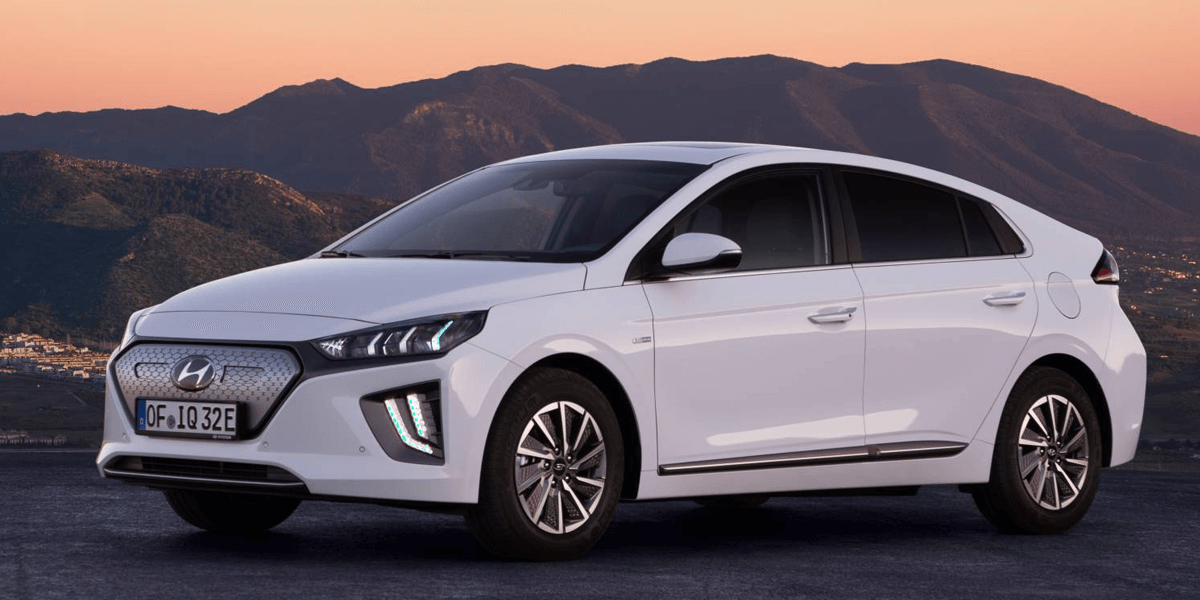
2020 Hyundai IONIQ (Image: Hyundai)
The Mercedes-Benz EQS, the futuristic, electrified version of the automaker’s S-Class executive sedan, was named World Luxury Car for its performance and premium cabin.
As World Performance Car, the Audi e-tron GT couples sporty performance with everyday usability. “Our big goal with the Audi e-tron GT was to reimagine the gran turismo philosophy for the electric age,” says Christiane Zorn, Audi’s head of product marketing.
If you would like to know more about Solar Panels and the PowerBanx range of home battery systems, and get a free instant quote, please complete our online form:
With much of the UK today being battered by Storm Eunice, sparking the strongest wind on record in the south to massive snowfall in the north, a number of households are already experiencing power cuts, with more predicted for the weekend.
For those suffering this unfortunately consequence, if they have one of the latest Korean electric cars on their driveway they will be able to keep their home appliances running for days.
That’s because the £37,500 Hyundai Ioniq 5 and £41,000 Kia EV6 boast a feature that turns the vehicles into mobile power stations that can charge laptops, power a fridge or even watch TV for hours on end.
Charging at Cherwell (Image: T. Heale)
The electric SUVs both have something called ‘Vehicle-to-load’ (V2L) technology, which consists of a three-pin adapter that plugs into the cars’ charging sockets to take electricity directly from the lithium-ion battery so you can boil a kettle even when your house has no power.
While electric cars are undeniably expensive to buy and certainly not to all tastes, they offer one big benefit to owners if there are power cuts and blackouts for prolonged periods.
The sister Korean brands have developed ‘built-in bi-directional chargers’ that can take electricity away from the lithium-ion batteries as well as send it to them – tech that’s expected to feature on most new electric models.
Bi-directional systems are designed to allow plug-in vehicles to send electricity stored in their batteries back to the grid (vehicle-to-grid, or V2G), which can be financially lucrative for owners who charge at the cheapest off-peak times and sell that electricity back to the network during the most expensive in-demand hours.
If you would like to know more about Solar Panels and the PowerBanx range of home battery systems, and get a free instant quote, please complete our online form:
The new rear-wheel-drive Hyundai Ioniq 5 EV saves you £6k on the AWD version
Verdict
This more affordable rear-drive Ioniq 5 has all of the hi-tech strengths of the dual-motor range-topper, but adds extra value for money into the mix. You lose a little performance, but it’s still more than quick enough, has excellent real-world range and blazingly fast charging, while it mixes polarising looks with decent practicality and a roomy cabin. Factor in fantastic infotainment, enough comfort and strong quality inside, and in this spec at this price, it receives top marks.
Hyundai has really stirred things up with its first electric car on a bespoke platform, the Ioniq 5. Indeed, the oversized hatchback made enough of a splash to earn our coveted Car of the Year title. It did so in range-topping Project 45 specification, though – so we’ve been curious to see whether more modest versions have the same appeal. Now’s our chance to find out.
There are seven versions of the Ioniq 5 on offer to UK customers, with a choice of three powertrains. This 73kWh Premium-spec car features a rear-mounted electric motor with 215bhp and 350Nm of torque, which means that it also offers the longest official range of any Ioniq 5, at 300 miles.
This car’s 7.4-second 0-62mph time isn’t as fast as the dual-motor model’s 5.2 seconds, but it does bring a useful saving of just over £6,000 on list price.
Hyundai Ioniq 5 (Image: hyundai.co.uk)
In a weird way, that drop in price might well shift perception of the Ioniq 5 from “that’s a lot of money for a Hyundai” (unfair though that is) to “that’s a lot of car and battery for that amount of cash”. And the good news is that rear-drive Ioniq 5s – even those with the smaller battery – still have cutting-edge 800v tech.
Find a fast enough public charger and you can replenish the battery at up to 350kW – so you can go from 10 to 80 per cent in less than 18 minutes. Kia’s forthcoming EV6 aside, nothing else at around this price offers that level of tech.
On the road, this Ioniq 5 feels almost as impressive as the full-blown version. Instant electric-motor punch means that it feels quick from rest, and while it’s only brisk at best beyond that point – losing one motor doesn’t save much weight, so it still weighs more than 1,900kg – it’s perfectly acceptable in most situations. The lack of a front motor means that sheer geography places you further away from any electric whine, too, so if anything it’s more refined.
The chassis set-up is fundamentally the same as before – which is to say it feels inherently stiff and heavy, but that it still does a good job of soaking up low-speed bumps and potholes, and there’s a nice tendency to float along once you’re up to speed. There’s a bit of patter from beneath, but in general it’s a comfortable experience.
If you would like to know more about Solar Panels and the PowerBanx range of home battery systems, and get a free instant quote, please complete our online form:
The new Hyundai Ioniq 5 has arrived and it’s simply one of the best electric cars on sale right now
Verdict
If the Ioniq 5 is a signal of intent from Hyundai, then rival car brands should be worried. This showcase of the Korean firm’s next generation electric car tech is hugely impressive in almost every area; from the performance to the charging speeds, few rivals can match it for the money. That it also looks unlike anything else on sale, inside and out, has great tech and is relaxing to drive, means there’s very little to fault.
This is the all new Hyundai Ioniq 5. The first car that will showcase the Korean brand’s second generation EV tech – quite an ominous thought for rivals considering that, at the more affordable end of the electric car market, Hyundai and its sister brand Kia already build some of the best offerings in the business.
This time, however, Hyundai is aiming higher. This is a car that has set its sights on premium rivals, with cars like the Audi Q4 e-tron and the upcoming Tesla Model Y seen as competition as much as the likes of the Volkswagen ID.4 and Ford Mustang Mach-e.
Hyundai Ioniq 5 (Image: hyundai.co.uk)
With premium construction comes a premium design. The Ioniq 5 is a world away from the Kona Electric or indeed anything else on the road; the retro-modern shape is covered in cool details. The multi-slotted glowing front panel, the 8-bit headlights (made from 256 individual LED ‘cubes’) and bold side surfacing are just some of the features that have created a proper head-turner.
Unlike Hyudai’s previous EVs, which used architecture designed to be compatible with combustion-powered offerings, the Ioniq 5 uses the brand’s Electric Global Modular Platform. It’s the first car to ride on the fully electric architecture, with the equally dramatic looking Kia EV6 set to be the next model to hit the roads.
The move upmarket has also resulted in an increase in size. Don’t let those neat proportions fool you – when you realise that the wheels this car rides on measure a whopping 20 inches, you realise that it’s almost like Hyundai has taken the blueprints for a family hatchback and clicked ‘select all’ then ‘resize 110 per cent’. At 4,635mm long and 1,890mm wide, the Ioniq 5 is longer and wider than Hyundai’s Tucson mid-size SUV – though its roofline is slightly lower. Perhaps more significant is the wheelbase; at 3,000mm, the gap between the front and rear axles is a couple of millimeters longer even than that on an Audi A8.
It’s a stat that really makes itself known once you swing open the huge back doors – the Ioniq’s cabin is simply vast. The floor is almost completely flat throughout, and rear occupants get genuinely limo-like levels of legroom. Yet compared to the finest luxury saloons, the Ioniq’s open plan feel and big windows make it so much brighter and more airy. The boot floor is high and the space is fairly shallow, but the area it covers is so huge that there’s still an impressive 527 litres of volume on offer.
Ahead of the driver sit a pair of screens. The central infotainment display uses a similar interface to other Hyundai models, but with cleaner graphics. The digital instrument display is equally clear to read – they’re not quite the sharpest resolution you’ll find in an EV (Tesla still holds that title) but everything is very logical and intuitive. The driver assist systems are particularly well integrated; on versions equipped with blind spot cameras, the images are displayed in real time in the instrument panel when the indicators are turned on.
It’s comfy, too. The seats are squishy yet supportive, while those in the front can recline almost completely – ideal if you fancy a quick nap when the car is charging.
If you would like to know more about Solar Panels and the PowerBanx range of home battery systems, and get a free instant quote, please complete our online form:
Hyundai has opened order books for its Ioniq 5 pure-electric car.
The Ioniq 5 is Hyundai’s first bespoke electric car and is the first in a new range of electric cars under its Ioniq pure-electric sub-brand.
It uses a new dedicated electric car platform called E-GMP, as shared with the new Kia EV6, and features a number of clever features including ultra-fast 800-volt charging and Vehicle-to-Load – the latter allowing owners to charge other items by using the car’s battery.
Two battery sizes are available: 58kWh has rear-wheel drive and a range of up to 240 miles, and the 73kWh rear-wheel drive can travel up to 300 miles.
An all-wheel drive version of the 73kWh battery car also be specified and comes with a range of up to 287 miles.
Thanks to the 800-volt charging system, the Ioniq 5 can be zero-to-80-per-cent charged in just 18 minutes from an ultra-fast charger.
Aside from the already sold-out Project 45 special first edition car, the Ioniq 5 comes in SE Connect, Premium and Ultimate trims.
The SE Connect kicks off the range at £36,995. It only comes with the smaller battery and features 19-inch alloys, sliding rear seats, two 12.3-inch displays, wireless phone charging, sat nav-based smart cruise control and host of safety equipment.
Hyundai Ioniq 5 (Image: hyundai.co.uk)
Premium starts at £39,295 for the 58kWh battery and gets an electric driver’s seat, heated front seats and steering, LED projector headlights and the Vehicle-to-Load pack. The Premium also comes in the 73kWh battery for £41,945.
Ultimate tops the range and gets leather seats, electrically-adjustable and ventilated front seats, heated rear seats, a Bose sound system, a head-up display with augmented reality, 20-inch wheels and a sliding centre console.
An Eco pack (a battery heating system and heat pump) and Tech Pack (extra safety kit along with aircraft-style relaxation seats) can also be specified.
Along with the 58kWh and 73kWh rear-wheel drive versions at £42,295 and £44,945 respectively, the Ultimate also gets the 73kWh all-wheel drive option at £48,145.
Nine colour options are available and every Ioniq 5 gets a free one-year subscription to the ultra-fast Ionity charging network.
Ashley Andrew, Hyundai UK MD, said: ‘Hyundai is at the forefront of zero emission vehicle technology and is recognised as a leader in producing highly efficient electric vehicles.
With Ioniq 5, we’ve taken this expertise and combined it with the highest level of progressive design to produce what has already become one of the most desirable models in our history.’
If you would like to know more about Solar Panels and the PowerBanx range of home battery systems, and get a free instant quote, please complete our online form:
Both share a platform but they look radically different.
The Hyundai Motor Group is getting serious about battery-electric vehicles. The Hyundai Ioniq 5 and Kia EV6 are the South Korean automaker’s first-ever dedicated BEVs with both utilizing the new Electric-Global Modular Platform (E-GMP). Consider the pair corporate cousins but, as we can clearly see, they look nothing alike.
Gone are the days of badge engineering shamelessly exploited by American carmakers. This practice has been replaced with an entirely new platform sharing method used by the entire auto industry. Hyundai and Kia have completely separate design studios and, to a certain extent, slightly different customers. Kias are aimed at younger buyers while Hyundais offer a slightly more mature look.
Regardless of one’s tastes, both the Ioniq 5 and EV6 are stunning EVs with distinctive personalities. What are their key differences? Read on.
Exterior Design
It’s hard to believe both EVs ride on the same platform because they look so radically different. The Ioniq 5 is based on 2019’s 45 Concept car, which itself took cues from the 1974 Hyundai Pony Coupe. Call the styling retro-futuristic. The edgy styling may not be for everyone but it’s great to see Hyundai making bold choices here.
The EV6, especially the supercar-fast GT variant, shares the Ioniq 5’s crossover-like body style, but that’s about it. It looks like it’s going fast even at a standstill thanks to a more sculpted hood and dual rear spoilers. Even the wheel designs scream performance. The Kia also sports the brand’s new signature front-end styling, but the Ioniq 5 lacks the jewel-like front grille found on other new Hyundais, such as the Tucson. Also noteworthy is the EV6’s wheelbase measures in at 114.2 inches while the Ioniq 5’s is 118.1 inches. Again, same platform but designers were clearly given the freedom to do as they pleased.
Hyundai Ioniq 5 (Image: hyundai.co.uk)
Interior Layout And Look
Both vehicles have very different interior layouts and designs than combustion-engined vehicles. That’s because the E-GMP platform has no center hump but rather a skateboard-like flat surface with a floor-mounted battery pack. Maximizing space was a core requirement.
The Ioniq 5 has a lounge-like attitude with electronically adjustable seats that nearly recline flat. It also boasts a movable center console that can slide 5.5 inches rearward for easier entry and exit. There’s a total of 56.5 cu. ft. of space with the second-row folded flat, whereas the EV6 has 45 cu. ft. with the same setup. Both vehicle interiors make use of recycled plastics and other eco-friendly materials.
The dual 12-inch screens, one the infotainment system display, the other a digital gauge cluster are found in each vehicle, though the Kia’s has a more Audi-like appearance. The Hyundai’s – dare we say – resembles Apple design. Again, these differences go to the heart of these EVs ‘ personalities: sporty vs. modern.
Batteries And Performance
The two have much in common here. Shared platforms means shared guts (mostly). Both come with a standard 58-kWh battery pack and a single motor layout with rear-wheel-drive. They also can accommodate 400- and 800-volt charging and 350 kW DC fast charging.
However, the Ioniq 5 has an optional 72.6-kWh unit that can be linked to a single or dual-motor setup. All-wheel drive is optional as well. The most powerful combination with AWD offers 301 horsepower and 446 lb-ft of torque with a 0-62 mph time of 5.2 seconds and a 115 mph top speed.
The top-of-the-line Kia EV6 GT, on the other hand, has a 77.4-kWh battery and standard AWD. It’s literally a supercar rival with 576 hp and 538 lb-ft of twist. Zero to 60 mph takes 3.5 seconds and top speed is 161 mph. This is clearly the enthusiast’s choice. The base and GT-Line can be had in RWD and AWD with as little as 167 hp and up to 320 hp.
The EV6 RWD with the long-range pack will go roughly 316 miles on the WLTP testing cycle, and the Ioniq 5, in the same configuration, will achieve just under 300 miles. Official figures for both vehicles are still pending.
If you would like to know more about Solar Panels and the PowerBanx range of home battery systems, and get a free instant quote, please complete our online form:
Hyundai is kicking off its new electric sub-brand with an absolute beauty. The Ioniq 5 is a mid-size crossover with hot hatch proportions. Or perhaps it’s just a very big hatchback – the jury is still out. Whatever you want to call it, it’s oozing style. While the design is sharp and modern, including the Z-shaped crease that’s part of Hyundai’s new design language, Hyundai says the Ioniq 5 was inspired by its first production car. We’ve squinted at it from all angles and don’t see it though. What we do see is a good-looking car with an innovative interior and a promising drivetrain. So let’s dig into its coolest features.
1. Thoughtful Aesthetic Design
Hyundai has come a long, long, long way when it comes to aesthetics, but there’s more to the Ionic 5 than next-generation European hot hatch looks. The Parametric Pixel lights, with their pixel-like clusters, are an artful acknowledgment of the Ioniq 5’s digital origins. Simultaneously, the clamshell hood and flush door handles are old-school tricks to maximize aerodynamic efficiency. The aero-optimized wheels will be available in sizes up to 20 inches and carry on the Parametric Pixel design theme. There’s a lot to love about the Ioniq 5’s styling, but the light clusters are arguably the coolest individual aspect.
2. Room For Activities
The Ioniq 5 has a 118-inch wheelbase, which is nearly four inches longer than Hyundai’s three-row Palisade SUV. Furthermore, the interior is unencumbered by a transmission tunnel and features a flat floor. That gives Hyundai room to apply what it calls a ‘Living Space’ theme to the interior. This means plenty of room to stretch out and relax, as well as lots of headroom and large amounts of useable storage space, including storage for a purse. The seats recline, complete with a (likely optional) first-class-cabin-style lower leg support on the front seats. Hyundai is even touting a single-pane glass ceiling so you can lay back and look at the stars. Lastly, and importantly, you can store all your stuff in 18.7 cubic feet of cargo space.
Hyundai Ioniq 5 (Image: hyundai.co.uk)
3. Solid Performance Meets Balanced Range
Power comes from either a 58-kWh or 72.6-kWh battery pack hooked up to a single rear electric motor or a dual-motor layout. With the two-wheel-drive configuration and a 72.6-kWh battery, the Ioniq 5 will jog up to 62 mph in 7.4 seconds while getting a range of almost 300 miles. The all-wheel-drive variant with the 72.6-kWh battery generates a healthy 301 horsepower and 446 lb-ft of torque and will sprint from 0-62 mph in 5.2 seconds and top out at 100 mph. These aren’t earth-shattering figures, but they’re more than adequate for the trendy family on the move.
From a range perspective, the WLTP test cycles suggest between 292 and 298 miles is capable on 2WD models with the larger battery. This will likely drop to around 220 miles when the EPA gets its mitts on the Ioniq 5.
4. Convenient Charging Technology
For electric vehicles to become widely adopted, charging the batteries needs to be quick and convenient. Hyundai claims that the Ioniq 5 can be charged from ten percent to 90 percent in 18 minutes using a 350-kW charger, which is a great start. The South Korean automaker also says that up to 62 miles of range can be recharged in just five minutes. For convenience, owners can start and stop charging with the touch of a button on their smartphone app, and Remote Climate Control gives the option of scheduling the vehicle’s pre-heating while connected to a power source. Hyundai’s E-GMP charging system can support both 400-V and 800-V charging infrastructures by using the motor and an inverter to boost 400 V to 800 V for stable charging.
5. Augmented Reality HUD
In its press release, Hyundai glosses over its Augmented Reality Head-Up Display (AR HUD). It shouldn’t, because the ability to turn the windshield into a display screen is crazy cool, especially when AR is involved. Plans for creating one for the brand started in 2020 when Hyundai Mobis, Hyundai’s parts and service arm, invested in Envisics, a UK-based AR HUD company. Hyundai hasn’t given any real details about the system yet, but we assume it’s similar to Mercedes-Benz’s AR-HUD technology. That said, with so much hype around it, we certainly expect some unique features to be debuted when the car arrives.
If you would like to know more about Solar Panels and the PowerBanx range of home battery systems, and get a free instant quote, please complete our online form:
And it’s the first Hyundai you might actually *desire*. Still want that Tesla Model 3?
Hyundais are cars we admire but don’t necessarily desire. Well that’s about to change. The Ioniq 5 is the first to use the brand’s new Electric-Global Modular Platform, so it’s hugely significant. It also references the Seventies Pony, the hatch (designed by il maestro Giorgetto Giugiaro) that first gave the brand serious traction outside South Korea. Not sure how many of us really remember it, but somehow that little nostalgia kick really works. The result is a sharply surfaced example of the perfect post-modern BEV.
Trailed by 2019’s lovely ‘45’ EV concept, the real thing remains impressively faithful to the motor show tease. “It’s an opportunity to showcase a part of history that not that many people know about. There’s a lot of history to tell,” Hyundai’s head of design for Europe, Thomas Buerkle tells TG.com. “We had the chance to pull the A-pillar forward, and extended it into the clamshell bonnet. So there are fewer shutlines, and it looks cleaner and wider. We wanted there to be some real excitement to the EV driving experience. There are lines on this car that are only possible with special tooling and stamping, and of course it helps that Hyundai is the only brand in the world that produces its own steel. So we can get the precision we need. The less busy the design, the more you focus on the details.”
Details like the body side slash, the pronounced V shape in the nose and the minimal ‘pixellated’ head- and tail-lights. There are flush door handles and cladding on the sills and at the front and rear which actually helps define the shape rather than looking tacked on, and also contains hidden illuminated elements.
It’s all part of what Hyundai calls ‘parametric design’, which means ‘something expressed in terms of a parameter’. Erm, isn’t everything? Never mind, because the car is a sensation: taut, well-proportioned and beautifully surfaced. It also rides on 20in wheels, the biggest ever fitted to a production Hyundai, and also surely the most imaginatively designed, kind of like fractals. Note also the Ioniq 5’s wheelbase: exactly 3000mm. This is a BEV purpose-designed and built as such, that takes the possibilities of the rapidly evolving electric car form, including the skateboard chassis, and runs with them.
Hyundai Ioniq 5 (Image: hyundai.co.uk)
Hyundai has thrown everything and then a bit more at this new car. You can choose between a single motor rear-drive version or an all-wheel drive dual motor one, with a 58kWh or 72.6kWh battery. The dual motor version makes just over 350bhp and 446 torques so it’s good for 62mph in 5.2 seconds (top speed on all versions is limited to 115mph). There’s a multi-link rear suspension too, promising genuine handling smarts.
Crucially, the Ioniq 5 uses 800-volt battery tech so it can rapid charge on a 350kW charger from 10 to 80 per cent in 18 minutes, or replenish 62 miles of range in just five. The higher voltage also improves charging efficiency and reduces heat loss. Hyundai is claiming a range of 295 miles on the most efficient version. It’s also fitted with something called Vehicle to Load (V2L) which turns the car into a giant portable powerpack – yep, this is an EV you can use to charge another EV (with the correct adapter), amongst other appliances. It supplies up to 3.6kW of power, and has a 220-volt port located under the back seats with another one beside the car’s exterior charging port. And there’s a solar panel roof which offers an additional boost to the battery pack – it can produce up to 205 watts, though this is probably a more significant USP in California than Clacton.
The Ioniq 5’s 3m-long wheelbase makes good on Hyundai’s ‘Smart Living Space’ claims for the interior, which also uses sustainable materials and slimline seats. The seats, headliner, door trim, floor and arm rest use recycled plastic bottles, plant-based yarns and eco-processed leather. A moveable centre console – dubbed the ‘universal island’ – can slide back by up to 140mm. The seats also fold almost totally flat, and together with an unimpeded floor suggests that the Ioniq 5 could double as a rather commodious mobile home. The boot can hold up to 540 litres with the seats up, 1,600 litres with them folded flat. There’s a bit more room in the ‘frunk’.
There’s full Android auto and Apple carplay connectivity, Bluelink connected car services for live routing and over-the-air updates, two 12.25in screens, augmented head-up display, wireless phone charging, voice recognition software, and a Bose audio system. And the full suite of advanced driver assistance tech – Hyundai calls it SmartSense – is also integrated.
Early adopters can go for a fully loaded ‘Project 45’ edition that’ll cost you £45k (prices for the rest of the range haven’t been confirmed yet). Hyundai’s Tesla Model 3 killer? This could be the closest yet.
If you would like to know more about Solar Panels and the PowerBanx range of home battery systems, and get a free instant quote, please complete our online form: