Category Archives: Solar

Our electric car is driving on sunshine

Our solar panels occupy only a third of our roof area. Even so, on a summer day they produce about the same power our Volkswagen electric car draws as it charges from a plug in the garage.
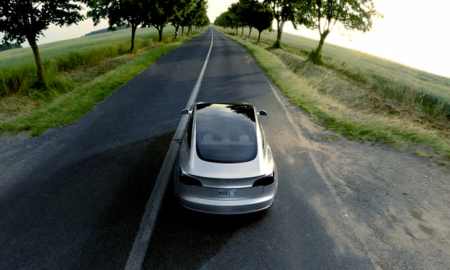
Electric car on the road. ‘We are literally driving on sunshine,’ write James and Lesley Willis. Photograph: EPA

So, to the extent that we top up during the day, we are literally driving on sunshine: nil use of resources, nil pollution, and, in the context of your article (Battery cars may eat up more than Hinkley Point’s capacity by 2030, 13 July), nil load on national power generation infrastructure. Going for a drive in serene, effortless near-silence, knowing that it hasn’t cost anybody anything, is quite simply wonderful.

The rapid increase in the number of distributed solar power installations is producing an unmanageable peak on sunny days. But our experience illustrates that there is an excellent match between renewable energy and electric vehicles. Electric cars are big batteries on wheels, storing far more power than they need for journeys. They could be made to play a dynamic part in balancing the uneven generation inherent in many forms of renewable energy.
James and Lesley Willis
Alton, Hampshire

Zoe Williams suggests (Is a car maker about to save the planet? 10 July) that “the goal has to be an electric car powered by renewable energy”. A seemingly admirable aim but one that implies that the only problem is atmospheric pollution. Unfortunately, the motor car also encourages sprawl, making our cities less compact and sustainable and resulting in healthy travel alternatives (walking, cycling, public transport) becoming more difficult. It divides communities, both by splitting them with transport corridors and by isolating users in their car bubbles. It maims and kills, which may become more of an issue, as electric cars are quieter. It requires road space that is increasingly not available, causing issues from congestion and excessive travel time to access and pavement parking. And, given that a high percentage of pollution in the life-cycle of a car is in its production, how much is actually avoided?

Source: The Guardian

Panasonic Joins Push to Put Photovoltaics on More Car Roofs

Panasonic Corp. sees the future of solar on car rooftops.

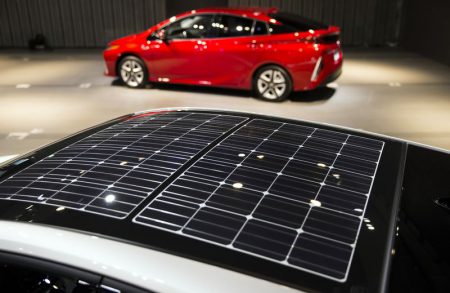
The Osaka-based electronics maker has started producing a 180-watt array of solar cells that can be fixed to the roof of an automobile. In February, Panasonic announced that its photovoltaic module would be used on the roof of Toyota Motor Corp.’s latest Prius plug-in hybrid.

Cars represent a potentially lucrative new outlet for solar cells in an industry where intense competition from Chinese manufacturers has pushed down prices sharply. That’s prompting some manufacturers to adapt solar cells for everything from home roofing tiles and the outer skins of buildings to backpacks and tents.

Solar panels on the roof of Toyota Motor’s Prius plug-in hybrid vehicles (PHV). Photographer: Tomohiro Ohsumi/Bloomberg

“Car roofs have the potential to become a new market for solar panels,” Shingo Okamoto, the general manager at Panasonic who was in charge of developing the technology, said. “We made history in the auto industry and in the solar industry with the sun powering mass-produced cars for the first time in the world.”

New Market

Cars could hold the promise of a giant new market for solar panels from Panasonic, which also is partnered with Tesla Inc. in making batteries at its Gigafactory outside Las Vegas. There are 264 million cars and light trucks in operation in the U.S., according to the National Automobile Dealers Association.

Others are noticing the potential. Tesla Chairman Elon Musk tweeted in November that his company’s Model 3 car may come with a solar roof. He’s also beginning to sell a type of roof tile for homes featuring embedded photovoltaics. Nissan Motor Co. offers an add-on solar panel option for its Leaf electric cars, giving extra charge to systems such as the air conditioners and radios, according to Nicholas Maxfield, a spokesman for the company.

Read more: Bloomberg Technology