Category Archives: Charging

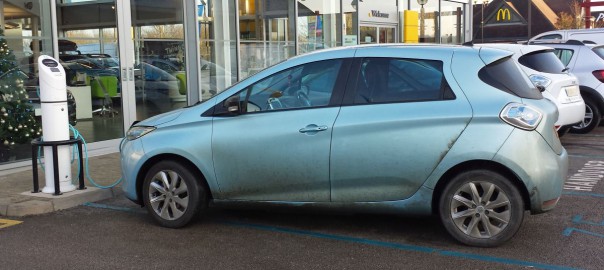
Catching a quick charge at the local Renault dealer (Image: T. Larkum)

Tested: Renault Zoe can grid-balance

In the Netherlands, Jedlix and Elaad say the Zoe is good for the smart grid

Dutch smart charging specialist Jedlix and the Elaad Competence Centre have concluded that Renault Zoe can be used in a balancing capacity of TenneT in the Netherlands.

National grids must be able to balance electricity production and consumption and when this is disrupted, Transport System Operators (TSOs) are forced to activate secondary options to prevent imbalance, which often come from fossil-fuelled power plants.

Catching a quick charge at the local Renault dealer (Image: T. Larkum)
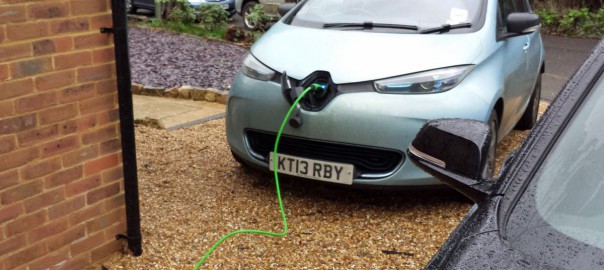
ZOE on charge (Image: T. Larkum)

To use Renault Zoe for network balancing, the car’s charging process had to be able to react to real-time signals. At Elaad’s test centre in Arnhem, in the Netherlands, the two partners conclusively proved that the Zoe is able to respond to TenneT signals within seconds. According to Jedlix, this kind of suitability is further proof that electric vehicle batteries can be efficient and competitive resources that contribute to increasing the flexibility requirements of national grids.

What the company has not mentioned in their press release, however, is whether the charging is bidirectional, i.e. whether electricity from the car’s battery can also be fed into the grid. Certainly, the Renault electric car does not come ex-works supporting bi-directional charging, only being designed to take up electricity. What is possible to help balance the grid, is that the charging power can be reduced if necessary – which can reduce peak loads and thus contribute to grid stability.

Two years ago, Jedlix and Elaad made the same tests with Tesla cars. “In a previous study with Jedlix, we also found a positive effect on the distribution network when we respond to transmission network signals, which is crucial for the long-term introduction of electric vehicles,” says Elaad Director Onoph Caron. “We invite all OEMs to implement similar programs here in the Netherlands.”

Read more: Electrive

Milton Keynes 'Mushrooms' Charging Hub (Image: T. Larkum)

Government EV charging fund to kick off with Masdar-backed spend to double rapid charging network

The UK government has formally unveiled its new £400 million Charging Infrastructure Investment Fund (CIIF), boasting a maiden investment from UAE renewables investment group Masdar.

That investment, provided by both the government and Masdar, is valued at £70 million and will be used to more than double the UK’s rapid charge point infrastructure over the next five years.

It’s intended that the investment will take the number of rapid chargers installed in the UK to 5,000, of which 2,000 are already installed.

Milton Keynes 'Mushrooms' Charging Hub (Image: T. Larkum)
Milton Keynes ‘Mushrooms’ Charging Hub (Image: T. Larkum)

The CIIF was first announced in July 2018, prompting a lengthy search for a fund manager. Zouk Capital was then announced as the government’s preferred bidder in February this year, and has now been formally handed the reins to the CIIF.

Speaking to Current± after that news, Zouk senior partner Colin Campbell said its fundamental interest would remain in charging networks and EV charging technologies.

Government has also today announced a review to explore EV charge point infrastructure across major road networks, which is aimed to educate investment destinations.

Read more: Current News

Hyundai joins IONITY to trigger a ‘new era’ of ultra-fast EV charging

Hyundai has joined IONITY’s ranks of car manufacturers in a bid to “open a new era” of high power charging (HPC).

A joint venture between BMW, Ford, Daimler and Volkswagen, IONITY was launched in 2017 with the aim of establishing and operating a HPC network along the main highways in Europe.

The firm’s 350kW chargers hit the UK in May as part of a partnership with Octopus Energy for the installation of 40 charging stations, supplied with renewable energy.

IONITY also penned a deal with Extra MSA Group, which owns and operates part of the UK’s motorway network, for installations at eight service stations.

Thomas Schemera, executive vice president and head of product division at Hyundai, said:

“I am confident that our work with IONITY will open a new era of high power charging experiences, where charging will be seamless and easier than refueling for our customers.”

Read more: Current News

Milton Keynes 'Mushrooms' Charging Hub (Image: T. Larkum)

Top 10 fastest charging EVs

Driving an EV is one thing, topping up its batteries another.

Most drivers resort to AC charging at home or at the office, which is possible at a rate of anything between 3.7kW (e.g. Citroën C-Zero) and 16.5 kW (e.g. Tesla Model S and X). It depends on the output of the wallbox, but also on the capacity of the EV’s onboard charger, which has to convert AC from the grid to DC for the battery. Even if the wallbox is rated at 11kW, you can never charge faster than the capacity of the on-board device.

Milton Keynes 'Mushrooms' Charging Hub (Image: T. Larkum)
Milton Keynes ‘Mushrooms’ Charging Hub (Image: T. Larkum)

In the case of DC fast charging, which is only done occasionally by most, the limitations don’t stem from AC-DC conversion, but (mainly) from cooling. Most DC fast chargers today offer 50kW, but the latest ones reach 150kW. BMW, Jaguar Land Rover and Porsche have already tested fast chargers at 350kW, which are indeed seven times faster than most stations today. These would reduce the charging time for a big 100kWh battery to just fifteen minutes (from 10 to 80% State of Charge).

We thought it would be interesting to draw up a top 10 of the fastest charging sub-80,000-euro EVs (excluding VAT) that have officially been presented and can be ordered today, expressed in kilometres of range added per charging hour.

Read more: Fleet Europe

Charging Hub with eVolt Rapid Chargers (Image: SWARCO eVolt)

Scottish government unveils £7.5 million ‘groundbreaking’ EV infrastructure pilot

The Scottish government has thrown its weight behind a £7.5 million project to ramp up EV charge point installs in the country.

The partnership will bring together Transport Scotland and Scotland’s two distribution network operators – SP Energy Networks (SPEN) and Scottish and Southern Electricity Networks (SSEN) – in a bid to deliver more EV charging points.

SSEN is to examine the necessary electricity network infrastructure to support more electric vehicles on the road, taking a particular interest in the infrastructure needed for new charging points set to be installed along the A9; a critical route running from Edinburgh to the north of Scotland.

Charging Hub with eVolt Rapid Chargers (Image: SWARCO eVolt)
Scottish Charging Hub with eVolt Rapid Chargers (Image: SWARCO eVolt)

SPEN meanwhile is to work on opening additional, publicly-accessible EV charging points integrated on its network. A pilot project is to look into ways of increasing the pace, accessibility and efficiency of public charger installation.

The Scottish government is to contribute £5 million of funding for the programmes, matched by an additional £2.5 million of funding from both SPEN and SSEN, with projects set to go live in 2020/21.

The project was unveiled at an event held at University of Strathclyde’s power networks demonstration centre, which was also attended by First Minister Nicola Sturgeon.

Sturgeon spoke of the “critical role” networks have to play in facilitating an “electric vehicle revolution”.

“This project will develop a new model for delivering both EV charging and electricity network infrastructure which can more effectively satisfy Scotland’s ambitions, including delivering inclusive universal access to the benefits of the decarbonisation of transport.”

Read more: Current News

Charging Station in Sunderland (Image: Fastned)

MP welcomes new electric car charging points at South Western Stations

South Western Railway has installed 60 new electric car charging points at six station car parks on its network.

The charging points cost a total of £100,000 and Basingstoke MP Maria Miller welcomed the investment by SWR.

The charging points help make rail travel more sustainable, and passengers can charge their electric vehicles free of charge between now and the end of October, just having to pay the car park fee.

As well as Basingstoke, the charging points are also installed at five other stations – Farnborough, Andover, Haslemere, Wokingham and Fleet.

SWR worked with mechanical and electrical engineering specialists, SSE Enterprise Rail, to install Rolec EV WallPod charging units at each station.

The electric car charging points are 13-amp trickle chargers, allowing passengers to leave their vehicles on charge for the day.

The new charging points can be upgraded for higher currents to cover future developments.

Read more: RailAdvent

There are now more electric vehicle charging points than petrol stations in UK

The latest figures have revealed there are 9,300 EV charging stations in the UK compared to 8,400 fuel stations

Electric car owners now have almost 1,000 more places to publicly charge their vehicle than petrol and diesel owners have to fill their tank, in a landmark tipping point for motorists.

The latest figures have revealed there are 9,300 EV charging stations in the UK compared to 8,400 fuel stations.

The crossover has taken place a year before Nissan’s 2016 prediction of August 2020 – a result of the fast-improving infrastructure for electric vehicles in the UK.

Sales of pure EVs are up by 70 per cent this year as buyers take advantage of government grants and perks such a road tax exemption and, from 2020/21, no company car tax.

In fewer than 100 years since Britain’s first fuel station opened at Aldermaston in Berkshire in November 1919, the number of forecourts has peaked, declined and been overtaken by charging stations designed for battery-powered cars.

Almost 80 per cent of UK petrol stations have closed since 1970, while the number of electric vehicle charging locations has increased from a few hundred in 2011, when Nissan launched its LEAF electric car in the UK, to 9,300 in August 2019, according to the charging platform Zap-Map.

More than 1,600 of these locations provide ‘rapid charging’, where a typical EV battery can be charged to around 80 per cent in under an hour.

Kalyana Sivagnanam, managing director, Nissan Motor (GB) Ltd, said: “Many consumers are saying their next car will be electric.

Read more: Mirror

Figure 4: Charging on Christmas Day (Image: T. Larkum)

UK electric vehicle development: rising investment, concerns over Brexit

As the UK government announces a range of schemes investing in UK electric vehicle development, concern has grown over the post-Brexit future of the industry.

Last week the government launched a consultation on proposals to compel all newly built houses in the UK to be fitted with a chargepoint for electric vehicles, a legislative world first aimed at supporting UK electric vehicle development and uptake of electric mobility. The proposal follows the implementation of a government scheme offering homeowners a £500 (€555.71) grant to cover the cost of installing a chargepoint at their home.

Figure 4: Charging on Christmas Day (Image: T. Larkum)
Charging my ZOE (Image: T. Larkum)

Separately, the government has announced the deployment of £80m (€88.91m) through its Industrial Strategy to support UK electric vehicle development and innovation. In addition to supporting new research and development in on-road electric vehicles, the funding will go towards exploring potential development of a hybrid-powered aircraft. Business Secretary Greg Clark said:

“Building on our Faraday Battery Challenge and Battery Industrialisation Centre this co-investment from Government and industry is a key part of our modern Industrial Strategy, building on our strengths and helping to create the next generation of net zero technologies that will transform entire industries. The UK leads the world on combatting climate change and is the first major economy to legislate for net zero.”

The UK’s e-mobility industry is growing exponentially, with projected growth of more than 200% in the next three years. However, analysis by sustainable transport body Transport & Environment published this week highlights concerns over whether the growth of UK electric vehicle development can be maintained once the UK has left the EU. Greg Archer, Transport Environment’s UK Director, said:

“Thanks to new EU rules, a wave of new, longer range, and more affordable electric cars will be on sale across Europe. But if the UK leaves the EU with no deal it will no longer be part of these rules and the cars sold in the UK won’t count towards meeting the carmakers’ targets. As a result, cars simply won’t be made available in large numbers in the UK, slowing progress in the shift to zero emissions cars here.”

Read more: Government Europa

Electric cars ready for free test drives in Milton Keynes (Image: T. Larkum)

Luton Airport trials reduced drop-off charge for electric vehicles

Electric car drivers will get a 75 per cent reduction in drop-off charges at London’s Luton Airport as part of a new trial.

Until September 30, drivers will pay £2 for 30-minute drop-offs and pick-ups (stays over that length will not be discounted).

Electric vehicles won’t use the normal drop-off zone, instead being directed to the nearby multi-storey car park (not the further away mid- and long-term car parks) which normally costs £8 for 30 minutes’ parking.

Electric cars ready for free test drives in Milton Keynes (Image: T. Larkum)
Electric cars charging (Image: T. Larkum)

Drivers will also be able to use the charging points on level 2 for free while they wait.

The usual price in the drop-off zone is £4 for 13 minutes and £1 a minute after.

The airport says that if the trial is “successful” the reduced rate will be brought in on a permanent basis.

Read more: Business Traveller

Drive Energi 50kW Tritium Veefil-RT chargers (Image: Drive Energi)

Proposals unveiled for a new network of 2,500 EV chargers

A new charge point operator, Drive Energi, is pledging to install 2,500 chargers in the UK by 2025.

Each site on the proposed network is to have two 50kW Tritium Veefil-RT chargers and a number of 22kW chargers, according to plans put forward by Drive Energi yesterday.

Drive Energi is planning on having 100 chargers installed by the end of the year and between 300 and 500 by the end of 2020.

Tritium would provide 24 hour support to the network, which Drive Energi said will be a mix of public and private charging.

Drive Energi 50kW Tritium Veefil-RT chargers (Image: Drive Energi)

Drive Energi has been in development for the last 12 months by Box Energi, which also provides energy storage and computing services, CEO James Moat said.

Moat claimed the company has 5,000 locations secured in the UK which have been undergoing assessment and said it chose Tritium’s chargers as they are “reliable, robust and trustworthy”.

“These chargers are not only the fastest and most advanced in their class, but incredibly easy to use and, with the world’s smallest physical footprint, to deploy as well – particularly in our cities and high-density areas where space is increasingly limited.”

Read more: Current News