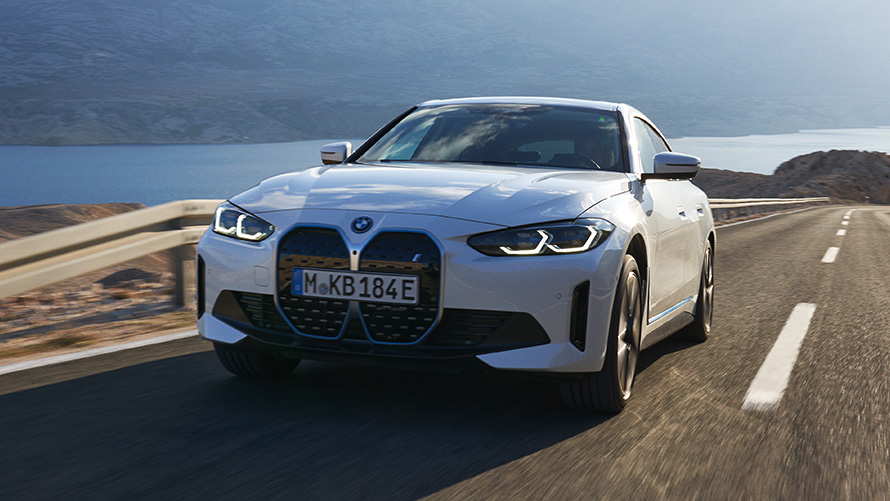
Part carbon, 2.5 tonnes and that grille – welcome to BMW’s immediate future
The new i4 M50 that got its moment in the wintry sun last week represented the sensible, buttoned-down side of BMW’s electrification strategy, being an EV version of the 4 Series Gran Coupe. It’s the sort of car that offers an easy – if pricey – migration for those who want to change powertrain but keep the rest familiar. Not so the equally fresh iX, a car with all the nuanced subtlety of a Frankie Boyle punchline.
BMW i4 EV (Image: BMW)
The design was always going to trigger debate and lead to social media punch-ups. Indeed that seems to have been part of the corporate strategy, with BMW’s corporate “OK, boomer” tweet last year targeting those with doubts as to whether this was a bright new future for the brand. Yet, as often the case with louder personalities, the iX is much less radical under the surface than it is on top, sitting on the same CLAR platform that underpins the combustion-powered dinosaurs in the range.
If you would like to know more about Solar Panels and the PowerBanx range of home battery systems, and get a free instant quote, please complete our online form:
The BMW i4 is available to order with a starting price of £52,000. The i4 will most likely reach showrooms in 2022 and be a rival for the Tesla Model 3, which is more than £10,000 cheaper.
BMW i4 EV (Image: BMW)
So it’s not a bargain, but the i4 is the German carmaker’s first attempt at moulding everything you like about a modern BMW – stylish design, luxurious interior and sharp driving dynamics – around an electric powertrain.
Stylish design? Well, we’ll let you decide.
Upfront, you get the love it or loath beaver-tooth grille that first appeared on the new 4 Series. It’s not as striking now and, on the i4, it gets a flush finish with a panel that can open to provide cooling to the motors when needed. Aerodynamics feature a lot in the design.
Thus, the BMW has a slippery profile with a coupe-like roofline reminiscent of the Tesla Model S and door handles that sit flush in their housings. You can also go for 17-inch wheels with plastic inserts that help them cut through the air more easily and add 6 miles to your total range. Standard 17, 18 and 20-inch wheels are also available.
Around the back, you’ll find a rear diffuser that’s stuck on the end of the BMW’s completely flat floor, which again helps lower drag. The diffuser, lower section between the wheels which houses the battery and the opening grille are finished in iBlue highlights to press home the i4’s perceived eco-friendliness.
If you would like to know more about Solar Panels and the PowerBanx range of home battery systems, and get a free instant quote, please complete our online form:
BMW’s forsaken i3 was exceptional, underwhelming, and far too ahead of its time.
The BMW i3 has reached the end of the line. Two weeks ago, BMW confirmed that this is the last month the company will be making its quirky and often misunderstood electric vehicle for US customers. In doing so, the automaker acknowledged what many EV owners, enthusiasts, and observers have long believed: the company, which was once lauded as a leader in electrification, has squandered the last eight years.
I don’t say this lightly or without experience—I owned a 2014 BMW i3 for nearly five years. It was my first electric vehicle, and I loved it. Sometimes, I wish I hadn’t sold it. Other times, I’m glad I did. It wasn’t perfect, but it was unique and fun to drive, and it felt years ahead of its time.
The i3 was a polarizing car. Its upright, narrow body rolled on skinny tires, and its layered design was loved or loathed, depending on the customer. But no matter how you feel about the i3, it was a car made by a company with a clear vision of the future, pursued with tenacity and purpose. BMW pitched the i3 as the foundation of an entirely new line, and BMW could have seriously iterated on the design. There was talk in the early days of how easy it would be to simply drop a new carbon-fiber reinforced plastic body onto the brilliantly engineered aluminum chassis, creating a suite of models that would explore a wide range of electrified mobility.
BMW i3 120Ah (Image: BMW Group)
But then BMW wavered and abandoned the i3 platform as an evolutionary dead end.
Come August, BMW won’t have a single EV for sale in the US market until next summer’s arrival of the i4, a conservative sedan based on a compromise platform that shares little of the clarity of purpose that defined the i3. The i4 may be a good car, or even a great one, but its late entry to a crowded field underlines just how much time BMW has wasted.
A car from the future
I still remember the first time I saw an i3 in real life. It was at the Boston auto show—a third-tier event—and even there, crowded among the other gleaming BMWs, it stood out. I didn’t immediately fall for its tall, rounded box exterior, but I did swoon over its interior. Here, available for purchase, was a concept car. The front doors swung wide, revealing suicide doors that made the rear seat surprisingly accessible. After I stepped over the carbon-fiber door sill and slid into the front seats, which were swathed in wool fabric and olive-tanned leather, my eyes were drawn to the wide infotainment screen floating over a curving swath of eucalyptus wood.
I had read about this car, but I wasn’t prepared for the impression it made in person.
Months later, over a bowl of cereal, I decided to buy an EV. I didn’t have the i3 in mind at first, but it quickly became a front-runner. This was February 2015, and most EVs at the time were short-range affairs. What made the i3 stand out was its range extender, a safety blanket that helped ease me into the idea of buying an EV as our household’s only car. BMW also offered something called the “Flexible Mobility Program,” which loaned fossil fuel-powered BMWs to i3 owners who needed to venture farther afield. Those features, plus a hefty discount and the appeal of driving a car from the future, sold me on it.
The car turned heads for the first year I owned it. Pedestrians would gape as I slipped silently by, and other drivers would pepper me with questions at stoplights. I grew addicted to its instant torque and the way it flipped my stomach when I punched the accelerator. If I saw an opening in traffic, I would picture myself in it and—boom—there I was. It wasn’t a Tesla Model S, but it was fast and responsive. Being rear-wheel drive, the i3 handled well around town, and it had an enviable turning radius. Parallel parking in the city was a breeze. The skinny tires made it dart a bit on highways, but I never found that issue problematic.
When BMW was designing the car, the range extender made sense. Lithium-ion batteries cost in the neighborhood of $1,300 per kWh, and most people drive around 30 miles per day or less, so at the time, it made sense to extend the range not by adding batteries but by adding an occasionally used internal combustion engine (ICE). BMW decided the car would operate best as a series hybrid with the engine only charging the battery, never driving the wheels. The company reached deep into its parts catalog, pulled out a 647 cc scooter engine, and tweaked it until it met automotive emissions standards.
The result was less than perfect. In the US, to meet California regulations for range-extended electric vehicles, the ICE only kicked in when the battery’s state of charge dropped below 6 percent. That’s fine if you’re cruising on flat terrain, but climbing mountains meant the range extender couldn’t keep up with demand, and the car quickly slipped into turtle mode.
If you would like to know more about Solar Panels and the PowerBanx range of home battery systems, and get a free instant quote, please complete our online form:
Final i4 shown at Goodwood ahead of a market launch three months early, in line with BMW’s accelerated EV plans
BMW has revealed the final, production-spec version of its new i4 saloon to the UK public for the first time at this year’s Goodwood festival of speed, as it gears up to launch the Tesla Model 3 rival three months ahead of schedule.
“The decision to launch three months early was easy,” according to CEO Oliver Zipse, who outlined how BMW is “picking up the pace” with respect to the electrification of its line-up. Full specifications will be announced in the coming weeks.
The i4 will go on sale alongside the i3 electric hatchback, new iX3 mid-sized SUV and iX flagship in BMW’s expanding electric line-up. By 2023, the firm will have 12 pure EVs on sale worldwide, with an electric option available in 90% of its current market segments.
BMW i4 (Image: BMW.co.uk)
The i4’s production-spec debut comes as BMW unveils a plan to radically overhaul its approach to electric car development from 2025.
The ‘Neue Klasse’ transformation process will see the firm usher in a radically new design approach and place a heightened emphasis on technology and software. A new modular powertrain family will also be introduced, as will more efficient battery technology and greater use of recycled materials in the production process.
The final i4 stays true to the design of last year’s production-previewing concept and is clearly visually related to the combustion-engined 4 Series that went on sale late last year. The upcoming 4 Series Gran Coupé will be largely identical to the exclusively four-door i4.
Precise technical specs remain under wraps, but we know the range-topping model – likely badged i4 M – will send up to 523bhp to both axles and offer a range of 367 miles. A 0-62mph time of around 4.0sec and top speed of more than 124mph are likely.
If you would like to know more about Solar Panels and the PowerBanx range of home battery systems, and get a free instant quote, please complete our online form:
Several automobile manufacturers have made pledges in recent months to halt or drastically reduce producing cars with internal combustion engines between 2030 and 2035.
Fuel Included BMW i3 on static display (Image: T. Larkum)
The latest was Audi, a subsidiary of Germany’s Volkswagen, which pledged Tuesday to launch only fully electric vehicles from 2026 and halt manufacturing cars with internal combustion engines by 2033. Here’s a look at other major automakers who have already set a deadline for their model line-ups to go fully electric.
BMW
The German carmaker has increased its electric vehicle sales targets as stricter EU emission limits are pushing all manufacturers to make the shift.
Over the coming decade, BMW now wants to sell 10 million fully-electric vehicles, up from its previous target of four million.
If you would like to know more about Solar Panels and the PowerBanx range of home battery systems, and get a free instant quote, please complete our online form:
This is BMW’s first electric car since the i3 and uses a completely different recipe.
The world is changing at a faster pace than ever. Most of the credit goes to the rapid tech advancements in all fields. At the same time, this change doesn’t seem to happen fast enough in some industries. The automotive world is one of them. Even though there were some pioneers, including the BMW Group. In 2011, the Bavarians founded the BMW i division, and this was supposed to be the specialist arm of the Bavarians, focused solely on electric drivetrains and alternatives to internal combustion engines.
BMW i – Born In 2011
The BMW i engineers started cranking out new technologies at a fast pace. One clear example in this regard is the BMW i3, their flagship EV, if you will. Even eight years later, the i3 is still the only car you can buy under $100,000 with a carbon fiber monocoque layout. But the more important thing to remember about the i3 is that it now has its third different battery pack to rely on. And over the course of just about 6 years, its energy storage capacity more than doubled. All that was done without physically increasing the size of the huge battery pack in the floor.
And that seems to be the key to a truly electric future, a future that is so uncertain, most companies don’t really know what the perfect recipe to tackle it is.
At the moment, there are two different philosophies at play in the automotive industry. On the one hand, we have companies with dedicated EV platforms which allows them to build electric cars from the ground up with no limitations. These platforms would be adjustable and allow you to make the most out of the specifics of an electric car. From adjusting the design, to offering more space inside than a similarly sized internal combustion engine car. The problem with this approach is that it’s costly and you’re investing a lot in a platform that may not cater to all the needs your customers have.
Other car makers opted for a modular platform that can house both purely electric cars and internal combustion engine. That means they can build both types of cars on the same assembly line, with the same overall chassis design, allowing you to be very flexible and adapt to the customer demand. This is what BMW is doing and they call it ‘The Power of Choice’.
It’s a risky strategy that does come with a couple of shortcomings. For example, a car that was designed to use an internal combustion engine will have some issues with interior space, with weight distribution and even practicality once is converted to an EV. But that can be overlooked if the car in question is good enough for the customer.
Meet The iX3 – BMW’s First Electric SUV
That’s what the BMW iX3 is setting out to do. This is BMW’s first electric car since the i3 and uses a completely different recipe. This time, instead of giving it a bespoke platform just for itself, the new electric SUV is using the same platform as the regular X3.
Choosing the BMW X3 to be the first car offered as part of the ‘Power of Choice’ strategy wasn’t at random. The X3 is one of the best-selling BMWs and with this new choice, the range now includes all types of powertrains: from petrol to diesel engines, PHEV and, a full-on M car and now an EV. But what is the iX3 exactly? Nothing more than an electric X3 and you can see that from every angle.
If you would like to know more about Solar Panels and the PowerBanx range of home battery systems, and get a free instant quote, please complete our online form:
Though it’s electric, the BMW iX3 feels very familiar.
It had to be an SUV, everything these days is an SUV. But if you’re a brand launching its first “mass-produced” electric car, why wouldn’t you position it in the lowest-risk segment? The 2021 BMW iX3 may not be a completely new model (like, say, the Volkswagen ID.4), but it rounds out the range, joining the already available gasoline, diesel, and plug-in hybrid variants.
And visually, the iX3 doesn’t look all that different from its gas-powered sibling. Trim-exclusive design elements like new front aprons, a faux dual kidney grille, and electric blue accents – the latter available as an option – are the only elements that give away its identity. The fancy aero wheels come standard, and not only do they save 15 percent in weight versus traditional alloys, but they’re also five percent more aerodynamic, adding an extra six miles of range.
BMW iX3
While it may not be brand-new, the iX3 does have a few advantages that other manufacturers don’t – the key of which being that the iX3 borrows nearly all of its packaging from the base X3. But since there are no major changes to the exterior and cabin versus the standard X3, that also means there are some drawbacks. The iX3 has no extra trunk (or frunk), no noticeable increase in passenger space compared to the gas model, and no additional power.
Unfortunately, there is no brutal dual-motor, all-wheel-drive version of the BMW iX3 that accelerates with supercar quickness (yet). This EV is rear-wheel-drive only with a usable but not huge 74-kilowatt-hour battery pack. That battery pack also sits pretty low in the car, which gives the iX3 a nice center of gravity, but not great ground clearance, as one might expect of an SUV.
But the BMW iX3 doesn’t necessarily need to mimic market trends to be successful. This is the EV for people who are looking for a practical crossover that also happens to be electric. And BMW knows how to build practical, comfortable crossovers – the company has been doing it for quite some time now.
The iX3 benefits from BMW’s pioneering work in electric mobility. Seven years after the brand’s very first electric car, the BMW i3, the company now employs its “fifth-generation eDrive technology.” All of the drive and battery development takes place in-house. The motor now has 30 percent more energy density than that of the i3 and, according to BMW, is 93 percent efficient (a combustion engine is around 40 percent).
The battery may not be the largest, but the WLTP range of 286 miles is a real achievement. The storage system has 20 percent more energy density and uses 66 percent less cobalt than before. In addition, it can be charged super fast at DC stations with up to 150 kilowatts. Charging from 0 to 80 percent takes just 34 minutes, and adding 62 miles of range takes just 10 minutes.
BMW also wants to reassure those skeptics who see the carbon footprint of electric cars over the entire life cycle as a major problem. If you consider raw material procurement, supply chain, production, use phase, and recycling, it is significantly lower here than with an X3 xDrive20d, for example – by more than 30 percent when using electricity from the European electricity mix during the use phase. And that number jumps to around 60 percent if only green electricity is used.
WHICH ELECTRIC cars can be driven 300 miles or more between charges? When buying a new battery-electric vehicle, a long range is one of the first things a customer will look for.
At the time of the original Nissan Leaf’s launch 10 years ago, the car makers dabbling with pure-electric models were trying to convince us that its official range of 109 miles between charges (less than that in the real world) was more than enough for most drivers.
In a way, it was true — research from 2008, published in the Society of Motor Manufacturers and Traders’ 2011 Electric Car Guide, showed that the average individual journey length in the UK was 8.6 miles and the average total daily distance travelled was 25 miles, while more than 80% of motorists across Europe drove less than 63 miles in a typical day.
And yet “range anxiety” (the fear of running out of charge) was still a major talking point, with many commentators asking, “But what happens if I want to drive from London to Scotland”. Although journeys of that distance aren’t common, a long road trip — say for a family holiday — once or twice a year isn’t out of the question for many households — especially with the coronavirus pandemic forcing us away from air travel.
Elon Musk, the founder of Tesla, was one of the few pure-electric car advocates arguing that drivers shouldn’t just put up with a range of 100 miles or less. He knew that if the tech was going to take off, drivers would need electric cars capable of travelling at least three times as far as the Leaf. He had introduced the Roadster in 2008, which could travel 244 miles according to the American test cycle, and then the Model S (more than 300 miles) in 2012.
Now it seems, the rest of the car industry is catching up. Cars that can go at least 300 miles per charge are becoming the norm rather than the exception, and they’re becoming more affordable, too.
Tesla Model 3 (Image: Tesla.com)
Here are 10 of longest-range electric cars available to buy in 2020/2021.
1. Long range electric cars: Tesla Model S Plaid — 520 miles
The most powerful and quickest-accelerating Model S yet certainly packs some impressive stats, ahead of its production beginning in late 2021.
A teaser video released by Tesla as part of its Battery Day celebrations in September claimed 0-62mph in under two seconds, a 200mph top speed, the ability to cover a quarter mile in nine seconds and 1100hp (1085bhp), intermingled with shots of the much-awaited model sprinting around the Laguna Seca racetrack in 1:30.3 minutes, 6 seconds quicker than a model that the car maker sent round in 2019.
In the era of electric hypercars like the Lotus Evija or the Pininfarina Battista, however, stats like this are nothing new. What is, is an estimated range of 520 miles, which leaves even the Tesla Model S Long Range, second in this list, in its dust. At a price of £130,980 it’s not what you’d call cheap, but it’s a fraction of the price of an Evija or Battista.
2. Long range electric cars: Tesla Model S Long Range Plus — 405 miles
This version of the Model S is already available to buy. It’s the cheapest version of the electric saloon — although, at £74,980, “cheap” might not be an apt descriptor — meaning the Model S is still the standard-bearer when it comes to how far an electric car can go on a single charge.
3. BMW iX — 373 miles
The announcement of the BMW iX was overshadowed somewhat by the red-blooded anger about its looks, which have proved, to put it mildly, polarising. However, beneath the skin is a seriously impressive drivetrain, packing what BMW claims will be a range of 373 miles.
That’s considerably more than any of the electric SUV’s current competitors, including the Jaguar I-Pace, Mercedes EQC and Tesla Model X. How far ahead of its rivals it will be when it goes into production at the end of next year remains to be seen.
4. BMW i4 — 373 miles
The i4 electric coupé represents another step in BMW’s desire to diversify the drivetrain options in its current lineup, as part of what it is calling its “power of choice” mantra. It will share the same electric setup as the aforementioned iX, with the same range.
If you would like to know more about Solar Panels and the PowerBanx range of home battery systems, and get a free instant quote, please complete our online form:
The BMW i3 happens to be one of the top 10 best-selling electric cars globally.
BMW announced that the cumulative production of the i3 model just reached 200,000. The jubilee i3 was completed on October 15, 2020.
The i3 has been produced in Leipzig, Germany for almost seven years. It’s the first series-produced all-electric car from BMW Group (there is also the i3 REx version with a small emergency ICE generator).
BMW i3 120Ah (Image: BMW)
The BMW i3 achieved a milestone of 150,000 in May 2019, so we can estimate that it needed one and a half years to add an additional 50,000.
As the Group so far sold well over 600,000 plug-in cars (mostly PHEVs), the i3 is responsible for close to one third and remains the best selling plug-in in the lineup (cumulatively).
According to the German manufacturer, the i3 “is still enjoying strong demand”, which is kinda cool after all those years and growing competition from a growing number of newer BEVs on the market.
Currently there are two versions of the i3 BEV: standard (125 kW/170 hp) and sporty i3s (135 kW/184 hp), both equipped with the 44.2 kWh battery pack (almost twice bigger than initial 22.6 kWh 7 years ago). The WLTP range varies between 285 and 310 km (177-193 miles).
The i3 is quite unique, as it utilizes carbon fiber reinforced plastic (CFRP) on an unprecedented scale for a series-produced cars:
Since 2019, parts from the i3s (like the drive unit) are used also in the all-electric MINI Cooper SE.
The next step for BMW is the fifth generation of BMW eDrive technology and the new wave of electric models, starting with the BMW iX3.
The Leipzig plant in particular will start production of new battery modules in 2021.
If you would like to know more about Solar Panels and the PowerBanx range of home battery systems, and get a free instant quote, please complete our online form:
One of the biggest concerns about electric cars is what happens to the batteries
They are historically difficult to recycle and could result in waste mountains . BMW UK has partnered with Off Grid Energy to provide second-life solutions for batteries decommissioned from its electric cars. Batteries are being used by the energy storage firm for mobile charging stations. Prototype device has been built using lithium-ion modules from a Mini Electric.
One of the biggest criticisms of electric cars is what happens to their high-powered batteries once they degrade and have to be decommissioned from plug-in vehicles.
Not only are EV batteries expensive for owners to replace, high-skilled workforces are required to extract valuable metals inside them, and even then they are difficult to recycle – and this could lead to huge waste mountains, experts have warned.
German car maker BMW says it has found a resolution for its high-mileage electric vehicles, giving their batteries a second-life use as mobile power units to provide charging solutions for other plug-in cars.
BMW i3 and i3S 120Ah (Image: BMW Group)
The auto brand will supply a British energy storage firm with decommissioned battery modules from electric BMW and Mini models that can be used in mobile power units.
The aim is to provide a sustainable second-use model for the batteries, which lose capacity over time and after years of use are deemed no longer efficient for electric cars.
As part of a new partnership with the car giant, Off Grid Energy has produced its first prototype mobile charging device, which is powered by lithium-ion battery modules extracted from a Mini Electric development vehicle.
It has a 40kWh capacity delivering a 7.2kW fast charge and will be used at BMW and Mini UK events over the next year.
As more battery modules become available over time, it says it can produce combined systems with a capacity of up to 180kWh from multiple electric vehicle batteries, which will be able to provide charges at rates of up to 50kW.
‘When these units are used to displace conventional ways of generating temporary power, the battery modules will at least double the CO2 reduction achieved in their original use in the car, continuing their positive impact in reducing carbon emissions,’ says the energy storage company.
Commenting on the partnership, Graeme Grieve, ceo at BMW Group UK, said: ‘BMW Group will have 25 electrified models on the roads by 2023 – half of them fully electric.
‘We are delighted to work with Off Grid Energy to find a sustainable way of continuing to use these valuable batteries, even after they have put in many years of service in our electrified cars.’
Like many electric models on the market, batteries in BMW and Mini cars have a warranty of eight years or 100,000 miles.
After this period the battery could still retain up to 80 per cent of its initial capacity, according to the vehicle maker.
However, it concedes that it is ‘inevitable’ that as EVs get older their batteries will no longer function at an optimum level for the car.
According to battery degradation calculations by Canadian firm Geotab, the average capacity loss for electric and plug-in hybrid cars is an estimated 12 per cent after six years – essentially dropping 2 per cent capacity annually.
BMW says despite its car batteries declining in performance – significant enough to retire the unit from a vehicle – it can continue to serve a secondary use purpose as a mobile power source as part of its sustainability and resource efficiency strategy.
BMW Group ceo, Oliver Zipse, said: ‘How we use resources will decide the future of our society – and of the BMW Group. As a premium car company, it is our ambition to lead the way in sustainability. That is why we are taking responsibility here and now.’
Earlier this year, Warwick University announced it had created a ‘fast grading’ system for second-life car batteries to determine if they could be purposed after being decommissioned from vehicles, using Nissan Leaf EV power supplies for the study.
If the battery’s end of life capacity is less than 70 per cent, the report says they can be reused for less demanding second life applications such as domestic and industrial energy storage.
The university said: ‘Graded second-life battery packs can provide reliable and convenient energy storage options to a range of customers: from electric roaming products – providing electricity for customers on the move, to home storage products – enabling customers with solar panels to store their energy generated.
‘More crucially, the packs can be used for storage allowing increased intermittent renewable energy sources on the grid, without putting security of supply at risk.’
Professor David Greenwood from WMG, University of Warwick, added: ‘Automotive batteries deliver some great environmental benefits, but they consume a lot of resources in doing so.
‘Opening up a second life for batteries improves both the environmental and the economic value we draw from those resources before they need recycling.’
If you would like to know more about Solar Panels and the PowerBanx range of home battery systems, and get a free instant quote, please complete our online form: