Fossil industry faces a perfect political and technological storm
The IMF says we can no longer afford the economic wastage of fossil fuels, turning the green energy debate upside down as world leaders plan a binding climate deal in Paris
The political noose is tightening on the global fossil fuel industry. It is a fair bet that world leaders will agree this year to impose a draconian “tax” on carbon emissions that entirely changes the financial calculus for coal, oil, and gas, and may ultimately devalue much of their asset base to zero.
The International Monetary Fund has let off the first thunder-clap. An astonishing report – blandly titled “How Large Are Global Energy Subsidies” – alleges that the fossil nexus enjoys hidden support worth 6.5pc of world GDP.
This will amount to $5.7 trillion in 2015, mostly due to environmental costs and damage to health, and mostly stemming from coal. The World Health Organisation – also on cue – has sharply revised up its estimates of early deaths from fine particulates and sulphur dioxide from coal plants.
The killer point is that this architecture of subsidy is a “drag on economic growth” as well as being a transfer from poor to rich. It pushes up tax rates and crowds out more productive investment. The world would be richer – and more dynamic – if the burning of fossils was priced properly.
This is a deeply-threatening line of attack for those accustomed to arguing that solar or wind are a prohibitive luxury, while coal, oil, and gas remain the only realistic way to power the world economy. The annual subsidy bill for renewables is just $77bn, trivial by comparison.
A new report shows that renewable energy investment in the United Kingdom hit a record high in 2014, with electricity generated from renewables increasing by 20% as well.
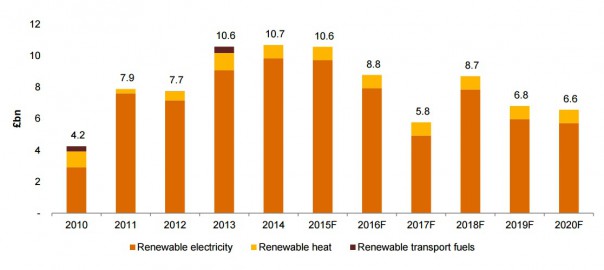
In fact, in 2014, not only did renewable energy investment hit a record of £10.7 billion, but renewable jobs increased by 9% as well.
Nevertheless, the authors of the report — PricewaterhouseCoopers (PwC) and Innovas, and commissioned by the UK’s Renewable Energy Association (REA) — are sure to warn that complacency will severely hurt the country’s renewable energy industry, especially in light of future decisions about Feed in Tariffs (FiT), the Renewable Heat Incentive (RHI), and transport.
The specifics of the report include a total electricity generation of 64,404GWh in 2014, up 20% from 53,667GWh in 2013. This news comes only a few weeks after the Renewable Energy Association announced that the UK’s renewable energy industry saw a 9% increase in jobs, with regions such as the East Midlands, North West, London and Scotland showing stronger than average employment growth. These are promising figures for the UK renewable energy industry, with the UK’s 2020 obligations quickly coming up.
“We are delighted that renewable energy sources are becoming an ever greater contributor to the UK’s energy mix,” said Dr Nina Skorupska, Chief Executive of the Renewable Energy Association. “Today’s figures show excellent progress in a number of sectors, both in terms of generation and installed capacity.”
However, according to the REA, the growth rate required to meet these 2020 obligations — 15% of the UK’s energy (including electricity, transport, and heat) from renewable sources by 2020 — currently sits at 16%, one of the highest rates in the European Union.
Subsequently, newly re-elected Prime Minister David Cameron has some serious decisions to make regarding the FiT review and whether or not to extend the RHI, which has only been allocated funding through to April 2016. And according to the REA, “renewable transport remains stagnant” ahead of the UK government needing to make a decision on the Renewable Transport Fuel Obligation.
“But we cannot be complacent,” Dr Skorupska continued. “Our analysis shows that where regulatory and financial support for renewable energy has been stable and sufficient, there has been considerable success, but where there has not, technologies have either stalled or gone backwards.
“In light of the growth rate for renewables needed for the UK to meet its 2020 targets, it is vital that the new government demonstrates the necessary leadership and ambition to enable our industry to thrive.”
The country’s investment figures also surged over 2014, though there are similar concerns over the future of the industry’s investments.
According to the report, 2014 saw investment of £10.7 billion, its highest levels, bringing the total investment into the UK renewables industry up to £50 billion forecast for the end of this year.
Historical and forecast investment in renewables 2010-20 (Image: PwC)
“2014 has been another strong year for investment in the renewable energy sector, bringing the total investment since 2010 to £40 billion,” said Ronan O’Regan, director, Renewables and Cleantech, PwC. “The majority of investment during 2014 was in renewable electricity generation, attracting almost £10 billion of capital, with solar the big winner representing £4.5 billion of investment.
“However, reaching the 2020 targets is estimated to require a further £50 billion of investment, The sector will be looking to the new Secretary of State to provide the investor certainty through to the end of the decade and beyond both in terms of funding and technology preferences.”
A new study has shown that increasing Britain’s installed wind energy capacity could go a long way to securing energy independence for the island nation.
Commissioned by national trade body RenewableUK, and conducted by independent analysts Cambridge Econometrics, the report concluded that additional wind power in the country’s energy grid would make Britain’s energy supply more resilient, by way of cutting the need for ever-increasingly costly imports of fossil fuels.
In 2013, wind energy played a small role in minimising the need for coal and gas imports — reducing coal imports by an estimated 4.9 million tonnes, and gas by 1.4 billion cubic metres.
Increasing the level of wind energy generation would serve to increase these figures, minimising how much Britain needs to import.
Without wind, in 2013, Britain would have needed to acquire — somehow — an additional 6.1 million tonnes of coal, and 2.5 billion cubic metres of gas to generate the additional 45.8 TWh and 24.8 TWh of coal and gas respectively (these figures are so high, because there is a significant efficiency loss involved in converting fuel to electricity).
“Beyond the environmental benefits brought about by the continued deployment of wind power, this report shows that wind energy is contributing to reducing fossil fuel import dependence and that this contribution will grow in future as wind capacity expands,”
explains Phil Summerton, Director at Cambridge Econometrics.
“Investment into wind power acts as an insurance policy against uncertainty in future wholesale gas prices and could provide a degree of stability to future electricity prices.”
“This report shows how much the UK relies on wind power to reduce our dependence on sources of costly fossil fuels imported from abroad,” explains RenewableUK Chief Executive Maria McCaffery. “In these uncertain times, we need to recognise the wider benefits of wind. The costs for the entire life of a wind farm are known very early on, whereas the volatile price of fossil fuels can never be accurately predicted.
“Wind power is already helping us manage future price instability, and industry is confident that by 2020 onshore wind will be the cheapest form of new generation of any form of energy.”