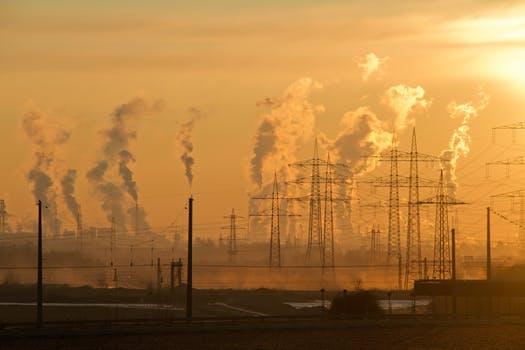
Mothers revealed their fear over toxic air in London today with seven out of 10 admitting they worry about its impact on their children.
A YouGov poll found that parents in the capital now see air pollution as the biggest health threat.
The stark findings are published as the Standard launches Clean London — a series of hard-hitting reports on dirty air and ways to tackle it.
Experts now blame air pollution for a death toll of more than 9,000 a year in the capital.
The survey, commissioned by environmental lawyers ClientEarth, shows 68 per cent of London parents are worried about their children breathing in dirty air.
More women than men highlighted their fears — 71 per cent against 64 per cent. Mothers have told of their concern that as they push buggies along the street, their young children are sitting at the same level as filthy fumes being spewed out by many diesel cars and other vehicles.
India has a grandiose vision for its 1.2 billion people to drive only electric vehicles by 2030. And that’s not even the most ambitious part — the government thinks it can do it without spending a dime.
“We are trying to make this program self-financing,” Power Minister Piyush Goyal said at a youth conference this week, according to The Times of India. “We don’t need one rupee of support from the government. We don’t need one rupee of investment from the people of India.”
Goyal noted that a small working group of politicians will meet in early April to hammer out the details of the goal, which could include a program to incentivize buying electric cars by making them zero-down investments. Later on, the money the car owners would have spent on gas could go to paying off the price of the vehicle, according to Goyal.
As far as number of cars owned per household, India ranks low on the list, with just 6 percent of households reporting they own a car. But that number is expected to grow exponentially as the economy expands.
It’s not the first time India has announced sweeping sustainability plans under Prime Minister Narendra Modi, sometimes to mixed results. Last October, the world’s third biggest greenhouse gas polluter announced its new climate plan, promising to obtain 40 percent of its electricity from renewable sources (primarily solar) by 2030. But earlier this year, the World Trade Organization ruled that provisions of Modi’s solar plan shut out international companies, particularly the U.S., from India’s burgeoning solar market. Most recently, the country levied a 4 percent “green” tax on new passenger vehicle sales, part of an effort to fight air pollution and traffic congestion.
India has no time to waste to tackle its pollution problem as its capital, New Delhi, already has worse air quality than Beijing.
Study shows that large number of diesel vehicles exceed emissions limits; pressure to reduce environmental impact spurs support for new tax structure
The first year rate of Vehicle Excise Duty (VED) for new diesel cars should be raised by up to £800 to help reduce emissions, according to Policy Exchange.
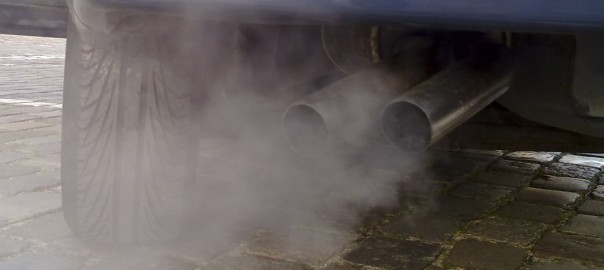
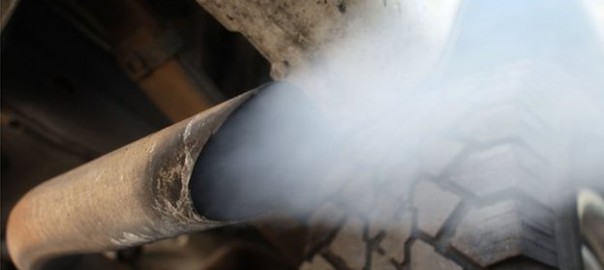
Car exhaust pollution (Image: Wikipedia)
The think tank is proposing HM Treasury increase the first year VED rate for new diesels to reflect the greater air pollution caused, in a bid to encourage people to buy lower emission alternatives such as petrol, hybrid or electric cars, instead. Based on a 50% decrease in diesel car sales, the increase in VED would raise around £500 million a year in additional taxes.
A study launched in January as part of a response to the VW ‘dieselgate’ scandal, found that a large number of diesel vehicles were breaking official emissions limits, despite actually following testing processes.
Richard Howard, head of environment and energy at Policy Exchange, said:
“Air pollution is overwhelmingly a diesel problem. The CO2 advantage of diesels has now been eliminated with data from the Society of Motor Manufacturers and Traders showing that, in 2013, CO2 emissions from new petrol cars were lower than those of diesel cars (on a sales-weighted basis).
“Euro 5 diesel cars sold as recently as 2014 perform no better in terms of NOx emissions than Euro 1 diesels sold in the 1990s. Despite this, Government policies continue to promote diesel vehicles. Consequently, diesel cars have increased from 14% of the car fleet in Britain in 2001, to 36% today. While the latest Euro 6 diesel cars show some improvement over Euro 5, on average they still emit six times more NOx than the latest petrol vehicles.”
A diesel scrappage scheme is also being proposed to provide grants for drivers who trade in their old diesel car or van for a lower emission vehicle.
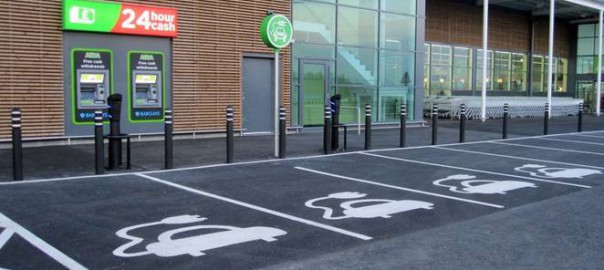
Electric car charging and parking (Image: G. Wallace)
Those perks will include a solar-powered charger at a York park-and-ride, free parking in Bristol and Milton Keynes, as well as bus lane access in Milton Keynes and Derby.
Cue the environmentalist handwringing.
On the one hand, I am sure Lloyd will be worrying about electric cars making it harder to fix our cities. After all, cars driving in bus lanes will inevitably impact public transit. And free parking for private automobiles seems to be the antithesis of reclaiming the ridiculous amount of space we devote to the motor car. With a demographic shift away from the car apparently underway, we do need to keep an eye on where we spend our resources.
In the other hand, I tend to be a part of the “it’s not this or that” crowd. Given our current dependence on private vehicles, and British’ cities on-going battle against life threatening smog, I’d suggest that speeding up the transition to emission-free cars is a significant step in the right direction.
The only caveat to that is the fact that the £40m pot being shared between these eight cities should not detract from other, non-car based efforts to slash emissions. From electric buses to treating cycling as mass transport, we must also continue our shift away from the car.
But surely, if done right, increased use of EVs should help us on this front too? As our streets get quieter, and as our air gets cleaner, it becomes easier and more pleasant for us to walk and cycle. And that can only be a good thing for everyone.
World Health Organisation describes new data as ‘health emergency’, with rising concern likely to influence decision over Heathrow expansion
Nissan Leaf electric car on charge in London (Image: T. Larkum)
The World Health Organisation has issued a stark new warning about deadly levels of pollution in many of the world’s biggest cities, claiming poor air quality is killing millions and threatening to overwhelm health services across the globe.
Before the release next month of figures that will show air pollution has worsened since 2014 in hundreds of already blighted urban areas, the WHO says there is now a global “public health emergency” that will have untold financial implications for governments.
The latest data, taken from 2,000 cities, will show further deterioration in many places as populations have grown, leaving large areas under clouds of smog created by a mix of transport fumes, construction dust, toxic gases from power generation and wood burning in homes.
The toxic haze blanketing cities could be clearly seen last week from the international space station. Last week it was also revealed that several streets in London had exceeded their annual limits for nitrogen dioxide emissions just a few days into 2016.
“We have a public health emergency in many countries from pollution. It’s dramatic, one of the biggest problems we are facing globally, with horrible future costs to society,” said Maria Neira, head of public health at the WHO, which is a specialist agency of the United Nations. “Air pollution leads to chronic diseases which require hospital space. Before, we knew that pollution was responsible for diseases like pneumonia and asthma. Now we know that it leads to bloodstream, heart and cardiovascular diseases, too – even dementia. We are storing up problems. These are chronic diseases that require hospital beds. The cost will be enormous,” said Neira.
Road test reveals cars emit seven times the permitted level of exhaust emissions when tested in real-world conditions
Car exhaust (Image: BBC)
Nine out of 10 new diesel cars break new EU pollution limits when tested on roads rather than test tracks, according to a new report.
On average, the cars emit seven times the permitted level of NOx gasses, with the worst car producing 22 times the legal limit. Models from every major motor manufacturer breached the limit when they were evaluated in real-world conditions.
From 1 September, new diesel cars in the EU have had to comply with emissions rules called “Euro 6”. However, carmakers can use a whole range of techniques to ensure that their cars perform far better under test conditions than when driven by ordinary drivers.
These include stripping components from the car to reduce weight, using special lubricants, over-inflating tyres and using super-smooth test tracks. The same techniques are used to boost the apparent fuel efficiency of vehicles.
Campaign groups are calling on the Government to do more to tackle ‘breathtaking’ air pollution levels
Car exhaust pollution (Image: Wikipedia)
Diesel exhaust fumes are causing the biggest health catastrophe since the Black Death, a campaign group has claimed, as new figures show air pollution limits for the whole year have been breached in just eight days in London.
European Union limits demand that maximum hourly nitrogen dioxide (NO2) concentrations are not exceeded for more than 18 hours a year – yet Putney High Street, in west London, had recorded its 19th hour breaching the limits during Friday morning’s rush hour, the London Air Quality Network said.
Oxford Street, where legal limits for the toxic gas for the whole of 2015 were breached in just two days, has almost certainly broken the limit again but the monitoring equipment is currently being repaired. Campaigners say that the Government must do more to tackle air pollution which has been linked to respiratory and heart problems.
Simon Birkett, founder and director of campaign group Clean Air in London, said it was breathtaking that toxic air pollution in the capital had breached the legal limit for the whole calendar year within the first few days of 2016. Mr Birkett also called on all the candidates in the mayoral elections to pledge to ban diesel exhausts from the most polluted areas by 2020.
He said:
“Worse, several air pollution monitors have been vying for the dubious honour of recording the first officially monitored breach of the nitrogen dioxide (NO2) legal limit in the world in 2016.”
After the Great Smog of 1952 killed up to 12,000 Londoners, the country cleaned up its act. But today, pollution of another kind may be just as insidious – and almost as lethal.
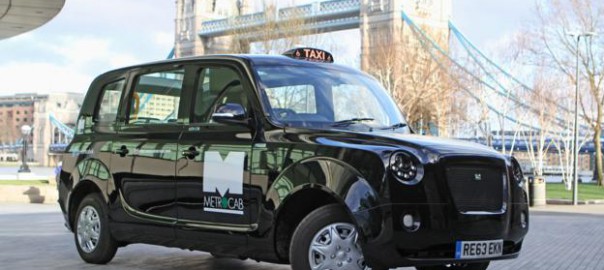
The release of the Metrocab, a battery-powered taxi capable of zero emissions, is one of the efforts to clean up the city’s transport (Image: Metrocab)
Imagine smog so thick that you can’t see your feet as you walk through it; so impenetrable that it blots out the sun; so toxic that it stings your eyes and leaves you gasping for breath.
It may sound like the backdrop to some post-apocalyptic nightmare, but on 5 December 1952, this terrifying scenario became the reality for the people of London. That day’s incident alone killed thousands and prompted a global transformation in the way we deal with air pollution.
On that cold, clear day in 1952, Londoners huddled around their coal fires for warmth. But while the smoke would normally disperse into the atmosphere, an anticyclone hanging over the region created an inversion – trapping the pollution close to the ground and leading to the formation of a sulphurous, toxic shroud that would blanket the capital for the next five days.
Before the weather conditions changed and the smog retreated, thousands had died. Official estimates at the time put the number of fatalities at 4,000 – more civilian casualties than were caused by any single incident during the war – while recent research suggests that it may have caused as many as 12,000 deaths.
Buyers are turning away from all diesel models, and cleaning up the technology will be a long and expensive business
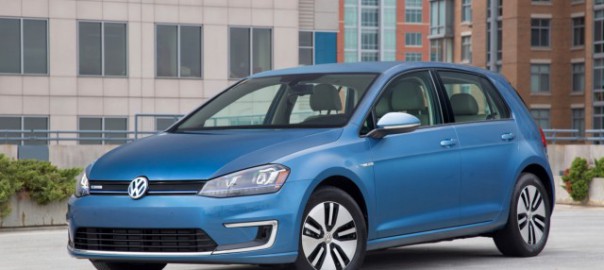
The 2016 VW e-Golf is a spirited runabout that makes almost no compromises in terms of performance, comfort or cargo space (Image: Volkswagen of America Inc.)
Since the Volkswagen emissions test scandal in September, it is not just the German carmaker that has suffered a blow to its image. Diesel automotive technology also faces a battle to regain public trust.
There are already some signs of demand for diesel cars shrinking since VW was forced to apologise for installing “cheat devices” in 11 million vehicles. In Germany, Europe’s largest car market, demand for diesel cars was down 11% by the end of October compared with the average level this year, according to data from car buying website MeinAuto. The decline for VW diesel cars was even steeper, down 14%.
“The slump in demand has surprised us,” said MeinAuto’s managing director, Alexander Brugge. “It’s interesting that it’s not only VW customers who are reluctant to buy diesel vehicles but customers of other brands, too.”
In the UK, official registration numbers of for diesel cars seem to be holding up. Diesel made up 51% of new car sales in both October and November, according to Society of Motor Manufacturers and Traders (SMMT). That is in line with last year and above this year’s average of 48%. However, there could still be a decline, because of the three-month wait between car order and delivery.
VW chief executive Matthias Müller has promised that the company will increase spending on alternative technologies such as electric and hybrid vehicles by €100m next year.
Consumers and businesses will have to be more energy-efficient and switch to alternatives to fossil fuels
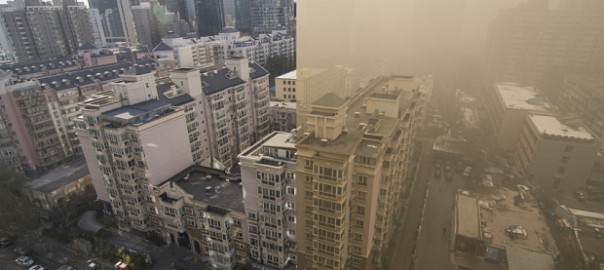
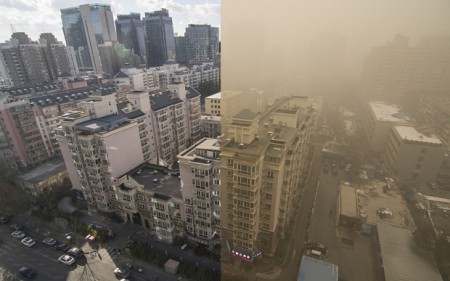
Two pictures of Beijing taken 24 hours apart show the Chinese capital engulfed by smog earlier this month (Image: Rex)
[From 4 December} The Paris climate change summit will conclude at the end of next week. It aims to reach an international agreement on limiting emissions of carbon dioxide and other greenhouse gases that are contributing to global warming. The main source of these emissions is the burning of fossil fuels – oil, coal and natural gas – that power industry, and heat and light our homes.
…
One big area where technology is helping is through the development of renewable energy sources, such as solar and wind power. The energy from these sources has increased by a factor of four in the past 10 years. Biofuel production, which is more environmentally friendly than extracting oil from the ground, has increased at a similar rate.
If we can get another four-fold increase from renewable energy sources over the next decade, a total of around a quarter of the world’s energy needs can be met from renewables, nuclear energy and hydro-electricity – without burning fossil fuels and creating greenhouse gas emissions.
Another area where technology is having a big impact is in the development of electric cars. Bigger and better batteries are being developed so that electric cars can be charged more quickly and drive further without recharging.
These developments in technology will enable society to cut its dependence on fossil fuels and reduce the damage to the world’s climate.
But there will still need to be changes to our lifestyles and the way in which businesses operate.
The first change is that we are going to have to become a lot more energy-efficient at home and at work. The less energy we use overall, the easier it will be to reduce our carbon emissions. Consumers need better-insulated homes and smart meters to monitor their energy use.