Category Archives: Pollution

Mayor reveals zero emission London transport plans

Mayor of London Sadiq Kahn has revealed the proposals that will help achieve his aim of dramatically cutting vehicle emissions in the capital. The plan is to make London’s transport network zero-emission by 2050.

The Ultra Low Emission Zone and T-Charge proposals are already confirmed to come into force in the near future, but zero-emission zones will be launched in phases, with central London and town centres first from 2025, inner London between 2035 and 2040, and a blanket London-wide zone by 2050.

Between now and 2025, a ‘major expansion in electric vehicle charging points’ is planned, along with the installation of at least 15 hydrogen refuelling stations in and around London. These investments in infrastructure will continue in a significant manner to encourage expansion until at least 2035.

In terms of public transport, all new buses bought will be hybrid, electric, or hydrogen, before all buses operating in the capital being zero-emission of hybrid from 2030. All buses will be zero-emission between 2035 and 2040.

All new taxis will need to be zero-emission capable from the beginning of next year, with the same rule for new private hire vehicles by 2025. From 2030, only zero-emission capable taxis and private hire vehicles will be able to operate in London.

The overall aim of these proposals is to improve air quality and reduce congestion. Despite a predicted expansion in London’s population to 10.5 million over the next 25 years – with a forecast additional 5 million trips each day by 2041 using current models – Kahn’s plans aim to cut the number of car journeys by three million each day.

Read more: Next Green Car

Queen’s Speech introduces an Electric Vehicles Bill

New Bill unveiled in Queen’s Speech to require charging points to be fitted at services and fuel stations, support driverless cars and keep insurance claims simple

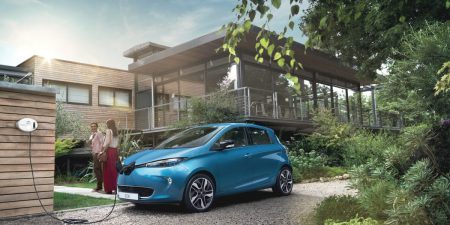
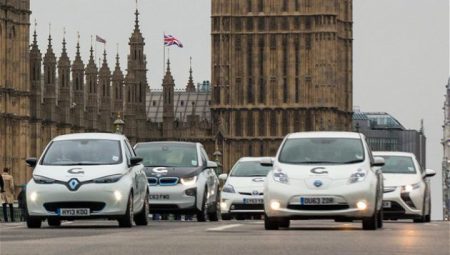
Renault ZOE

Motorway services and petrol stations may be forced to install electric charging points as part of Government plans to ensure the UK

“remains a world leader in new industries”.

An Automated and Electric Vehicles Bill will be introduced to encourage the use of electric and self-driving cars, the Government announced in the Queen’s Speech.

The first all-electric car to be built in the UK rolled off of the production line in 2013, and the Government wants

“almost every car and van to be zero-emission by 2050”.

Of more than 36.7 million licensed vehicles in the UK, just over 100,000 have been purchased with help from a government plug-in car grant.

Registrations of electric vehicles are increasing, with 13,800 being registered in the first quarter of 2017, a 17% rise on the same period the year before.

Plans to fund the additional electric charging points have not yet been announced, although the Government said it was committed to spending £600m during this Parliament to support the ultra-low emissions market.

The new law also aims to support British manufacturing and innovation by allowing self-driving cars to operate in the country.

Source: Platts Garages

Lasting legacy of VW diesel scandal: EU gets serious about testing

The Volkswagen diesel scandal left lasting imprints on the entire automotive industry, and may have changed the way regulators look at vehicles using the fuel forever.

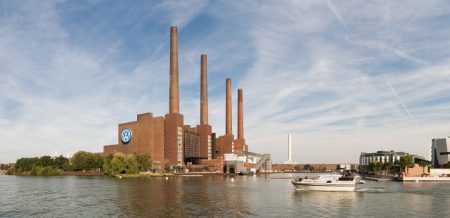
Volkswagen Plant, Wolfsburg Germany

That’s true not just in the United States, but elsewhere as well. The European Union is now increasing its efforts to make sure a scandal like Volkswagen’s can never happen again.

EU ministers have agreed to a new draft of rules and regulations for approving cars in the countries that make up the trade bloc; they give the European Commission more power in such circumstances.

Under the current system, national agencies such as Germany’s KBA have the authority to give new cars a pass for the entire European Union, according to Reuters.National bodies also have the power to revoke the rights to sell a vehicle should a controversy arise.

However, the newly drafted rules hand additional power to Brussels—a move Germany itself and its powerful car industry aren’t keen about.

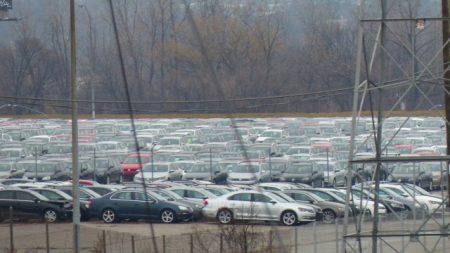
Volkswagen TDI Desiel Cars, Stored at Pontiac Silverdome

German junior economic minister Matthias Machnig told his national counterparts Germany is in favor of increased oversight. But, he said, the country remained wary over conflict of interest.

The changes to testing and approving new vehicles for sale in the EU come in response to Volkswagen’s deceit in the United States.

The German automaker used “defeat devices” in order to pass federal emission tests, and carried out a multi-year cover-up of that fact to continue selling its diesel-powered cars and SUVs.

The devices were programmed to comply with regulations for 23 minutes—exactly how long the EPA regulatory test takes. At minute 24, the NOx levels emitted by Volkswagen and Audi TDI vehicles rose considerably.

Read more: Green Car Reports

Cash-strapped councils breaking the law on air pollution, documents reveal

Exclusive poll for The Independent shows public – and most Conservative voters – back banning the most-polluting cars from city centres as pressure builds on the Government

It has been described as a “public health emergency” responsible for tens of thousands of deaths every year, but dozens of local councils have been failing to report on air pollution as required by law for years.

The revelation, based on documents obtained under Freedom of Information rules, casts doubt on local authorities’ ability to play their part in the Government’s new draft Air Quality Plan – its third attempt to meet minimum safety standards after repeatedly being taken to court by campaigners.

Ministers had sought to delay publication of the plan until after the general election, with a Government lawyer arguing it would drop a “controversial bomb” on the campaign.

But a judge ordered ministers to comply with a court-ordered deadline and the resultant plan was duly derided as “feeble” and “much weaker” than expected.

Public concern about air pollution has been growing. A new survey for The Independent found the majority of the public is now in favour of banning the most-polluting vehicles from city centres.

Some 51 per cent of respondents agreed with this suggestion, with only 15 per cent against and the remainder not expressing a view, pollsters ORB said.

The Government’s latest Air Quality Plan sought to pass the buck to a large degree to councils, saying they were “best placed to take the lead”.

However, the council documents, obtained by the DeSmog UK environmental news website, show that local authorities have already been failing to carry out the current requirements, suggesting they would struggle to cope with further responsibilities without extra funding.

Of the 77 councils contacted, 59 had not made air pollution reports, which must be produced under the 1995 Environment Act, available to the public.

After the website got in touch with the councils, 34 authorities were found to have gaps in their reporting between 2011 and 2016, although some said they were still in the process of producing reports covering last year. If this is a representative sample, it would mean 44 per cent of councils in the country are failing to properly monitor and assess the extent of air pollution.

Mat Hope, deputy editor of DeSmog UK, said:

“I think it shows local councils need resources to be able to deal with this problem properly.

“I think the councils themselves are doing what they can, but with the current budget constraints it’s clear they are likely to struggle with the extra obligations under the new Air Quality Plan.

“The Government needs to think very hard about the resources they are putting behind this.”

Read more: The Independent

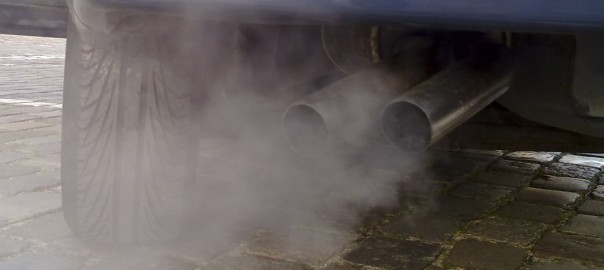
Car exhaust pollution (Image: Wikipedia)

High pollution is reducing house prices by 15pc as buyers reject ‘unhealthy’ homes

Property listings will include traffic light-style pollution warnings in the near future, experts have predicted as they said poor air quality can knock up to 15 per cent off house prices.

Pollution has become a top concern among potential buyers, who are snubbing “unhealthy homes” and have started using sophisticated pollution websites to track air quality.

The trend has prompted calls for new rules which force estate agents to publish traffic light style pollution warnings alongside energy efficiency ratings in property adverts.

Car exhaust pollution (Image: Wikipedia)

A toxic air alert was issued for the first time in London over “very high” pollution levels, sparking major public concern over the health impacts of living in congested areas.

Nearly 9,500 people died early in a single year as a result of long-term exposure to air pollution in London, a Kings College London report claimed.

Concerned buyers have started actively researching granular data through websites which let them track air quality at individual postcodes, they said.

Henry Pryor, a professional home buyer and property agent, said:

“Home buyers used to have a blaze attitude to air pollution but now this has completely changed. People are very concerned and they are suddenly discovering that they can look at two homes at different ends of a street, and one will be more polluted than another.

“I get asked about pollution levels so regularly that I now check it as standard before suggesting a property to clients. If a house is in a highly polluted area, such as near a train line, it might go for a 15 per cent less than a similar property in a less polluted zone.”

Read more: The Telegraph

Election 2017: Motoring manifesto commitments compared

With the General Election fast approaching, Next Green Car compares the key motoring elements of each of the main parties’ manifestos.

In [this] policy comparison, we focus on green vehicle issues and advances in autonomous and connected technologies; subjects we cover day-to-day on the website. Ultra low emission vehicles, air quality, electric vehicle issues and autonomous driving plans are all covered.

Promoting electric vehicles is a key policy for all the main political parties

In the interest of neutrality, parties are listed alphabetically and cover both previously announced promises and those new elements revealed in the latest manifestos. The three main parties which have published their manifestos are included – other parties will be added when their manifestos are released.

Conservatives

  • Aim to lead the world in electric vehicle and autonomous vehicles
  • Almost every car and van to be zero-emission by 2050
  • Invest in smart grids for more efficient EV charging
  • Modest roll-out of Clean Air Zones as part of air quality plans

Although the Conservative manifesto is rather light on motoring-related announcements, as the party in power they have already implemented a number of clear policies relating to low and ultra low emission vehicles.

The headline policy is the ambition

“for Britain to lead the world in electric vehicle technology and use….” and for “almost every car and van to be zero-emission by 2050”.

To achieve this, the Conservative Party has already earmarked funding of £600 million by 2020, which will take the total investment since 2011 to £900 million, extending a policy that was initiated under the previous Conservative-Lib Dem coalition. Investment is also planned for ‘smart grids’ designed to make the most efficient use of electricity infrastructure through the use of Vehicle to Grid (V2G) technology….. Read more, Next Greencar

Labour

  • Return the railways back into public ownership
  • Work towards zero road deaths in UK
  • Maintain UK at forefront of the manufacture and use of ultra low emission vehicles
  • Retrofit diesel buses to Euro 6 standards

Labour’s key message is that the party

“will invest in a modern, integrated, accessible and sustainable transport system that is reliable and affordable.”

Road safety is an important element of the party’s transport agenda, with aims to work towards zero deaths on the UK transport network. The manifesto lays out a number of policies to

“encourage and enable people to get out of their cars, for better health and a cleaner environment.”

To achieve these aims, Labour’s main focus is to improve public transport and reduce fares. One central element of this policy is the aim to return the railways back into public ownership, a policy that has already gained much coverage since the manifesto launch. While there is less focus (and detail) on road vehicle technology in the document, the party is committed to maintaining the UK at the forefront of the development, manufacture and use of ultra low emission vehicles, and supporting the creation of clean modes of transport through investment in low emission vehicles…. Read more, Next Greencar

Liberal Democrats

  • Creation of a new Green Transport Act
  • Ban on sale of diesel cars and vans by 2025
  • Encourage manufacture and uptake of electric vehicles
  • Introduce ultra-low-emission zones and Clean Air Zones to ten towns and cities

In the Lib Dems’ manifesto, the party sets out a detailed set of measures to reduce environmental impact of transport, which would be implemented through the creation of a Green Transport Act. This would include an air quality plan to tackle air pollution, and support for manufacturers of low-emission and electric vehicles.

The plans include a diesel scrappage scheme, and a ban on the sale of diesel cars and small vans in the UK by 2025. All private hire vehicles and diesel buses licensed to operate in urban areas would have to to run on ultra-low-emission or zero-emission fuels within five years. The party would also reform vehicle taxation to encourage sales of electric and low emission vehicles….Read more, Next Greencar

Read more: Next Greencar


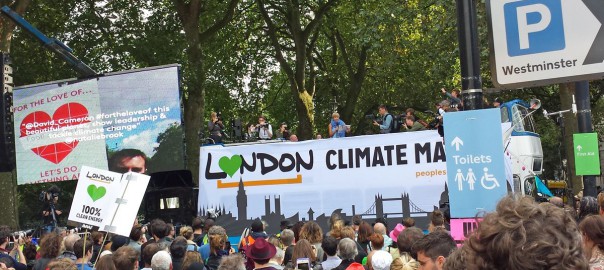
London Climate March - the Rally (Image: T. Larkum)

New French president Macron aims for the last fossil fuel cars to be sold in 2040

The newly elected French president Emmanuel Macron is broadly pursuing the energy and traffic policies outlined by his predecessor, Francois Hollande. He is especially looking to promote electric vehicles (EVs) and aims for the last car with an internal combustion engine (ICE) to be sold in France in 2040.

London Climate March - the Rally (Image: T. Larkum)
London Climate March (Image: T. Larkum)

French daily newspaper Le Monde reported in the run-up to the election that one of Macron’s objectives is ‘to get out of fossil fuels’ and he therefore wants to expand France’s charging network.  In order to ‘protect the health of the French,’ Macron also proposes to align the taxation of diesel with that of gasoline by 2022 and ‘to strengthen the European antipollution standards of new vehicles and controls in real conditions.’ These measures were already in place under Hollande’s government but Macron has additionally announced plans to introduce a bonus of €1000 for the purchase of a new or used ‘greener’ vehicle.

This extends further than the current bonus which is restricted to the purchase of a hybrid or electric vehicle. Apart from this, Macron wants to keep the existing bonus-malus scheme, which rewards the acquisition of clean cars and penalises those with higher fuel consumption. Ultimately, however, Macron’s aspiration is that there will be no more ‘sale of thermal vehicles’ in France in 2040.

As far as broader energy policy is concerned, Macron aims to increase the share of renewable energies in France’s energy mix to 32 per cent by 2030 and also to close the latest coal-fired power stations. By way of comparison, as early as 2016, renewable energy sources already contributed 29 percent to gross electricity generation in Germany. Macron was already committed to this project when he was the Minister of Economy in the cabinet of presidential predecessor François Hollande. In his term in office from 2014 to 2016, he passed the energy transition law for green growth (LTECV) and explicitly mentioned this several times during the election campaign.

Macron also aims to reduce the proportion of nuclear energy in France to 50 per cent by 2025, and the CO2 tax will rise to €100 per tonne by 2023. In total, Macron wants to invest €15 billion in ecology and power generation.

Source: Autovista Group

The Predicament of Venice

I’m currently enjoying a short stay in Venice. It’s a beautiful place with an astonishing amount of priceless art and architecture.

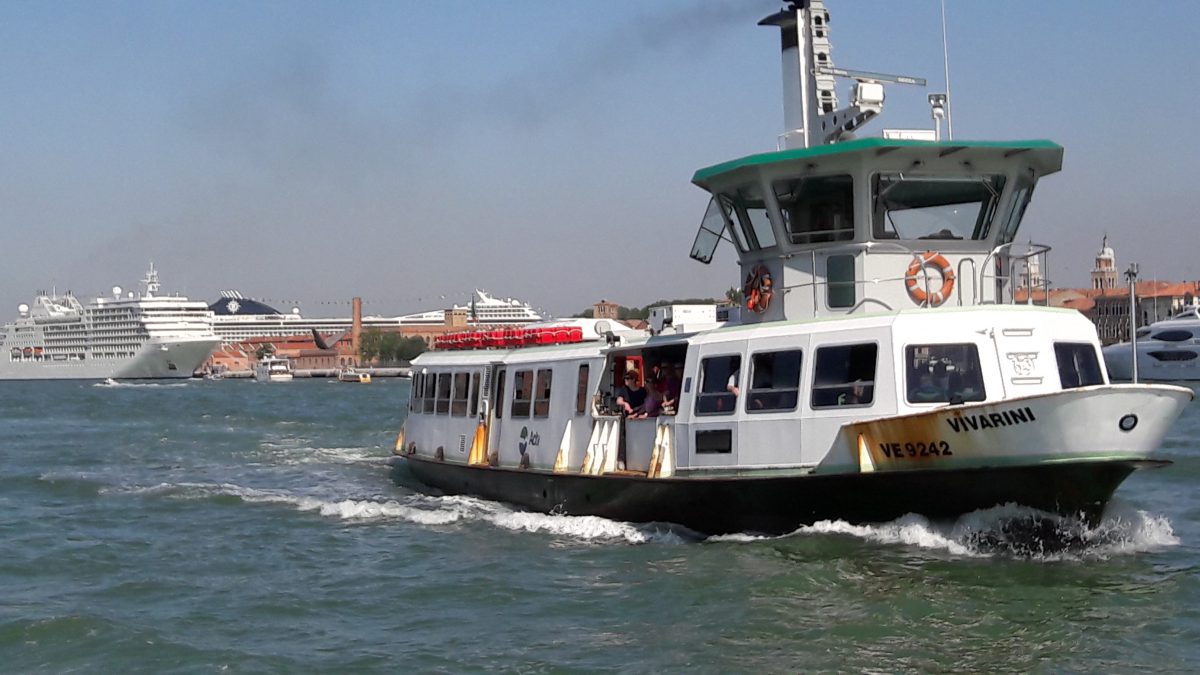
The fumes from the tourist boat merge with the fumes from a berthed cruise ship in Venice (Image: T. Larkum)
The fumes from a tourist boat merge with the fumes from a berthed cruise ship in Venice (Image: T. Larkum)

However, it is clearly dying. Over the centuries it has suffered from regular flooding. Most of the buildings have long-term damp. This has led to inevitable deterioration of the art, particularly murals and frescoes.

Now with climate change the problems are accelerating. There are plans being made to save the island and its art. However I think they can only delay the day that Venice goes under permanently, not prevent it.

Venice is in a predicament; if it were a problem it could be solved. A predicament you have to manage the best you can.

Part of the issue, of course, is that Venice itself is itself a contributor to climate change. It is a major hub for tourism. People come here from all over the world by plane, train, bus and car.

Once here everyone travels around in a range of boats, all of which (with the exception of the famous people-powered gondoliers) appear to be diesel powered.

Anywhere near the waterways has the smell and often haze of diesel fumes and black smoke. And this place receives massive cruise ships.

There were four berthed yesterday morning, and we saw one tugged past St Michael’s Square yesterday evening. It appeared to dwarf the Basilica and bell tower.

A vast cruise ship goes past St Mark's Square, Venice (Image: T. Larkum)
A vast cruise ship goes past St Mark’s Square, Venice (Image: T. Larkum)

Of course, none of that will change. It’s tourism that pays to keep Venice going and to repair the ongoing damage. It also allows for planning of additional flood defences.

Hence the predicament of Venice, a problem that can’t be solved.


[Update: Since getting back home I’ve found some interesting related articles:


Diesel drivers will be paid to scrap their cars to improve air quality

Diesel drivers will receive compensation to encourage them to scrap or “retrofit” highly polluting vehicles under Conservative plans to reduce emissions to be unveiled later this week.

The Government will on Friday publish its new air quality strategy which will include plans for a “targeted” diesel scrappage scheme, The Telegraph has learned.

Ministers will also consult on plans to give people help with “retrofitting” older, more polluting diesel vehicles to reduce the levels of harmful nitrogen dioxide that they emit.

The Conservatives will warn local authorities against imposing pollution taxes on motorists amid concerns that doing so would “punish” motorists and become an election issue.

It comes after Theresa May, the Prime Minister, said last month that she was “very conscious” that motorists were encouraged to buy diesel cars under Labour more than a decade ago because of concerns about carbon emissions.

A Conservative source said:

“We will help drivers on modest incomes who bought their diesel vehicles in good faith, having been badly advised by the last Labour Government. We are cleaning up Labour’s mess.”

The Government has been forced to come up with tougher measures to target diesel drivers after losing a case against environmental campaigners ClientEarth over breaches of EU emissions standards.

Last week a High Court judge rejected an application by the Government to delay publication of its strategy until after the General Election. Ministers have decided against making an appeal.

Read more: The Telegraph

Newest, cleanest diesels in Europe can still be very dirty: analysis

It has become increasingly more evident that carmakers must take aggressive steps to ensure that diesel cars and light trucks meet current environmental regulations.

Tests done by Emissions Analytics found that the majority of new diesel-powered cars sold in Europe do not meet the Euro 6 emission standards for nitrogen oxides (NOx) in real-world use.

Worse, some of them emitted as much as 12 times the current levels when tested in real-world driving—and didn’t meet even the far lower Euro 3 standards from decades ago.

Diesel vehicles have been under more scrutiny since the world’s largest car manufacturer, Volkswagen Group, was caught using “defeat device” engine-management software to pass tests.

The deception was discovered by the University of West Virginia’s Center for Alternative Fuels Engines and Emissions (CAFEE) during independent research trying to prove that automakers could meet the NOx emissions standards.

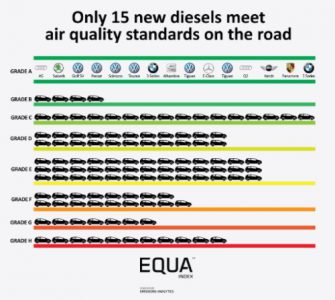
Emissions Analytics, like CAFEE, tested vehicles independently under real-world conditions to see if they met the new Euro 6 standards. Their disturbing results are published by the EQUA Index.

The Emissions Analytics real-world tests found that only 16 of 116 diesel vehicles tested meet the Euro 6 emission standards for NOx, as depicted in the EQUA Air Quality Index chart.

Ony 14 additional vehicles would have met the standards even if the less stringent Euro 5 standards were used, giving a total of just 30 vehicles meeting a now-obsolete regulation under real-world driving conditions.

But the most disturbing part of the results may be how many cars exceeded the limits by wide margins.

More than half the 67 vehicles tested met only the decades-old Euro 3 emission limits.

Against the newly imposed Euro 6 limits, 21 of the cars tested exceeded the maximums with emissions that were at least six times the allowable limits.

Ten of the 21 worst-performing cars had emission levels 12 times or more the limits set under the Euro 6 standards.

Read more: Green Car Reports