Category Archives: Peak Oil

100 Things You Can Do To Prepare Yourself for Peak Oil

This is the followup 49-100 peak oil tools as written by Sharon Astyk. To read tips #1-49 read here

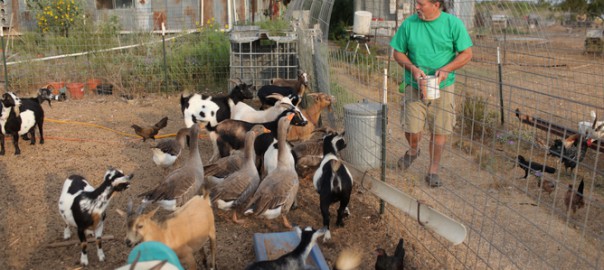
Floresville, Texas: Paul Range feeds his brood of livestock. Each can serve as a food source if things get bad. (Photo Credit: National Geographic Channel/ Sharp Entertainment)

49. Invite someone new to your house once every month. Try and expand your community and circle of friends regularly. Invite people to eat with you regularly – sharing food is an important part of community building.

50. Attend zoning meetings and consider running for zoning board. Work to amend local zoning laws to allow green building, composting toilets, clotheslines, small livestock, cottage businesses, front lawn gardens and other essentials.

51. Have a large house and not a lot of people in it? Consider a roommate, or borders. This will make you more economically stable and also expand your community and local resources. If you currently rent an apartment, consider sharing housing with a roommate.

52. If your community doesn’t have a food coop, start one now. There is a great deal of information on the web here: This can be a powerful tool for creating local food economies.

53. Consider creating a community currency. They keep money local and encourage small businesses and sustainable economies.

54. Sometimes you get more by giving things away than by selling them. Do you have something you don’t need? Extra produce? Spare time? Give extra tomatoes to a neighbor, offer spare items to friends, go over and help out someone who could use it. Good deeds mostly return to us.

55. Build an in-law apartment, or set your home up so that elderly family members can live comfortably with you when the time comes. Sit down and talk to them before the problem becomes acute, and tell them that you want them with you. It is easier to move elderly folks in with you before things become difficult.

56. Take time to get to know children in your neighborhood, especially teenagers. Make friends with them, talk and listen respectfully. Consider inviting them to apprentice with you on some work, or join in a work project (don’t forget to pay them for their help). Older children and teenagers need *meaningful* work – they need to know their contribution matters. Make sure it does.

57. Get to know local farmers and encourage them to fill gaps in your local food system – get together with neighbors and friends and create a market for local wheat, local dried beans, and other foods that are often grown industrially. If farmers know that even small quantities of these foods, locally grown, would be welcome, they will grow them.

58. Create a community festival to showcase local agricultural products, arts or other truly local creations and skills. Instead of focusing on simply drawing tourists, emphasize activities that bring the community together as part of it – dances, demonstrations of skill, children’s activities.

59. Draw attention to your local watershed, and on your vulnerabilities in that regard. Will you be competing with other communities? Are there areas of waste to be dealt with? Wetlands to be preserved? Make assuring a safe, long term water supply a community priority.

60. Create local educational systems – resist regionalizing schools and advocate for the creation or recreation of neighborhood school and library systems. Build homeschooling coops, and set up library branches at walkable sites. Encourage extension programs, community college branches and everything you can to make education more local.

Read more: Organic Consumers
(Image: D. Bacon/Shutterstock/Economist)

10 Ways to Identify a Closet Prepper

This article made me smile!

Although an increasing number of people are adapting to the realities of more expensive and declining energy, and a permanently depressed economy, many are still… shall we say, circumspect, about their activities. They may have been driven underground after encountering ridicule or denial from friends and family, or perhaps are just are leery about random people showing up at their door when crunch time arrives.

Prep-dar n. Informal 1. The keen observation skills and attention to detail which allow you to identify other people who are aware of, and covertly preparing for, peak oil. 2. A shortened version of “prepper radar”.

So how do we find these fellow prep enthusiasts, so we can join forces, help each other, and make our communities stronger? You could check out your local Transition initiative, or search online for a peak oil meet-up in your area. However, some of these undercover peak-oil-preparers may be people you already know…. friends, acquaintances, work buddies, even family – you just have to figure out who they are.

(Image: D. Bacon/Shutterstock/Economist)
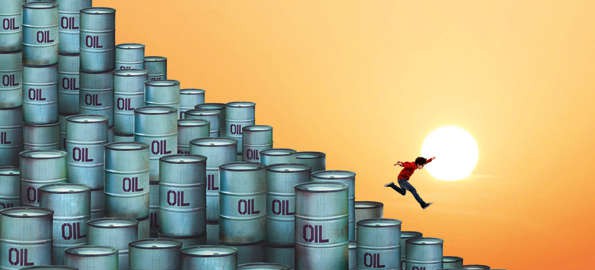
Oil Mountain (Image: D. Bacon/Shutterstock/Economist)

To help you find them, here are the top ten clues that should set your Prep-dar buzzing. You might know a closet prepper if he or she:

10. Gives you a Bo-Go flashlight, first-aid kit, or copy of Just In Case: How to be self-sufficient when the unexpected happens for Christmas.

9. Knows the difference between the IEA and the EIA; and/or calls the EIA “the most incompetent bungling liars in the government.”

8. Is overheard exclaiming “But Sharon Astyk/Richard Heinberg/James Howard Kunstler/Dmitry Orlov/Matt Simmons/Gail the Actuary says ____________!”

7. Sends you articles published by The Oil Drum, Energy Bulletin, or Life After the Oil Crash , “FYI.”

6. Stores any type of food in a bucket.

5. Is fired after a happy hour at which she tells the boss he’ll be doing hard labor when “TSHTF.”

4. Privately admits to cashing out their entire 401(K) to purchase gold, ammunition, and prime farmland.

3. Complains of marital discord arising from arguments about the number of chickens that might fit on a quarter-acre lot, or the excessive amount of lawn which has been converted to okra production.

2. Tends to use terms like Cantarell, TEOTWAWKI or Hirsch Report after a few glasses of wine.

and finally…..

1. Offers to share seeds, teach you to can tomatoes, help you compost, build a raised garden bed, plant a fruit tree for you, car-pool, chop firewood, give you fresh eggs, set up a rain barrel, or show you how to use a solar cooker.

In that case, who cares if they know about peak oil – you want to be their friend!

Oil’s place in the global energy mix is transforming, including in mobility, which uses three-fifths of world oil (Image: Thinkstock/curraheeshutter)

A snarky guide to peak oil

It pretty much does what it says on the tin…

“Peak oil” is starting to pop up in the media more and more these days. Everybody from Glenn Beck to the Sierra Club says that the world is running out of cheap oil and that this could be, well, inconvenient, for the global economy. But really, What is peak oil and what does it mean for you? And most importantly, is peak oil just another excuse for Beck to hawk Goldline or for Al Gore to seek more subsidies for solar panels?

Oil’s place in the global energy mix is transforming, including in mobility, which uses three-fifths of world oil (Image: Thinkstock/curraheeshutter)

Not to worry. Transition Voice’s Snarky Guide to Peak Oil sorts it all out for you. Or double your money back. That’s a promise.

What is peak oil?

The collapse of society? Mutant zombie bikers in the streets? Fox News commentator Neil Cavuto starring in his own prime-time TV reality show?

Peak oil is not the end of the world, but it will be the end of the Oil Age. That doesn’t mean we’re running out of oil, but it does mean the world is running out of cheap oil. And talk about bad timing — world oil has peaked just when countries like China, India and Brazil have started to use lots of oil for the first time, competing with America, Europe and Japan for the second half of world oil.

“How did OUR gas wind up in THEIR tanks?”
More Customers + Less Oil = Higher Prices.

Peak oil is as much about the economy and politics as it is about geology. And it’s not just about pain at the pump, though it couldn’t hurt to trade your pick-up truck for a Prius soon — or better yet, try to work and shop closer to home. Peak oil is also about paying more for all the stuff that oil makes possible, from bread made with wheat grown on factory farms to polo shirts and DVDs imported from China.

Peak oil, combined with climate change, might just mean the end of shopping as we know it, in the words of Australian author Paul Gilding.

Read more: Transition Voice

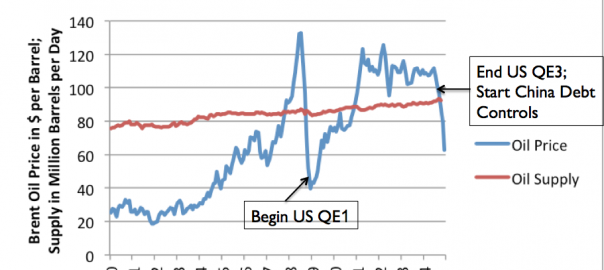
World Oil Supply (production including biofuels, natural gas liquids) and Brent monthly average spot prices, based on EIA data (Image: G. Tverberg/Our Finite World)

Deflationary Collapse Ahead?

Both the stock market and oil prices have been plunging. Is this “just another cycle,” or is it something much worse? I think it is something much worse.

Back in January, I wrote a post called Oil and the Economy: Where are We Headed in 2015-16? In it, I said that persistent very low prices could be a sign that we are reaching limits of a finite world. In fact, the scenario that is playing out matches up with what I expected to happen in my January post. In that post, I said

Needless to say, stagnating wages together with rapidly rising costs of oil production leads to a mismatch between:

  • The amount consumers can afford for oil

  • The cost of oil, if oil price matches the cost of production

This mismatch between rising costs of oil production and stagnating wages is what has been happening. The unaffordability problem can be hidden by a rising amount of debt for a while (since adding cheap debt helps make unaffordable big items seem affordable), but this scheme cannot go on forever.

World Oil Supply (production including biofuels, natural gas liquids) and Brent monthly average spot prices, based on EIA data (Image: G. Tverberg/Our Finite World)

Eventually, even at near zero interest rates, the amount of debt becomes too high, relative to income. Governments become afraid of adding more debt. Young people find student loans so burdensome that they put off buying homes and cars. The economic “pump” that used to result from rising wages and rising debt slows, slowing the growth of the world economy. With slow economic growth comes low demand for commodities that are used to make homes, cars, factories, and other goods. This slow economic growth is what brings the persistent trend toward low commodity prices experienced in recent years.

Read more: Resilience

Businesses from Crif Dogs to Goldman Sachs can be considered true business preppers in the aftermath of Hurricane Sandy (Image: dsgray16/Flickr)

Doomsday Preppers Vindicated By Hurricane Sandy

A look back at November 2012

Brian Shebairo, the owner of hipster hot dog haven Crif Dogs in Manhattan’s East Village, just made it through Hurricane Sandy’s devastating power outage without closing down. Now he’s sitting on 210 gallons of gas — during a quasi-apocalyptic fuel shortage — in anticipation of another looming crisis: the nor’easter expected Wednesday.

Businesses from Crif Dogs to Goldman Sachs can be considered true business preppers in the aftermath of Hurricane Sandy (Image: dsgray16/Flickr)

“People looked at me like I’m crazy, but the reality is you never know,” Shebairo told The Huffington Post.

“It sucks to need something and not have it, and it’s pretty awesome to need something and have it. And I’ve had it.”

Shebairo is prepping for the nor’easter just as he did for Sandy, not only with full gas cans, but with heavy duty extension cords, power strips, batteries, chainsaws, bolt cutters, pallets of water and about 10 generators.

“I don’t have a ‘go bag’,” he said. “I have a ‘go truck’.”

Shebairo is what’s known, in certain circles, as a doomsday prepper. And these folks are having something of a moment. Often mocked for fearing a nuclear war or zombie apocalypse, they’ve gotten a bad rap since Chicken Little, but the consequences of not being prepared for Hurricane Sandy has given preppers a credibility boost. Many believe it may draw the prepper movement from the fringe to the mainstream.

Read more: Huffington Post

It’s time to call Peak Oil

I’ve been thinking a lot about Peak Oil recently, and am increasingly convinced that we are seeing its effects already starting to play out in world news, in low oil prices, flat economies, etc.

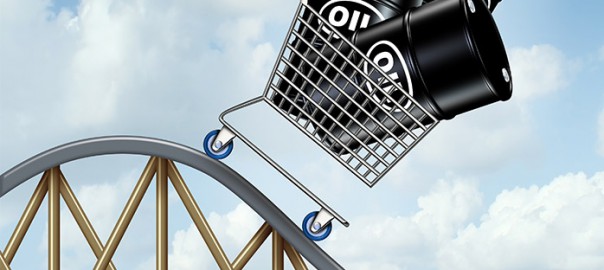
AAEAAQ_Oil_RollerCoaster_LinkedIn

It is widely accepted that Peak Oil occurred for conventional oil in 2005/6 and that led via very high oil prices to the global financial crisis of 2007/8. However, the high oil prices had an important side-effect, and that was to allow oil that was hard to extract to become potentially profitable and so we had the dash for shale and tar sands oil that has been booming since. This growth in unconventional oil increased the total annual oil extraction figures such that ‘Peak Total Oil’ looked to be moved into the future.

The Saudis, however, put a spoke in the wheel in October last year when they decided they were better off with low oil prices – since they can extract oil very cheaply – and so get back their reducing market share. This led to the current price tumble and oil glut.

While the notoriously optimistic U.S. Energy Information Administration (EIA) has been talking up the US shale oil industry for years, recently it has been moderating its view and suggesting that there may be a peak in unconventional oils as soon as 2020. I believe even this to be over-optimistic.

It is in this context that I see the currently unfolding Chinese stock market crash as being the key turning point, and in particular the week beginning 24 August 2015 – Black Monday – when the Chinese stock market lost 16% of its value. Given that China is currently the world’s economic engine this faltering is a major warning sign, and will likely lead to a softening of demand over the next few years (and perhaps indefinitely).

Putting these things together – a reduction in supply from unconventional oil and a reduction in demand from a faltering global economy – means I’m going to call it:

I think the conditions required for Peak Oil occurred together in August 2015.

This doesn’t mean that Peak Oil has itself just occurred since production drops will lag the economic situation – not least because shale oil production is heavily hedged and credit is currently cheap. Rather, that the peak is imminent – it cannot be avoided unless there is a major increase in either supply or demand in the short term, and neither seems likely.

Longer term, if the Saudis hold their nerve, the US shale industry is likely to implode* from insufficient revenue to service its debts – I think this will occur before the end of 2016, and very likely before the end of 2017 – and shale oil production will drop like a stone. Then Peak Unconventional Oil will have occurred, and therefore Peak Oil itself.

In summary:

In the future, we will be able to look back and see that Peak Oil occurred in 2016/17 and followed naturally and inevitably from the collision of supply and demand reductions in the summer of 2015.


*I think if this plays out we will have another Global Financial Crisis within three years from now, but that’s a topic for another day.

(Image: D. Bacon/Shutterstock/Economist)

Oil and Gas Industry to Lose Credit Supply

The screws are being tightened on the debt-laden US shale industry

More U.S. oil and gas companies could come under financial distress in the coming months as crucial hedging protection begins to expire.

Many companies had locked in high prices for their oil sales last year, allowing them a degree of protection as oil prices collapsed precipitously over the second half of 2014. Few, if any, hedged all of their production though, so revenues declined along with the oil price. Still, with some protection, the vast majority of companies (aside from a tragic handful) have not missed debt payments and have stayed out of bankruptcy.

That could become an increasingly tricky feat to pull off. As time passes, more and more hedges are expiring, leaving oil companies fully exposed to the painfully low oil price environment.

“A lot of these smaller guys who had bad balance sheets have pretty good hedge books through full-year 2015,” Andrew Byrne, an analyst with IHS, told the Houston Chronicle. “You can’t say that about 2016.”

In fact, about one-fifth of North American production is hedged at a median price of $87.51 per barrel. Smaller companies rely much more heavily upon hedging as they are more vulnerable to price swings and are not diversified with downstream assets. Across the industry, IHS estimates that smaller companies had about half of their production hedged at a median oil price of $89.86 per barrel in 2015.

But as those positions expire, any new hedges will be linked to current oil prices, which are now trading around $45 per barrel (although prices are fluctuating with great intensity and ferocity these days).

More worrying for the oil and gas companies that are struggling to keep their lights on is the forthcoming credit redeterminations, which typically take place in April and September. Banks recalculate credit lines for drillers, using oil prices as a key determinant of an individual company’s viability. With oil prices bouncing around near six-year lows, more companies will find themselves on the wrong side of that equation.

Banks were more lenient in April when oil prices were a bit higher and many analysts expected prices to rise. This time around the pain is mounting and there will be a lot less leeway. Somewhere around 10 to 15 percent credit offered to drillers could be cut back on average, a move that could slash $15 billion in credit capacity, according to CreditSights Inc.

With other financial avenues cut off, indebted drillers could be left with no way out.

“Nobody is in good shape with oil at $39,” CreditSights Inc. analyst Brian Gibbons told Bloomberg in an interview. “Most energy companies are shut out of the debt markets. There are few companies that can get a deal done right now.”

Read more: Oil Price

It’s not climate change, it’s everything change

Oil! Our secret god, our secret sharer, our magic wand, fulfiller of our every desire, our co-conspirator, the sine qua non in all we do! Can’t live with it, can’t — right at this moment — live without it. But it’s on everyone’s mind.

Back in 2009, as fracking and the mining of the oil/tar sands in Alberta ramped up — when people were talking about Peak Oil and the dangers of the supply giving out — I wrote a piece for the German newspaper Die Zeit. In English it was called “The Future Without Oil.” It went like this:

The future without oil! For optimists, a pleasant picture: let’s call it Picture One. Shall we imagine it?

There we are, driving around in our cars fueled by hydrogen, or methane, or solar, or something else we have yet to dream up. Goods from afar come to us by solar-and-sail-driven ship — the sails computerized to catch every whiff of air — or else by new versions of the airship, which can lift and carry a huge amount of freight with minimal pollution and no ear-slitting noise. Trains have made a comeback. So have bicycles, when it isn’t snowing; but maybe there won’t be any more winter.

Then there’s Picture Two. Suppose the future without oil arrives very quickly. Suppose a bad fairy waves his wand, and poof! Suddenly there’s no oil, anywhere, at all.

Everything would immediately come to a halt. No cars, no planes; a few trains still running on hydroelectric, and some bicycles, but that wouldn’t take very many people very far. Food would cease to flow into the cities, water would cease to flow out of the taps. Within hours, panic would set in.

Read more: Medium

The parallel between food and oil prices (Image: FoodDownTheRoad.ca)

Peak Oil Primer

An introduction to Peak Oil

Contrary to popular opinion we do not live in the Information Age. What we live in is the Oil Age. Look around you and you’ll have a virtually impossible task of trying to find something that isn’t tied back to oil – be it hip replacement surgery, the little pieces of plastic wrapped around the ends of your shoelaces, or the vast infrastructure that makes the so-called “Information Age” possible.

But not only is the relatively superfluous dependent on oil, but so is the very non-superfluous, such as food we eat. Not simply an issue of food being shipped around the world on the back of fossil fuels, the fact of the matter is that fossil fuels are used to plant and harvest our foods, and upon much else, the very fertilizers we spread on our fields are mined from the ground and even derived from fossil fuels themselves (the ammonia and urea we apply to our fields for nitrogen are products of nitrogen atoms paired in the air around us of which were split and combined with hydrogen from natural gas). Simply put, oil and the rest of the fossil fuels are the “lifeblood” of industrial civilization and our modern way of life.

The parallel between food and oil prices (Image: FoodDownTheRoad.ca)

Enter peak oil.

Read more: From Filmers to Farmers