Category Archives: Peak Oil

Are Electric Vehicles Near a Tipping Point?

Oil consumption continues to rise in the U.S. and around the world, but as electric vehicles keep growing as a percentage of vehicle sales, there will ultimately be a tipping point on multiple fronts.

The first will be manufacturers investing in more EVs to ultimately overtake internal combustion engines, which is happening today from Tesla (NASDAQ: TSLA) to General Motors (NYSE: GM) to Porsche.

The bigger tipping point will be a peak in oil consumption that the world will (likely) never look back from. We don’t know when peak oil will happen, but given the cost reduction of EVs and the focus on reducing emissions around the world, it’s only a matter of time.

EV sales are still booming

There’s no question that Tesla has led the EV revolution the last decade, and it’s helping drive the industry’s growth. According to the website Inside EVs, Tesla has already sold 99,525 Model 3, S, and X vehicles in the U.S. through July 2019, and total U.S. EV sales across all manufacturers were 176,174 thru seven months of 2018, a 14.5% increase from 153,854 a year ago.

Global electric vehicle sales were 1,105,405 in the first six months of this year, a 46.9% jump from 752,690 a year ago. It’s this growth on a global level that’s going to lead to that tipping point.

No matter where you look, EV sales are going up. And in 2020 and 2021, there will be even more options coming to the market from Porsche, Ford, Kia, Mini, and many more.

Read more: Yahoo

The sun sets on drilling (Image: Pexels)

Economics of Electric Vehicles Mean Oil’s Days As A Transport Fuel Are Numbered

The future is not looking bright for oil, according to a new report that claims the commodity would have to be priced at $10-$20 a barrel to remain competitive as a transport fuel.

The new research, from BNP Paribas, says that the economics of renewable energy make it impossible for oil to compete at current prices. The author of the report, global head of sustainability Mark Lewis, says that “renewable electricity has a short-run marginal cost of zero, is cleaner environmentally, much easier to transport and could readily replace up to 40% of global oil demand”.

The oil industry faces a disruption on the same scale as that which has hit the European utilities sector over the last decade, he adds.

The sun sets on drilling (Image: Pexels)

The report, Wells, Wires, And Wheels… Eroci And The Tough Road Ahead For Oil, introduces the concept of the Energy Return on Capital Invested (EROCI), focusing on the energy return on a $100bn outlay on oil and renewables where the energy is being used to power cars and other light-duty vehicles (LDVs).

“For a given capital outlay on oil and renewables, how much useful energy at the wheel do we get? Our analysis indicates that for the same capital outlay today, new wind and solar-energy projects in tandem with battery electric vehicles will produce six to seven times more useful energy at the wheels than will oil at $60 per barrel for gasoline powered light-duty vehicles, and three to four times more than will oil at $60 per barrel for light-duty vehicles running on diesel,” says Lewis.

Read more: Forbes

The sun sets on drilling (Image: Pexels)

Why oil needs to plummet in price if it’s to remain competitive in the mobility sector

  • Mark Lewis is global head of sustainability research at BNP Paribas Asset Management.
  • The number of electric cars may be increasing, but there are challenges for charging infrastructure and energy storage.

Oil prices will need to fall to between $10 and $20 per barrel if it is to remain competitive in the mobility sector, according to a recent report from BNP Paribas Asset Management.

The report’s author, Mark Lewis, told CNBC’s Squawk Box Europe Friday that such a view reflected how the economics of renewables were changing “very dramatically” and the way in which electric vehicles were becoming more competitive.

The sun sets on drilling (Image: Pexels)

“We have to be very clear here,” Lewis, who is global head of sustainability research at BNP Paribas Asset Management, added.

“What we’re saying is if you’re comparing investing money in renewable energy in tandem with electric vehicles, you can get six to seven times the energy yield at the wheels – useful energy, mobility – for the same capital outlay as you can spending on oil at the current market price of $60 a barrel, and then refining it into gasoline and using it in an internal combustion engine, which loses 80% of the energy as heat.”

Read more: CNBC

The sun sets on drilling (Image: Pexels)

Redefining Geopolitics in the Age of Electric Vehicles

Oil has played a pivotal role in shaping geopolitics for more than a century. But the rise of electric vehicles and shift toward cleaner fuels means that the world’s dependence on oil could begin to shrink, with both expected and unexpected consequences.

Most countries are not prepared for the consequences of this transition, according to E3G’s new report Rules of the Road: The Geopolitics of Electric Vehicles in Eurasia. The biggest sources of conflict will not come from the places security and foreign policy analysts instinctively look, like the struggle to control valuable mineral resources. Rather they will emerge from the need to navigate the social impacts of the energy transition, including supply chain disruption, employment impacts, and trade disputes.

The sun sets on drilling (Image: Pexels)

Fast-growing Electric Vehicle Market

Electric Vehicle (EV) sales have been growing at a rapid pace—between 40 percent and 50 percent per year, according to McKinsey. Even conservative forecasts show significant growth in EV adoption over the next several decades, with some projections showing EV penetration rising high enough to flatten oil demand from 2020 to 2030. Oil demand could fall steadily thereafter.

This shift could occur much faster than mid-range forecasts predict. The world’s largest independent energy trader has predicted peak oil demand in 15 years and signaled it intends to focus on clean fuels and power trading. Many of the international oil companies (IOCs) now are getting involved in EV markets or supply chains. Several of the world’s largest economies, including France and the UK, have set phase-out targets for internal combustion engine vehicles, and car companies collectively have announced that they are investing more than US$100 billion new EV models. It’s also worth noting that most forecasts have consistently underestimated EV deployment and other clean energy technology adoption rates.

Read more: New Security Beat

Electric vehicles alone could cause peak oil demand within decade

In an aggressive scenario, electrified transportation could displace 8 million barrels of oil per day.

When Tesla announced that it had built 7,000 cars in a week, I got excited. Even though electric vehicles (EVs) make up only a small percentage of new car sales in most countries, those sales are growing rapidly.

But how long before they really start to take a bite out of oil demand?

Norway offers some clues, where years of generous—some would say unsustainable—incentives saw EVs and plug-in hybrid sales grow to 55% of the new car market in March. And the cumulative impact of those sales may have FINALLY translated into a drop in overall demand, with gasoline in particular seeing a 2.9% drop in sales.

Of course 2.9% is not exactly groundbreaking, but it’s important to remember that change is rarely linear. If it really is due to electric vehicles, then that figure should grow each year as adoption rates increase and older model gasoline cars retire from the fleet. And that, in turn, could lead to further drivers like gas stations closing, or lower resale value for fossil fueled vehicles.

Similar dynamics will be at play on a global scale, albeit many years behind. Now the carbon/finance geeks at Carbon Tracker have launched an interesting EV Demand Displacement Tool that allows users to explore how rates of EV adoption, mileage and efficiency gains in internal combustion engine (ICE) cars might interact to displace oil demand, and how that in turn could lead to major disruption for investors and volatility in oil pricing.

Read more: Treehugger

The sun sets on drilling (Image: Pexels)

Electric vehicle sales promise shock for Big Oil

If motor manufacturers are right about the prospects for electric vehicle sales, an oil price crash won’t be far behind.

LONDON, 5 July, 2018 – Oil and gas companies have underestimated probable electric vehicle sales and the effect they will have on their own businesses and profits, a new report says.

If the car manufacturers’ projections of future sales of electric cars are correct, then demand for oil will have peaked by 2027 or even earlier, sending the price of oil in a downward spiral as supply exceeds demand, says Carbon Tracker (CT), an independent financial think-tank carrying out in-depth analysis on the impact of the energy transition on capital markets.

The sun sets on drilling (Image: Pexels)

It says fossil fuel companies have taken into account some engine fuel efficiencies and the effect they would have on oil demand, but not the expected increase in electric vehicles themselves. There is a big mismatch between forecasts of EV market penetration from vehicle manufacturers and from oil majors, says Laurence Watson, a CT data scientist.

“The oil industry is underestimating the disruptive potential of electric vehicles, which could reduce oil demand by millions of barrels a day. Increases in fuel efficiency will also eat into oil demand and the industry’s profits. The oil majors’ myopic position presents a serious investor risk,” he told the Climate News Network.

Read more: Climate News Network

Big Oil, Utilities are Lining Up for an Electric Vehicle War

  • BP and Shell have bought electric-car charging companies
  • Power utilities are boosting sales to homes, chargers on roads

A red-hot electric vehicle market has triggered a face-off between Big Oil and utilities.

Oil majors, who’ve sold fossil fuels to cars for a century, are now moving into an electricity sector that’s preparing for exponential growth. The problem is that utilities, the primary power suppliers for a century, have the same idea.

BP Plc predicts electric vehicle sales will surge by an eye-watering 8,800 percent between 2017 and 2040, making it an attractive business for oil companies as demand for gasoline and diesel are forecast to slow. Big Oil will have to battle the traditional utilities for charging at people’s homes, on the road and even offices of green-car owners.

Read more: Bloomberg

Electric cars charging in Milton Keynes (Image: T. Larkum)

Electric vehicle growth will start hurt tanker shipping by 2025

Come 2025 the switch to electric vehicles (EV) will start to impact the demand for gasoline, which will be bad news for shipping.

While charging infrastructure and range limits remain a concern for EVs the fact they are much cheaper to manufacture on a large scale than their petrol powered cousins will see a shift in the market by the middle of the next decade according to James Leake, an analyst at NS Lemos.

Electric cars charging in Milton Keynes (Image: T. Larkum)

Speaking at the Bimco Power Panel at Posidonia 2018 Leake said:

“EVs do represent a serious threat but not for the time being, if you ask me to put a date on it 2025 would be the point where it really starts to hurt.

“What is to me the killer fact is ultimately manufacturing an electric vehicle is much cheaper than manufacturing an internal combustion engine when you are producing them on scale.”

An electric powered car requires significant less components than one with an internal combustion engine making the structural production cost lower if the scale is large enough, and this why Leake said the likes of Volkswagen is investing $40bn into electric cars with an aim to be the world’s number one player in electric mobility by 2025.

With lower production costs car manufacturers will be much more keen to sell electric powered vehicles than petrol ones. “We will educated as customers to buy the product that will give them a higher profit.”

Read more: SeaTrade Maritime

Is Big Oil planning its own funeral?

The end of the Oil Age is within sight. Everyone who follows the news should be able to see this by now, although people have vastly different ideas about the timeline.

Above: Internal Combustion Engine vs. Battery Electric Vehicle (Instagram: cars217mph / gunthersahagun)

Consultancies, investment analysts and think tanks around the world produce a constant stream of predictions about the future impact of new technologies on the auto and oil industries. Despite the pundits’ painstaking perusal of primary sources, including economic data and interviews with industry insiders, their conclusions do not agree, to say the least.

The oil industry itself, along with mainstream investment banks, tends to foresee a gradual, decades-long transition. BP’s 2017 Energy Outlook predicts that electric vehicle (EV) sales will grow to a mere 6% of the global auto market by 2035 (from around 1% today). A recent report by Goldman Sachs is a bit more adventurous, predicting that pure EVs will capture 5% of the market by 2025. The US Department of Energy’s Energy Information Administration (EIA) has doubled its forecast from last year, but still predicts that EVs will account for only 8% of the US market in 2025.

Sign of the times: Emirates National Oil Company just opened the first solar-powered gas station in Dubai (Source: CleanTechnica)

Organizations of a more greenish hue are more sanguine: Greentech Media Research expects EVs to score 12% of the US market in 2025, and Bloomberg New Energy Finance predicts 35% globally by 2040. A study from the Carbon Tracker Initiative argues that EVs could capture 33% of the global market by 2035, and that reductions in battery costs

“could halt growth in global demand for oil from 2020.”

To those who follow the EV industry, none of this is really news. Lately, however, there have been signs that at least some in the oil industry are reassessing the threat to their empire, and preparing for a “peak oil” scenario that may come much sooner than they have been predicting.

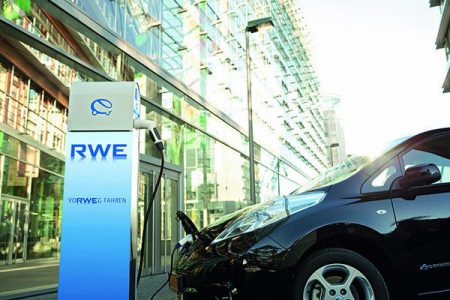
Another sign of the times: RWE, Germany’s biggest gas and energy provider, just launched hundreds of electric vehicle charging stations (Source: Trustnodes)

Read more: Evannex

Oil Majors Can No Longer Ignore The Electric Car Threat

Many carmakers, and not just Tesla, have been developing electric vehicles, betting on the expected continuous rise of battery-powered cars in the future. Now it’s not only carmakers that predict that EVs will make up a substantial part of new vehicle sales in a decade or two—oil majors are admitting it too.

France’s Total SA expects EVs to account for up to 30 percent of new car sales by 2030, which could lead to oil-based fuel demand peak in the 2030s, Total’s Chief Energy Economist Joel Couse said at Bloomberg New Energy Finance conference earlier this week.

Couse reckons that after 2030, fuel demand “will flatten out” and “maybe even decline”, in what Colin McKerracher, head of advanced transport analysis at Bloomberg New Energy Finance, described as the “most aggressive” projection by an oil major about the rise of EVs.

Other oil majors have their projections about peak oil demand as well, ranging anywhere from as early as the next decade, to nowhere in sight. At the same time, analysts believe that EV sales will only rise, but the pace will greatly depend on incentives and government policies. Meanwhile, many carmakers are preparing for the EV surge and entering the battery-powered car market.

France’s Total sees that growth as potentially leading to peak oil-based fuel demand in the 2030s. Other majors also have ideas about the impact of EVs on global oil demand.

Shell’s chief executive Ben van Beurden said in March that oil demand could peak as early as in the next decade.

“We have to acknowledge that oil demand will peak, and it could already be in the next decade. It could happen. There are people who believe it will grow forever but I don’t subscribe to that,”

van Beurden told the CERAWeek energy forum, as quoted by The Telegraph.

BP, in its Energy Outlook 2017, said that an extra 100 million battery EVs could lower oil demand by around 1.4 million bpd. Still, the UK oil major sees oil demand peak in the mid-2040s, with many drivers to factor in, including global GDP growth, efficiency trends, and climate policy. According to BP, the penetration of the EVs will depend on how fast battery costs would continue to drop; the size and durability of government incentives; how conventional cars’ efficiency would improve; and how consumer preference towards EVs would shift.

Read more: Oilprice.com