The UK’s political leaders have pledged to work together to combat climate change, whatever the election result.
In a joint statement, David Cameron, Ed Miliband and Nick Clegg said climate change was one of the most serious threats facing the world.
They said climate change threatens not just the environment but also security, prosperity and poverty eradication.
They have promised to end coal burning for power generation in the UK – unless it uses new clean-up technology.
Environmentalists say the pledge is significant because it quells some of their fears that the Conservatives might adopt a more climate-sceptic line, to mirror UKIP’s position.
‘Moment of unity’
The move will be noticed by the UK’s European partners working towards a global agreement on climate change at the UN conference in Paris in December. Some of them had been nervous that the UK might soften its leadership position in the talks, given the level of climate scepticism expressed by some newspapers and Conservative backbenchers.
The statement will also please investors who have been deterred from sinking money into renewable energy systems because they feared a withdrawal from climate policies.
It has been brokered by Matthew Spencer of the think tank Green Alliance, who told BBC News:
“The purpose is to create space for the current and future PM to ensure that the UK can play a full role in securing a good outcome in Paris.
He added that another aim was “to reassure investors that agreement remains strong across current leaders on emissions reduction, and that we’re unlikely to see a major change in direction whichever party forms the next government”.
“It’s very unusual to get a moment of unity in the midst of a general election, and it is generating lots of excitement. A non-partisan approach is the holy grail in the US. It is in our national interest to act and to ensure that others act with us.”
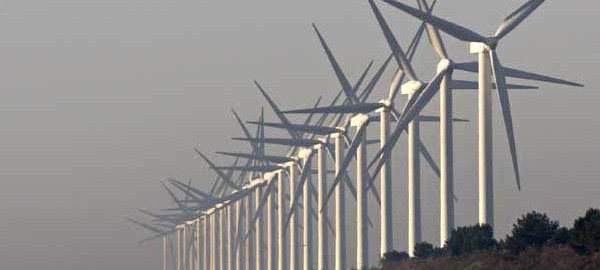
Severe Flooding, Against a Background of Wind Turbines: November 2012, Tyringham, Bucks. (Image: T. Larkum)
The leaders have gone so far as to promise to ban “unabated” coal-fired power generation – meaning that, if it is to continue, the emissions will need to be captured and stored in rock formations. This decision has been long debated and will send a strong signal of intent to the power industry.
The leaders state:
“Acting on climate change is an opportunity for the UK to grow a stronger economy more efficient, and more resilient to risks ahead.”
They pledge:
to seek a fair, strong, legally binding, global climate deal which limits temperature rises to below 2C
to work together, across party lines, to agree carbon budgets in accordance with the Climate Change Act
to accelerate the transition to a competitive, energy efficient low carbon economy and to end the use of unabated coal for power generation
Critics fear that combating climate change will make energy unaffordable. UKIP says climate change fears are inflated and the party’s UKIP’s energy spokesman recently said his party wanted to repeal the Climate Change Act, which commits the UK to step-by-step reductions in CO2 until 2050. He said the relationship between CO2 levels and global temperatures is “hugely open to question”.
Labour leader Ed Miliband recently restated that tackling climate change “goes to the heart of” his beliefs. A Liberal Democrat source said tackling climate change was in the party’s DNA.
The Green Party says the UK should be making much more urgent progress towards getting the country powered by renewables.
Greenpeace welcomed the new statement. Its director John Sauven said:
“This pledge marks a turning point in the collective effort to take Britain’s energy system out of the Victorian age and into the 21st century. Party leaders now need to set a clear expiry date on coal pollution, stop subsidies to coal plants, and start investing in the clean energy infrastructure this country really needs.”
Industry leaders will need reassuring about how this can be done without pushing up energy prices and making the UK uncompetitive.
This time, it could be long-lasting—with dramatic consequences for the climate, the economy and the global balance of power.
Oil is the most valuable commodity in world trade, so any significant change in its price—whether upward or downward—has far-reaching economic consequences. Because oil also plays a pivotal role in world politics, such shifts can have equally momentous implications for international relations. It is hardly surprising, then, that the recent plunge in prices has generated headlines around the world. Many giant energy firms have announced massive cutbacks in employment and investment, and major producing countries like Russia and Venezuela have been forced to scale back government expenditures. While some analysts speculate that prices have now reached bottom and will soon begin climbing again, there are good reasons to believe that this descent is not just another cyclical event but rather the product of something far more profound and durable.
Before examining these factors, let’s consider the sheer magnitude of the price collapse. Last June, Brent crude was selling at about $115 per barrel, ensuring substantial wealth for the major oil corporations and oil-producing countries. Most analysts assumed, moreover, that prices would remain at this elevated level. As recently as October, for example, the Energy Information Administration of the Energy Department predicted that the average price of crude in 2015 would be $102 per barrel, about the same that it’s been for the past five years. Just three months later, Brent had fallen to as low as $46 per barrel, with some experts predicting a further slide into the $30s.
Why this sudden plunge in oil prices? That old mantra, supply and demand, is mostly to blame. The high prices of recent years have been driven, in large part, by ever-increasing demand from China and other rapidly developing countries of the Global South. Chinese consumption jumped from 7 million barrels per day in 2005 to 11 million in 2014; comparable increases were posted by India, Indonesia, Brazil and Saudi Arabia. Production increased to satisfy all this added demand, but not always fast enough to keep up—thus explaining those high prices. Over the past six months, however, the fundamentals have shifted. The economic doldrums in Europe and tepid growth elsewhere have resulted in less than expected levels of demand, while the flow of crude from America’s shale formations has reached flood proportions, producing a glut of supply and driving prices downward.
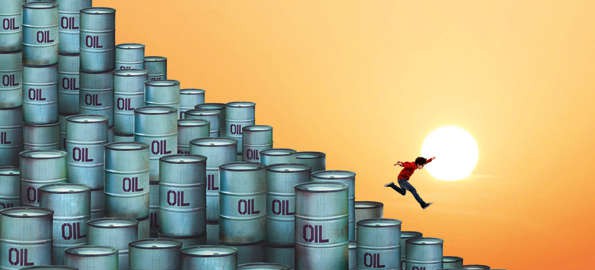
The sun sets on drilling (Image: Pexels)
Historically, the major oil powers have responded to falling prices by reining in production, thereby constricting supply and reversing the slide—but not this time around. Saudi Arabia, which lost market share to its rivals after pursuing this strategy in previous price declines, has chosen to keep pumping at current rates. At the same time, several producers, including Iraq and Russia, have increased their output. But with the US market inundated with cheap domestic shale oil and demand shrinking elsewhere, the Saudis and their competitors have been forced to lower prices in order to attract customers in non-US markets. Some have speculated that the Saudis also hope that low prices will force the Russians into curtailing their support for the Assad regime in Syria; but retaining market share appears to be their principal objective.
Whatever the combination of factors at work, the plunge in prices is having far-reaching consequences. For countries that depend on oil revenue to finance government operations, the price collapse has already inflicted serious damage. Major producers like Mexico, Nigeria, Russia and Venezuela have announced budget cutbacks, significantly impairing the ability of these governments to implement favored domestic and international programs. Russia, for example, is under pressure to reduce its military expenditures, calling into question its ability to undertake major military operations in Ukraine or other peripheral regions. Mexico has announced a budget reduction of $8.3 billion, eliminating funding for prestige projects favored by President Enrique Peña Nieto, who is already facing strong popular opposition because of rampant corruption and lawlessness at the local level. The Venezuelan government, which has long relied on oil revenue to finance social programs aimed at lifting the status of the poor, is now scaling back its efforts—further eroding public support for the socialist government of Nicolás Maduro.
If prices remain at these depressed levels for any length of time, the consequences could prove even more severe. Although President Vladimir Putin continues to enjoy strong support from the Russian population for what is seen as his aggressive pursuit of Russian national interests in Crimea and Ukraine, this could change as the current economic downturn cuts deeply into people’s standard of living. The Iraqi government, which needs high oil prices to buy new weapons and bolster its army, is having to scale back its planned offensive against ISIS. The Nigerian government is also having trouble paying its soldiers and taking the offensive against rebel forces, in this case Boko Haram. While entrenched corruption (largely the product of misappropriated oil revenue) is a major part of Nigeria’s problem, the fall in prices is making things worse; some analysts now predict that a former military strongman, Muhammadu Buhari, will defeat incumbent Goodluck Jonathan in the forthcoming presidential election. Such upsets are likely in other countries that rely heavily on oil revenue, including Mexico and Venezuela.
The fall in prices has also affected the long-range plans of many major oil companies, especially those planning costly projects in “unconventional” producing areas, such as the Arctic, the deep oceans, Canada’s tar sands and US shale formations. These projects generally turn a profit only when oil sells for $70 to $90 or more per barrel—but prices that high are now considered unattainable for the foreseeable future. In January, for example, Royal Dutch Shell abandoned plans for one of the world’s largest petrochemical plants, the $6.5 billion Al-Karaana facility in Qatar, saying high construction costs and low oil prices had rendered it “commercially unfeasible.” Chevron has indefinitely shelved its plans to drill in the Beaufort Sea and withdrawn from its shale projects in Poland; BP is scaling back its operations in the North Sea, while Occidental Petroleum is curtailing its activities in Canada’s tar sands.
Much speculation has also arisen about the viability of drilling projects in US shale reserves. Most analysts believe that drilling in the most productive formations, notably Eagle Ford in Texas and Bakken in North Dakota, will continue as before, albeit at reduced levels; however, drilling in less productive “plays,” such as the Permian Basin in Texas and the Niobrara formation in Colorado, could slow down appreciably. A lot depends on the ultimate bottom level of oil: most independent drillers, it is said, can survive a price of $60 to $70 per barrel, but a sustained rate of $40 to $50 could kill off many of them. “For rivals on the periphery of Eagle Ford and Bakken, or with acreage in more frontier plays, [2015] will be a test of endurance,” observed John Kemp of Reuters. “Some will almost certainly fail or be taken over.”
Bust cycles like this have occurred before in the oil industry, most notably in the later 1980s and ’90s, when a glut of new production from Mexico, Saudi Arabia, the North Sea, West Africa and elsewhere depressed prices and discouraged investment in frontier regions. But eventually demand, much of it from China, overtook supply, again boosting prices. This, in turn, prompted investment in new technologies that permitted drilling in previously inaccessible or noncommercial areas. With demand continuing to grow, prices rose from as low as $10 per barrel in 1998 to the recent average of $100 (except for a sharp but temporary plunge after the financial crisis of 2008). It is reasonable to assume, therefore, that prices will again recover, as occurred in 2009.
Were prices to recover quickly, we would likely see a return to business as usual, with mammoth corporate investments in shale and other unconventional sources of crude. This, in turn, would result in rising carbon emissions and pervasive environmental destruction of the sort chronicled in Naomi Klein’s new book, This Changes Everything. It would also bolster the coffers of the giant oil companies and their government backers, enabling them to better resist efforts by environmentalists to curb the consumption of fossil fuels. But will this come to pass? Although some increase in prices is inevitable—given that the current cutbacks in investment will produce an eventual contraction in supply—a return to the $100-plus levels of recent years is by no means assured. This is so for several reasons:
First, the Chinese leadership is committed to slowing and eventually reducing the country’s emissions of carbon dioxide and other greenhouse gases. Although Beijing’s drive to reduce CO2 emissions will largely focus on coal, it is also seeking to retard the growth in China’s petroleum consumption. The leadership is also wary of becoming excessively dependent on imported oil, a trend that has led to increased—and often unwelcome—Chinese involvement in the politics of major supplying countries, such as Sudan and Ethiopia.
Second, automobiles in the United States are becoming increasingly fuel-efficient as a result of rules adopted by the Obama administration in 2012. If fully implemented, these rules will require that US-made cars achieve an average fuel consumption rate of 54.5 miles per gallon in 2025—nearly twice the current level. Although lower gas prices are likely to spur increased driving and rising sales of SUVs, the increase in fuel efficiency will result in diminished overall consumption.
Finally, we are likely to witness a worldwide shift from fossil fuels to green energy. As awareness of and concern over climate change grows, governments and individuals around the world will take steps to reduce their consumption of oil. This shift will take different forms—from government-imposed fuel efficiency standards and higher taxes to multiple individual decisions to replace conventional oil-driven cars with hybrids and all-electric vehicles—but will gain momentum as the climate changes. Oil will not disappear in this process, but the giant growth in demand needed to sustain $100-plus prices may never materialize.
Given all this, it seems rather unlikely that global oil demand will expand sufficiently in the months or years ahead to re-establish the high-price regime of recent years. Prices will rise, to be sure, but could stabilize at a level well below that needed to justify costly investments in unconventional sources of crude. We would, in essence, be entering a new epoch in which oil plays an ever-diminishing role in the global energy equation.
Should this prove to be the case, we can expect a welter of accompanying changes. Many oil companies will be forced to downsize, and to abandon plans for drilling in frontier areas. This in turn will bolster the argument posed by those favoring divestment from fossil fuels that these companies are sitting on large reserves of carbon that will never be exploited—“stranded assets,” as they’re called—making these companies a less attractive long-term investment. Reduced drilling in Alberta and the Arctic would also diminish the threat to the climate and the environment. Because natural gas prices are often pegged to the price of petroleum, moreover, lower oil prices will make gas cheaper—further clouding the future role of coal and nuclear power in generating electricity. Lower prices will also make biofuels and some other energy alternatives less competitive, but, by and large, the environment will be better off.
The global political scene will also be altered. In general, power will shift from oil-producing states like Iran, Russia, Saudi Arabia and Venezuela to consuming states like China, Japan and the United States. The producers, with their revenue sharply reduced, will be less capable of pursuing ambitious political endeavors, of whatever sort. The consuming states, on the other hand, will be spending less on imported petroleum and so should see an improvement in their domestic economies. This, in turn, could tempt them to adopt a more assertive stance in foreign affairs, with unforeseen consequences. The United States, for example, could be emboldened to increase its pressure on potential adversaries like Iran and Russia, knowing they are more vulnerable to economic sanctions—but risking a dangerous backlash in the process.
How all this will play out in the months ahead is impossible to foresee. But given oil’s importance to the world economy—and the prospect for a protracted period of low or moderate prices—we could see dramatic and lasting changes in the energy economy, the climate struggle and the global balance of power.
When it comes to electric cars, buyers are often interested in two types of green.
The lower environmental impact of a zero-emission vehicle, and the potential to save cash by eliminating gasoline use are both typically factors that motivate the purchase of an electric car, to varying degrees in different individuals.
It’s also generally assumed that–for the mass market of car buyers — saving money is more important than saving the environment.
That has implications for the way electric cars are marketed, leaving carmakers to contemplate which benefits to emphasize.
Now, a new study suggests the environmental factor may be more important than many believe.
Participants who were reminded that conserving energy would cut air pollution used less electricity in their homes than those who were reminded only of the money they saved, according to the study results (via TakePart).
Titled “Altruism, Self-Interest, and Energy Consumption,” the study was conducted by researchers at the the University of California–Los Angeles (UCLA) and published in the journal PNAS.
At the outset, participants were asked what kinds of messages would get them to cut energy consumption.
The majority answered that it those would be messages on how much money they’d be saving. Reminders about air pollution would be less persuasive, they said.
Yet in practice, consumers who received messages about environmental benefits saved more electricity than those who received only messages about money.
Each household surveyed received updates comparing electricity use to that of their neighbors, to add a dash of competition.
One group was told how many pounds of pollution they were responsible for, while the other was shown the difference in electricity bills among neighbors.
The group that got the environmental messages saved more–cutting electricity use by an average 8 percent, or a remarkable 19 percent in households with children.
In a statement, lead researcher Magali Delmas attributed that result primarily to the “dual good” of reducing air pollution as a matter of public policy, and reducing health risks for individuals.
She said the environmental message was effective because it bundled public and private good, driving the point home for individuals.
Reminding consumers about personal health risks arguably taps into the same self-interest that motivate people to make a decision for financial reasons.
That duality between altruistic and personal motivation could make cutting air pollution a possible centerpiece for electric-car marketing.
Having two reasons to do something is better than one, after all.
Oil giant BP is recommending its shareholders support a resolution calling on the company to address its climate change risks.
The move comes after Shell recommended its shareholders support an identical resolution, filed by more than 150 investors, including UK local authorities and the Church of England.
The resolutions call on the oil companies to transparently assess their business model against the commitment by governments not to let global temperatures rise more than 2C above pre-industrial levels – the threshold above which “dangerous” climate change is expected.
BP and Shell must also show how they are reducing emissions, investing in renewable energy and reforming their bonus systems so they no longer reward activities which drive climate change, the resolutions urge.
The resolutions also call on Shell and BP to report on their public policy positions relating to climate change.
The shareholders, which include multibillion-pound pension funds, investors and insurers in the UK and internationally, own about 1% of the companies.
BP is recommending its shareholders support the resolution, co-ordinated by environmental lawyers ClientEarth, responsible investment movement ShareAction and the Aiming for A coalition, at the company’s annual general meeting (AGM) on April 16.
ClientEarth barrister Elspeth Owens said:
“It’s great news that BP has today recommended its shareholders support the climate risk resolution.
“This confirms the potential of shareholder engagement and demonstrates that BP is listening to some of its biggest investors.”
Edward Mason, head of responsible investment for the Church Commissioners, part of the Aiming for A coalition, said:
“The positive way in which BP and Shell have responded to our shareholder resolutions is completely unprecedented.
“This represents a step change in engagement between institutional shareholders and the oil and gas industry on the strategic challenge that climate change poses to the industry.
“The next step is for investors to back the boards of both companies and to vote for the disclosures that we have requested and that the companies have said they will provide.
“We look forward to seeing the new in-depth reporting from both companies later this year and to continued engagement.”
In Saudi Arabia, drivers pay roughly 45 cents a gallon to fill up their cars, and in Venezuela even less. Energy is so inexpensive in Kuwait and Qatar that residents chill their enormous swimming pools in the summer and typically leave their air-conditioners on at full blast while they are away on vacation.
Across the Middle East and much of the developing world, government subsidies make energy cheap and encourage consumption. But governments around the world are beginning to take advantage of plummeting oil and natural gas prices by slashing the subsidies. The cuts are just a small fraction of the global total of annual subsidies, but energy experts say they are beginning to add up.
Even with oil rebounding in recent days — including a 6 percent rise on Tuesday for the global Brent crude benchmark — the price is down nearly 50 percent from its peak last year of just over $110 a barrel.
On Jan. 1, the Indonesian government abandoned a four-decade-old policy of subsidizing gasoline, permitting prices at the pump to rise and fall with global oil prices. As long as oil is cheap, Indonesians will not see much of a difference. Since October, India has stopped subsidizing diesel and raised fuel taxes. Malaysia cut subsidies on gasoline and diesel late last year.
Indonesians waiting to fill their scooters with subsidized fuel last November. The country has quit subsidizing gasoline. (Image: Dedi Sahputra/European Pressphoto Agency)
Angola, a major African producer, raised gasoline and diesel prices 20 percent in December. Ghana has also acted to remove subsidies, and Nigeria is expected to follow suit after its national elections in February. Iran cut gasoline subsidies early last year.
“Many of the big producers have no choice but to raise domestic energy prices,” said Jim Krane, a Middle East energy expert at Rice University. “This includes prices on fuel, but also electricity and water, since most water in the region is desalinated by burning fossil fuels. Now, with less revenue coming in, the oil-exporting regimes have a stronger fiscal incentive to do this.”
Such subsidies amount to more than $540 billion a year worldwide, and for decades they have been used as a crutch by governments to buy political support and lend a crude, but flawed, safety net to the poor, energy experts say. But they are also a drag on economic development and cause environmental damage by encouraging the burning of fossil fuels and discouraging efficiency, the experts say.
Now, with political tensions high in North Africa and the Middle East, Kuwait, Oman and Abu Dhabi have all begun to reduce subsidies on power, diesel and natural gas in recent months. Kuwait has been notably aggressive because of a fiscal squeeze, and it has plans to triple the price of kerosene and diesel early this year. (Subsidies on gasoline and electricity, though, will remain untouched for now.)
At the same time, Egypt, which began cutting energy subsidies last spring even before oil prices began their 50 percent decline, is quickening the pace of its energy reform.
For countries like India, Egypt and Indonesia, which import sizable amounts of oil, governments hope not only to save money on subsidies but also to curb energy use to improve their balances of trade. For producing countries like Oman and Kuwait, lower subsidies save their governments money when they are earning much less from their exports. For both producer and consumer countries, government funds that finance subsidies could instead go to social programs and other investments.
“We know from studies in Mexico, Africa and Asia that these subsidies do not end up in the hands of the poorest people,” said Amy Myers Jaffe, an energy expert at the University of California, Davis. “They put a strain on federal budgets that are needed to help the poor, and they end up helping the wealthiest and middle class in these societies more.”
Sultan Ahmed al-Jaber, United Arab Emirates minister of state and chairman of Masdar, a company specializing in clean-energy technology, told officials at a regional energy conference in January that money saved from reduced subsidies is
“money that can otherwise be redirected to improve energy systems and transform economies by creating jobs, stimulating economic growth and educating future generations.”
The United States, like most developed countries, does not subsidize the consumption of energy or put price controls on fossil fuels, although environmentalists point out that oil companies receive tax breaks for exploration. A debate has begun about whether to raise gasoline taxes now to repair roads and bridges, as well as to damp demand for cheap fuel.
With oil prices halved, cutting subsidies is half as expensive for the governments at a time when they are under financial stress. Saudi Arabia, for example, now consumes about a quarter of its production of oil domestically compared with only 3 percent in the 1970s, because of a growing and more prosperous population and dependence on burning oil for electrical power. At the same time, subsidized consumption has meant lower revenues for national oil companies across the region, impeding exploration and technological advancement.
Rising consumption of oil in the Middle East and in the developing world has tightened global supplies by several million barrels a day, energy experts say, helping to raise crude prices over the last decade.
For years, the International Monetary Fund and the World Bank have been urging Middle East producers and developing countries alike to cut subsidies. In a report in October, the I.M.F. reported that subsidies distort prices and foster overconsumption.
“Overconsumption leads to adverse impacts on traffic congestion, health, and the environment,” the I.M.F. paper said. “Subsidies also discourage investment in the energy sector, and encourage smuggling and black market activity, which can lead to shortages of subsidized products.”
Since 2011, there has been slow reform in the Middle East and Africa, with Jordan, Egypt, Morocco, Sudan, Mauritania, Tunisia and Yemen raising some energy prices. But turbulence in the region has slowed change. Saudi Arabia, Russia and Venezuela — three of the most heavily subsidized countries — have done little or nothing to reform.
That is because cutting subsidies often leads to a political backlash, energy experts say, and they have already emboldened the opposition in Kuwait. Cuts in energy subsidies helped produce serious political turbulence in Venezuela in 1993 and Indonesia in 1998, and more recently in Nigeria, Jordan and Ecuador.
At an energy conference in Abu Dhabi in December, Maria van der Hoeven, executive director of the Paris-based International Energy Agency, urged regional oil ministers to seize the moment of low energy prices to reduce subsidies.
“There is no time for action like the present,” she was quoted as saying by the Middle East Petroleum and Economic Publications, which is based in Cyprus. “It’s an opportunity to put a price on carbon and slash fossil fuel subsidies.”
Oil prices have fallen by more than half since July. Just five years ago, such a plunge in fossil fuels would have put the renewable-energy industry on bankruptcy watch. Today: Meh.
Here are seven reasons why humanity’s transition to cleaner energy won’t be sidetracked by cheap oil.
1. The Sun Doesn’t Compete With Oil
Oil is for cars; renewables are for electricity. The two don’t really compete. Oil is just too expensive to power the grid, even with prices well below $50 a barrel.
Instead, solar competes with coal, natural gas, hydro, and nuclear power. Solar, the newest to the mix, makes up less than 1 percent of the electricity market today but will be the world’s biggest single source by 2050, according to the International Energy Agency. Demand is so strong that the biggest limit to installations this year may be the availability of panels.
“You couldn’t kill solar now if you wanted to,” says Jenny Chase, the lead solar analyst with Bloomberg New Energy Finance in London.
2. Electricity Prices Are Still Going Up
The real threat to renewables isn’t cheap oil; it’s cheap electricity. In the U.S., abundant natural gas has made power production exceedingly inexpensive. So why are electricity bills still going up?
Fuel isn’t the only component of the electricity bill. Consumers also pay to get the electricity from power plant to home. In recent years, those costs have soared. Annual investments in the grid increased fourfold since 1980, to $27 billion in 2010, according to a report by Deutsche Bank analyst Vishal Shah. That’s driving bills higher and making rooftop solar attractive.
3. Solar Prices Are Still Going Down
You may have seen this chart before. It’s the most important chart. It shows the reason solar will soon dominate: It’s a technology, not a fuel. As time passes, the efficiency of solar power increases and prices fall. Michael Park, an analyst at Sanford C. Bernstein, has a term for the staggering price relationship between solar and fossil fuels: the Terrordome.
The chart above shows the price of energy from different sources since the late 1940s. The extreme outlier is solar, which only recently entered the marketplace, at a very high price. Prices are falling so fast that solar will soon undercut even the cheapest fossil fuels, coal and natural gas. In the few places oil and solar compete directly, oil doesn’t stand a chance.
Case in point: Oil-rich Dubai just tripled its solar target for the year 2030, to 15 percent of the country’s total power capacity. Dubai’s government-owned utility this week awarded a $330 million contract for a solar plant that will sell some of the cheapest electricity in the world.
Jobs cuts and cancelled projects mean that oil prices could bounce back harder and faster than before
Is the return of $100 oil just around the corner?
Just over a year ago, Peter Voser, in one of his last speeches as chief executive of Royal Dutch Shell, warned about the catastrophic consequences that could arise from the energy industry failing to invest in providing the world with enough oil and gas to meet global demand.
Mr Voser told an audience of senior oil and gas industry executives gathered in London:
“Our first priority must be to invest heavily in new supplies, and to maintain it through economic and political turbulence. Failing to do so would be a sure path to another crunch and major price volatility.”
On the day Mr Voser spoke in London a barrel of Brent crude was trading at $107 per barrel, the same barrel is now worth under $50.
The sun sets on drilling (Image: Pexels)
It can take a decade to discover a major oil field and bring it into production, and most oil majors have been basing their long-term forecasts for such projects on the assumption of $80 oil.
Failure to ride out the bumps in oil prices along the way can lead to even bigger shortfalls in supply further down the track. The risk in the current market is that oil companies will cut back too hard, too fast, setting the world’s consumers up for another shock that will see the price of a barrel of crude trade well above $100.
Instead of heeding Mr Voser’s advice and forging ahead with new investments to boost capacity by pushing the search for new resources in the frontiers of the Arctic and offshore Africa, oil and gas companies are now looking inwards by aggressively reining in capital expenditure.
Oil majors like Shell are forensically evaluating their project pipeline to filter out schemes that may not make sense in a supposedly new era of low oil prices, which some pessimistic pundits have predicted could fall to as low as $20 per barrel. The Anglo-Dutch company and its partner Qatar Petroleum this week shelved its first major development this year when it decided not to go ahead with a $6.5bn petrochemicals plant near Doha. Its reason for cancelling the project was simple: the scheme, which probably started as a concept in a world of $100 oil, no longer makes commercial sense with the current economic circumstances weighing on the energy industry.
More energy projects are expected to be placed on ice as companies prioritise short-term shareholder returns ahead of long-term strategic planning to meet future demand. According to estimates made by Wood MacKenzie, in Europe and the UK around £55bn-worth of oil and gas developments are under threat while prices remain at their current levels. Most of these projects are centred around the North Sea, one of the world’s most expensive operating areas.
The first wave of cutbacks spreading across the industry started to hit the UK this week. BP announced plans to shed 300 workers from its North Sea operations, where the company employs 3,500 people. The BP announcement was followed by news that US oil giant ConocoPhillips plans to trim 230 staff from its UK workforce of 1,400 people. These cuts followed similar moves in the North Sea by Chevron and Shell last year. Oil and gas contractor Schlumberger, which has a significant presence in the UK, then said it will have to cut 9,000 jobs to remain profitable.
More jobs cuts are expected across the industry both among engineering contractors and operating companies. The Telegraph revealed this week that Tullow Oil plans to shrink its number of staff as the company said that it would have to write off $2.2bn as a direct result of the oil price collapse. Oil industry veteran Sir Ian Wood has warned that 15,000 jobs could go in the UK’s offshore oil and gas industry.
The problem is that the current fall in oil prices has been artificially engineered by Saudi Arabia and its close allies within the Organisation of the Petroleum Exporting Countries (Opec). They are determined to win back lost market share from US shale oil drillers at any cost, and are keeping their spigots open with the knowledge that prices will whiplash back even higher. The latest data released by the International Energy Agency (IEA) and Opec’s research office prove that this strategy is already working after only a few months.
The IEA now predicts that oil supplies from producers outside Opec will grow at a much slower rate this year than it had previously forecast. The Paris-based watchdog has revised down its estimate by 350,000 barrels barrels per day (bpd), which is roughly equivalent to six “Elephant” scale oil fields worth of output. It now expects non-Opec countries to produce an additional 950,000 bpd this year, bringing total production excluding the cartel to 57.5m bpd in 2015. Opec’s secretariat has also made a similar call and now sees US frackers under severe pressure from falling prices.
In the current rush to predict a floor to the oil prices it is easy to forget that over the next 25 years rising populations and economic growth will require significantly more energy. Demand for energy will double over the next 50 years but the IEA still forecasts that crude oil output from wells producing in 2011 will have dropped by almost two-thirds by 2035. Opec itself expects oil prices to be somewhere in the region of $177 per barrel by 2040 as the world will require 111m bpd of crude, up from just over 91m bpd at present.
Irrespective of the final outcome of Opec’s oil price war with US shale drillers in North Dakota and Texas, the next 20 years will continue to see a historic shift in the world’s economy. This will see billions of people in China, India, Southeast Asia and possibly Africa emerge from poverty, increasing demand on the world’s finite resources.
Don’t get too used to the price of petrol at pumps falling; it could be shooting up again all too soon.
Labour’s shadow environment minister Barry Gardiner has admitted that the party made the wrong decision to base car tax on CO2 emissions, encouraging people to buy diesel cars.
[Published 27 January] In an interview with Channel 4′s Dispatches programme, which was aired yesterday evening, he said:
“Hands up. There is absolutely no question that the decision that we took was the wrong decision. At that time we didn’t have the evidence that subsequently we did have and we had cleaner diesel engines which we thought meant that any potential problem was a lower grade problem than the problem we’re try to solve of CO2.”
It comes after Islington Council increased the cost of parking permits for diesel cars in a bid to completely rid the borough of diesel vehicles by 2023.
London Mayor Boris Johnson has called for a diesel scrappage scheme and Paris is planning to ban diesel cars by 2020.
The programme, named The Great Car Con, claimed that diesel cars emit 22 times more particulate matter (soot) emissions than petrol vehicles, putting people in urban areas at risk of cancer.
Meanwhile, four times the amount of oxides of nitrogen emissions could be responsible for an increased risk of heart disease, strokes and diabetes.
Despite strict EU targets, the UK government recently admitted that there was too much nitrogen dioxide in 38 out of 43 areas in the UK.
Fuel consumption figures not representative of the real world
Dispatches went on to claim that official NEDC lab tests for fuel consumption were not representative of the real world.
A spokesman for the Transport and Environment campaign group, Greg Archer, said:
“The carmakers have found dozens of ways of manipulating those test results, so that the car passes the test but doesn’t perform anything like as well on the road.”
The programme claimed that some manufacturers could go as far as removing rear seats to save weight when undergoing the test, as well as removing door mirrors and taping up panel gaps to make the cars before streamlined.
Archer added:
“The procedures the companies have to follow don’t say you can’t disconnect the battery, and you can’t tape up the doors and grilles. Of course they don’t, because that would be stupid.”
In response, Mike Hawes, chief executive of the Society of Motor Manufacturers and Traders (SMMT), said:
“All the manufacturers operate within the set test. The test has to be witnessed by an independent, third-party witness, which is appointed by the government agency.”
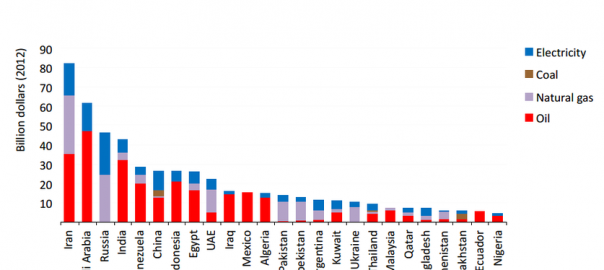
In 2013, governments around the world spent $548 billion to subsidize the use of oil, gas, and coal. This practice drives economists absolutely nuts: they say it’s wasteful, eats up budgets, and leads to more pollution and global warming than would otherwise be the case.
Yet countries have long been reluctant to scrap these fossil-fuel subsidies. After all, if the government stops underwriting the cost of gasoline, prices will rise at the pump. That makes people upset — and can lead to protests or riots, as happened in Nigeria in 2012.
Lately, however, that’s started to change. The price of oil has been plunging, and gasoline is getting cheaper. And that’s made it less painful for nations that are trying to rein in bloated fossil-fuel subsidies. Back in July, Egypt began slashing billions in government energy subsidies. Indonesia has been doing the same. So has Ghana. India is now deregulating its diesel prices. Iran has been slowly hiking its artificially low gasoline prices.
It’s all starting to add up. In November 2014, the International Energy Agency (IEA) reported that 27 countries have been cutting back on fossil-fuel subsidies in some form or other. The agency no longer expects total subsidies to soar to $660 billion by 2020, as it once projected.
Fossil Fuel Consumption Subsidies (Image: IEA)
If these cuts continue, this could end up being a big deal: scaling back these subsidies is seen as one of the most straightforward ways to bolster the global economy and help address climate change.
A new study has shown that increasing Britain’s installed wind energy capacity could go a long way to securing energy independence for the island nation.
Commissioned by national trade body RenewableUK, and conducted by independent analysts Cambridge Econometrics, the report concluded that additional wind power in the country’s energy grid would make Britain’s energy supply more resilient, by way of cutting the need for ever-increasingly costly imports of fossil fuels.
In 2013, wind energy played a small role in minimising the need for coal and gas imports — reducing coal imports by an estimated 4.9 million tonnes, and gas by 1.4 billion cubic metres.
Increasing the level of wind energy generation would serve to increase these figures, minimising how much Britain needs to import.
Without wind, in 2013, Britain would have needed to acquire — somehow — an additional 6.1 million tonnes of coal, and 2.5 billion cubic metres of gas to generate the additional 45.8 TWh and 24.8 TWh of coal and gas respectively (these figures are so high, because there is a significant efficiency loss involved in converting fuel to electricity).
“Beyond the environmental benefits brought about by the continued deployment of wind power, this report shows that wind energy is contributing to reducing fossil fuel import dependence and that this contribution will grow in future as wind capacity expands,”
explains Phil Summerton, Director at Cambridge Econometrics.
“Investment into wind power acts as an insurance policy against uncertainty in future wholesale gas prices and could provide a degree of stability to future electricity prices.”
“This report shows how much the UK relies on wind power to reduce our dependence on sources of costly fossil fuels imported from abroad,” explains RenewableUK Chief Executive Maria McCaffery. “In these uncertain times, we need to recognise the wider benefits of wind. The costs for the entire life of a wind farm are known very early on, whereas the volatile price of fossil fuels can never be accurately predicted.
“Wind power is already helping us manage future price instability, and industry is confident that by 2020 onshore wind will be the cheapest form of new generation of any form of energy.”