Category Archives: Energy and Climate Change

News and articles on climate change, vehicle pollution, and renewable energy.

We Need to Keep 80 Percent of Fossil Fuels in the Ground (Image: Yes!/J. Eckwell)

Why We Need to Keep 80 Percent of Fossil Fuels in the Ground

Life depends on it. Bill McKibben on the big changes we’ve already made in remarkably short order.

We Need to Keep 80 Percent of Fossil Fuels in the Ground (Image: Yes!/J. Eckwell)

Physics can impose a bracing clarity on the normally murky world of politics. It can make things simple. Not easy, but simple.

Most of the time, public policy is a series of trade-offs: higher taxes or fewer services, more regulation or more freedom of action. We attempt to balance our preferences: for having a beer after work, and for sober drivers. We meet somewhere in the middle, compromise, trade off. We tend to think we’re doing it right when everyone’s a little unhappy.

But when it comes to climate change, the essential problem is not one group’s preferences against another’s. It’s not—at bottom—industry versus environmentalists or Republicans against Democrats. It’s people against physics, which means that compromise and trade-­off don’t work. Lobbying physics is useless; it just keeps on doing what it does.

So here are the numbers: We have to keep 80 percent of the fossil-fuel reserves that we know about underground. If we don’t—if we dig up the coal and oil and gas and burn them—we will overwhelm the planet’s physical systems, heating the Earth far past the red lines drawn by scientists and governments. It’s not “we should do this,” or “we’d be wise to do this.” Instead it’s simpler: “We have to do this.”

And we can do this. Five years ago, “keeping it in the ground” was a new idea. When environmentalists talked about climate policy, it was almost always in terms of reducing demand. On the individual level: Change your light bulb. On the government level: Put a price on carbon. These are excellent ideas, and they’re making slow but steady progress (more slowly in the United States than elsewhere, but that’s par for the course). Given enough time, they’d bring down carbon emissions gradually but powerfully.

Time, however, is precisely what we don’t have. We pushed through the 400 parts per million level of CO2 in the atmosphere last spring; 2015 was the hottest year in recorded history, smashing the record set in … 2014. So we have to attack this problem from both ends, going after supply as well as demand. We have to leave fossil fuel in the ground.

Read more: Yes Magazine
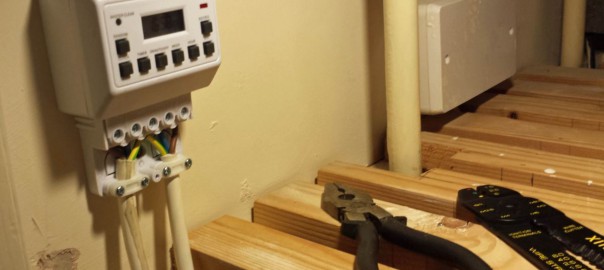
Figure 1: Timer in place, ready to close up (Image: T. Larkum)

Reducing Home Energy Usage

As I wrote in a previous post about looking for wasted energy around the homeFuel Included isn’t just about electric cars, but about the transition to a low carbon lifestyle”. Having insulated our hot water tank the next logical step seemed to be to power it from our renewable electricity supply so as to save the carbon footprint of heating it with gas.

Figure 1: Timer in place, ready to close up (Image: T. Larkum)

Of course, electricity is more expensive than gas per unit so I looked for a way to power it cheaply. This can be done during the day from solar, and also at night on an Economy 7 tariff. Therefore I needed a timer controller that would switch on the electric immersion heater only during the Economy 7 hours and, later in the year when there’s significant sunshine, during peak solar hours.

Figure 2: Old thermostat, removed from top of tank (Image: T. Larkum)

To make a fairly short story even shorter, I wired in a small timer and it was a relatively easy job (though I wouldn’t recommend it if you have no electrical experience or knowledge). We had had some problems with the immersion heater (audible bubbling, etc.) that indicated that the thermostat needed replacing so I simply bought a new thermostat and picked up the timer at the same time. They were from a local Screwfix outlet, but obviously there are lots of other suppliers available.

Figure 3: New thermostat installed, note temperature adjustment (Image: T. Larkum)

The one I got was an LAP Digital Weekly Immersion Timer and it seems to get the job done at a reasonable price. I switched off the electrics, cut the cable from the immersion switch to the immersion element and fitted the timer; the instructions that came with it were basic but sufficient.

I installed the new thermostat at the same time and adjusted its set temperature to be higher than the gas one (which is on the front of the tank) so that it can act as a ‘pre-heater’ and do the bulk of the water heating overall. Combined with installing the new insulated jacket previously described I’m expecting to see a significant reduction in our gas bill from now on.

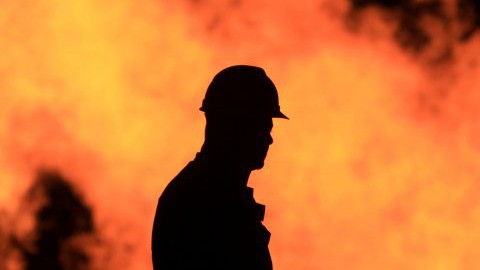
An unidentified oil worker walks in front of a natural gas flame burning off in the Persian Gulf desert oil field of Sakhir, Bahrain (Image: AP/H. Jamali)

Big bankruptcies are coming to the oil and gas sector

Warning: This “Safe Energy Industry Is In Danger”

An unidentified oil worker walks in front of a natural gas flame burning off in the Persian Gulf desert oil field of Sakhir, Bahrain (Image: AP/H. Jamali)

The canary at the drill rig just croaked.

Last week, one of the largest energy companies in the U.S. – and a major darling of the shale or “fracking” industry — started showing major signs of distress.

“Chesapeake Plunges 40% on Report It Hired Restructuring Adviser” shouts the headline from Bloomberg.

Chesapeake is closing in on bankruptcy? This is big news. And whether you’re an energy investor or not, there’s much to be gleaned from this huge story. Today, most of the major financial indexes are following the price of crude oil and the energy sector. As the drill bit goes, so does the market. And right now things are getting scary – which, as I’ll share in a moment, could be bad news for one “once safe” sector.

With oil trading hands for less than $30 a barrel, there’s major strain on the American fracking industry. For most American oil companies, $50-60 dollars a barrel is needed just to break even. The same goes for gas companies like Chesapeake, natural gas prices are far below most frackers’ break even.

Read more: Business Insider

Fleet of 150 Renault ZOE for smart solar charging project

  • Renault has signed a letter of intent with the Dutch Utrecht City Council, ElaadNL and LomboXnet on Smart Solar Charging for electric vehicles.
  • The signature took place during the state visit to Paris of King Willem-Alexander and Queen Máxima of the Netherlands, under the schedule of Franco-Dutch Economic Year 2015-2016.

76331_Solar_ZOE_Renault

THE SMART SOLAR CHARGING NETWORK PROJECT

Renault, Europe’s leading electric vehicles manufacturer, and its Dutch economic partners Utrecht City Council, ElaadNL and LomboXnet signed a letter of intent in Paris on 11 March 2016 to develop a Franco-Dutch framework of smart solar charging solutions for electric vehicles.

The signature ceremony was attended by Renault’s Laurens van den Acker, SVP Corporate Design and Guillaume Berthier, EV sales Director; in presence of the king and queen of the Netherlands, the Dutch minister of trade, Lilianne Ploumen and the French Foreign Affairs Ministry’s secretary of state for European affairs, Harlem Désir.

SMART-CHARGE SYSTEMS FOR ELECTRIC TRANSPORT

According to the letter of intent, the city of Utrecht could be the testing ground for the solar smart-charge project. Renault, Europe’s leader in electric vehicles, would supply a fleet of 150 Renault ZOE models through 2017 to the city. ElaadNL would handle management of infrastructures and the smart-charge standard, and LomboXnet would take charge of installing the network of unique public charging terminals powered by a 44 kW grid connection. Grid operator Stedin would be involved to balance supply and demand of the grid.

Phase one of the project would involve setting up 1,000 smart solar-charge stations, powered by 10,000 photovoltaic panels in the Utrecht region. Infrastructure installation would run side by side with development of a car-share service of electric cars, powered by renewable energy, for Utrecht residents. The Renault ZOE R.Access connectivity and 22 kW charging make it ideal for car-share and smart charging applications.

Phase two of the project would proceed with the partners developing a vehicle-to-grid ecosystem, with the network of solar chargers capable of both charging the electric cars and of feeding energy stored in the batteries of parked cars onto the grid to meet demand peaks. This could be the starting point for a new system storing renewably sourced energy.

STEPPING UP THE ENERGY TRANSITION

Through its pioneering work on EVs and their batteries, Renault contributes to the energy transition in the automotive industry by reducing the use of fossil fuels. Renault, through smart charging experiments, increases the proportion of renewable energy EVs use. One of the goals of the Smart Solar Charging Project developed by Renault, ElaadNL, LomboXnet and the Utrecht City Council is to make a substantial contribution to reducing the carbon footprint not only of the auto industry but of all sectors consuming electricity.

ElaadNL researches and tests the possibilities for smart charging on behalf of the dutch grid operators. With innovative techniques ElaadNL can charge electric cars in a smart way, exactly at the right moment. With Smart Charging, the abundance of electricity from the sun and wind is used to charge our cars. Live off the wind and drive on the sun!

In June 2015, LomboXnet introduced in Utrecht a world-wide scoop: a charging station making Smart Solar Charging accessible worldwide. This charging station can charge and discharge (vehicle-to-grid, V2G), establishing the foundation for a new local energy system based on local energy sources and local storage. The unique charging station is developed in a consortium of GE, Stedin, Vidyn, Last Mile Solutions, Utrecht Municipality and led by LomboXnet.

By implementing the vehicle-to-grid project on a regional scale, the region of Utrecht creates – together with partners like Renault – a large living lab for innovative smart grid solutions. This show case implements not only green power, but ensures also clean air zero emissions in the city and region of Utrecht. Thus, Utrecht makes way with Healthy Urban living. Not only to continuously improve its leading position as the most competitive region of the EU (according to Eurostat) but also to inspire other metropolitan regions as well.

Source: Renault Media

Living in interesting times: have CO2 emissions peaked?

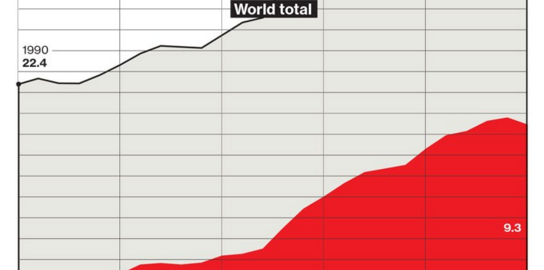
The projections that had been circulating during the past few months turned out to be correct. Now, it is official: the global carbon dioxide (CO2) emissions peaked in 2014 and went down in 2015. And this could be a momentous change.

World_Emissions_2015_unk
Don’t expect the emission peak, alone, to save us from the impending climate disaster, but, if CO2 emissions will start an irreversible decline, then we need to rethink several assumptions that we have been making on how to deal with climate change. In particular, depletion is normally assumed to be a minor factor in determining the trajectory of the world’s economy during the coming decades, but that may not be the case. Depletion is not a good thing in itself, but it might help us (perhaps) to stay within the “safe” limits and avoid a climate disaster.

CO2 emissions are mainly the result of the combustion of fossil fuels and of activities made possible by the combustion of fossil fuels. And, since we expect the production of fossil fuels to peak and decline as the result of depletion, it shouldn’t be a surprise that CO2 emissions should peak too. But it is surprising that we may be already seeing the peak. For instance, Laherrere had assumed the peak for all fossils to occur not before around 2025. And many people would have seen these projections as ridiculously catastrophistic. Most of the published scenarios for the future saw CO2 emissions increasing for at least a few decades in the future unless draconian economic or legislative measures to limit them were taken.

So, what we are seeing may be simply a fluctuation; not necessarily “the peak”. But, it might also be the big one: the point of no-return. From now on, we may find ourselves rolling down on the other side of the Hubbert curve. It would be the true vindication of the “base case” scenario of “The Limits to Growth” that had seen the combination of gradual depletion and pollution to cause the start of the terminal decline of the fossil based industrial system at some moment during the 2nd-3rd decade of the 21st century.

Read more: Cassandra’s Legacy

Severe Flooding, Against a Background of Wind Turbines: November 2012, Tyringham, Bucks. (Image: T. Larkum)

Dangerous global warming will happen sooner than thought

Australian researchers say a global tracker monitoring energy use per person points to 2C warming by 2030

Severe Flooding, Against a Background of Wind Turbines: November 2012, Tyringham, Bucks. (Image: T. Larkum)

The world is on track to reach dangerous levels of global warming much sooner than expected, according to new Australian research that highlights the alarming implications of rising energy demand.

University of Queensland and Griffith University researchers have developed a “global energy tracker” which predicts average world temperatures could climb 1.5C above pre-industrial levels by 2020.

That forecast, based on new modelling using long-term average projections on economic growth, population growth and energy use per person, points to a 2C rise by 2030.

The UN conference on climate change in Paris last year agreed to a 1.5C rise as the preferred limit to protect vulnerable island states, and a 2C rise as the absolute limit.

The new modelling is the brainchild of Ben Hankamer from UQ’s institute for molecular bioscience and Liam Wagner from Griffith University’s department of accounting, finance and economics, whose work was published in the journal Plos One on Thursday.

It is the first model to include energy use per person – which has more than doubled since 1950 – alongside economic and population growth as a way of predicting carbon emissions and corresponding temperature increases.

The researchers said the earlier than expected advance of global warming revealed by their modelling added a newfound urgency to the switch from fossil fuels to renewables.

Hankamer said:

“The more the economy grows, the more energy you use … the conclusion really is that economists and environmentalists are on the same side and have both come to the same conclusion: we’ve got to act now and we don’t have much time.”

Read more: The Guardian

Electric Cars Are The Only Solution For The Future

The Geneva Motor Show is ground zero for all things automotive for Europe, and a major launching pad for new offerings – plug-in or otherwise. So it was no surprise to see Nissan-Renault CEO (and Avtovaz Chairman) Carlos Ghosn making an appearance, and doing a little ‘show and tell’ with his company’s most recent hotness.

The IDS Concept (a 60 kWh, 200+ mile all-electric car that we feel is a thinly disguised look at the next generation Nissan LEAF), is one such European debut that Mr. Ghosn attended this week.

And while on hand, Ghosn made some comments about the future of the plug-in technology – what it means to Nissan, the automotive segment, and the fact that VW’s recent emission scandal has accelerated the urgency to convert to a plug.

Basically, the CEO says that ‘Dieselgate’ demonstrated you can’t trust anyone, and that we need zero emissions to get serious about saving the planet as ‘zero means zero’:

“Without any doubt, because it has attracted the attention on the fact that even though the regulators are trying to do their best to say what is acceptable, and what is not acceptable, in term of emissions, there will always be conditions that the regulators cannot regulate. So if you really worry about emissions, the only solution is the electric car because here you have zero emission, you have nothing to measure.

On top of this, as you know, COP 21 has lead to the conclusion that we cannot afford to have more than 2 degrees of heating of the planet 20 or 30 years down the road, and this means more zero emission cars”

Source: Bloomberg via Inside EVs

Drive like the wind: Electric Highway

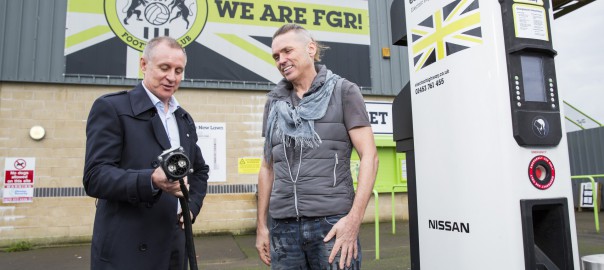
“Five years ago, it was said that one of the main reasons people weren’t buying electric cars was because of a lack places to charge them – and the main reason more places to charge weren’t being built was because not enough people were buying electric cars – classic chicken and egg stuff,” says Dale Vince, former new age traveller and outspoken founder of the world’s first green energy company, Ecotricity. “We decided to break that impasse.”

AG_SOUTHAUSTRALIA_VISIT_Ecotricity

Vince received an OBE from the Queen for services to the environment in 2004. In 2011, Ecotricity created the Electric Highway, the first national network of fast chargers in Britain. Free, compatible with all electric vehicles on the market, and powered by the wind and the sun, it is now the most comprehensive charging network in Europe.

Vince says:

“We built Britain’s first electric supercar, the Nemesis, in 2010 – we wanted to show the true potential of electric cars and demonstrate how we can get around without fossil fuels. We had to shake the old image of the electric car first. The next step was to tackle the infrastructure problem, which led us to conceive of the Electric Highway.”

With Ecotricity pumps covering the entire motorway network in Britain, as well as strategic A-roads, ports and airports, electric cars are now reality in Britain – as owners travel the length and breadth of the country, literally from John O’Groats to Lands’ End.

Vince started by installing essentially three-pin plugs on the British motorway network. These would take eight hours to charge a car. Fast forward five years and there are now multiple charging networks across Britain, but the Electric Highway still leads the way, with nearly 300 Electricity pumps across the British motorway network that can charge in as little as 20 minutes.

Every charge uses Ecotricity’s 100% green energy, from the wind and sun – enabling electric cars to reach their true potential, zero emission free driving. And it’s been completely free to use since 2011, to encourage more people to make the switch.

“Our work fits in perfectly with the target the whole world agreed to in Paris last year,” adds Vince, “to limit global temperature rise to 2 degrees or less. To achieve this, we simply must stop burning fossil fuels by 2050, and that requires nothing short of a revolution in the three biggest areas of impact – energy, transport and food. The revolution is already underway on British roads.”

Transport is currently one of the biggest contributors towards our personal carbon footprints, so the Electric Highway network offers a solution to one of the world’s greatest problems.

Source: Atlas of the Future

Severe Flooding, Against a Background of Wind Turbines: November 2012, Tyringham, Bucks. (Image: T. Larkum)

Do I need a bug out bag in the UK?

In case you were wondering. A bug out bag is typically a backpack containing enough items to sustain you for three days, or 72 hours. Thought by some, particularly Americans, as an essential item to have with you at all times. The reason for having a bug out bag is in case of natural or unnatural disasters. Or as some would call it. The zombie apocalypse.

Those that have bug out bags are often thought of as being ‘doomsday sayers’ or a bit strange. Particurly when you consider what Americans will include in their bug out bags. Which includes weapons for self defence.

Do I need a bug out bag in the UK?

But hang on a minute. Before we go down the ruling it out as a bit ott. Should we not consider our own situation in this country. The UK.

Severe Flooding, Against a Background of Wind Turbines: November 2012, Tyringham, Bucks. (Image: T. Larkum)
Severe Flooding (Image: T. Larkum)

Taking recent events and history in the UK as an example.

In the last couple of years we have been stuck in overnight traffic jams due to snow. Without electricity for three days. Stuck in a traffic jam for 7 hours because of a fatal accident. And more recently been flooded out of our homes. Admittedly, you don’t need to head for the hills and live like Grizzily Adams during these events, but just think how much easier our life’s would have been with a little preparation. The key is to think where you are most likely to be sent during an evacuation. The chances are that it will be a village hall or similar. It will also be more comfortable than trying to live in the woods. So it’s unlikely that you’ll need animal snares, knifes for skinning animals etc.

So do I need a bug out bag?

Perhaps not to the extent that the Americans go to. But I do think that a little common sense and a little forethought will help massively. Self reliance in such situations can make a very unpleasant situation tolerable. Think of a bug out bag not as a survival option for when the apocalypse comes, but more as a ‘comfort’ option, when you need to leave home quickly or get stuck in your car.

Read more: Midlife Crisis Man

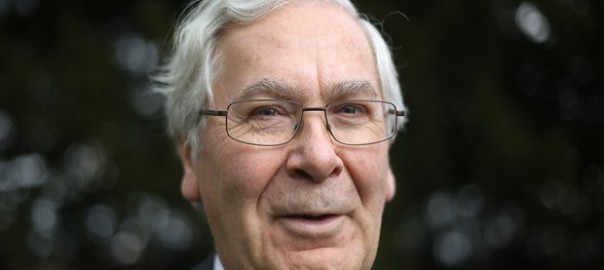
Mervyn King: ‘Failure to tackle the disequilibrium in the world economy makes it likely that a crisis will come sooner rather than later.’ (Image: Philip Toscano/PA)

New financial crisis is ‘certain’ without reform of banks

The former Bank of England governor says in his new book that imbalances in the global economy makes a crash inevitable

Mervyn King: ‘Failure to tackle the disequilibrium in the world economy makes it likely that a crisis will come sooner rather than later.’ (Image: Philip Toscano/PA)
Mervyn King: ‘Failure to tackle the disequilibrium in the world economy makes it likely that a crisis will come sooner rather than later.’ (Image: P. Toscano/PA)

Another financial crisis is “certain” and will come sooner rather than later, the former Bank of England governor has warned.

Mervyn King, who headed the bank between 2003 and 2013, believes the world economy will soon face another crash as regulators have failed to reform banking.

He has also claimed that the 2008 crisis was the fault of the financial system, not individual greedy bankers, in his new book, The End Of Alchemy: Money, Banking And The Future Of The Global Economy, serialised in The Telegraph.

“Without reform of the financial system, another crisis is certain, and the failure … to tackle the disequilibrium in the world economy makes it likely that it will come sooner rather than later,” Lord King wrote.

He added that global central banks were caught in a “prisoner’s dilemma” – unable to raise interest rates for fear of stifling the economic recovery, the newspaper reported.

A remark from a Chinese colleague who said the west had not got the hang of money and banking was the inspiration for his book.

Lord King, 67, said without understanding what caused the crash, politicians and bankers would be unable to prevent another, and lays the blame at the door of a broken financial system.

He said: “The crisis was a failure of a system, and the ideas that underpinned it, not of individual policymakers or bankers, incompetent and greedy though some of them undoubtedly were.”

Spending imbalances both within and between countries led to the crisis in 2008 and he believes a current disequilibrium will lead to the next.

To solve the problem, Lord King suggests raising productivity and boldly reforming the banking system.

He said:

“Only a fundamental rethink of how we, as a society, organise our system of money and banking will prevent a repetition of the crisis that we experienced in 2008.”

Lord King was in charge of the Bank of England when the credit crunch struck in 2007, leading to the collapse of Northern Rock and numerous other British lenders, including RBS, and has been criticised for failing to see the global financial crisis coming.

Source: The Guardian