Category Archives: Energy and Climate Change

News and articles on climate change, vehicle pollution, and renewable energy.

Oil Majors Can No Longer Ignore The Electric Car Threat

Many carmakers, and not just Tesla, have been developing electric vehicles, betting on the expected continuous rise of battery-powered cars in the future. Now it’s not only carmakers that predict that EVs will make up a substantial part of new vehicle sales in a decade or two—oil majors are admitting it too.

France’s Total SA expects EVs to account for up to 30 percent of new car sales by 2030, which could lead to oil-based fuel demand peak in the 2030s, Total’s Chief Energy Economist Joel Couse said at Bloomberg New Energy Finance conference earlier this week.

Couse reckons that after 2030, fuel demand “will flatten out” and “maybe even decline”, in what Colin McKerracher, head of advanced transport analysis at Bloomberg New Energy Finance, described as the “most aggressive” projection by an oil major about the rise of EVs.

Other oil majors have their projections about peak oil demand as well, ranging anywhere from as early as the next decade, to nowhere in sight. At the same time, analysts believe that EV sales will only rise, but the pace will greatly depend on incentives and government policies. Meanwhile, many carmakers are preparing for the EV surge and entering the battery-powered car market.

France’s Total sees that growth as potentially leading to peak oil-based fuel demand in the 2030s. Other majors also have ideas about the impact of EVs on global oil demand.

Shell’s chief executive Ben van Beurden said in March that oil demand could peak as early as in the next decade.

“We have to acknowledge that oil demand will peak, and it could already be in the next decade. It could happen. There are people who believe it will grow forever but I don’t subscribe to that,”

van Beurden told the CERAWeek energy forum, as quoted by The Telegraph.

BP, in its Energy Outlook 2017, said that an extra 100 million battery EVs could lower oil demand by around 1.4 million bpd. Still, the UK oil major sees oil demand peak in the mid-2040s, with many drivers to factor in, including global GDP growth, efficiency trends, and climate policy. According to BP, the penetration of the EVs will depend on how fast battery costs would continue to drop; the size and durability of government incentives; how conventional cars’ efficiency would improve; and how consumer preference towards EVs would shift.

Read more: Oilprice.com

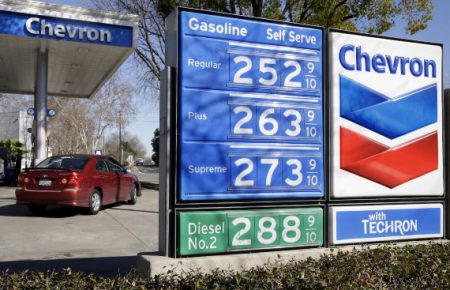
Chevron is first oil major to warn investors of risks from climate change lawsuits

Big Oil’s lies about the existential risk posed by its product are now catching up with the industry and threatening profits.

For the first time, one of the major publicly owned fossil fuel companies admitted publicly to investors that climate change lawsuits poses a risk to risk to its profits.

You’re probably thinking that seems like an obvious admission. After all, 190 nations unanimously agreed in the December 2015 Paris climate deal to leave most fossil fuels in the ground because of the existential threat they pose to human civilization.

But this is Big Oil — the industry that has been denying or pretending to deny the existence of climate change for over half a century.

In the “risk factors” section of Chevron’s 2016 10-K financial performance report to the Securities and Exchange Commission (SEC) — amid a discussion of how those pesky climate rules governments are enacting might hurt demand for its product — is this sentence:

“In addition, increasing attention to climate change risks has resulted in an increased possibility of governmental investigations and, potentially, private litigation against the company.”

Naomi Ages, Greenpeace USA’s climate liability project lead, said this is the first time a major oil company admitted that such investigations and private litigation were

“a material risk to the company and its shareholders.”

Red more: Think Progress

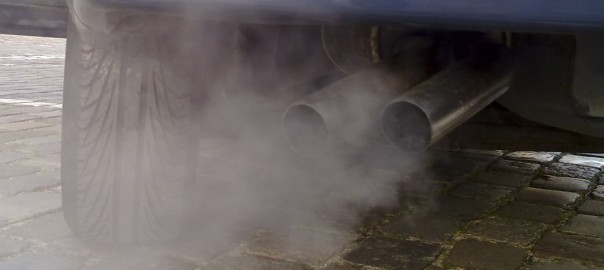
Car exhaust pollution (Image: Wikipedia)

Nearly 40 million people live in UK areas with illegal air pollution

Nearly 40 million people in the UK are living in areas where illegal levels of air pollution from diesel vehicles risk damaging their health, according to analysis commissioned by the Labour party.

The extent of the air pollution crisis nationally is exposed in the data which shows 59% of the population are living in towns and cities where nitrogen dioxide (NO2) pollution breaches the lawful level of 40 microgrammes per cubic metre of air.

Car exhaust pollution (Image: Wikipedia)

Labour says the air pollution crisis is a “national scandal”. Sue Hayman, shadow secretary of state for environment, food and rural affairs, said a Labour government would bring in a new clean air act to tackle what was a public health emergency.

“Labour will not allow the Tories to use the snap general election or Brexit to kick this issue into the long grass or water down standards that would put millions of UK adults and children at risk,”

said Hayman.

She said the party was committed to putting in place a network of clean air zones across the UK where there are high emissions, and would act at an international level to close loopholes in emissions testing of vehicles.

The analysis published by Labour shows more than 38 million people, representing 59.3% of the UK population, are living in areas where levels of nitrogen dioxide pollution are above legal limits.

Local authorities including Aberdeen, Birmingham, Bournemouth, Burnley, Derby, Chelmsford, Leeds, Northampton, Richmond and Sheffield – among many others – have NO2 levels above the legal limit.

Read more: The Guardian

Tesla Powerwall display (Image: T. Larkum)

How Batteries Could Revolutionize Renewable Energy

All over California, there’s evidence of the state’s goal to lead the country in renewable energy. Enormous farms of shiny solar panels have popped up across southern California, and gigantic wind turbines dot the landscape outside nearly all the major cities.

There are less flashy—and less visible—investments in renewables going on, too. Tucked away in warehouses, trailers and industrial parks are lithium ion batteries that, if all goes well, will play a critical role in helping California hit its ambitious target: to have 50% of all electricity come from renewables by 2050.

Tesla Powerwall display (Image: T. Larkum)

Some green energy sources come with a built-in challenge: the wind and the sun can’t be turned on and off at will. When it’s windy and sunny, an abundance of energy may be harnessed—but any excesses go to waste. That’s where batteries, the most common type of energy storage, come in. Batteries solve that problem by allowing utility companies to collect excess electricity and store it for times when the sun may not be shining or the wind not blowing.

“Networks care about reliability,”

says Logan Goldie-Scot, an energy-storage analyst at Bloomberg New Energy Finance. “Energy storage is being viewed by network operators as a potential tool in their toolbox, and that hasn’t been the case up until now.”

Batteries will also change the power sector as homeowners and businesses install their own products. Batteries at homes, offices and other commercial buildings allow customers to save electricity collected by their solar panels and use it at times when electricity prices are highest. One in four businesses with more than 250 employees has already deployed batteries to help with their electricity management, according to a Deloitte study. Regulatory changes that encourage battery owners to sell back stored electricity when it’s in high demand could increase interest in batteries, analysts say.

Batteries installed in electric vehicles, for instance, will also affect the electric grid as automakers continue to expand their offerings. Experts say the impact will both stress and help utilities manage their electricity supply. The stress comes as vehicles create a new demand for energy, but at the same time, batteries in those vehicles act as a storage unit of their own that may offer new flexibility. The largest battery in a Tesla, as one example, can store enough electricity to power the average American home for more than three days. Utilities have begun exploring programs to encourage electric vehicle owners to charge their cars when there is extra power on the grid.

Read more: Time

Coral reefs cannot grow fast enough to keep pace with rising sea levels, finds study

Sea floor is getting lower as erosion gets worse

Coral reefs are failing to keep pace with rising sea levels, increasing the depth of the sea and removing a natural form of storm defence, according to a new study.

Researchers were stunned by the amount of reef lost due to erosion at sites in the Pacific off Hawaii, Florida’s Atlantic coast and in the Caribbean, saying it had resulted in water depths not predicted to occur until 2100.

Dead Elkhorn coral near Buck Island in the US Virgin Islands. As coral reef structure degrades, valuable habitat for marine life is lost and nearby coastlines become more susceptible to storms, waves and erosion

They said it was evidence that an “Anthropocene reef crisis” had begun.

Corals are facing an array of problems from bleaching caused by the rising temperatures and ocean acidification to dredging and pollution from the land.

The iconic Great Barrier Reef has been so badly affected that one leading environmental writer was moved to write its obituary.

In the new study, researchers examined two sites in the Florida Keys, two in the US Virgin Islands and also the waters around the Hawaiian island of Maui.

The sea floor was found to be lower at all five sites by anything from nine to 80 centimetres.

All five reefs had lost large amounts of coral, sand and other sea floor materials to erosion.

Dr Kimberly Yates, of the US Geological Survey, said: “Our measurements show that seafloor erosion has already caused water depths to increase to levels not predicted to occur until near the year 2100.

“At current rates, by 2100 sea floor erosion could increase water depths by two to eight times more than what has been predicted from sea level rise alone.”

Writing in the journal Biogeosciences, the researchers warned that the deeper water would increase coastal erosion, storm surges and tsunami hazards.

Read more: Independent

Re-Energizing Earth Day 

The eco-dream of the ’90s is alive in the electric car

Electric motors have instant acceleration, like a roller coaster on wheels

I haven’t bought gas in a year. Yes, you read that right. Go ahead and let that sink in a bit.

Last April, when I was looking for a new ride, my wife told me I should try an electric car. Why not? Skeptically, I tested a used BMW i3, and it was like going out to take a look at a puppy. Of course we brought it home.

You should know that my first car was a Chevy Celebrity — probably the least sexy car to come off an American production line in the past 50 years. So I was overdue, but who knew the solution to my midlife crisis would look more like a golf cart than a Mustang?

A year in, I can tell you it’s the coolest car I’ve owned — the technology makes you feel like you’re driving around inside an iPhone. It’s also an instant conversation starter. “What is that thing?” asks the dude in the parking lot or the woman working the drive-through window.

“It’s an electric car,” I say. “Did I mention that I haven’t bought gas for it in a year?”

What I didn’t realize at first was that the simple act of driving an electric car is kinda subversive. Lots of powerful people don’t want us to go electric. Sticking with gasoline to power our lives is part economics, but part unfair play, as oil-industry fat cats have long pulled the levers of power to kill the dream of emission-free travel.

There were electric cars going all the way back to the dawn of the automobile, but the concept was put on the shelf as Henry Ford’s factories dictated the future of the industry.

Then in the 1990s, with the dawning realization that our cars were like cigarettes, choking our planet’s health, electricity got another look. Starting in 1996, GM built more than 1,000 prototype EV1 vehicles, and celebrities and other energy rebels started leasing them. (As a test vehicle, they couldn’t buy them.)

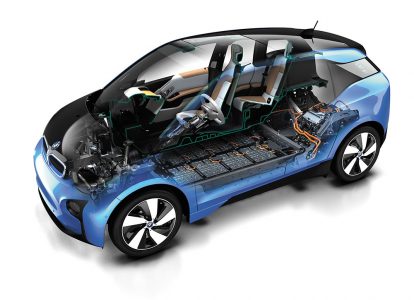
The electric BMW i3’s passenger compartment is made from strong, lightweight carbon fiber manufactured in Moses Lake.

The test was going well — too well, and those big-oil folks, some claim (as documented in the 2006 film Who Killed the Electric Car?) got nervous. The project was not only ended, but the cars were repossessed by GM and nearly all of them were crushed into oblivion.

Instead GM doubled down on the all-American, gas-guzzling SUV. Meanwhile, America changed. We bought a lot of SUVs, sure, but we also learned about some nasty things that some of the money we were spending on foreign oil was being used to fund. The growing desire to clean up our carbon footprint led Toyota to launch the Prius hybrid; in 2008 Elon Musk sold his first Tesla. In 2009, outgoing GM CEO Rick Wagoner said his biggest mistake was killing the EV1.

And in a sign of how far the tables have turned, last week Tesla surpassed Ford in total market value — and is only $3 billion behind General Motors. Here in 2017, driving an electric car isn’t so subversive any more.

Read more: Inlander

Receding glacier causes immense Canadian river to vanish in four days

First ever observed case of ‘river piracy’ saw the Slims river disappear as intense glacier melt suddenly diverted its flow into another watercourse

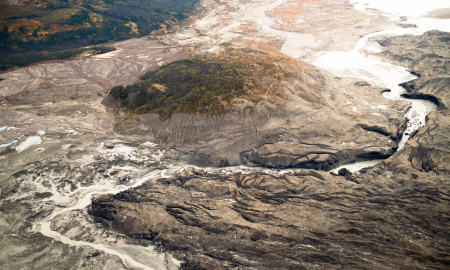
A view of the ice canyon that now carries meltwater from the Kaskawulsh glacier, seen here on the right, away from the Slims river and toward the Kaskawulsh river. Photograph: Dan Shugar/University of Washington Tacoma

An immense river that flowed from one of Canada’s largest glaciers vanished over the course of four days last year, scientists have reported, in an unsettling illustration of how global warming dramatically changes the world’s geography.

The abrupt and unexpected disappearance of the Slims river, which spanned up to 150 metres at its widest points, is the first observed case of “river piracy”, in which the flow of one river is suddenly diverted into another.

For hundreds of years, the Slims carried meltwater northwards from the vast Kaskawulsh glacier in Canada’s Yukon territory into the Kluane river, then into the Yukon river towards the Bering Sea. But in spring 2016, a period of intense melting of the glacier meant the drainage gradient was tipped in favour of a second river, redirecting the meltwater to the Gulf of Alaska, thousands of miles from its original destination.

The continental-scale rearrangement was documented by a team of scientists who had been monitoring the incremental retreat of the glacier for years. But on a 2016 fieldwork expedition they were confronted with a landscape that had been radically transformed.

The retreat of the Kaskawulsh glacier has resulted in a drastic change in the destination of its meltwater

“We went to the area intending to continue our measurements in the Slims river, but found the riverbed more or less dry,”

said James Best, a geologist at the University of Illinois.

“The delta top that we’d been sailing over in a small boat was now a dust storm. In terms of landscape change it was incredibly dramatic.”

Dan Shugar, a geoscientist at the University of Washington Tacoma and the paper’s lead author, added:

“The water was somewhat treacherous to approach, because you’re walking on these old river sediments that were really goopy and would suck you in. And day by day we could see the water level dropping.”

The team flew a helicopter over the glacier and used drones to investigate what was happening in the other valley, which is less accessible.

“We found that all of the water that was coming out from the front of the glacier, rather than it being split between two rivers, it was going into just one,”

said Best.

The Kaskawulsh River, seen here near its headwaters, is running higher now thanks to the addition of water that used to flow into the Slims River. Photograph: Jim Best/University of Illinois

Read more: The Guardian


The Oil junkies and The moral panic over pollution

Every trainee journalist is taught about a model of behaviour exhibited by the general public called ‘moral panics’. In a moral panic the media pumps out stories like it has bad guts after a curry and people get enraged over the issue. Currently there’s a swirl of stories going out on pollution killing us and our children. The BBC is running a series of stories called So I can breathe and even the fossil fuel loving Telegraph has stooped to tell its high Tory readership that the air is foul. I smell a moral panic somewhere…

But hold on, wasn’t it bad before the media storm?

Traffic congestion has got steadily worse over the years on nearly every major British road, and energy demand has rocketed. No matter what they tell you, a car pumping out 130g/km of carbon emissions would kill you in about five minutes if you sat in an airtight room with it. Energy supply has to come from somewhere and generally that’s coming from coal, gas and even oil powered power plants.

We are at a tipping point with Global Warming. Even if Donald Trump hadn’t got into power we would be in a dire climate emergency and, guess what? That’s the same pollution that’s choking us.


Oil Junkies

Let’s start a new name for climate change deniers and those who can’t get their heads away from fossil fuels. Let’s call them oil junkies. Junkies freak out and get sick without heroin, and given the US and UK governments’ somewhat less than rational stance on renewable energy, you wonder if they need to be locked in a room for a month with 24 hour medical care if they stopped using fossil fuels central to their energy policy.

Forget Trump – our oil junkies have been in for almost a decade now. Only last week the UK Chancellor of the Exchequer said he would give more tax breaks to oil companies working in the North Sea. A 2015 LinkedIn blog by energy expert Simon Ede says simply: “As it now stands, local communities will have veto power to stop new wind turbines being constructed but should those communities resist or delay the development of Shale gas projects they’ll risk their case being fast tracked to Ministers in Whitehall for decision.”

The air looks clean…

The UK, US and Europe have all got ‘clean air’ legislation that prevents the smogs that choke Beijing, Kolkata and other developing countries’ cities. These clean air acts and regulations ensure at least some semblance of cleanliness in the pollution that our power stations, cars and factories belch out.

Even so it is estimated that 2,500 people in London died due to pollution in 2016. Though people can smell the fumes of cars, vans and lorries they can’t see the stuff. Much of this has been put down to diesel?

The diesel red herring

The focus of the moral panic is turning towards diesel engines. London’s Mayor Sadiq Khan has started a campaign to get rid of diesel engine vehicles in his city. His campaign seems to be gaining traction and there is talk of a ‘diesel scrappage scheme’ to get rid of the most polluting older diesel engine cars.

Read more: Electric Car Test Drives

Climate March poster on the Underground (Image: T. Larkum)

Donald Trump’s Mar-a-Lago Florida estate to be submerged by rising sea levels due to climate change

Donald Trump once said climate change was a “hoax” invented by the Chinese but the phenomenon could be responsible for flooding his own Florida properties.

Environmental experts lined up to testify at a senate hearing on climate change this week, just four miles from Mr Trump’s Mar-a-Lago estate in Florida, arguing that water could rise so high by the end of the century that the President’s own resorts would be damaged.

According to data from the National Oceanic and Atmospheric Administration, the President’s so-called Winter White House would be partially submerged if sea levels rose by three feet in the next 83 years.

Climate March poster on the Underground (Image: T. Larkum)
Climate poster (Image: T. Larkum)

“Today we sit at ground zero of the impacts of climate change in the US,” said Democratic Senator Bill Nelson, ranking member of the Senate Commerce, Science and Transportation Committee.

His state has already suffered multiple cases of serious flooding.

“And while there are still some who continue to deny climate change is real, South Florida offers proof that it is real and it’s an issue we’re going to be grappling with for decades to come.”

Data from NOAA would not just affect the President, but millions of residents who live along the east coast as sea levels could rise by as much as five feet.

A recent study published in journal Nature found that sea levels could rise by six feet by 2100 due to ice melting in the Antartic, and the President’s golf course at Doral, Florida, and several of his Sunny Isles Beach properties – along with two million homes – would be underwater.

Read more: Independent