Category Archives: Energy and Climate Change

News and articles on climate change, vehicle pollution, and renewable energy.

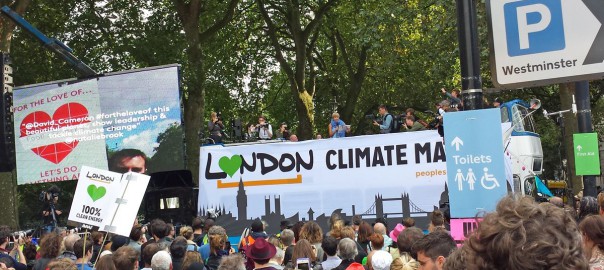
London Climate March - the Rally (Image: T. Larkum)

New French president Macron aims for the last fossil fuel cars to be sold in 2040

The newly elected French president Emmanuel Macron is broadly pursuing the energy and traffic policies outlined by his predecessor, Francois Hollande. He is especially looking to promote electric vehicles (EVs) and aims for the last car with an internal combustion engine (ICE) to be sold in France in 2040.

London Climate March - the Rally (Image: T. Larkum)
London Climate March (Image: T. Larkum)

French daily newspaper Le Monde reported in the run-up to the election that one of Macron’s objectives is ‘to get out of fossil fuels’ and he therefore wants to expand France’s charging network.  In order to ‘protect the health of the French,’ Macron also proposes to align the taxation of diesel with that of gasoline by 2022 and ‘to strengthen the European antipollution standards of new vehicles and controls in real conditions.’ These measures were already in place under Hollande’s government but Macron has additionally announced plans to introduce a bonus of €1000 for the purchase of a new or used ‘greener’ vehicle.

This extends further than the current bonus which is restricted to the purchase of a hybrid or electric vehicle. Apart from this, Macron wants to keep the existing bonus-malus scheme, which rewards the acquisition of clean cars and penalises those with higher fuel consumption. Ultimately, however, Macron’s aspiration is that there will be no more ‘sale of thermal vehicles’ in France in 2040.

As far as broader energy policy is concerned, Macron aims to increase the share of renewable energies in France’s energy mix to 32 per cent by 2030 and also to close the latest coal-fired power stations. By way of comparison, as early as 2016, renewable energy sources already contributed 29 percent to gross electricity generation in Germany. Macron was already committed to this project when he was the Minister of Economy in the cabinet of presidential predecessor François Hollande. In his term in office from 2014 to 2016, he passed the energy transition law for green growth (LTECV) and explicitly mentioned this several times during the election campaign.

Macron also aims to reduce the proportion of nuclear energy in France to 50 per cent by 2025, and the CO2 tax will rise to €100 per tonne by 2023. In total, Macron wants to invest €15 billion in ecology and power generation.

Source: Autovista Group

Could Electric Vehicles Kill Alberta Oil Sands Industry?

A new study from author and Stanford University lecturer Tony Seba has raised eyebrows in the Canadian oil patch. He forecasts that by 2030, electric vehicles will account for 95% of the miles traveled in the U.S., which is the sole market for Canadian oil exports.

As if that prediction isn’t remarkable enough, Seba said global oil production will fall from 100 million barrels per day (MMbbl/d) to 70 MMbbl/d, which, if true, would possibly devastate the high-cost 2.7 MMbbl/d Alberta oil sands industry.

The trigger for what Seba calls

“one of the fastest, deepest, most consequential disruptions of transportation in history”

will be the perfection of electric vehicle (EV) self-driving technology. Companies such as Uber and Lyft will buy fleets of autonomous cars and charge users to ride, a business model known as “transportation as a service.”

After more than a century of private auto ownership, families and businesses will give up their cars because transportation costs will simply fall off a cliff, said Seba, who co-authored “Rethinking Transportation 2020-2030: The Disruption of Transportation and the Collapse of the ICE Vehicle and Oil Industries” with Bryan Hansel and James Arbib.

The new way of getting around town will be 4x to 10x cheaper per mile than a new car, and 2x to 4x cheaper than a paid-off vehicle, with the average American household saving a whopping $5,600 annually.

In an interview, Seba said that under the right conditions, he can even foresee

“free transportation” supported by advertising revenue:“There is nothing magical about it. This is driven by the economics.”

The economics are that at present, Americans use their vehicles only 4% of the time. The study estimates transportation-as-a-service companies will have their EVs on the road earning money at least 40%—and maybe even 50% to 80%—of the time.

And EVs will seemingly run forever, lasting 500,000 miles while requiring far less maintenance and repair than internal combustion engine (ICE) autos, whose life on average is only 140,000 miles.

“Many automakers are working on million-mile electric vehicles, which drives down costs even lower,”

Seba said.

As fewer cars travel more miles, the number of passenger vehicles on American roads will drop from 247 million to 44 million.

Read more: E&P

LG CHEM OFFICIALLY LAUNCHES HOME BATTERIES IN NORTH AMERICA

The lithium-ion battery manufacturer LG Chem has officially launched its residential battery systems line in the North American market. This news follows the completion of UL certification.

The company’s residential battery systems line in North America is comprised of a variety of AC- and DC-coupled solutions, with system capacities ranging to up to 9.8 kilowatt-hours (kWh).

There are two different voltage options available (which are paired with compatible inverters). These are a low-voltage 48V option and a high-voltage 400V option. The low-voltage option is available in system capacities of 3.3 kWh, 6.5 kWh, and 9.8 kWh. The high-voltage option is available in system capacities of 7 kWh and 9.8 kWh.

The press release provides more:

“The 400V RESU10H (9.8 kWh) product is compatible with SolarEdge’s StorEdge, which is a DC coupled storage solution based on a single inverter for both PV and storage. Additional inverter compatibility options will become available later in 2017 to provide homeowners with a range of pre-tested solutions from the industry’s leading suppliers.”

The LG Chem lineup of residential energy storage products will, according to that pares release, be “available via a number of leading solar/storage providers in North America. Following last year’s announcement of a partnership with LG Chem, Sunrun — one of the leading US-based residential energy system providers — will be supplying LG Chem’s RESU systems. Sunrun already has installed initial systems in both Hawaii and California.”

In addition, LG Chem is reportedly in “advanced negotiations” for further distribution channels. The company claims that it will be offering the systems in all US states and Canadian provinces.

Briefly showing the company’s wide range of work in the automotive and stationary battery field, LG Chem notes that it

“has been awarded 82 projects from 28 global automotive OEMs as of September 2016, and deployed Gigawatt-hours of global stationary battery projects.”

Read more: Powur

The Predicament of Venice

I’m currently enjoying a short stay in Venice. It’s a beautiful place with an astonishing amount of priceless art and architecture.

The fumes from the tourist boat merge with the fumes from a berthed cruise ship in Venice (Image: T. Larkum)
The fumes from a tourist boat merge with the fumes from a berthed cruise ship in Venice (Image: T. Larkum)

However, it is clearly dying. Over the centuries it has suffered from regular flooding. Most of the buildings have long-term damp. This has led to inevitable deterioration of the art, particularly murals and frescoes.

Now with climate change the problems are accelerating. There are plans being made to save the island and its art. However I think they can only delay the day that Venice goes under permanently, not prevent it.

Venice is in a predicament; if it were a problem it could be solved. A predicament you have to manage the best you can.

Part of the issue, of course, is that Venice itself is itself a contributor to climate change. It is a major hub for tourism. People come here from all over the world by plane, train, bus and car.

Once here everyone travels around in a range of boats, all of which (with the exception of the famous people-powered gondoliers) appear to be diesel powered.

Anywhere near the waterways has the smell and often haze of diesel fumes and black smoke. And this place receives massive cruise ships.

There were four berthed yesterday morning, and we saw one tugged past St Michael’s Square yesterday evening. It appeared to dwarf the Basilica and bell tower.

A vast cruise ship goes past St Mark's Square, Venice (Image: T. Larkum)
A vast cruise ship goes past St Mark’s Square, Venice (Image: T. Larkum)

Of course, none of that will change. It’s tourism that pays to keep Venice going and to repair the ongoing damage. It also allows for planning of additional flood defences.

Hence the predicament of Venice, a problem that can’t be solved.


[Update: Since getting back home I’ve found some interesting related articles:


The great climate silence: we are on the edge of the abyss but we ignore it

We continue to plan for the future as if climate scientists don’t exist. The greatest shame is the absence of a sense of tragedy

After 200,000 years of modern humans on a 4.5 billion-year-old Earth, we have arrived at new point in history: the Anthropocene. The change has come upon us with disorienting speed. It is the kind of shift that typically takes two or three or four generations to sink in.

Our best scientists tell us insistently that a calamity is unfolding, that the life-support systems of the Earth are being damaged in ways that threaten our survival. Yet in the face of these facts we carry on as usual.

Most citizens ignore or downplay the warnings; many of our intellectuals indulge in wishful thinking; and some influential voices declare that nothing at all is happening, that the scientists are deceiving us. Yet the evidence tells us that so powerful have humans become that we have entered this new and dangerous geological epoch, which is defined by the fact that the human imprint on the global environment has now become so large and active that it rivals some of the great forces of nature in its impact on the functioning of the Earth system.

This bizarre situation, in which we have become potent enough to change the course of the Earth yet seem unable to regulate ourselves, contradicts every modern belief about the kind of creature the human being is. So for some it is absurd to suggest that humankind could break out of the boundaries of history and inscribe itself as a geological force in deep time. Humans are too puny to change the climate, they insist, so it is outlandish to suggest we could change the geological time scale. Others assign the Earth and its evolution to the divine realm, so that it is not merely impertinence to suggest that humans can overrule the almighty, but blasphemy.

Red more: The Guardian

Nissan launches British-made home battery to rival Tesla’s Powerwall

Batteries that have powered electric cars around the UK will get a second life providing energy storage for households, with the launch this week of a British-made home battery to rival the one made by Elon Musk’s Tesla.

Nissan has partnered with US power firm Eaton to produce home energy storage systems.

The cells will be made by the Japanese car-maker Nissan in Sunderland, where its popular Leaf electric car is built, and sold in partnership with the US power firm Eaton. Buyers will be able to choose cheaper, used batteries that are no longer fit for electric car use, or pricier new ones.

They are believed to be the first British-made household batteries pitched to the embryonic UK home storage market.

The batteries inside the Tesla Powerwall were previously made in Japan by Panasonic, but since January have been produced at its vast Gigafactory in Nevada. Sonnen, a German storage company, builds its European and Australian home batteries in Wildpoldsried, Germany.

With falling costs, home storage is seen as increasingly attractive in the UK, particularly to early adopters and the 850,000 homes with solar panels.

Solar owners can make the electricity they generate more valuable by storing it in the battery and using it later instead of exporting it to the grid – Eaton and Nissan estimate such customers will be about £43 better off each month.

Batteries also make it easier for people to take advantage of “time of day” energy deals, which charge consumers less if they avoid periods when energy demand peaks, for example at 4-7pm on weekdays. Such tariffs are expected to proliferate as every UK home is fitted with a smart meter by the end of 2020.

Nissan has partnered with Eaton, a US power management company with revenues of $20bn (£15.5bn), to sell the XStorage Home systems, which are about the size of a conventional boiler.

The lithium-ion batteries will be priced from £5,000 and up, depending on the home, with installations carried out by a nationwide network of electricians beginning in July.

Read more: The Guardian

Diesel drivers will be paid to scrap their cars to improve air quality

Diesel drivers will receive compensation to encourage them to scrap or “retrofit” highly polluting vehicles under Conservative plans to reduce emissions to be unveiled later this week.

The Government will on Friday publish its new air quality strategy which will include plans for a “targeted” diesel scrappage scheme, The Telegraph has learned.

Ministers will also consult on plans to give people help with “retrofitting” older, more polluting diesel vehicles to reduce the levels of harmful nitrogen dioxide that they emit.

The Conservatives will warn local authorities against imposing pollution taxes on motorists amid concerns that doing so would “punish” motorists and become an election issue.

It comes after Theresa May, the Prime Minister, said last month that she was “very conscious” that motorists were encouraged to buy diesel cars under Labour more than a decade ago because of concerns about carbon emissions.

A Conservative source said:

“We will help drivers on modest incomes who bought their diesel vehicles in good faith, having been badly advised by the last Labour Government. We are cleaning up Labour’s mess.”

The Government has been forced to come up with tougher measures to target diesel drivers after losing a case against environmental campaigners ClientEarth over breaches of EU emissions standards.

Last week a High Court judge rejected an application by the Government to delay publication of its strategy until after the General Election. Ministers have decided against making an appeal.

Read more: The Telegraph

Newest, cleanest diesels in Europe can still be very dirty: analysis

It has become increasingly more evident that carmakers must take aggressive steps to ensure that diesel cars and light trucks meet current environmental regulations.

Tests done by Emissions Analytics found that the majority of new diesel-powered cars sold in Europe do not meet the Euro 6 emission standards for nitrogen oxides (NOx) in real-world use.

Worse, some of them emitted as much as 12 times the current levels when tested in real-world driving—and didn’t meet even the far lower Euro 3 standards from decades ago.

Diesel vehicles have been under more scrutiny since the world’s largest car manufacturer, Volkswagen Group, was caught using “defeat device” engine-management software to pass tests.

The deception was discovered by the University of West Virginia’s Center for Alternative Fuels Engines and Emissions (CAFEE) during independent research trying to prove that automakers could meet the NOx emissions standards.

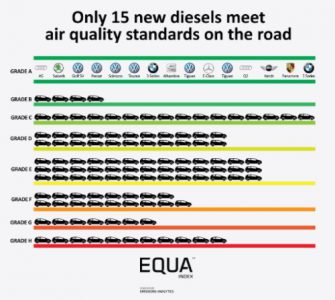
Emissions Analytics, like CAFEE, tested vehicles independently under real-world conditions to see if they met the new Euro 6 standards. Their disturbing results are published by the EQUA Index.

The Emissions Analytics real-world tests found that only 16 of 116 diesel vehicles tested meet the Euro 6 emission standards for NOx, as depicted in the EQUA Air Quality Index chart.

Ony 14 additional vehicles would have met the standards even if the less stringent Euro 5 standards were used, giving a total of just 30 vehicles meeting a now-obsolete regulation under real-world driving conditions.

But the most disturbing part of the results may be how many cars exceeded the limits by wide margins.

More than half the 67 vehicles tested met only the decades-old Euro 3 emission limits.

Against the newly imposed Euro 6 limits, 21 of the cars tested exceeded the maximums with emissions that were at least six times the allowable limits.

Ten of the 21 worst-performing cars had emission levels 12 times or more the limits set under the Euro 6 standards.

Read more: Green Car Reports

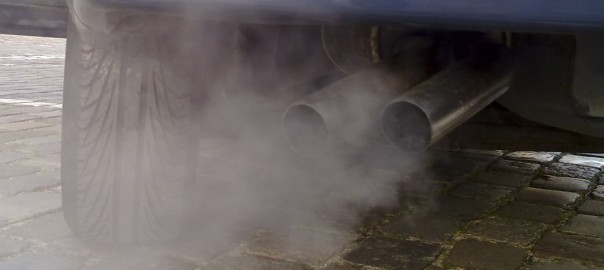
Car exhaust pollution (Image: Wikipedia)

When will we see ‘tailpipes’ on cars as morally wrong? An Earth Day question

Economists call them “externalities.” They’re the costs of people’s actions on other people or communities—though the people taking those actions don’t have to pay for those costs, even as they harm others.

Car exhaust pollution (Image: Wikipedia)

The emissions from combusting fossil fuels to propel vehicles are clearly a prime example.

While complaints about air quality in the Los Angeles Basin date back centuries, research established more than 50 years ago that vehicle emissions were the primary cause of photochemical smog.

That led the state of California to begin efforts to regulate tailpipe emissions—well before the U.S. Environmental Protection Agency even existed—which led in turn to the first catalytic converters in U.S. vehicles in 1975.

Catalysts spread throughout most of the automaking world over the next 20 years, hugely reducing emissions of carbon monoxide (CO), hydrocarbons (HC), and nitrogen oxides (NOx), all toxic in various ways.

It’s well established that electric cars have the lowest wells-to-wheels CO2 footprint of any near- or medium-term alternative, varying from the equivalent of about 35 miles per gallon on the dirtiest U.S. grids to more than 100 mpg on the cleanest grids.

And the carbon footprint per mile of driving an electric car declines every time the grid gets cleaner, whether from adding renewable energy sources or replacing a coal-fired generation plant with one using natural gas.

With increasing availability of zero-emission cars over the coming years, when will citizens at large start to question the idea that every vehicle has an “exhaust pipe” that just belches harmful substances into our shared air?

And when will driving a car that emits carbon dioxide every time it moves become morally unacceptable?

Read more: Green Car Reports

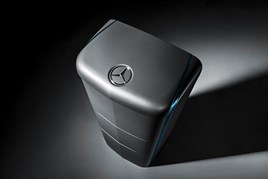
Mercedes-Benz ready to deliver home energy storage units

Mercedes-Benz Energy is ready for the delivery of the first energy storage units for residential use to homeowners in the UK.

The energy storage units are lithium-ion batteries based on the technology used by Daimler since 2012, in more than 80,000 hybrid and full electric vehicles.

By using the storage units, households with their own solar energy systems can store surplus power with virtually no losses. By combining renewable energy sources with a battery storage unit, households can increase their self-consumption of generated energy to as much as 65%.

Mercedes-Benz’s franchised dealer network will not be called upon to retail the systems, however.

Distribution is taken care of by a network of qualified partners such as Alternergy, Innasol and Wind & Sun, as well as with partners who offer a complete system installation, such as Solar Frontier.

“There is tremendous interest in our energy storage units in the UK. We’re very pleased to be able to offer Mercedes-Benz Energy Storage Home to customers here,” said Marc Thomas, managing director of Mercedes-Benz Energy.

Source: AM Online