Shell will start to equip its 870 service stations in the Netherlands and in Belgium with fast electric chargers /Belga
The Dutch oil company Shell is starting to equip its petrol service stations with fast electric chargers too, starting with 20 stations in the Randstad in the Netherlands.
“Only 15 to 20 minutes to charge up to 75%”,
says Machteld de Haan who is responsible for the Shell staions in the Benelux and France.
“Just enough time for a freshly made sandwich with coffee and a sanitary stop on the way”.
Electrical cars are still a niche. In the Netherlands around 15.000 fully electric cars are cruising the roads, in Belgium about 4.300 according to the latest figures.
“But the market can grow fast in the future and we feel the moment is right to step in”,
de Haan says. Last year Shell opened Europe’s largest service station in Luxembourg with 51 fuel pumps and not one electric charger, but now Shell is determined to make the switch.
In the Netherlands Shell is market leader with 600 service stations, in Belgium Shell accounts for 270 stations. Machteld de Haan won’t give any forecast on when all these service stations will be equipped with chargers.
“People will still need fossil fuels for decades. In rolling out the chargers we won’t look at what others do, but take into account our own infrastructure only. The charging stations will have a prominent position, next to the fuel pumps.”
No one can deny that something big is happening to the automotive industry.
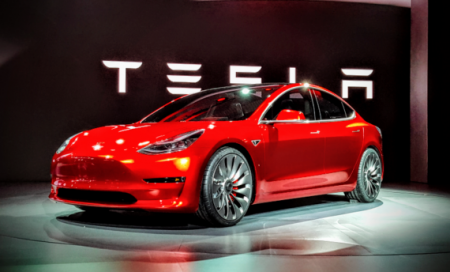
Take a look at Tesla, which has a permanent spotlight on its all-electric cars. From its flagship Model S luxury car, to locking in ~400,000 pre-orders within weeks of unveiling its much more affordable Model 3 for the masses, Tesla is taking on automotive giants that have been around for decades. According to Bloomberg Finance, Tesla’s market cap just surpassed General Motors by $2 billion.
Tesla Model 3
The underlying message surrounding this race is crucial: the transition toward sustainable transportation is happening, and it is happening now.
Most recent estimates show that, by 2019, the global market for EVs will grow to over $227 billion dollars. By 2022, it is estimated that they will cost the same as their internal-combustion counterparts up front (and be cheaper operationally). That’s the point of liftoff for sales and only the beginning. It is estimated that electric vehicles will account for 35% of all new vehicle sales by 2040, expressed in the chart below.
To better understand where the sudden acceleration in all-electric vehicles came from, let’s take a look at the surge in car demand. For every 1,000 people in the United States, there are 1,000 cars. Even with this 1:1 ratio, the USA’s 239.8 million units continue to be the largest vehicle population in the world.
With this, the EPA says that,
“transportation remains the largest single source of air pollution in the United States.”
Moving abroad, the automotive market started seeing rapid car demand in 2010. China’s vehicle registrations jumped by 27.5% and India’s by 8.9%. Looking at the growth potential in these developing countries and comparing them to the US, it has reached a point where it just isn’t feasible to work outside of global emission standards to meet this demand.
The rest of the world seems to be in agreement. Ten of the largest countries are establishing policies that promote better fuel economy and greenhouse gas emission standards for passenger vehicles, including Japan, the European Union, the United States, Canada, China, South Korea, Mexico, Brazil, India, and Germany.
So, great, the move toward all-electric vehicles is the way to a cleaner future.
World’s second largest greenhouse gas emitter will remove itself from global treaty as Trump claims accord ‘will harm’ American jobs.
Donald Trump has confirmed that he will withdraw the US from the Paris climate agreement, in effect ensuring the world’s second largest emitter of greenhouse gases will quit the international effort to address dangerous global warming.
The US will remove itself from the deal, joining Syria and Nicaragua as the only countries not party to the Paris agreement. There will be no penalty for leaving, with the Paris deal based upon the premise of voluntary emissions reductions by participating countries.
“In order to fulfil my solemn duty to the United States and its citizens, the US will withdraw from the Paris climate accord, but begin negotiations to re-enter either the Paris accords or a really entirely new transaction, on terms that are fair to the United States,”
the US president told press in the White House rose garden on Thursday.
“We will start to negotiate, and we will see if we can make a deal that’s fair,” Trump said. “If we can, that’s great. If we can’t, that’s fine.”
But Italy, France and Germany issued a joint statement shortly after Trump’s speech saying they believed the treaty could not be renegotiated.
Trump told the crowd outside the White House:
“The fact that the Paris deal hamstrings the United States while empowering some of the world’s top polluting countries should expel any doubt as to why foreign lobbyists should wish to keep our beautiful country tied up and bound down … That’s not going to happen while I’m president, I’m sorry.”
Trump’s predecessor, Barack Obama, issued a rare statement saying the new administration had joined
“a small handful of nations that reject the future”.
But he said that US states, cities and businesses
“will step up and do even more to lead the way, and help protect for future generations the one planet we’ve got”.
Property listings will include traffic light-style pollution warnings in the near future, experts have predicted as they said poor air quality can knock up to 15 per cent off house prices.
Pollution has become a top concern among potential buyers, who are snubbing “unhealthy homes” and have started using sophisticated pollution websites to track air quality.
The trend has prompted calls for new rules which force estate agents to publish traffic light style pollution warnings alongside energy efficiency ratings in property adverts.
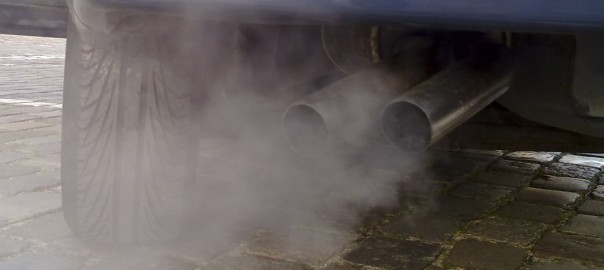
Car exhaust pollution (Image: Wikipedia)
A toxic air alert was issued for the first time in London over “very high” pollution levels, sparking major public concern over the health impacts of living in congested areas.
Nearly 9,500 people died early in a single year as a result of long-term exposure to air pollution in London, a Kings College London report claimed.
Concerned buyers have started actively researching granular data through websites which let them track air quality at individual postcodes, they said.
Henry Pryor, a professional home buyer and property agent, said:
“Home buyers used to have a blaze attitude to air pollution but now this has completely changed. People are very concerned and they are suddenly discovering that they can look at two homes at different ends of a street, and one will be more polluted than another.
“I get asked about pollution levels so regularly that I now check it as standard before suggesting a property to clients. If a house is in a highly polluted area, such as near a train line, it might go for a 15 per cent less than a similar property in a less polluted zone.”
Tesla is now expanding its energy storage business from simply supplying the battery systems, to also remote control of installed storage systems to make the grid cleaner and more efficient.
Tesla calls it aggregation – the next step in energy storage.
Tesla Powerwall
The idea is to enable Powerwall owners to give utilities access to the battery – for use when energy demand is at its highest. Naturally, in turn owners would gain compensation for the extra capacity.
The first Tesla partner with the project is Green Mountain Power in Vermont.
Tesla and Green Mountain Power are excited to announce a program where you can get a Powerwall to back up your home with reliable energy for only $15/month.
In some ways, it’s similar to renting autonomous car, as Tesla would also build a platform joining those who have product, with those who are in need of using a product.
Too many U.S. states, and their electric utilities, think electric vehicles are linked to urgent action on climate change. They see EVs as an environmental solution to a problem that has yet to gain political consensus, at least in the U.S.
But they’re wrong: Electric vehicles, like the rest of the products emerging from what I and other economists call the green economic revolution, will win mass-market adoption because they cost less. And that day is fast arriving.
Electric vehicles anchor a critical mass of technologies poised to slash transportation costs through a new business model often called mobility as a service, or MaaS.
Google tests a self-driving car prototype in Palo Alto, California.
Some posit that MaaS will win price-competitive advantage by:
Displacing fossil fuels with lower-cost renewable electricity
Reducing vehicle maintenance costs by displacing mechanical systems with electronics
Reducing labor with autonomous vehicles
Lowering consumer costs with digitally-purchased, incremental mobility services compared to vehicle ownership
Recent estimates project that MaaS will be four to 10 times cheaper than owning a car in less than 15 years. The average American household is projected to save $5,600 annually. Such a massive cut could potentially drive our national economy to a 3 percent annual growth rate.
Vehicles designed as consumer devices
MaaS innovators are not focused on improving existing car design. Instead they seek to design vehicles as consumer electronics. These five technologies will drive the redesign of vehicles into consumer electronic devices:
5G: 5G is the next wave of mobile connectivity. It has gigabyte speeds and bandwidth compared to today’s 4G speeds. As early as 2018, MaaS will use 5G to create real-time convenience and efficiency between smart, autonomous vehicles and consumers.
Artificial Intelligence (AI): AI is the autonomous electric vehicle’s operating system and “steering wheel.” It will autonomously steer electric vehicles from customer to customer and curb to curb. It will optimize for safety, on-time performance and lowest cost.
Digital commerce: Car loans will be displaced by cheaper, easier and more convenient digital payment for incremental mobility service. Think of Uber-like services supplying whatever you need (drones, SUVs, pick-up trucks or non-emergency medical vehicles). through a digital payment system accessed through a smart phone or wearable device.
Renewable electricity: Renewable electricity will fuel vehicles designed as consumer devices. Electricity is the preferred energy for consumer electronic, and renewables will eventually take over as they become cheaper than fossil fuels or fossil-derived electricity.
Batteries: Batteries are on a downward cost curve driven by innovation and manufacturing economies of scale. Battery costs have already fallen by 75 percent and are projected to win another 75 percent cost decline by 2030. Battery range is being extended even as costs decline. And this month a company claimed its new-generation battery technology put up a 300-mile driving range with five-minute recharging times.
On current trends, the Arctic will be ice-free in summer by 2040.
THOSE who doubt the power of human beings to change Earth’s climate should look to the Arctic, and shiver. There is no need to pore over records of temperatures and atmospheric carbon-dioxide concentrations. The process is starkly visible in the shrinkage of the ice that covers the Arctic ocean. In the past 30 years, the minimum coverage of summer ice has fallen by half; its volume has fallen by three-quarters. On current trends, the Arctic ocean will be largely ice-free in summer by 2040.
Climate-change sceptics will shrug. Some may even celebrate: an ice-free Arctic ocean promises a shortcut for shipping between the Pacific coast of Asia and the Atlantic coasts of Europe and the Americas, and the possibility of prospecting for perhaps a fifth of the planet’s undiscovered supplies of oil and natural gas. Such reactions are profoundly misguided. Never mind that the low price of oil and gas means searching for them in the Arctic is no longer worthwhile. Or that the much-vaunted sea passages are likely to carry only a trickle of trade. The right response is fear.
With the General Election fast approaching, Next Green Car compares the key motoring elements of each of the main parties’ manifestos.
In [this] policy comparison, we focus on green vehicle issues and advances in autonomous and connected technologies; subjects we cover day-to-day on the website. Ultra low emission vehicles, air quality, electric vehicle issues and autonomous driving plans are all covered.
Promoting electric vehicles is a key policy for all the main political parties
In the interest of neutrality, parties are listed alphabetically and cover both previously announced promises and those new elements revealed in the latest manifestos. The three main parties which have published their manifestos are included – other parties will be added when their manifestos are released.
Conservatives
Aim to lead the world in electric vehicle and autonomous vehicles
Almost every car and van to be zero-emission by 2050
Invest in smart grids for more efficient EV charging
Modest roll-out of Clean Air Zones as part of air quality plans
Although the Conservative manifesto is rather light on motoring-related announcements, as the party in power they have already implemented a number of clear policies relating to low and ultra low emission vehicles.
The headline policy is the ambition
“for Britain to lead the world in electric vehicle technology and use….” and for “almost every car and van to be zero-emission by 2050”.
To achieve this, the Conservative Party has already earmarked funding of £600 million by 2020, which will take the total investment since 2011 to £900 million, extending a policy that was initiated under the previous Conservative-Lib Dem coalition. Investment is also planned for ‘smart grids’ designed to make the most efficient use of electricity infrastructure through the use of Vehicle to Grid (V2G) technology….. Read more, Next Greencar
Labour
Return the railways back into public ownership
Work towards zero road deaths in UK
Maintain UK at forefront of the manufacture and use of ultra low emission vehicles
Retrofit diesel buses to Euro 6 standards
Labour’s key message is that the party
“will invest in a modern, integrated, accessible and sustainable transport system that is reliable and affordable.”
Road safety is an important element of the party’s transport agenda, with aims to work towards zero deaths on the UK transport network. The manifesto lays out a number of policies to
“encourage and enable people to get out of their cars, for better health and a cleaner environment.”
To achieve these aims, Labour’s main focus is to improve public transport and reduce fares. One central element of this policy is the aim to return the railways back into public ownership, a policy that has already gained much coverage since the manifesto launch. While there is less focus (and detail) on road vehicle technology in the document, the party is committed to maintaining the UK at the forefront of the development, manufacture and use of ultra low emission vehicles, and supporting the creation of clean modes of transport through investment in low emission vehicles…. Read more, Next Greencar
Liberal Democrats
Creation of a new Green Transport Act
Ban on sale of diesel cars and vans by 2025
Encourage manufacture and uptake of electric vehicles
Introduce ultra-low-emission zones and Clean Air Zones to ten towns and cities
In the Lib Dems’ manifesto, the party sets out a detailed set of measures to reduce environmental impact of transport, which would be implemented through the creation of a Green Transport Act. This would include an air quality plan to tackle air pollution, and support for manufacturers of low-emission and electric vehicles.
The plans include a diesel scrappage scheme, and a ban on the sale of diesel cars and small vans in the UK by 2025. All private hire vehicles and diesel buses licensed to operate in urban areas would have to to run on ultra-low-emission or zero-emission fuels within five years. The party would also reform vehicle taxation to encourage sales of electric and low emission vehicles….Read more, Next Greencar
Scotland’s geographical share of North Sea oil revenues was negative for the first calendar year on record in 2016, Scottish Government figures show.
The latest quarterly national accounts reveal the amount received in tax receipts fell to minus £338 million over the 12-month period.
When a geographical share of UK offshore and overseas economic activity is included, Scottish gross domestic product (GDP) is estimated at £159 billion during the year, or £29,554 per person, amounting to growth of 1.7%.
North Sea oil revenue has fallen to minus �338m, the latest accounts show.
Growth in onshore GDP was mostly driven by consumer spending, with positive contributions also made by government, capital investment and exports.
However, a widening of the onshore trade deficit due to the increasing value of imports had a negative impact.
Economy Secretary Keith Brown said the latest statistics
“highlight the challenges facing the Scottish economy”.
He said:
“Current headwinds relating to the oil and gas sector and Brexit uncertainty are continuing to weigh on growth.
“Despite this, recent business survey evidence shows positive signals for manufacturing and other sectors whilst Scotland’s onshore output per head continues to be higher than the UK average excluding London. This demonstrates that our economic fundamentals remain strong.
“The Scottish Government is taking action to support the labour market, particularly surrounding the oil and gas sector.
“Whilst the statistics also show that recent growth was mostly driven by consumer spending, we are doing all we can to support growth across the wider economy through initiatives such as our £500 million Scottish Growth Scheme to stimulate investment in new and early-stage businesses, and investing in our £6 billion infrastructure plan.”
‘The full impacts will take decades to play out, but once set in motion they could be hard to reverse’
The Earth could be 1.5 degrees Celsius warmer than the late 1800s in just nine years, according to new research which suggests the aspirational Paris Agreement target is unlikely to be achieved.
A paper in the journal Geophysical Research Letters said natural climate variations in the Pacific which change over a period of decades may have provided a “temporary buffer” to the effects of greenhouse gas emissions, reducing extreme events such as heatwaves.
But this cycle, called the Interdecadal Pacific Oscillation (IPO), could be about to flip or may have already done so, sending temperatures higher for the next 10 to 20 years.
Under the Paris Agreement, the world decided to
“pursue efforts to limit the temperature increase to 1.5C above pre-industrial levels”.
However, the researchers said the combination of a natural warming phase and human carbon emissions could see temperatures reach this point by 2026.
Last year, the hottest on record for the third time in a row, was 1.1 degrees Celsius warmer than the average between 1850 and 1900, according to separate research by the Met Office and Nasa. That prompted Professor Gabi Hegerl, a world-leading climatologist at Edinburgh University, to warn that it was
“getting tight for avoiding dangerous climate change”.