Category Archives: Energy and Climate Change

News and articles on climate change, vehicle pollution, and renewable energy.

Consumer Reports Runs The Numbers On Tesla’s Solar Roof

Consumer Reports, which six months ago was skeptical about the viability of Tesla’s Solar Roof product, has once again “done the math” using newly announced pricing estimations.

Tesla Solar Roof in Slate, Due for Release in 2018

According to CR, it’s not easy to weigh value of the offer, as company’s online calculator

“relies upon some important assumptions and predictions that delve deep into the economy of residential solar power in the U.S.”

In its first analysis, CR said that costs need to be below $24.50 per square foot to match costs of conventional roofs (including the cost of Powerwall batteries, but excluding solar incentives or rebates). A 3,000-square-foot Solar Roof would then cost $73,500.

Tesla announced an estimated cost at $21.85 per square foot, which would be $65,550 for the same example house.

After using Tesla calculator for example homes in New York, Texas and California and a 30 years period, CR found out that in some cases Tesla offers a good savings opportunity, although in other cases, it doesn’t look so good.

However, even if one’s first calculations seem tempting, CR advises to answer some questions before placing deposit.

Read more: Inside EV’s

Lasting legacy of VW diesel scandal: EU gets serious about testing

The Volkswagen diesel scandal left lasting imprints on the entire automotive industry, and may have changed the way regulators look at vehicles using the fuel forever.

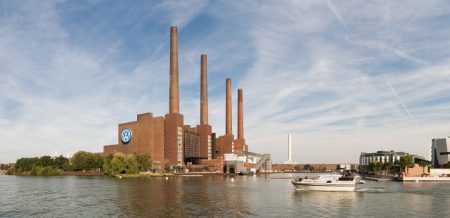
Volkswagen Plant, Wolfsburg Germany

That’s true not just in the United States, but elsewhere as well. The European Union is now increasing its efforts to make sure a scandal like Volkswagen’s can never happen again.

EU ministers have agreed to a new draft of rules and regulations for approving cars in the countries that make up the trade bloc; they give the European Commission more power in such circumstances.

Under the current system, national agencies such as Germany’s KBA have the authority to give new cars a pass for the entire European Union, according to Reuters.National bodies also have the power to revoke the rights to sell a vehicle should a controversy arise.

However, the newly drafted rules hand additional power to Brussels—a move Germany itself and its powerful car industry aren’t keen about.

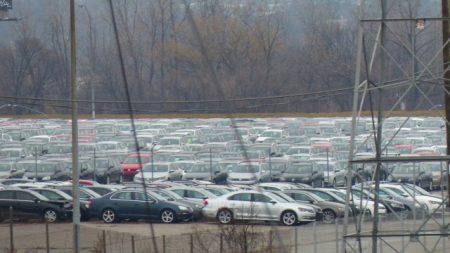
Volkswagen TDI Desiel Cars, Stored at Pontiac Silverdome

German junior economic minister Matthias Machnig told his national counterparts Germany is in favor of increased oversight. But, he said, the country remained wary over conflict of interest.

The changes to testing and approving new vehicles for sale in the EU come in response to Volkswagen’s deceit in the United States.

The German automaker used “defeat devices” in order to pass federal emission tests, and carried out a multi-year cover-up of that fact to continue selling its diesel-powered cars and SUVs.

The devices were programmed to comply with regulations for 23 minutes—exactly how long the EPA regulatory test takes. At minute 24, the NOx levels emitted by Volkswagen and Audi TDI vehicles rose considerably.

Read more: Green Car Reports

Financial Times declares a winner in the war for energy’s future, and Big Oil won’t be happy

‘Fossil fuels have lost. The rest of the world just doesn’t know it yet.’

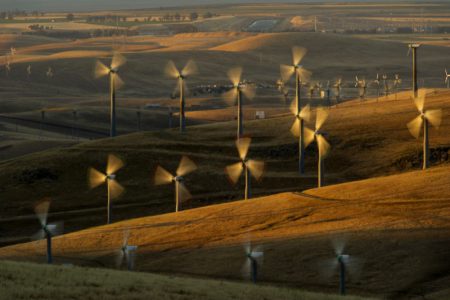
Wind turbines in California.

Traditional energy companies and mainstream financial publications are finally waking up to the new reality: The shift to renewable energy, electric cars, and a low-carbon economy is now unstoppable.
The details of this transition are spelled out in a new, must-read, 4000-word article in the Financial Times,

“The Big Green Bang: how renewable energy became unstoppable.”

What is most remarkable about the article is that it appears in the Financial Times. The free-market oriented paper is the “most important business read” for the world’s top financial decision makers and

“the most credible publication in reporting financial and economic issues”

for global professional investors, according to surveys.

We simply don’t see articles like this in Rupert Murdoch-run Wall Street Journal or even the New York Times, which continues to misreport the clean energy revolution and just hired a columnist who spreads misinformation on climate solutions.

The business community, though, is starting to see the writing on the wall, especially in Europe. The CEO of Royal Dutch Shell, Europe’s largest company, declared in a recent speech that the transition to a low-carbon economy is not just “unstoppable.” It is a necessity that “must be embraced” if an oil company like Shell is to survive and thrive. The low-carbon future, he explained, will be built around renewable electricity and electric cars.

The Financial Times article, in fact, begins with an anecdote of a company that developed a better turbocharger for gas-powered cars. After getting some interest from big car companies last year, in January,

“Suddenly, none wanted new products for cars running on fossil fuels.”

Instead, car companies were putting their limited R&D budgets into electric cars, a seismic shift at an unprecedented speed.

Read more: Think Progress

Charging ahead: Welsh battery scheme may aid growth of green energy

One of the UK’s largest battery storage schemes, built next to a windfarm, will offer vital services to the National Grid.

Nestling alongside rows of conifers and wind turbines in a Welsh valley, a pioneering project will materialise this summer that could prove a blueprint for unlocking Britain’s renewable energy potential.

The Upper Afan Valley near Swansea is already home to the biggest windfarm in England and Wales, but in July work will begin there on one of the UK’s largest battery storage schemes.

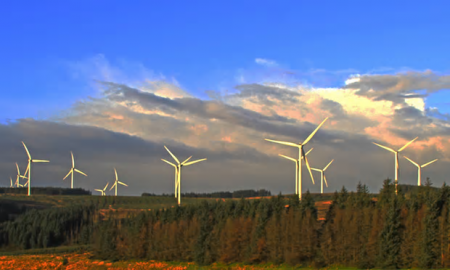
The Pen y Cymoedd wind energy project near Swansea. Photograph: Vattenfall

Built by Swedish energy company Vattenfall, the facility will involve six shipping containers stuffed with lithium-ion batteries made by BMW’s electric car division.

The project is seen as a crucial part of the jigsaw for helping wind, solar and other renewable sources go from the 25% of UK power they provide today, to the much greater share the government needs to hit its climate change targets.

The batteries will not store the electricity generated by the Pen y Cymoedd windfarm with which they share a site, but will offer vital services to the National Grid to cope with the fluctuations that come from renewable power.

Colocating the plant with the windfarm was key to making the economics of the scheme work. Vattenfall said that the site’s existing infrastructure, such as connections to the grid’s transmission network to take power around the UK, meant it was about £5m cheaper than building it on a standalone site.

“To connect a battery project to the transmission network would be prohibitively expensive, but because we have the windfarm already in place, we can share the assets. It’s a huge cost-saving,”

said Frank Elsworth, who is managing construction of the 22MW plant, the battery equivalent of 450 BMW i3 electric cars.

Read more: The Guardian

How Much Does Solar Panel Battery Storage Cost?

Your solar panels are converting light into electricity. This means that they are generating electricity during the day, when the house is often empty. Most commonly, this electricity is fed back to the grid.

Light, efficient, eco-friendly battery technology is advancing very fast in response to market demand. It is not by any means cheap yet, but prices are falling as the technology improves and battery storage is beginning to offer a genuine option for increasing savings, reducing your dependence on the grid and further reducing your carbon footprint.

Once you are sure that you are a good candidate to benefit from adding battery storage to your solar panels, the key factor in calculating the cost and potential return lies in the size of battery you will need and the amount of surplus electricity you generate.

What is your load profile?

Homes with 2.5kW to 4kW solar panel systems are generating somewhere between 1,700kwh and 3,400kWh per year. Suitability to benefit from adding or including battery storage will depend on what is called your Load Profile. Put simply this is the way in which you consume your electricity. If you are already using all or most of the electricity you generate then battery storage will bring you little value. If, however, you are generating a significant amount of your electricity when you are not in your house to use it then battery storage becomes a better option.

A qualified solar engineer will help you [choose] the size of battery you require to store your excess solar electricity. Installation costs tend to remain similar no matter the size of the battery. The size of the battery will, of course, affect the cost.

Tesla Powerwall 14kW

The new Tesla 14kW Powerwall battery will cost you approximately £6,500 including installation.

Sonnen

The German company Sonnen, offer a modular system starting at 2kW with additional 2kW batteries available up to a total of 16kW. Approximately £3,200 will install the basic 2kW system including inverter and controls which can take you up to the full 16kW. Each 2kW add-on will then cost a further £850.

LG Chem

The LG Chem range includes 3.3kW, 4.2kW and 9.8kW options for which you can expect to pay £2,200, £3,300 and £5,500 respectively. You should add approximately £1,000 to these prices for installation.

Calculating the savings you can expect from adding battery storage is complicated and requires both the expertise of a qualified installer and knowledge of your own particular system and load profile. If you think that battery storage would be a viable option then your next step should be to book a visit from a solar specialist who will be happy to do the calculations with you and advise you on your best options.

Read more: Green Business Watch

Cash-strapped councils breaking the law on air pollution, documents reveal

Exclusive poll for The Independent shows public – and most Conservative voters – back banning the most-polluting cars from city centres as pressure builds on the Government

It has been described as a “public health emergency” responsible for tens of thousands of deaths every year, but dozens of local councils have been failing to report on air pollution as required by law for years.

The revelation, based on documents obtained under Freedom of Information rules, casts doubt on local authorities’ ability to play their part in the Government’s new draft Air Quality Plan – its third attempt to meet minimum safety standards after repeatedly being taken to court by campaigners.

Ministers had sought to delay publication of the plan until after the general election, with a Government lawyer arguing it would drop a “controversial bomb” on the campaign.

But a judge ordered ministers to comply with a court-ordered deadline and the resultant plan was duly derided as “feeble” and “much weaker” than expected.

Public concern about air pollution has been growing. A new survey for The Independent found the majority of the public is now in favour of banning the most-polluting vehicles from city centres.

Some 51 per cent of respondents agreed with this suggestion, with only 15 per cent against and the remainder not expressing a view, pollsters ORB said.

The Government’s latest Air Quality Plan sought to pass the buck to a large degree to councils, saying they were “best placed to take the lead”.

However, the council documents, obtained by the DeSmog UK environmental news website, show that local authorities have already been failing to carry out the current requirements, suggesting they would struggle to cope with further responsibilities without extra funding.

Of the 77 councils contacted, 59 had not made air pollution reports, which must be produced under the 1995 Environment Act, available to the public.

After the website got in touch with the councils, 34 authorities were found to have gaps in their reporting between 2011 and 2016, although some said they were still in the process of producing reports covering last year. If this is a representative sample, it would mean 44 per cent of councils in the country are failing to properly monitor and assess the extent of air pollution.

Mat Hope, deputy editor of DeSmog UK, said:

“I think it shows local councils need resources to be able to deal with this problem properly.

“I think the councils themselves are doing what they can, but with the current budget constraints it’s clear they are likely to struggle with the extra obligations under the new Air Quality Plan.

“The Government needs to think very hard about the resources they are putting behind this.”

Read more: The Independent

Solar panels, EV chargers required in new homes in Fremont, CA

Half a century ago, the General Motors assembly plant was the largest employer in Fremont, California, and the town was known for its dragstrip.

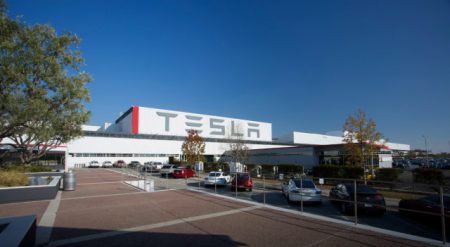
Today, that plant makes Tesla electric cars and Fremont is a part of the San Francisco Bay Area’s Silicon Valley, creating advanced technology for the world.

Tesla Factory, Fremont, California

The city has now taken another step into the future, requiring that all new houses be delivered ready for the installation of electric-car charging stations.

According to the East Bay Times, the city of Fremont has announced that any new housing project must include both solar panels and the electrical wiring required for the installation of a charging station.

The town, across the bay from Palo Alto—where a similar regulation was adopted in 2013—prides itself on being the ZIP Code with the highest concentration of electric-car owners in the state.

That makes it likely to have the highest such concentration in the U.S.

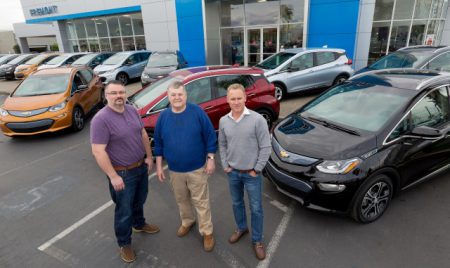
First 2017 Chevrolet Bolt EV Buyers, Fremont, California: Bobby Edmonds, Bill Mattos and Steve Henry

When the first 2017 Chevrolet Bolt EV electric cars were sold in December, Fremont Chevrolet was the site—because it sells more Chevy Volt plug-in hybrids than any other dealer in the country.

It’s exactly 3 miles from the dealer to the Tesla factory, formerly the GM-Toyota joint venture known as New United Motor Manufacturing Inc. or NUMMI.

The required coverage of the solar panels will be determined by the size of the new project.

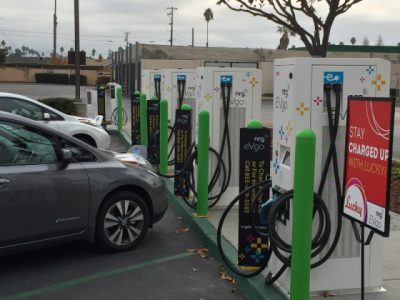
EVgo DC Fast-Charging Site in Fremont, California.

As for the charging stations, the wall hardware itself will not be mandatory.

New buildings will, however, have to be equipped with the electrical setup needed for later installation.

For commercial or multifamily projects, the ruling goes even further, requiring that at least 10 percent of the parking spaces have charging stations installed

Read more: Green Car Reports

Trump just passed on the best deal the planet has ever seen

His rationale for abandoning the Paris agreement is outdated and false. Now, America forges its own, lonely path in being shackled to coal and fossil fuels

Since day one as a contender for the Oval Office, current US President Donald Trump has pushed a dominant narrative: he’s a businessman. He gets economics. He knows the art of the deal. This week, with his decision to withdraw the US from the Paris agreement, the president has given the world strong reason to reject that narrative.

His rationale – that it’s a choice of economy over environment, and a fossil fuel economy is the top priority – is outdated and false. States and nations around the world have harvested the fruits of clean energy, and are redefining their economies and energy sources accordingly. Yet under false pretenses that “clean coal”, natural gas and other fossil fuel fixes are better than energy conservation and clean energy, the US forges its own, lonely path.

The idea that clean, renewable energy will generate power for our planet for generations to come is not rhetoric. The extent of human-caused climate change – and the rapidly improving economics driving the proliferation of renewable energy sources – make it fact.

If the US administration isn’t ready to move forward, hundreds of individual states and other countries will.
California is already a world leader on climate policy. Texas is rapidly expanding its wind energy capacity. In Germany, clean energy has become a movement itself, focused on thousands of small-scale projects under the Energiewende program. In Scotland, wind generation has increased by 81% over the past year, and in March this year, it produced enough energy to satisfy 136 % of the country’s household energy needs. These are just a few examples.

The US’s withdrawal doesn’t mean Americans and US investors will sit still, either. There is substantial economic opportunity in renewables. The US solar industry alone creates one in 50 new jobs. Worldwide, nearly 10 million people already work in renewable energy. Global clean technology exports doubled between 2008 and 2015, surpassing $1.15tn per year. Even America’s corporate giants – from Apple and Google to Walmart, and even oil giant Exxon Mobil – support the Paris agreement.

When news of the potential withdrawal reached the United Nations, the organization’s Twitter page read:

“Climate change is undeniable. Climate change is unstoppable. Climate solutions provide opportunities that are unmatchable.”

A Globe and Mail report showed that even fossil fuel companies – the likes of ExxonMobil, BP and Shell – think the US should stick with Paris.

This withdrawal is an ugly decision, made by a country that ought to be leading the transition to a cleaner future – not only because of its stature as an international economic powerhouse, but also because of its less-than-desirable environmental track record.

Read more: The Guardian

GM commits to sustainable natural rubber for tires

General Motors buys a lot of tires. About 49 million a year, in fact. As part of its sustainability efforts, the automaker announced a goal of 100-percent sustainability for its natural rubber needs, and suppliers like Bridgestone, Continental, Goodyear, and Michelin – which were all represented at GM’s announcement this week in Detroit – ­are on board, too.

The partners also want to uphold labor rights for those in the rubber industry, conserve wildlife, and preserve carbon stocks, all while still producing quality products without raising costs.

Together, they aim to set the standard for sustainable and ethical rubber, holding every member of the supply chain accountable, and encouraging other suppliers and customers to follow suit. Traceability and transparency are keys, GM says, to making sure the rubber doesn’t lead to deforestation, and that it contributes to the economic and social development of the areas where it’s harvested.

Natural rubber will continue to be part of tire manufacturing for the foreseeable future. As Dr. Juan Botero, Continental VP of Sales of Passenger & Light Truck Tires for the Americas, points out,

“The properties that you get from that material, unfortunately, we have not been able to replicate in a laboratory. Mother nature does a fantastic job with this material.”

At this point, manufacturers simply can’t build as good of a tire without natural rubber. Over the years, advances have allowed them to use a smaller ratio of natural rubber, but it still makes up 10 to 15 percent of a passenger car’s tires, up to around 30 percent for a truck, and even higher for larger vehicles.

Proper management is critical to making natural rubber more sustainable. It’s better, of course, to make the most of existing trees than to clear land for new plantations, and all participating parties aim to dramatically increase their yield as demand continues to grow. It’s also important to protect rubber trees from disease, as their limited growing range makes them particularly susceptible. At the end of their lifecycle of about 20 years, the trees can harvested for their wood, and new ones are replanted in their place.

The natural rubber industry produces about 12 million tons per year, 75 percent of which is used in the tire industry. GM and the participating tire manufacturers hope this initiative will make a difference in their impact, as well as that of the other customers that share their supply chain.

The sustainable natural rubber plan is in its early stages, and we can expect more announcements about this initiative in the future.

Read more: Auto Blog

Living with the Tesla Powerwall for a year: the first Australian case study

Savings in excess of 90% have been reported by the first Australian to install a Tesla Powerwall after a year of living with the solar system. And with rapid advancements making home batteries more affordable, the number of installations are expected to triple in 2017.

Nick Pfitzner and his family live in a four bedroom home in Kellyville Ridge, NSW. It’s a large place with a study, an internal laundry, a pool and an outdoor entertainment area.

Powering the home with electricity in 2015 cost him $2289. But just over a year ago, he invested in a solar power system that has since significantly cut costs.

Nick, a self-confessed Tesla fanboy, was the first person in Australia to buy the company’s Powerwall. He bought a 7kW battery, a 5kWp solar array, a SolarEdge inverter and a Reposit monitoring system for $16,790 in January 2016.

A year on and Nick’s annual electricity bill has dropped to $178.71 – that’s a 92% saving of $2110.

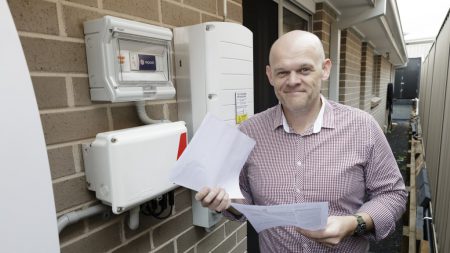
Nick Pftitzner standing alongside his home solar system

The savings exceeded projections, as well as Nick’s own expectations.

“Before I crunched the numbers I was looking at what would be my return on investment. If it saved me 80% of my power bill, [I thought] it would be pretty good,”

he says.

“I really learned a lot about myself and how my house uses energy and how we can improve with solar now.”

Home batteries are an emerging technology. They gained a lot of attention when electric carmaker Tesla entered the market. Original projections estimated a payback time of more than a decade, anywhere from 14 to 18 years.

At this rate, Nick’s solar system will pay itself off within eight years.

His average quarterly bill dropped from $572 in 2015 to $45 in 2016.

One of his quarterly bills was in credit of $50. This is because his system can sell unused electricity back to the grid.

“The system will power whatever the house needs first as a priority, then it will fill the battery as a second priority and then anything over it’ll export,”

he tells CHOICE.

“The aim is to try and export about three times of what I import because my electricity cost is about three times [as much].”

Read more: Choice