Category Archives: Energy and Climate Change

News and articles on climate change, vehicle pollution, and renewable energy.

Elon Musk’s big battery brings reality crashing into a post-truth world

For months, politicians and fossil fuel industry have lied about the viability of renewables. Now Tesla’s big battery in South Australia will prove them wrong

Elon Musk’s agreement to build the world’s largest battery for South Australia isn’t just an extraordinary technological breakthrough that signs coal’s death warrant. It’s potentially a game changer in the way we do politics, reinserting the importance of basic reality into a debate which has been bereft of it for too long.

There’s been a lot written in recent years on the idea that we are living in a “post-truth” world. Climate writer David Roberts brought it to my attention around 2010, when I was grappling with the idea that dinosaur politicians and rent-seeking corporates not only weren’t telling the truth about climate change and energy: they were actively dismissive and destructive of the very idea of truth.

While we got a taste for it in Australia under Tony

“don’t believe anything I haven’t written down”

Abbott’s government, the idea sprang into the global mainstream last year with Donald Trump’s election campaign and the Brexit bus.

It seemed that truth no longer mattered. Facts were not just unimportant, but barriers to be smashed through with rhetoric. Demonstrating beyond reasonable doubt that a politician was lying no longer had any impact. Even when people agreed that he (usually) was lying, they still supported him, because he activated a frame or a value that drove their political decision-making.

Read more: The Guardian

Big Oil Just Woke Up to Threat of Rising Electric Car Demand

  • OPEC quintupled forecast for battery powered cars in last year
  • Oil majors and automakers diverge on outlook for EVs

The world’s biggest oil producers are starting to take electric vehicles seriously as a long-term threat.

OPEC quintupled its forecast for sales of plug-in EVs, and oil producers from Exxon Mobil Corp. to BP Plc also revised up their outlooks in the past year, according to a study by Bloomberg New Energy Finance released on Friday. The London-based researcher expects those cars to reduce oil demand 8 million barrels by 2040, more than the current combined production of Iran and Iraq.

Growing popularity of EVs increases the risk that oil demand will stagnate in the decades ahead, raising questions about the more than $700 billion a year that’s flowing into fossil-fuel industries. While the oil producers’ outlook isn’t nearly as aggressive as BNEF’s, the numbers indicate an acceleration in the number of EVs likely to be in the global fleet.

“The number of EVs on the road will have major implications for automakers, oil companies, electric utilities and others,”

Colin McKerracher, head of advanced-transport analysis at BNEF in London, wrote in a note to clients.

“There is significant disagreement on how fast adoption will be, and views are changing quickly.”

BNEF expects electric cars to outsell gasoline and diesel models by 2040, reflecting a rapid decline in the cost of lithium-ion battery units that store power for the vehicles. It expects 530 million plug-in cars on the road by 2040, a third of worldwide total number of cars.

Read more: Bloomberg

Electric cars charging in Milton Keynes (Image: T. Larkum)

Electric car revolution: calculating the cost of green motoring

More battery-powered vehicles would mean cleaner air and quieter streets – but also a drain on the National Grid and less fuel duty to the Treasury

Electric cars ready for free test drives in Milton Keynes (Image: T. Larkum)

Streets will be quieter, the air will be cleaner, people will spend less time at petrol stations and car factories might even return to Britain’s shores if the country switches to electric cars in a dramatic, widespread fashion.

But widespread adoption of battery-powered vehicles would not be without challenges too. A large-scale switchover to electric cars could create problems for power grids, could mean roads lined with charging poles and it could also leave a big hole in public coffers as fuel duty dries up.

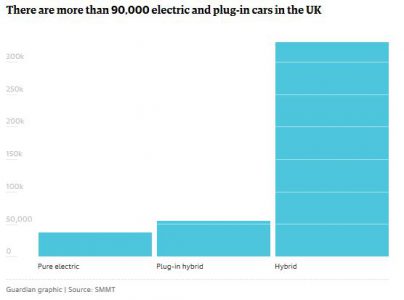
With just over 90,000 fully electric and plug-in hybrid cars now on UK roads, such risks and benefits might look a way off.

But this week big changes have been announced. On Wednesday Volvo said it will only launch electric or hybrid cars from 2019 and just a day later Emmanuel Macron’s new government pledged that France will ban diesel and petrol cars by 2040. Battery-powered travel could be coming far sooner than previously thought.

According to research published this week by Bloomberg New Energy Finance the proportion of fully electric new cars sold in the UK will be one in 12 by 2030 – up from one in every 200 today.

The surge in electric cars will have to be accompanied by thousands of new charging points to plug them all in.

Today there are around 4,000 publicly accessible locations with 13,000 plug sockets. Of the 13,000, a fifth are so-called rapid charging connections that will top up a Nissan Leaf, the UK’s best-selling pure electric car, in half an hour.

Read more: The Guardian