Category Archives: Flooding

Miles of ice collapsing into the sea

[The NY Times] went to Antarctica to understand how changes to its vast ice sheet might affect the world.

Ice sheets flow downhill, seemingly in slow motion. Mountains funnel the ice into glaciers. And ice flowing from the land into the sea can form a floating ice shelf.

Glaciers in certain areas have been undercut by warmer ocean waters, and the flow of ice is getting faster and faster.

The acceleration is making some scientists fear that Antarctica’s ice sheet may have entered the early stages of an unstoppable disintegration.

Because the collapse of vulnerable parts of the ice sheet could raise the sea level dramatically, the continued existence of the world’s great coastal cities — Miami, New York, Shanghai and many more — is tied to Antarctica’s fate.

Four New York Times journalists joined a Columbia University team in Antarctica late last year to fly across the world’s largest chunk of floating ice in an American military cargo plane loaded with the latest scientific gear.
Inside the cargo hold, an engineer with a shock of white hair directed younger scientists as they threw switches. Gravity meters jumped to life. Radar pulses and laser beams fired toward the ice below.

On computer screens inside the plane, in ghostly traces of data, the broad white surface of the Ross Ice Shelf began to yield the secrets hiding beneath.

“We are 9,000 miles from New York. But we are connected by the ocean.”

said the white-haired engineer, Nicholas Frearson of Columbia.

Nicholas Frearson, at left, in the cargo hold of an LC-130 Hercules.

A rapid disintegration of Antarctica might, in the worst case, cause the sea to rise so fast that tens of millions of coastal refugees would have to flee inland, potentially straining societies to the breaking point. Climate scientists used to regard that scenario as fit only for Hollywood disaster scripts. But these days, they cannot rule it out with any great confidence.

Yet as they try to determine how serious the situation is, the scientists confront a frustrating lack of information.

Recent computer forecasts suggest that if greenhouse gas emissions continue at a high level, parts of Antarctica could break up rapidly, causing the ocean to rise six feet or more by the end of this century. That is double the maximum increase that an international climate panel projected only four years ago.

Read more: NY Times

Climate March poster on the Underground (Image: T. Larkum)

Donald Trump’s Mar-a-Lago Florida estate to be submerged by rising sea levels due to climate change

Donald Trump once said climate change was a “hoax” invented by the Chinese but the phenomenon could be responsible for flooding his own Florida properties.

Environmental experts lined up to testify at a senate hearing on climate change this week, just four miles from Mr Trump’s Mar-a-Lago estate in Florida, arguing that water could rise so high by the end of the century that the President’s own resorts would be damaged.

According to data from the National Oceanic and Atmospheric Administration, the President’s so-called Winter White House would be partially submerged if sea levels rose by three feet in the next 83 years.

Climate March poster on the Underground (Image: T. Larkum)
Climate poster (Image: T. Larkum)

“Today we sit at ground zero of the impacts of climate change in the US,” said Democratic Senator Bill Nelson, ranking member of the Senate Commerce, Science and Transportation Committee.

His state has already suffered multiple cases of serious flooding.

“And while there are still some who continue to deny climate change is real, South Florida offers proof that it is real and it’s an issue we’re going to be grappling with for decades to come.”

Data from NOAA would not just affect the President, but millions of residents who live along the east coast as sea levels could rise by as much as five feet.

A recent study published in journal Nature found that sea levels could rise by six feet by 2100 due to ice melting in the Antartic, and the President’s golf course at Doral, Florida, and several of his Sunny Isles Beach properties – along with two million homes – would be underwater.

Read more: Independent

Severe Flooding, Against a Background of Wind Turbines: November 2012, Tyringham, Bucks. (Image: T. Larkum)

Government ‘tried to bury’ its own alarming report on climate change

Exclusive: The five-yearly assessment of what will happen to the UK as the world warms says one of an array of potential threats is the ‘significant risk’ to supplies of food

The Government has been accused of trying to bury a major report about the potential dangers of global warming to Britain – including the doubling of the deaths during heatwaves, a “significant risk” to supplies of food and the prospect of infrastructure damage from flooding.

Severe Flooding, Against a Background of Wind Turbines: November 2012, Tyringham, Bucks. (Image: T. Larkum)

The UK Climate Change Risk Assessment Report, which by law has to be produced every five years, was published with little fanfare on the Department for Environment, Food and Rural Affairs’ (Defra) website on 18 January.

But, despite its undoubted importance, Environment Secretary Andrea Leadsom made no speech and did not issue her own statement, and even the Defra Twitter account was silent. No mainstream media organisation covered the report.

One leading climate expert accused the Government of “trying to sneak it out” without people noticing, saying he was “astonished” at the way its publication was handled.

In the report, the Government admitted there were a number of “urgent priorities” that needed to be addressed.

It said it largely agreed with experts’ warnings about the effects of climate change on the UK.

These included two “high-risk” issues: the damage expected to be caused by flooding and coastal erosion; and the effect of rising temperatures on people’s health.

The report concluded that the number of heat-related deaths in the UK “could more than double by the 2050s from a current baseline of around 2,000 per year”.

It said “urgent action” should be taken to address overheating in homes, public buildings and cities generally, and called for further research into the effect on workers’ productivity.

The Government also recognised that climate change “will present significant risks to the availability and supply of food in the UK”, the report said, partly because of extreme weather in some of the world’s main food-growing regions.

The report also said the public water supply could be affected by shortages and that the natural environment could be degraded.

Read more: Independent

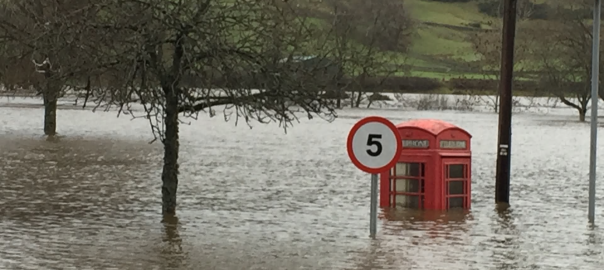
Flooding in the village of Aberfeldy, Perthshire, Scotland, 2015. Critical infrastructure, such as water and telecoms, are at serious risk from floods (Image: C. Webster/PA)

Flooding: UK government plans for more extreme rainfall

National review prompted by severe flooding in recent winters anticipates 20-30% more extreme downpours than before

Flooding in the village of Aberfeldy, Perthshire, Scotland, 2015. Critical infrastructure, such as water and telecoms, are at serious risk from floods (Image: C. Webster/PA)

The UK’s new flood defence plans anticipate significantly higher extreme rainfall, after new research was published as part of the government’s National Flood Resilience review.

The government, which had been criticised for not taking full account of the impact of climate change in driving up flood risk, will now plan for 20-30% more extreme downpours than before.

The review, prompted by severe flooding in recent winters, also found that 530 critical infrastructure sites, such as water and telecoms, are at serious risk from floods, each potentially affecting at least 10,000 people. Utility companies have pledged to have new protection in place by the end of the year.

The government’s official climate change advisers recently warned that flooding could cause a cascade of emergencies by knocking out energy, transport, water and communications links.

The review allocates £12.5m for more temporary defences, such as barriers and pumps, at strategic locations around the country. By this winter, the government said, four times more temporary barriers will be available.

“Last winter we saw just how devastating flooding can be. This review sets out clear actions so we are better prepared to respond quickly in the event of future flooding and can strengthen the nation’s flood defences,” said the environment secretary, Andrea Leadsom.

Ben Gummer, Cabinet Office minister, said:

“The government has made clear that we expect water and telecoms companies to work ever closer together to improve their preparation and response to flooding, making sure lifelines such as mobile phone masts and water treatment works continue to function.”

Bob Ward, policy director at the Grantham Research Institute on Climate Change at the London School of Economics and Political Science, said:

“This review was launched because the government was caught out by [recent] flooding. It deserves credit for admitting that ministers have previously misunderstood and significantly underestimated the probability of flooding.

“However, it is disappointing that the government chose to ignore surface water flooding during the review, even though it poses a threat to more properties in the UK than does coastal and river flooding.”

Read more: The Guardian

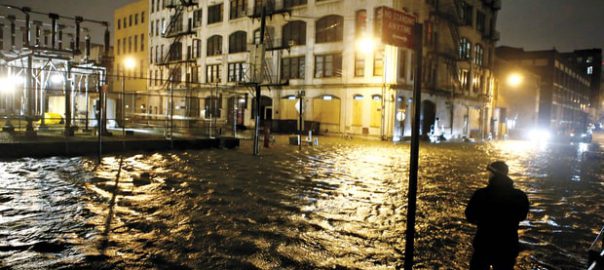
Hurricane Sandy flooded huge parts of Lower Manhattan and downtown Brooklyn (Image: J. Countess/Redux)

New York will be flooded due to climate change

Klaus Jacob, a German professor affiliated with Columbia’s University’s Lamont-Doherty Earth Observatory, is a geophysicist by profession and a doomsayer by disposition.

Hurricane Sandy flooded huge parts of Lower Manhattan and downtown Brooklyn (Image: J. Countess/Redux)

I’ve gotten to know him over the past few years, as I’ve sought to understand the greatest threat to life in New York as we know it. Jacob has a white beard and a ponderous accent: Imagine if Werner Herzog happened to be a renowned expert on disaster risk. Jacob believes most people live in an irrational state of “risk denial,” and he takes delight in dispelling their blissful ignorance. “If you want to survive an earthquake, don’t buy a brownstone,” he once cautioned me, citing the catastrophic potential of a long-dormant fault line that runs under the city. When Mayor Bloomberg announced nine years ago an initiative to plant a million trees, Jacob thought, That’s nice — but what about tornadoes?

For the past 15 years or so, Jacob has been primarily preoccupied with a more existential danger: the rising sea. The latest scientific findings suggest that a child born today in this island metropolis may live to see the waters around it swell by six feet, as the previously hypothetical consequences of global warming take on an escalating — and unstoppable — force. “I have made it my mission,” Jacob says, “to think long term.” The life span of a city is measured in centuries, and New York, which is approaching its fifth, probably doesn’t have another five to go, at least in any presently recognizable form. Instead, Jacob has said, the city will become a

“gradual Atlantis.”

The deluge will begin slowly, and irregularly, and so it will confound human perceptions of change. Areas that never had flash floods will start to experience them, in part because global warming will also increase precipitation. High tides will spill over old bulkheads when there is a full moon. People will start carrying galoshes to work. All the commercial skyscrapers, housing, cultural institutions that currently sit near the waterline will be forced to contend with routine inundation. And cataclysmic floods will become more common, because, to put it simply, if the baseline water level is higher, every storm surge will be that much stronger. Now, a surge of six feet has a one percent chance of happening each year — it’s what climatologists call a “100 year” storm. By 2050, if sea-level rise happens as rapidly as many scientists think it will, today’s hundred-year floods will become five times more likely, making mass destruction a once-a-generation occurrence. Like a stumbling boxer, the city will try to keep its guard up, but the sea will only gain strength.

Read more: NY Mag