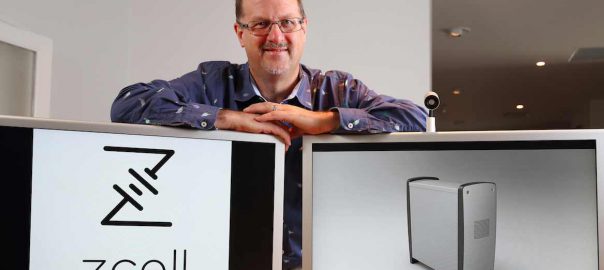
Simon Hackett, the executive chairman of Australian battery storage developer Redflow, declares himself to be the number one fan of Tesla electric vehicles in Australia. But he insists that Redflow’s battery storage product is better than the Tesla Powerwall.
Redflow threw down the gauntlet to its much-hyped international rival on Wednesday, announcing the release of the ZCell battery storage product, bigger and more expensive than Tesla and other big name products, but one Hackett expects to be a force in the market.
“As Tesla’s biggest fan in Australia I’ve got a view that they’ve got the best battery technology for cars, but we do a better technology for houses and that’s totally cool,”
says Hackett, who has bought Tesla Roadsters and several Model S electric vehicles, has orders in for the Model X and will also be head of the queue for the new “mass market” Model 3.
“I expect Tesla to sell a hell of a lot of Powerwalls and the nice thing is that we have a market here that is going to explode, it’s not a matter of them having to lose for us to win or vice versa and you can appreciate as well we make a battery that’s a lot more grunt, a lot more capacity,” Hackett told RenewEconomy in an interview.
Hackett expects the market for battery storage in Australia to be “huge”. This, he says, will be driven by Australia’s high grid prices, its big rates of rooftop solar installation, a desire for more grid “independence”, and a wish to do something for the environment.
“I’m seeing the same set of signals from human beings that I saw at the start of the internet boom,” says Hackett, who made his fortune with his company.
“The batteries have gone from something that people that use to talk about in dark corridors to something that is a dinner table conversation in households.
“Tesla are the catalyst here, not the cause. The cause is that the conditions are right, batteries are … starting to approach the cost where we can have these conversations.
“It’s a tipping point in my view , you can see it a year ago you couldn’t have this discussion with a random person about batteries, now every second person I talk to engages me about it.”
Tesla has quietly removed all references to its 10-kilowatt-hour residential battery from the Powerwall website, as well as the company’s press kit. The company’s smaller battery designed for daily cycling is all that remains.
Tesla Powerwall home battery storage system (Image: Tesla)
The change was initially made without explanation, which prompted industry insiders to speculate. Today, a Tesla representative confirmed the 10-kilowatt-hour option has been discontinued.
“We have seen enormous interest in the Daily Powerwall worldwide,” according to an emailed statement to GTM. “The Daily Powerwall supports daily use applications like solar self-consumption plus backup power applications, and can offer backup simply by modifying the way it is installed in a home. Due to the interest, we have decided to focus entirely on building and deploying the 7-kilowatt-hour Daily Powerwall at this time.”
The energy storage system market is expanding at a fast pace, and 2016 could double the world’s power output of installed ESS.
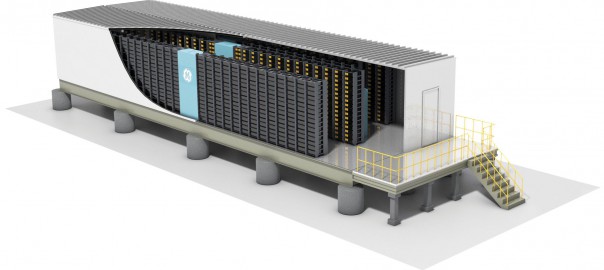
General Electric Lithium-Ion Energy Storage System (Image: GE)
ESS is becoming dominated by lithium-ion batteries – cost reductions of those batteries, combined with government funding programs and utility tenders, brings tremendous growth of orders, according to IHS.
The global pipeline of planned battery and flywheel (who still uses flywheels these days?) projects had reached 1.6 gigawatts (GW) in Q4 2015 (up 45% compared to Q3 2015).
IHS doesn’t reveal the MWh of ESS because they measure installations in MW or GW. That makes comparison to EVs more difficult.
45% of new ESS installations are planed in the U.S. followed by Japan with 20%.
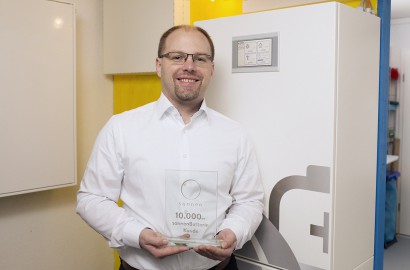
German startup Sonnen shipped its 10,000th battery system this week, claiming a leading position in the global smart energy storage market as it takes on Tesla and shakes up the traditional electricity business model.
“Our goal is really to create a world where everyone is able to cover their own energy needs with a decentralized energy source.”
Sonnen marked the milestone by gifting German homeowner Stefan Wolpert an extra 2 kilowatts of battery capacity and a free membership to sonnenCommunity — Sonnen’s decentralized energy trading platform.
The shipment announcement comes on the heels of the startup’s expansion into the U.S. last month, with a new headquarters unveiled in Los Angeles and a rapidly growing distribution network. Sonnen has already partnered with 30 local solar installers and aims to reach 100 partners by the end of the year.
In early February, Sonnen announced that it is now ready to install systems in Hawaii after meeting the advanced energy storage requirements from the Hawaii Electric Companies (HECO). The sonnenBatterie, which comes fully equipped with smart energy management technology, is billed as an “out-of-the-box” solution that meets the obligations under HECO’s new distributed energy tariffs. Company executives say a 4-kilowatt-hour sonnenBatterie in Hawaii will cost about $10,000 and provide a return on investment in as little as 6.5 years.
At the outset, Sonnen is targeting sales to solar customers in places with high electricity costs, like Hawaii and Puerto Rico. California is another promising market, where storage benefits from incentives and can help solar customers arbitrage time-of-use rates. But the company ultimately sees batteries offering financial and resiliency benefits across the U.S., and is currently working with Spruce to offer attractive financing packages for energy storage in all 50 states.
Sonnen already has 1,000 battery storage systems under contract in the U.S. and aims to contract for up to 3,500 systems through the year. As Sonnen increases its U.S. presence, it continues to grow sales in seven European countries, Australia and the Philippines.
“Our goal is really to create a world where everyone is able to cover their own energy needs with a decentralized energy source,” said Boris von Bormann, CEO of Sonnen North America, at the company’s L.A. office launch. “Of course we love the utilities, but just imagine if you could take your energy future into your own hands.”
Just a week after the first Tesla Powerwall for residential use in Australia has reportedly been installed in a Sydney suburb, it’s now the UK’s turn to get its first Tesla home battery pack.
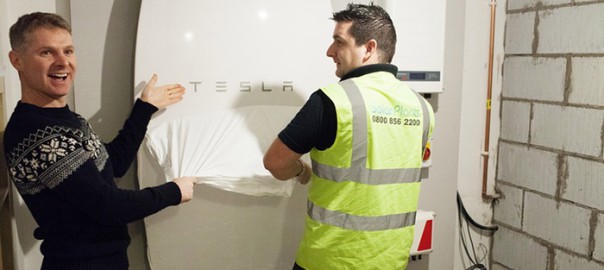
A SolarPlant engineer installs the UK’s first Powerwall home battery in Cardiff at Mark Keer and Lyndsey Bennett’s home (Image: G. Phillips/Guardian)
Homeowner Mark Kerr has become the first British Tesla Powerwall owner after a SolarPlant engineer installed the system at his home in Wales. Kerr and his family have a solar installation at their home and will use the excess energy produced during the day to charge the battery pack. Kerr talked to The Guardian about his new energy storage system:
“This is the future, definitely. For me this is the logical next step. We have the solar panels but we need a way to make best use of the power they produce. Me and my family are all out in the day, and we are not making use of the enormous amount of clean energy that our solar panels produce. The battery will allow us to store the energy we don’t use in the day to use when we need it in the evenings.”
Kerr, an electrician by trade, added about the design of the Powerwall:
“It’s a gorgeous-looking piece of technology, its design is very sleek and minimalistic and something you can hang on the wall like a piece of art, definitely nothing like some of the other clunky looking batteries.”
South Wales solar installer Solar Plants installed Kerr’s new home battery pack. The company shared some marketing statistics about the Powerwall. Since it has been made available, the company emailed 3,000 solar customers about the battery. Out of the 1,500 who opened the email, 600 said they wanted one.
These potential buyers will have to wait a bit since Solar Plants says Kerr’s installation will work as a pilot project to get a better idea of how the system works.
Renault will provide used EV batteries to Connected Energy Ltd for second-life application in its E-STOR product
Renault is the electric vehicle market leader in Europe
E-STOR is a revolutionary energy storage system that can reduce costs and enable more flexible and efficient use of energy – including high capacity fast charging
E-STOR will be available in the UK from July 2016
2016 -Connected Energy Ltd E-Stor and Renault ZOE (Image: Renault)
Renault and Connected Energy are partnering to develop sustainable and efficient ways of using electric vehicle batteries at the end of their useable in-vehicle life in order to supply innovative and more affordable vehicle charging solutions.
At the end of their useful in-vehicle life, Renault EV batteries still have considerable remaining capacity, which means that they can continue to give great service in other applications before they are ultimately recycled. And with rapidly increasing EV sales – 97,687 EVs were sold in Europe in 2015, up 48% on 2014 – so is the requirement in energy to charge them.
E-STOR: a flexible and environmentally friendly energy management system
Through its award-winning E-STOR technology, Connected Energy is offering a highly innovative solution to this conundrum through use of ‘second life’ EV batteries.
This can be used, for example, to store energy generated from on-site renewable generation resources such as solar panels and wind turbines, and then release it as it’s needed at a later time. The system also allows the batteries to be charged via low-cost off-peak electricity tariffs, enabling users to reduce their energy costs.
The batteries used are Renault EV batteries, chosen by Connected Energy because Renault, as EV market leader with 23,000 units sold in Europe in 2015, has expertise in the technology, its lifecycle and impact on the environment.
The first E-STOR product is nominally rated at 50kW/50kWhr which could typically be used to support one rapid charger or a cluster of fast chargers but the system is fully scalable and higher capacity units will follow.
In practical terms, as well as allowing more efficient use of energy, the system can also enable installation of rapid electric vehicle charging in sites where electricity supply would traditionally only allow slower rates. Instead of charging vehicles via a high-capacity supply directly from the grid, E-STOR allows multiple batteries to be charged at a slower rate over a period of time, ready to release their energy and charge a car when an EV driver needs it.
Renault offers two concrete solutions with its electric vehicles and their batteries through E-STOR. First to the grid, by providing energy storage that prevents power grid overload and balances supply and demand. Second to the environment, because batteries not fitted for automobile use, but that still have considerable remaining capacity, can have a longer life and lower carbon footprint before they are actually recycled.
In June 2015, E-STOR was named winner of the innovation category in the prestigious British Renewable Energy Awards 2015, hosted by the Renewable Energy Association.
Matthew Lumsden, Managing Director, Connected Energy, said:
“E-STOR will enable the more cost-effective roll-out of electric vehicles in commercial and industrial settings, thus increasing the overall sustainability of this clean form of transport. With Renault we have secured the supply of second life batteries for future E-STOR installations.”
Eric Feunteun, Electric Vehicle Program Director, Renault, commented:
“The second life application of Renault electric vehicle batteries supports Renault’s commitment to the energy transition in the automotive industry. Through E-STOR, EV owners can charge their car at reduced costs with electricity that is less carbon-dependent. It makes driving an EV a smart and even more sustainable transportation solution. With this energy management technology, EVs and their batteries become an asset for the grid rather than create overload.”
Renault is a leader and pioneer in the emerging electric vehicle market and has sold electric vehicles since 2011, offering a range of 100 per cent electric cars and vans to suit most requirements. The ZOE supermini sits alongside the fun and distinctive Twizy urban run-around which is also available in a commercial vehicle version with a boot instead of a rear passenger seat – Twizy Cargo. Completing the Renault Z.E (Zero Emissions) line-up is the Kangoo Van Z.E. – the perfect compact van for urban deliveries and tradesmen and is available in a range of bodystyles.
In 2015, Renault was the best performing EV brand in Europe, with sales rising 49 per cent to 23,086 units, with a 23.6 per cent European EV market share. It was a similar story in the UK, with ZOE sales up 102 per cent in 2015 to 2,053 vehicles – significantly outpacing the UK electric vehicle market, which was up 48 per cent on 2014.
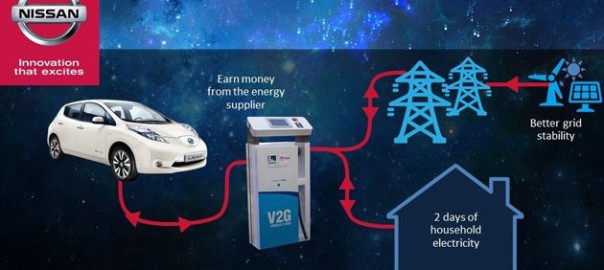
Nissan has joined up with energy supplier ENEL to trial the idea of ‘Smart Grids’ using electric cars. The two companies will work together to set up innovative vehicle-to-grid systems that allow owners to use their car as a movable energy hub – using, storing or returning energy to the grid.
The deal has been announced during the Nissan-Renault Alliance’s support of the COP21 climate change conference in Paris. The leading EV manufacturers have supplied a fleet of 200 EVs to shuttle delegates around the conference.
Based in a large number of European and north and central American countries, ENEL is Italy’s largest energy provider. Nissan’s partnership with the company will see smart grid trials begin in Europe. This dovetails with the recent announcement that Nissan has also teamed up with power management specialists Eaton to reuse old EV batteries.
The smart grid concept sees EV owners avoid peak tariffs for household energy, with the car able to supply either the home or national grid with power during high demand periods such as evenings after normal working hours. This will give the Leaf owners a greater degree of financial freedom, and they can then either recharge their vehicle at off peak times in the early hours of the morning, or maintain enough charge to be able to drive to their workplace and charge there.
Denmark will be the first country to trial the smart grid project, with plans already in place to roll it out to Germany, the Netherlands and other northern European countries.
Elon Musk is at Université Paris 1 Panthéon-Sorbonne to talk about the danger of climate change and his vision of what we can do to help the world transition to a sustainable future.
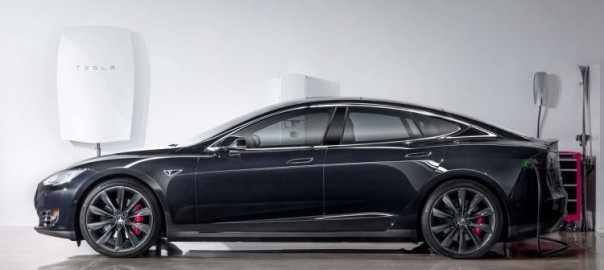
No the game changer is not the 2015 Tesla Model S in the picture above. It’s the white device shaped like a medieval-shield that is blending into the wall behind it. It is a wall-mounted lithium-ion home battery system designed to store energy from rooftop solar panels. It can hold up to 10 kilowatt-hours of energy, enough to power a typical home for about 10 hours. It would enable homes to be powered by solar energy during the day and by battery during the night time.
It’s called Powerwall, and in 5 years it could be a major cash cow for Tesla
When Powerwall was released in April this year, it received largely negative press. The press assessed that Powerwall at the current price point was uneconomic for the average user, who gets fairly cheap electricity from the grid. Tesla took the negative feedback to heart and came back in June with double the specs with no change in the price. In doing this, Tesla raised the bar on price competitiveness in battery storage marketplace to a whole another level. The Tesla Model S And The Powerwall (Image: Tesla)
Correct as the original assessment by the press may have been, it was incomplete. The economics associated with Powerwall may look entirely different in 5 years time than it does today, making it a game changer for Tesla. 3 mega-trends are shaking up how we consume energy today –
Let’s hope one day schemes like this get to the UK
Energy provider Ergon Retail is running a trial, with support from the Australian Renewable Energy Agency (ARENA), in 33 Queensland homes in Toowoomba in the south of the state and Townsville and Cannonvale in the north.
In recent months, about 30 country householders have joined a pilot project that provides a glimpse of the future of our energy grid.
For no up-front cost, these homes will get a state-of-the-art rooftop solar and battery system installed in their homes.
Tesla Motors plans to bring its new batteries in 2016 to Australia, which will join Germany as the company’s first two markets outside the US (Image: Reuters)
Participants will pay a monthly fee to use the battery system, with their electricity bills expected to be significantly reduced because about 75 per cent of their power will be generated by the sun. Their shiny new cabinet-sized battery will allow them to store some of the energy from their solar panels that they then use during peak times – usually in the early evening.
For its part, Ergon will be able to remotely control and monitor these home batteries, and feed power back into the grid when the network is being stretched. The company talks about these in-home batteries as “virtual power plants” that will act to smooth out demand and strengthen the network.