All posts by Trevor Larkum

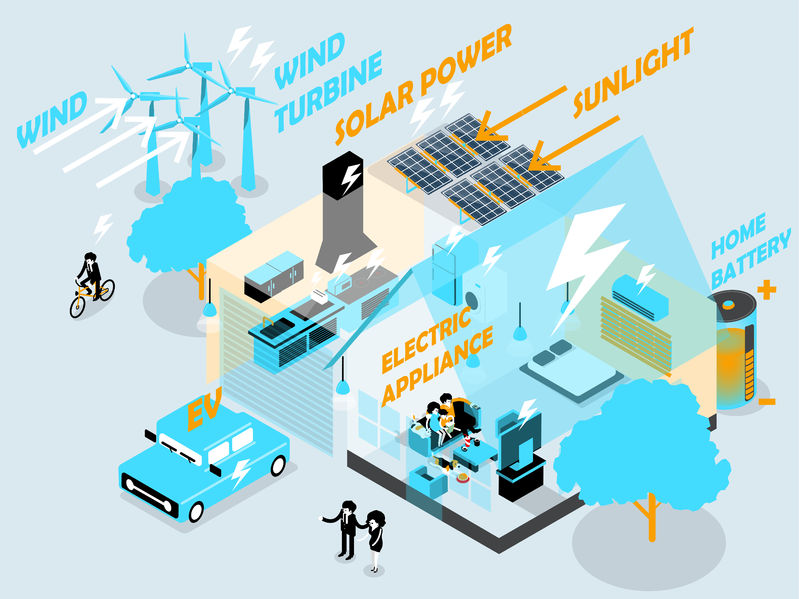
The Transition Trinity: Electric Car, Solar and Home Battery

Fuel Included was founded in 2014 in response to the threat of global warming. Our aim is to promote sustainable technologies at affordable prices, a mission that becomes ever more important as global climate changes accelerate.
59210374_EnergyHome_IsometricGraphic_123RF
Initially we concentrated on electric cars but as they become increasingly mainstream we are able to focus on other green technologies. We now offer our own home battery system, the PowerBanx, to go along with solar panel installs.

While the Global Energy Transition often seems to be about big infrastructure projects, like offshore windfarms and grid battery storage, what’s happening at the home level is arguably more important, in terms of the impact on the individual and on the future requirements for national grids.

For years we have seen the rise of solar power as it becomes cheaper and undercuts other forms of power generation. More recently, we have seen the spread of electric vehicles (EV), as the replacement of fossil fuel vehicles accelerates.

Finally we are seeing the widespread introduction of battery systems (such as our PowerBanx) into homes; all already have solar and many already have an EV.

Read more: LinkedIn


Red Tesla Model S (Image: T. Larkum)

5 Reasons EVs Will Displace ICEs

My grandfather was quite intrigued with those horseless carriages. Here he is, with a big grin on his face, testing out a Model T back in 1913.

A few years earlier, Henry Ford had debuted his Detroit assembly line and began cranking out Model Ts – the world’s first mass-produced automobile. The rest is history.

Then, a hundred years later in 2010, Nissan (OTCPK:NSANY) became the first company to mass-produce EVs (cars powered only by electricity), the Nissan Leaf. Motortrend at the time noted that the Leaf “could be the most significant vehicle of the century.”

Red Tesla Model S (Image: T. Larkum)

Did the 2010 Leaf and does today’s Tesla (NASDAQ:TSLA) Model 3 indeed herald a transportation revolution into EVs, much as Henry Ford’s Model T did into “horseless carriages” a century earlier?

Well, EV sales have soared from practically nothing in 2010 to an estimated 1.6 million in 2018 and are up 68% over 2017.

The surge in EV sales (growing 50-100% each year now) is primarily due to better and more affordable batteries and today virtually every major automaker plans on introducing electric cars, if they haven’t already, both hybrids and EVs.

Read more: Seeking Alpha

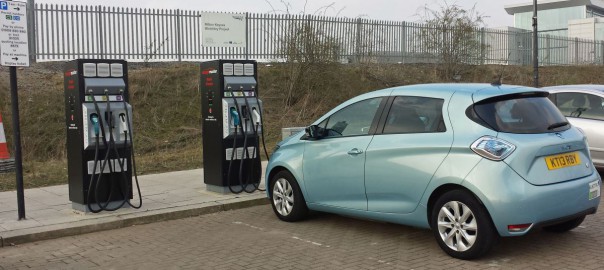
Rapid Chargers next to Milton Keynes Central railway station parking (Image: T. Larkum)

BP to buy Chargemaster electric car charging network

BP to add EV fast chargers at its 1,200 filling stations with its new BP Chargemaster venture

Oil giant BP has announced that it intends to buy the UK’s biggest electric vehicle charger suppliers Chargemaster. The Luton-based company operates the Polar charging network with over 6,000 charging points across the UK, covering home, workplace and public installations.

Rapid Chargers next to Milton Keynes Central railway station parking (Image: T. Larkum)
Chargemaster Rapid Chargers next to Milton Keynes Central railway station parking (Image: T. Larkum)

BP currently has 1,200 filling stations in the UK and says that it will roll out ultra-fast chargers, including 150kW rapid chargers capable of delivering 100 miles of range in just 10 minutes, across its forecourts within the next 12 months. The oil company estimates that there will be 12 million EVs on UK roads by 2040, up from around 135,000 in 2017.

David Martell, Chief Executive of Chargemaster, said

“The acquisition of Chargemaster by BP marks a true milestone in the move towards low carbon motoring in the UK. I am truly excited to lead the Chargemaster team into a new era backed by the strength and scale of BP, which will help us maintain our market-leading position and grow the national POLAR charging network to support the large range of exciting new electric vehicles that are coming to market in the next couple of years.”

The deal will see Chargemaster, which has 40,000 customers, rebranded as BP Chargemaster.

Read more: AutoExpress

First Pivot Power battery plans emerge outside Southampton without electric vehicle chargers

Pivot Power’s maiden 50MW battery and electric vehicle charging hub could be set for Southampton after the first planning documents appeared for the company’s proposed 2GW nationwide network.

But despite presenting the plans to the market last month as a combined energy storage and EV solution to accelerate the take-up of low carbon transport, the first documents to appear in Test Valley Council’s planning database includes no mention of charging infrastructure.

The battery storage facility, if approved, will be located on National Grid land adjacent to the existing 400kV Nursling Substation, where it will be connected directly to the transmission grid.

The 49.9MW site, just off Station Road to the south of the M27, will comprise 25 containerised batteries that will seek to utilise the advantages of the higher level connection to provide frequency response and other ancillary services to National Grid.

In place of specific mention of EV chargers connected to the site, the documents merely state that the site, as part of a “programme of installed batteries”, will provide “significant opportunities for councils” to implement their EV strategies.

Read more: Current News

Cheapest electric car uk

Renault Confirms “New Alliance Electric Platform” New Electric Vehicle Family

One billion euros is a lot of cash, even for an automaker as successful and strong from a financial standpoint as Renault. As part of the Drive the Future strategy, the French automaker said that it’s investing more than that “to accelerate investments for the development and production of electric vehicles” in its domestic market.

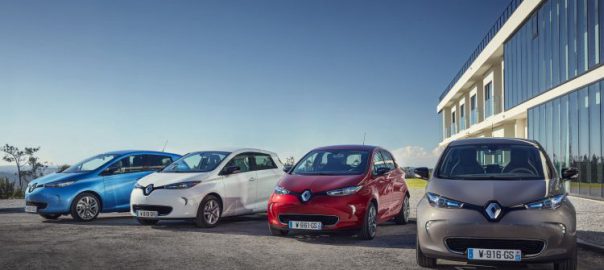
Renault ZOE Z.E. 40 Example Colours (Image: Renault)
Renault ZOE Z.E. 40 (Image: Renault)

Aiming to strengthen the industrial base in France, jumping on the EV bandwagon is the right thing to do. A considerable chunk of the one billion euros will go into the introduction of “a new Alliance electric platform” that will be manufactured in Douai. There, the company will open its second electric vehicle manufacturing site.

Regarding the assembly plant in Flins, Renault confirmed that it’s doubling production capacity of the Zoe subcompact hatchback. This decision comes as a result of an increase of 44 percent in registrations in 2017. The automaker’s growth in EV sales in Europe stands at 38 percent, boasting a 23.8-percent market share.

Over in Cleon, the company will “triple electric motor production capacities” and introduce “a new generation electric motor from 2021.” This news comes days after Renault updated the Zoe to R110 specification, improving the output to 109 PS.

Read more: Auto Evolution

Nissan Leaf (Image: Qurren/Wikipedia)

Nissan 2022: 1 million e-cars per year, zero lethal accidents

Renault’s Japanese ally has presented its first ever sustainability plan – and it’s rather ambitious. Over the next 4 years it wants to crank up its annual sales of electric or electrified cars to 1 million units per year, thereby reducing by 40 percent the CO2 emissions of its models compared to the year 2000. At the same time, it targets a 30-percent reduction in CO2 emissions coming from vehicle manufacturing and other corporate activities.

Nissan Leaf (Image: Qurren/Wikipedia)

Moreover, it wants to reduce the use of new materials by 70 percent through the promotion of circular economy of reused and recycled lithium-ion batteries used in electric vehicles. Finally, Nissan aims at reducing the water intake per unit in global production by 21 percent compared with 2010.

Read more: Fleet Europe

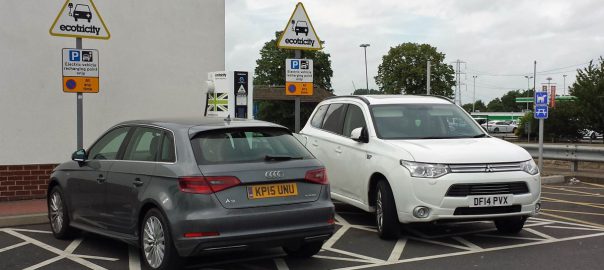
A full charge point at Newport Pagnell services, and my first ever sight of an Audi A3 e-tron (Image: T. Larkum)

Audi delays launch of e-tron quattro electric SUV amidst arrest of the CEO

After months of showing us a camouflage production prototype of the e-tron quattro, Audi was finally going to reveal the official production version of the electric SUV in August.

Now the German automaker has reportedly postponed the launch of the vehicle amidst the arrest of its CEO.

If you haven’t been following the Dieselgate scandal lately, it has started to heat up from a legal standpoint after Audi CEO Rupert Stadler was arrested earlier this month.

A full charge point at Newport Pagnell services, and my first ever sight of an Audi A3 e-tron (Image: T. Larkum)

Following the events, Audi has decided to cancel its Summit, which was the set of the launch of the production e-tron quattro.

The Financial Times reported:

“Audi, Volkswagen’s most profitable unit, said late on Monday that the Audi Summit, set for August 30 in Brussels where the e-tron will be built, has been cancelled. Instead, the summit will take place at an undetermined time and location in the United States.”

Read more: Electrek

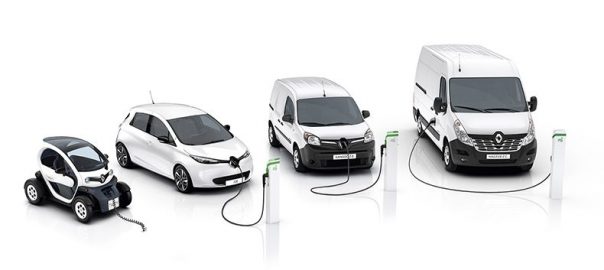
The Renault Electric Z.E. Range (Image: Renault)

Why Ghosn’s Renault paycheck depends on EV sales

PARIS — Renault CEO Carlos Ghosn has a new incentive to promote development and sales of electric vehicles: A significant part of his pay now depends on it.

Ghosn, who has led Renault since 2005, was formally named to another four-year term by shareholders on Friday. However, his mission has been significantly altered. Earlier this year he handed off day-to-day operational duties to Thierry Bollore, and he agreed to a 19 percent reduction in base pay, to 1 million euros in 2018. The 64-year-old Ghosn’s mandate now is to prepare the Renault-Nissan-Mitsubishi alliance for a future without him at the helm.

The Renault Electric Z.E. Range (Image: Renault)

Ghosn’s compensation has been a point of contention in France, with the government (which holds 15 percent of Renault) and significant number of shareholders arguing that he is overpaid, because he receives a separate salary from Nissan. After he lost a non-binding vote on pay in 2016 (and with this year’s vote binding), Renault’s compensation committee held more than a dozen meetings “to better understand this negative outcome.”

In addition to cutting Ghosn’s base pay, his long-term incentives will be reduced to a total of 80,000 shares from 100,000 (Renault stock has been trading at about 84 euros recently). Until this year, his performance targets have been conventional, equally divided among operating margin, free cash flow and shareholder return.

Those targets represent an automotive industry that was more focused on current performance than future adaptation. Recognizing that, the board has changed the criteria to better align with new strategic plans for Renault and the alliance, which call for doubling synergies from the alliance and ramping up EV vehicle sales.

Read more: Autonews

Fuel Included in Top 10 Electric Vehicle Blogs

It is with great pleasure and pride that I can announce that we have been given the award ‘Top 10 UK Electric Vehicle Blog‘ for our Fuel Included Electric Car Blog. This is in the ‘most comprehensive list of best UK Electric Vehicle blogs on the internet’.

The Best UK Electric Vehicle Blogs list is selected by FeedSpot.com from thousands of UK Electric Vehicle blogs on the web using search and social metrics. These blogs are ranked based on the following criteria:

  • Google reputation and Google search ranking
  • Influence and popularity on Facebook, twitter and other social media sites
  • Quality and consistency of posts.
  • Feedspot’s editorial team and expert review

We thank the judges for this honour – and while you’re here do take a look at the blog.

Do also see if you would find the other EV blogs of interest (just click on the image):

UK Electric Vehicle Blogs

Note that we are also involved in other blogs that you might like:

Nissan Leaf (Image: Qurren/Wikipedia)

Long-Term 2018 Nissan Leaf: Electric Autonomy—Putting Nissan’s Pro Pilot Assist to the Test

The autonomous driving experience has been, up until recently, an expensive technology reserved for luxury cars. Among others, Nissan is working to bring partial autonomous driving to lower-priced machines. Nissan’s ProPilot Assist is part of a technology package that cost just $650 on our long-term Leaf. That’s a ridiculously good deal. The Leaf’s tech package also includes automatic emergency braking with pedestrian detection, intelligent lane intervention, an electronic parking brake and high beam assist. ProPilot Assist is also available on the Nissan Rogue as well as Infiniti’s new QX50 crossover.

Nissan Leaf (Image: Qurren/Wikipedia)

Okay, so ProPilot is cheap and available (like me when I was single) but is it any good? To find out we decided to give the ProPilot a workout from Los Angeles to San Diego. Why San Diego? Aside from simply being a destination within reach the Leaf’s driving range, San Diego was the location Nissan chose to launch its new Kicks entry-level crossover, and we were on the schedule to test drive it. The event headquarters was a hotel in San Diego’s Gaslamp Quarter with a charging station in its parking garage, so I could plug the Leaf in overnight and have a full charge for my drive home. Perfect.

ProPilot aims to ease the monotony and frustration of a typical freeway commute, and no other freeway in the free world will redline your temper quicker than I-405 in Los Angeles. There’s always traffic. And the I-5 freeway, which links southern Orange County to San Diego is no slouch in that department either. The 130-mile drive from LA to San Diego can easily suck more than 3 hours from your life. So, if there ever was a time we’d like to let the car do some of the driving—this would be it.

Read more: AutoWeek