You can now buy a new car just like a mobile phone with all expenses covered, including fuel, on a simple monthly tariff.
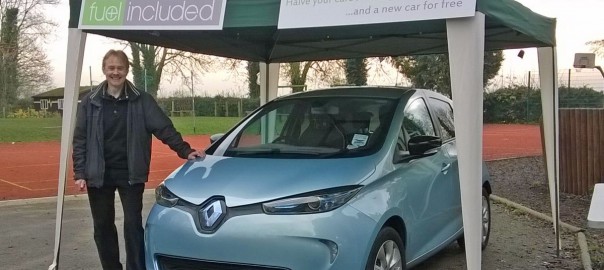
A new business, Fuel Included, has launched with the striking motto ‘Fixed Cost Motoring – Take control of your car – Take control of your life’. It is offering a completely new and unique way to drive a new car or van. You choose from a range of brand new plug-in vehicles (plug-in hybrids and all electrics) on lease, and the monthly cost includes the price of the electricity and vehicle tax.
There is a wide range of cars to choose from, including the Volkswagen Golf GTE, BMW i3 and i8, Mercedes B-Class, Nissan Leaf, Renault ZOE and Mitsubishi Outlander. New cars that will be available soon are the Audi A3 e-tron, Kia Soul EV and VW Passat GTE.
Fuel Included gives help to its new plug-in customers with telephone and email support, plus arranges the installation of a home charge point and provides public charge point access cards. It is primarily an online business (at FuelIncluded.com), supplying the cars through the customer’s local car dealer. However, it also arranges events where the public can get to see and test drive new plug-in cars.
Dr Trevor Larkum, Managing Director and CEO of Fuel Included, said:
“The vehicles we supply have very low or zero emissions and so have a very low carbon footprint. By buying your next car from us you’re not just saving money – you’re also saving the climate.”
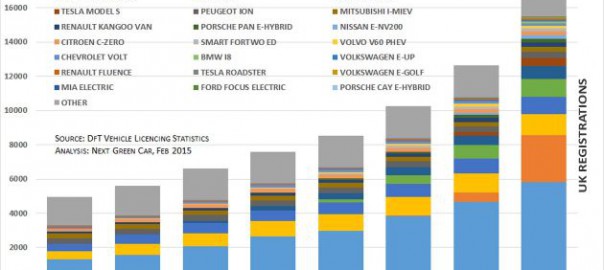
Figures recently released show that the Nissan LEAF maintains its position as the most popular electric car or van in the UK, with at least 5,838 vehicles registered by the third quarter of 2014, representing over a third of all EV sales.
The registration data also shows the new Mitsubishi Outlander PHEV has made a dramatic entry to the UK market; the electric SUV is already in second position with over 2,706 sales less than a year after its UK release.
In third and fourth places are two more established plug-in hybrids, the Toyota Prius PHEV (with 1,226 registrations) and the Vauxhall Ampera (1,039 vehicles). The BMW i3 now ranks fifth with at least 1,029 UK registrations (454 all-electric and 575 range-extender variants).
The Renault ZOE and Tesla Model S are also selling well in the UK with over 775 and 474 sales respectively; the two models in fourth and fifth sales positions across Europe as a whole (YTD October 2014).
UK electric vehicle registrations UK (Image: Next Green Car)
With the recent announcement from OLEV that 23,083 claims have been made through the Plug-in Car Grant scheme, the number of electric cars and vans in the UK now exceeds 24,500 vehicles for the first time.
Another indicator that the EV market is gaining momentum is the number of fully electric and plug-in hybrid models available in the UK. While only 9 EVs were available for the major manufacturers in 2011 (excluding quadricycles), this increased to 18 models in 2013, and now stands at 24 high-quality cars and vans (in 2014) with more models due for launch in 2015.
Dr Ben Lane, Director of Next Green Car said:
“The strong growth of the EV market in the UK as elsewhere provides yet more evidence that the light-duty vehicle market is undergoing a radical change with consumer preferences changing from petrol and diesel models to electric power-trains. With sales growing exponentially, the EVs are set to become commonplace on UK roads within the next few years.”
Until now, the only way you could get the words “electric” and “Golf” so close together was the put the word “cart” after them. Knowing that the e-Golf would be the next step in Volkswagen’s tilt at electrification, the automaker designed the MkVII platform to fit a myriad of drivetrains, none of which would require purchasers to sacrifice the Golf-ness that makes the best-selling car in Europe, not to mention a huge hit here in the States. In the e-Golf that means power electronics underhood and an amoeba-shaped battery that fits in the floorpan, between the axles, where it won’t ooze into the interior space.
We look at the e-Golf as another kind of crossover: traditional cars that just happen to be electric, offering a taste of the new EV religion in soothing, recognizable garb. We had one for a week in its natural habitat, Los Angeles and the surrounding area. We really like the fact that, powertrain aside, it maintains everything we dig about the Golf. The caveat is that this is an EV first and a Golf second – you must first address the EV challenges and live within EV constraints, then you can enjoy the Golf bits. Even so, it’s the electric car this writer would buy once we acquired the lifestyle to make proper use of it.
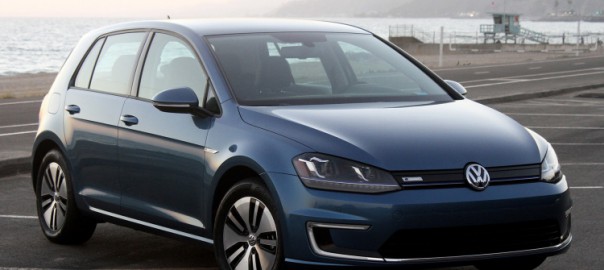
Volkswagen e-Golf (Image: J. Ramsey/Autoblog)
The most noticeable exterior change to the e-Golf are 16-inch Astana wheels wrapped in 205-series tires that reduce rolling resistance by ten percent. Once you’ve cottoned on to that, the other alterations become apparent: the blue trim strip underlining the radiator grille, the redesigned bumper with the C-shaped decoration LED lights and the full-LED headlamps above them, the little blue “e” in the model name on the rear hatch. You won’t notice the underbody paneling, that the frontal area of the e-Golf is ten percent smaller than that of a traditional Golf, that the radiator is closed off, or the reshaped rear spoiler and vanes on the C-pillars. Volkswagen says this results in a ten-percent drop in drag, getting the coefficient down to 0.281, but the standard Golf is also listed at 0.28. The TSI and TDI are 0.29. No matter those numbers, the point is the e-Golf looks just like… a Golf.
The 12,000-rpm, 85-kW electric motor equates to 115 horsepower and 199 pound-feet of torque, which compares to 146 hp and 236 lb-ft from the 2.0-liter diesel Golf. It takes 4.2 seconds to get to 37 miles per hour, 10.4 seconds to hit 62 mph, and the little guy tops out at 87 mph. That sounds like slacker acceleration, but it never feels that way – you can pull away from a light with the rest of traffic, and any time you need a squirt, 199 lb-ft of instant torque is there to woosh you forward.
Here is another short video review of the Kia Soul EV.
This time it comes from The New York Times and is a quite interesting presentation that maybe will be useful for those who are considering purchasing Kia’s electric car.
“Soul EV packs on an average of 500 pounds, making it one hefty hamster. In corners this mass is felt — generally in a good way — because of a lowered center of gravity. Acceleration is punchy and satisfying in city skirmishes, though over all, Soul EV is not particularly fast. Going from 0 to 60 hovers in the 11-second range. Don’t race a Prius. You will lose.”
When it comes to electric cars, buyers are often interested in two types of green.
The lower environmental impact of a zero-emission vehicle, and the potential to save cash by eliminating gasoline use are both typically factors that motivate the purchase of an electric car, to varying degrees in different individuals.
It’s also generally assumed that–for the mass market of car buyers — saving money is more important than saving the environment.
That has implications for the way electric cars are marketed, leaving carmakers to contemplate which benefits to emphasize.
Now, a new study suggests the environmental factor may be more important than many believe.
Participants who were reminded that conserving energy would cut air pollution used less electricity in their homes than those who were reminded only of the money they saved, according to the study results (via TakePart).
Titled “Altruism, Self-Interest, and Energy Consumption,” the study was conducted by researchers at the the University of California–Los Angeles (UCLA) and published in the journal PNAS.
At the outset, participants were asked what kinds of messages would get them to cut energy consumption.
The majority answered that it those would be messages on how much money they’d be saving. Reminders about air pollution would be less persuasive, they said.
Yet in practice, consumers who received messages about environmental benefits saved more electricity than those who received only messages about money.
Each household surveyed received updates comparing electricity use to that of their neighbors, to add a dash of competition.
One group was told how many pounds of pollution they were responsible for, while the other was shown the difference in electricity bills among neighbors.
The group that got the environmental messages saved more–cutting electricity use by an average 8 percent, or a remarkable 19 percent in households with children.
In a statement, lead researcher Magali Delmas attributed that result primarily to the “dual good” of reducing air pollution as a matter of public policy, and reducing health risks for individuals.
She said the environmental message was effective because it bundled public and private good, driving the point home for individuals.
Reminding consumers about personal health risks arguably taps into the same self-interest that motivate people to make a decision for financial reasons.
That duality between altruistic and personal motivation could make cutting air pollution a possible centerpiece for electric-car marketing.
Having two reasons to do something is better than one, after all.
After a few difficult years, Renault is finally moving upwards with electric car sales. Year 2014, with just over 18,000 EVs (almost 15,700 cars) sold, is still 3% down compared to 2013 (or 0% if we exclude Twizy), although the last couple of months of 2014 were really strong.
December ended with new record of over 3,300 sales (over 3,100 without Twizy) and it’s the very first time when Renault exceeded the mark of 3,000.
Growth year over year in November almost hit 50%, while in December it reached 57% for cars.
Renault Electric Car Sales (Image: InsideEVs)
All the good numbers comes from one car – the ZOE, because the three other models have seen sales going down. Fluence Z.E. almost doesn’t count (out of production), Kangoo Z.E. is struggling to sell at its pace from 2012 & 2013 (28% down year over year), while Twizy again weakened by 20% to 2,450.
ZOE shines at over 11,000 and this makes it the second best selling all-electric car in Europe, just behind the Nissan LEAF.
More than half (probably ~53%) of Renault ZOE sales occurred in France. Total number of ZOEs on the roads is now over 20,000.
We believe that Renault sold over 40,000 electric cars and additionally over 14,500 Twizys for a total ~ 55,000 EVs globally to date.
Oil giant BP is recommending its shareholders support a resolution calling on the company to address its climate change risks.
The move comes after Shell recommended its shareholders support an identical resolution, filed by more than 150 investors, including UK local authorities and the Church of England.
The resolutions call on the oil companies to transparently assess their business model against the commitment by governments not to let global temperatures rise more than 2C above pre-industrial levels – the threshold above which “dangerous” climate change is expected.
BP and Shell must also show how they are reducing emissions, investing in renewable energy and reforming their bonus systems so they no longer reward activities which drive climate change, the resolutions urge.
The resolutions also call on Shell and BP to report on their public policy positions relating to climate change.
The shareholders, which include multibillion-pound pension funds, investors and insurers in the UK and internationally, own about 1% of the companies.
BP is recommending its shareholders support the resolution, co-ordinated by environmental lawyers ClientEarth, responsible investment movement ShareAction and the Aiming for A coalition, at the company’s annual general meeting (AGM) on April 16.
ClientEarth barrister Elspeth Owens said:
“It’s great news that BP has today recommended its shareholders support the climate risk resolution.
“This confirms the potential of shareholder engagement and demonstrates that BP is listening to some of its biggest investors.”
Edward Mason, head of responsible investment for the Church Commissioners, part of the Aiming for A coalition, said:
“The positive way in which BP and Shell have responded to our shareholder resolutions is completely unprecedented.
“This represents a step change in engagement between institutional shareholders and the oil and gas industry on the strategic challenge that climate change poses to the industry.
“The next step is for investors to back the boards of both companies and to vote for the disclosures that we have requested and that the companies have said they will provide.
“We look forward to seeing the new in-depth reporting from both companies later this year and to continued engagement.”
In Saudi Arabia, drivers pay roughly 45 cents a gallon to fill up their cars, and in Venezuela even less. Energy is so inexpensive in Kuwait and Qatar that residents chill their enormous swimming pools in the summer and typically leave their air-conditioners on at full blast while they are away on vacation.
Across the Middle East and much of the developing world, government subsidies make energy cheap and encourage consumption. But governments around the world are beginning to take advantage of plummeting oil and natural gas prices by slashing the subsidies. The cuts are just a small fraction of the global total of annual subsidies, but energy experts say they are beginning to add up.
Even with oil rebounding in recent days — including a 6 percent rise on Tuesday for the global Brent crude benchmark — the price is down nearly 50 percent from its peak last year of just over $110 a barrel.
On Jan. 1, the Indonesian government abandoned a four-decade-old policy of subsidizing gasoline, permitting prices at the pump to rise and fall with global oil prices. As long as oil is cheap, Indonesians will not see much of a difference. Since October, India has stopped subsidizing diesel and raised fuel taxes. Malaysia cut subsidies on gasoline and diesel late last year.
Indonesians waiting to fill their scooters with subsidized fuel last November. The country has quit subsidizing gasoline. (Image: Dedi Sahputra/European Pressphoto Agency)
Angola, a major African producer, raised gasoline and diesel prices 20 percent in December. Ghana has also acted to remove subsidies, and Nigeria is expected to follow suit after its national elections in February. Iran cut gasoline subsidies early last year.
“Many of the big producers have no choice but to raise domestic energy prices,” said Jim Krane, a Middle East energy expert at Rice University. “This includes prices on fuel, but also electricity and water, since most water in the region is desalinated by burning fossil fuels. Now, with less revenue coming in, the oil-exporting regimes have a stronger fiscal incentive to do this.”
Such subsidies amount to more than $540 billion a year worldwide, and for decades they have been used as a crutch by governments to buy political support and lend a crude, but flawed, safety net to the poor, energy experts say. But they are also a drag on economic development and cause environmental damage by encouraging the burning of fossil fuels and discouraging efficiency, the experts say.
Now, with political tensions high in North Africa and the Middle East, Kuwait, Oman and Abu Dhabi have all begun to reduce subsidies on power, diesel and natural gas in recent months. Kuwait has been notably aggressive because of a fiscal squeeze, and it has plans to triple the price of kerosene and diesel early this year. (Subsidies on gasoline and electricity, though, will remain untouched for now.)
At the same time, Egypt, which began cutting energy subsidies last spring even before oil prices began their 50 percent decline, is quickening the pace of its energy reform.
For countries like India, Egypt and Indonesia, which import sizable amounts of oil, governments hope not only to save money on subsidies but also to curb energy use to improve their balances of trade. For producing countries like Oman and Kuwait, lower subsidies save their governments money when they are earning much less from their exports. For both producer and consumer countries, government funds that finance subsidies could instead go to social programs and other investments.
“We know from studies in Mexico, Africa and Asia that these subsidies do not end up in the hands of the poorest people,” said Amy Myers Jaffe, an energy expert at the University of California, Davis. “They put a strain on federal budgets that are needed to help the poor, and they end up helping the wealthiest and middle class in these societies more.”
Sultan Ahmed al-Jaber, United Arab Emirates minister of state and chairman of Masdar, a company specializing in clean-energy technology, told officials at a regional energy conference in January that money saved from reduced subsidies is
“money that can otherwise be redirected to improve energy systems and transform economies by creating jobs, stimulating economic growth and educating future generations.”
The United States, like most developed countries, does not subsidize the consumption of energy or put price controls on fossil fuels, although environmentalists point out that oil companies receive tax breaks for exploration. A debate has begun about whether to raise gasoline taxes now to repair roads and bridges, as well as to damp demand for cheap fuel.
With oil prices halved, cutting subsidies is half as expensive for the governments at a time when they are under financial stress. Saudi Arabia, for example, now consumes about a quarter of its production of oil domestically compared with only 3 percent in the 1970s, because of a growing and more prosperous population and dependence on burning oil for electrical power. At the same time, subsidized consumption has meant lower revenues for national oil companies across the region, impeding exploration and technological advancement.
Rising consumption of oil in the Middle East and in the developing world has tightened global supplies by several million barrels a day, energy experts say, helping to raise crude prices over the last decade.
For years, the International Monetary Fund and the World Bank have been urging Middle East producers and developing countries alike to cut subsidies. In a report in October, the I.M.F. reported that subsidies distort prices and foster overconsumption.
“Overconsumption leads to adverse impacts on traffic congestion, health, and the environment,” the I.M.F. paper said. “Subsidies also discourage investment in the energy sector, and encourage smuggling and black market activity, which can lead to shortages of subsidized products.”
Since 2011, there has been slow reform in the Middle East and Africa, with Jordan, Egypt, Morocco, Sudan, Mauritania, Tunisia and Yemen raising some energy prices. But turbulence in the region has slowed change. Saudi Arabia, Russia and Venezuela — three of the most heavily subsidized countries — have done little or nothing to reform.
That is because cutting subsidies often leads to a political backlash, energy experts say, and they have already emboldened the opposition in Kuwait. Cuts in energy subsidies helped produce serious political turbulence in Venezuela in 1993 and Indonesia in 1998, and more recently in Nigeria, Jordan and Ecuador.
At an energy conference in Abu Dhabi in December, Maria van der Hoeven, executive director of the Paris-based International Energy Agency, urged regional oil ministers to seize the moment of low energy prices to reduce subsidies.
“There is no time for action like the present,” she was quoted as saying by the Middle East Petroleum and Economic Publications, which is based in Cyprus. “It’s an opportunity to put a price on carbon and slash fossil fuel subsidies.”
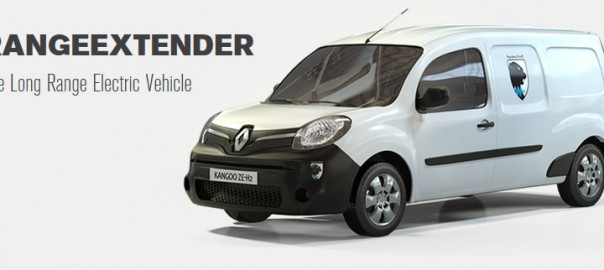
French company Symbio FCell delivered the first 5 out of 40 Renault Kangoo Z.E.s with hydrogen fuel cell range-extenders.
The electric vans are equipped with an ALP10 5 kW FC stack, which support batteries (at a certain level of discharge) to double the range.
Renault Kangoo Z.E. with Symbio FCell’s hydrogen fuel cell range-extender
The 1.8 kg hydrogen tank is good for up to 100 miles according to the press release, although we don’t know how much these modifications cost.
“In a major step towards the commercial deployment of zero-emission hydrogen-powered electric vehicles, Symbio FCell has put on the road the first five Renault Kangoo ZE Light commercial vehicles (LCVs) powered by its hydrogen Fuel Cell Range-Extender, as part of a full fleet project led by the Conseil Général de la Manche which will rapidly deploy 40 vehicles. This project demonstrates the effectiveness of hydrogen power but also the reliability of Symbio FCell’s as the world-leading provider hydrogen fuel cell Range-Extender.
“La Manche indeed counts amongst the first departments in France to own a hydrogen filling station (active in Saint Lo) and five plug-in hybrid battery fuel cell light vehicles. Furthermore, it has an important potential for low-carbon electricity production, based on marine renewable energies (hydrokinetic and offshore wind) and nuclear.
“The Conseil Général de la Manche aims to put on the road a total of forty hydrogen-powered Renault Kangoo ZE utility vehicles equiped with the Symbio FCell Range-Extender. This technology recharges the battery when it drops below a certain level and permits the vehicle to be refueled with 1.8kg of hydrogen, 1kg of which powers a distance of over 100km; the range-extender therefore almost doubles the daily range of battery powered vehicles, a significant improvement that makes hydrogen-powered electric vehicles more competitive in the automotive markets.”
Symbio FCell offers hydrogen fuel cell stacks from 5 kW to 300 kW.
Fabio Ferrari, CEO of Symbio FCell stated:
“The ‘Range-Extender’ increases both driving range and availability of Electric vehicles for commercial usage, while reducing the investment in battery recharging infrastructure for large fleet. Closer to a traditional ICE vehicle, this ensures seamless operations for professional intensive urban usages as demonstrated in previous experimentations such as La Poste.”
In 1994, no one knew how big the internet would be.
Not even broadcast journalists Bryant Gumbel and Katie Couric.
21 years later, a new big idea has them scratching their heads again.