Three new car manufacturers have joined Go Ultra Low, the campaign to increase awareness of ultra-low emission vehicles (ULEVs) among British car buyers.
Audi, Mitsubishi and Volkswagen have joined BMW, Nissan, Renault and Toyota to work with government to raise awareness of the benefits of ULEVs including low running costs and government incentives.
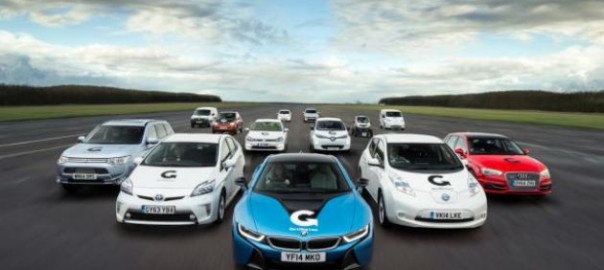
Between them, the seven Go Ultra Low members boast 15 ULEVs across a wide variety of model sizes and performance attributes, from family cars and vans, to SUVs and high performance sports cars. This broader scope of products has increased the appeal of ULEVs to more buyers, and increased uptake.
Go Ultra Low members boast 15 ULEVs across a range of segments (Image: OLEV)
With the recent announcement from OLEV that 23,083 claims have been made through the Plug-in Car Grant scheme, the number of electric cars and vans in the UK now exceeds 24,500 vehicles for the first time.
Hetal Shah, spokesperson for Go Ultra Low, said:
“More UK car-buyers are realising the advantages of owning an ultra-low emission vehicle, and the aim of the newly-expanded Go Ultra Low consortium is to share the multiple benefits with a wider audience.
“We’ve discovered that once people learn more about the benefits of these cars and vans, they’re keen to take action and once they’ve tried them, they’re hooked.”
With pure-electric vehicles able to travel around 100 miles on a single charge and other plug-in ULEVs boasting ranges of up to 700 miles, these efficient cars are a viable, low-cost option for millions of motorists across the country.
As well as tax benefits, government currently offers up to £5,000 of the price of ULEVs and the cost of driving them is as little as 2p per mile, compared to at least 10p per mile for a typical petrol or diesel car.
The Go Ultra Low campaign is the first of its kind, bringing together the Department for Transport, the Office for Low Emission Vehicles, SMMT and the consortium of seven car manufacturers.
By the end of this year, there will be several luxury SUV models offered in the U.S. with plug-in hybrid powertrains that let them run 12 to 20 miles on electricity alone.
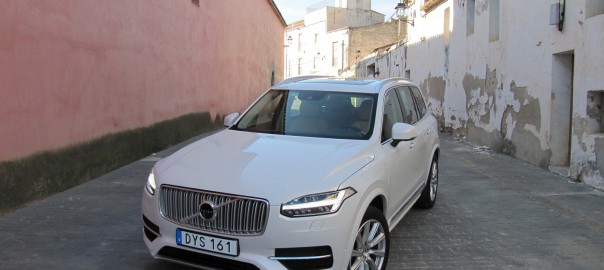
We’ve now driven one of them, the 2016 Volvo XC90 T8 “Twin Engine” model, which will go on sale this fall.
And based on our impressions of a pre-production prototype driven 96 miles through the Spanish countryside southwest of Barcelona, we think buyers will be pleased.
The plug-in XC90’s most immediate competitors will be plug-in hybrid versions of the BMW X5 and Mercedes-Benz GLE (nee ML) luxury crossover utility vehicles.
The big Volvo plug-in has one advantage over its near-term electrified competitors, though: It’s the only vehicle that was designed from scratch with a plug-in hybrid powertrain envisioned.
That allowed Volvo to put the battery pack not under the load bay, as the BMW and Mercedes do, but in the tunnel between the front passenger seats–meaning cargo capacity remains exactly the same as in the gasoline-only version.
That also makes it the world’s sole seven-seat plug-in hybrid SUV; the German models and also the Mitsubishi Outlander Plug-In Hybrid all have only two rows and five seats apiece.
The lithium-ion battery pack itself has a capacity specified at 9.2 kilowatt-hours, of which 6.5 kWh is used to power the vehicle. Volvo quotes a range of 40 km (25 miles), but that’s on the European NEDC cycle. We estimate that the comparable EPA number is likely to be between 18 and 21 miles.
The complete powertrain of the XC90 T8 comprises Volvo’s 316-horsepower 2.0-liter supercharged and turbocharged four-cylinder engine powering the front wheels through an eight-speed automatic transmission, with a 60-kilowatt (80-hp) electric motor driving the rear wheels.
There’s also a 34-kW (46-hp) starter-generator motor between the engine and transmission, which recharges the battery during regenerative braking or engine overrun, and can also provide additional torque to the transmission when maximum power is required.
The battery and both electric motors are liquid-cooled, and the battery coolant can also be refrigerated if additional heat must be shed.
Volvo quotes a combined power output of “about 400 horsepower,” but a precise torque figure of 472 lb-ft (compared to the 295 lb-ft produced by the non-hybrid version).
The onboard charger operates at 3.5 kilowatts and will have a North American standard J-1772 socket, though maximum amperage for the charger was quoted at 16 amps–a figure we’re double-checking with Volvo.
The company quotes a recharging time of 2.5 hours at 240 volts and 16 amps.
Elon Musk’s electricity empire could mean a new type of power grid
Earlier this week, during a disappointing Tesla earnings call, Elon Musk mentioned in passing that he’d be producing a stationary battery for powering the home in the next few months. It sounded like a throwaway side project from someone who’s never seen a side project he doesn’t like. But it’s a very smart move, and one that’s more central to Musk’s ambitions than it might seem.
To understand why, it helps to look not at Tesla, but at SolarCity, a company chaired by Musk and run by his cousin Lyndon Rive. SolarCity installs panels on people’s roofs, leases them for less than they’d be paying in energy bills, and sells surplus energy back to the local utility. It’s proven a tremendously successful model. Founded in 2006, the company now has 168,000 customers and controls 39 percent of the rapidly expanding residential solar market.
Fueled by financing systems like SolarCity’s, government subsidies, and a rapid drop in the price of photovoltaics, solar has been growing fast. But with that growth, some of solar’s downsides are coming to the fore. Obviously, the sun isn’t always shining when you need power, and sometimes the sun is shining when you don’t need power. The former is a problem for the user, who needs to draw on the grid when it’s cloudy or dark; the latter is a problem for the grid, which needs to find a place for that excess energy to go. When there’s a lot of solar in the system, it can get hard to keep the grid balanced.
That’s part of the reason that California, with one of the most aggressive renewable energy mandates in the country, recently declared the most aggressive energy storage mandate as well, with a goal of 1.3 gigawatts of storage by 2020. As other states adopt intermittent renewables like solar and wind, they’ll need to install energy storage too, providing a ready and waiting market for Tesla’s batteries.
Tesla Powerwall display (Image: T. Larkum)
This has been part of the plan for the Gigafactory all along. At an event in New York last fall announcing plans for SolarCity to build a gigantic PV-panel factory, Musk and Rive mentioned that every SolarCity unit would come with battery storage within five to ten years, and that the systems would supply power at a lower cost than natural gas. Those batteries will come from the gigafactory, currently being built in Nevada. Once the factory comes online, the strong demand for energy storage will allow it to immediately ramp up production and achieve economies of scale. Tesla CTO JB Straubel (who has said that he “might love batteries more than cars”) says that the market for stationary batteries “can scale faster than automotive” and that a full 30 percent of the gigafactory will be dedicated to them.
Indeed, SolarCity has already begun installing Tesla batteries, mostly on commercial buildings like Walmart stores, which have to pay higher rates when they use lots of power during peak hours. Tesla’s batteries let them store up solar power when they don’t need it, then use it when rates are high, shaving 20-30 percent off their energy bills, according to Ravi Manghani, an analyst at GTM Research.
SolarCity is also running a pilot project with 500 homes in California, according to the company’s director of public affairs, Will Craven. The project uses Tesla’s 10-kilowatt-hour battery packs and can power homes for about two days in the event of an outage, Craven says.
The prospect of cheap solar panels combined with powerful batteries has been a source of significant anxiety in the utility sector. In 2013, the Edison Electric Institute, the trade group for investor-owned electric companies, issued a report warning that disruption was coming. “One can imagine a day when battery storage technology or micro turbines could allow customers to be electric grid independent,” the report said, likening the speed of the coming transition to the one from landlines to cellphones 10 years ago. Suddenly regulated monopolies are finding themselves in competition with their own customers.
They haven’t had to deal with this on the residential side yet, primarily because people can sell excess power back to the utilities at fairly high rates — a practice called net metering. But that’s hurting utilities, too, and some have tried to lower the price at which they buy back power, which has been met by furious protests from people leasing panels. If utilities lower the buyback rate too much, however, and batteries get cheap enough, people may just unplug from the grid altogether — or more likely, install systems that let them rely on it only rarely — prompting what those in the industry call “the utility death spiral.” It’s quite a bind: by fighting net metering, utilities would help make battery storage more economically viable, driving the transition to a distributed grid.
Manghani believes utilities aren’t doomed, but they may undergo a radical transformation, becoming something closer to service providers and minders of an increasingly distributed grid rather than the centralized power producers they are today. Such a system would require lots of batteries to help balance the load and supply extra power during peak times, which is why GTM estimates the market will grow from $48 million today to about $1 billion in 2018.
This is the position SolarCity is taking as well. Last April, Peter Rive, SolarCity’s CTO, wrote that the company had no interest in prompting mass defections from the grid.
“When batteries are optimized across the grid, they can direct clean solar electricity where (and when) it is needed most, lowering costs for utilities and for all ratepayers,” he wrote.
Utilities are in the best position to direct that electricity, he said, inviting utility operators to contact him. Will Craven, Solar City’s director of public affairs, calls it “infrastructure as a service.”
“Utilities aren’t doomed, but they may undergo a radical transformation”
It would be a tricky transition, but some utilities may be open to it. During an earnings call last year, Straubel, Tesla’s CTO, said they were working with utilities.
“The long-term demand for stationary energy storage is extraordinary,” he said. “We’ve done a huge amount of effort there and have talked to major utilities and energy service companies.”
Another potential bright spot for utilities is Tesla itself. If electric vehicles take off, demand for power will go up, helping compensate for people whose homes are relying less on the grid.
All this is very good news for Musk, who starts to look less like a carmaker and more like the architect of a vertically integrated energy company, with SolarCity making solar panels that send power to Tesla batteries, both in the home and on the road.
“They’re not just carmakers,” Manghani says. “They’re part of the electricity network. At least folks in the energy industry are very well aware of Tesla as a battery maker.”
The UK’s political leaders have pledged to work together to combat climate change, whatever the election result.
In a joint statement, David Cameron, Ed Miliband and Nick Clegg said climate change was one of the most serious threats facing the world.
They said climate change threatens not just the environment but also security, prosperity and poverty eradication.
They have promised to end coal burning for power generation in the UK – unless it uses new clean-up technology.
Environmentalists say the pledge is significant because it quells some of their fears that the Conservatives might adopt a more climate-sceptic line, to mirror UKIP’s position.
‘Moment of unity’
The move will be noticed by the UK’s European partners working towards a global agreement on climate change at the UN conference in Paris in December. Some of them had been nervous that the UK might soften its leadership position in the talks, given the level of climate scepticism expressed by some newspapers and Conservative backbenchers.
The statement will also please investors who have been deterred from sinking money into renewable energy systems because they feared a withdrawal from climate policies.
It has been brokered by Matthew Spencer of the think tank Green Alliance, who told BBC News:
“The purpose is to create space for the current and future PM to ensure that the UK can play a full role in securing a good outcome in Paris.
He added that another aim was “to reassure investors that agreement remains strong across current leaders on emissions reduction, and that we’re unlikely to see a major change in direction whichever party forms the next government”.
“It’s very unusual to get a moment of unity in the midst of a general election, and it is generating lots of excitement. A non-partisan approach is the holy grail in the US. It is in our national interest to act and to ensure that others act with us.”
Severe Flooding, Against a Background of Wind Turbines: November 2012, Tyringham, Bucks. (Image: T. Larkum)
The leaders have gone so far as to promise to ban “unabated” coal-fired power generation – meaning that, if it is to continue, the emissions will need to be captured and stored in rock formations. This decision has been long debated and will send a strong signal of intent to the power industry.
The leaders state:
“Acting on climate change is an opportunity for the UK to grow a stronger economy more efficient, and more resilient to risks ahead.”
They pledge:
to seek a fair, strong, legally binding, global climate deal which limits temperature rises to below 2C
to work together, across party lines, to agree carbon budgets in accordance with the Climate Change Act
to accelerate the transition to a competitive, energy efficient low carbon economy and to end the use of unabated coal for power generation
Critics fear that combating climate change will make energy unaffordable. UKIP says climate change fears are inflated and the party’s UKIP’s energy spokesman recently said his party wanted to repeal the Climate Change Act, which commits the UK to step-by-step reductions in CO2 until 2050. He said the relationship between CO2 levels and global temperatures is “hugely open to question”.
Labour leader Ed Miliband recently restated that tackling climate change “goes to the heart of” his beliefs. A Liberal Democrat source said tackling climate change was in the party’s DNA.
The Green Party says the UK should be making much more urgent progress towards getting the country powered by renewables.
Greenpeace welcomed the new statement. Its director John Sauven said:
“This pledge marks a turning point in the collective effort to take Britain’s energy system out of the Victorian age and into the 21st century. Party leaders now need to set a clear expiry date on coal pollution, stop subsidies to coal plants, and start investing in the clean energy infrastructure this country really needs.”
Industry leaders will need reassuring about how this can be done without pushing up energy prices and making the UK uncompetitive.
Renault welcomes decision to introduce banding to Plug-in Car Grant
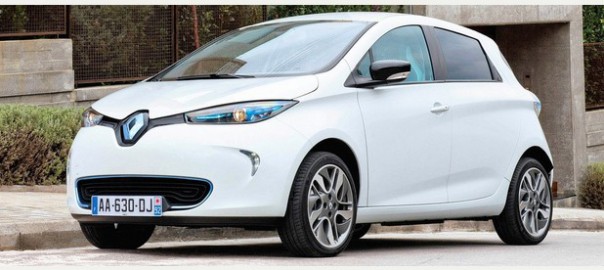
Renault ZOE now up to £552 cheaper from 1 April 2015
Renault EV sales in the UK rose 90 per cent in 2014
Renault welcomes the changes to the Plug-in Car Grant announced today by the Government’s Office for Low Emission Vehicles (OLEV).
The Plug-in Car Grant (PiCG) changes that will take effect from 1 April 2015 recognise the technological and environmental progress that vehicles have made since the original grant was announced in 2010 and provide further financial incentive for motorists to move to Ultra Low Emissions Vehicles such as the Renault Z.E. (Zero Emissions) range.
Commenting on the announcement, Ken Ramirez, Managing Director, Renault UK said:
“We welcome the changes announced today by OLEV as the move to a banding system for grant funding recognises the real-world practicality and zero tailpipe emission advantages that electric vehicles have over other types of alternative fuel vehicles.
“The Renault ZOE hatchback was already the most affordable electric vehicle on the market. The move to the 35 per cent funding for cars in the lowest emitting band will make ZOE even more affordable and encourage yet more motorists to move to zero tailpipe emission vehicles.”
The changes to the PiCG from 1 April 2015 mean that a Renault ZOE will reduce in price by £552 on the Expression trim level and by £152 on the Dynamique trim levels due to the move from a 25 per cent of vehicle value cap on the grant to a 35 per cent cap for vehicles in the new Band One (up to 75g/km and a range of 70 miles or above).
The Renault ZOE is a 5-door hatchback that has been designed from the ground-up to offer all the advantages of a practical supermini, including a 5-star Euro NCAP safety rating, with the environmental and running cost savings of a pure electric vehicle.
ZOE has an official NEDC range of 130 miles from one charge. Thanks to its patented Chameleon™ charger, and unlike its rivals, it is able to adapt itself and make the optimum use of any charging power source and therefore charge from empty to 80 per cent capacity in just 30 minutes – be that at home with the free charging wallbox that comes with the car when new or from a wide range of public sources.
Renault was a pioneer in the emerging electric vehicle market and offers a range of 100% electric cars and vans to suit most requirements. The ZOE supermini sits alongside the fun and distinctive Twizy urban run-around. Twizy is also available in a commercial vehicle version with a boot instead of a rear passenger seat – Twizy Cargo. Completing the Renault Z.E line-up is the Kangoo Van Z.E. – the perfect urban van for deliveries and tradesmen and is available in a range of bodystyles.
The Twizy is priced from £6,895, the ZOE from £13,995 (after the PiCG) and the Kangoo Van Z.E. from £12,995+VAT (after the Plug-in Van Grant).
Renault electric vehicle sales in the United Kingdom rose by 90 per cent in 2014, to 1,286 vehicles. Total Renault electric vehicle sales in Europe in 2014 stood at 17,580 vehicles – 11,231 of which were ZOEs, an amount up 27 per cent on 2013.
After a night charging up in the garage, the 2015 Volkswagen e-Golf’s display showed 108 miles of range when I pushed the start button. After slogging through San Francisco traffic then running down a rain-soaked freeway at 60 mph, covering 12 miles, the range figure was down to 82 miles, suggesting my real-world range from the garage had been 94 miles.
Still, it was considerably better than the EPA range of 83 miles for the e-Golf and illustrated the vagaries of electric car range estimates.
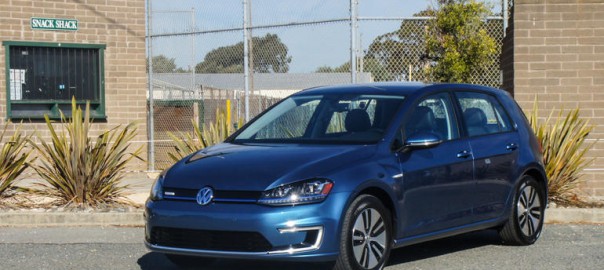
The e-Golf is Volkswagen’s entry into the electric car game, and incidentally broadens the Golf range beyond its gasoline and diesel offerings. As with other electric cars on the market, it could be considered a “compliance car,” necessary to meet zero emission vehicle (ZEV) sales requirements in seven US states that have adopted the ZEV mandate. Despite its limited range, however, I found nothing in the e-Golf to suggest it’s anything less than a fully realized car.
e-Golf is an attractive new electric from VW (Image: CNet)
Some of the e-Golf’s quality driving feel comes down to the base Golf model. Getting a major update for the 2015 model year, the new Golf is built on Volkswagen’s MQB platform, a modular chassis designed to handle a variety of drivetrains. The Golf GTI hot hatch and Golf TDI diesel share that platform and the basic Golf hatchback body with the e-Golf.
For the e-Golf, Volkswagen leaves out engine, transmission and fuel tank, replacing them with an 85-kilowatt motor driving the front wheels with a single reduction gear and a 24.2 kilowatt-hour lithium-ion battery pack. Impressively, this electric driveline gear does not impact the cabin space at all, nor does it unbalance the car. Instead, it gives the e-Golf 83 miles of zero emission driving, according to its EPA rating. The EPA rating of 116 mpg equivalent makes the e-Golf the most efficient compact electric car on the market.
As with electric cars from other manufacturers, Volkswagen offers just one well-stocked trim level. For the US, that means the navigation-equipped SEL Premium, at a price of $36,265 with destination fee. Volkswagen also offers the e-Golf in the UK, again with navigation, for a price of £30,845. UK buyers can shave off £5,000 with a government electric vehicle grant, and US buyers can figure in the government’s $7,500 tax credit.
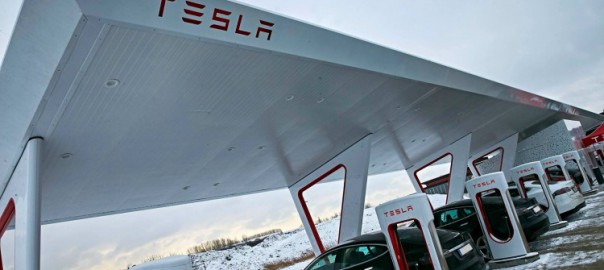
“We opened our largest Supercharger Station in Europe in Køge, just south of Copenhagen, Denmark. It has 12 Superchargers and is the first one in Europe with a solar canopy.”
States Tesla Motors.
Tesla’s Largest Supercharger In Europe…And Check Out That Solar Canopy
This site brings Tesla’s Supercharger tally in Europe too…well…we’re too busy to count and when Tesla redesigned its Supercharger site that continent-by-continent tally disappeared. See for yourself here.
“You never change things by fighting the existing reality.
To change something, build a new model that makes the existing model obsolete.”
― Buckminster Fuller
In 2007 I began to drive a Gem e4 Neighborhood electric vehicle (NEV) powered by roof top solar, It was a personal experiment connecting affordable solar PV “sunshine” to transportation.
In 2009 I began to drive the BMW Mini-E, a full electric car capable of around 90 miles of driving between charges.
At that time, in 2009, there were just the Mini-E and the Tesla Roadster drivers with no charging infrastructure, aiming at the goal of a better future for transportation.
That hopeful vision of the future was far from assured.
We had been down this road before, about a decade earlier with the GM EV1 and the Toyota Rav4EV and a few other smaller production run cars. That episode in the development of EV’s ended in disaster, and potentially our era would follow, arriving at the the same destiny.
The inertia of the status quo is a powerful foe of change. Its strength and certainty comes from the common knowledge of today and yesteryear.
By 2011 Chevy, Nissan, Tesla and others were in the EV game for good. No longer an R&D exercise, billions of dollars of plant development were green lighted for full production of the electric car. The future of the EV was almost certainly going to go forward with no chance of the stalled effort of the GM EV1 and Toyota Rav4EV.
Today, in 2015, we are looking at dozens of manufacturers and an ever growing number of plug in cars. From those first days of 2009 and less than 1000 cars on the road, to now, just five years later and 300,000 cars with plugs on the road. Amazing exponential growth.
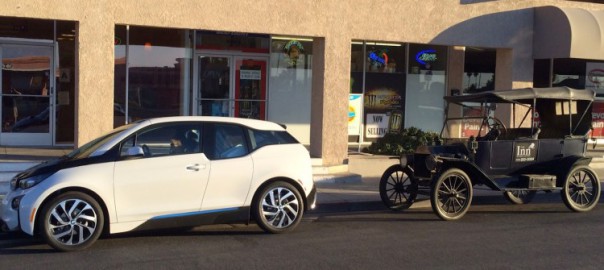
New (BMW i3) versus old (Image: P. Norby)
2017 looks to be the tipping point where the average electric car will improve to 150-200 miles per charge with both battery density and cycle duration increasing, with many manufacturers offering high volume electric cars. There ends the main obstacle of electric cars, range anxiety.
It’s possible, I would say predictable, that we will see a perfect storm in favor of EV’s in this 2017-2020 time frame. Extremely high gas prices and several models of 150-200 mile EV’s powered mostly by renewable energy.
It would not be surprising to see 30% of all cars sold being a hybrid or better with roughy 10% being pure electric by 2017. Exponential growth will continue. By 2020, a true revolution takes hold in transportation, the replacement of the gasoline vehicle feet will be underway en-masse.
Below is my view on why the electric vehicle will replace the gasoline powered car, and why it will do so very soon:
Top Ten reasons why the electric car will make the existing gasoline car obsolete.
1. They’re quicker.
2. They’re quieter.
3. They’re more fun to drive.
4. They’re connected to your home, instead of connected to oil.
5. You charge your car at home, not at the gas filling station. (just like your laundry is done at home and not at the Laundromat)
6. They’re up to 5 times more efficient and1/5th the cost to operate over the lifetime of the car. (energy conservation is wealth creation)
7. You can make your own fuel on the roof of your home.
8. They clean our air. Every EV that replaces a gasoline car makes every breath we take, cleaner and healthier.
9. They’re technologically superior, yet far simpler machines.
10. They will usher in a new transportation future including multiple mobility choices for our cities.
This time, it could be long-lasting—with dramatic consequences for the climate, the economy and the global balance of power.
Oil is the most valuable commodity in world trade, so any significant change in its price—whether upward or downward—has far-reaching economic consequences. Because oil also plays a pivotal role in world politics, such shifts can have equally momentous implications for international relations. It is hardly surprising, then, that the recent plunge in prices has generated headlines around the world. Many giant energy firms have announced massive cutbacks in employment and investment, and major producing countries like Russia and Venezuela have been forced to scale back government expenditures. While some analysts speculate that prices have now reached bottom and will soon begin climbing again, there are good reasons to believe that this descent is not just another cyclical event but rather the product of something far more profound and durable.
Before examining these factors, let’s consider the sheer magnitude of the price collapse. Last June, Brent crude was selling at about $115 per barrel, ensuring substantial wealth for the major oil corporations and oil-producing countries. Most analysts assumed, moreover, that prices would remain at this elevated level. As recently as October, for example, the Energy Information Administration of the Energy Department predicted that the average price of crude in 2015 would be $102 per barrel, about the same that it’s been for the past five years. Just three months later, Brent had fallen to as low as $46 per barrel, with some experts predicting a further slide into the $30s.
Why this sudden plunge in oil prices? That old mantra, supply and demand, is mostly to blame. The high prices of recent years have been driven, in large part, by ever-increasing demand from China and other rapidly developing countries of the Global South. Chinese consumption jumped from 7 million barrels per day in 2005 to 11 million in 2014; comparable increases were posted by India, Indonesia, Brazil and Saudi Arabia. Production increased to satisfy all this added demand, but not always fast enough to keep up—thus explaining those high prices. Over the past six months, however, the fundamentals have shifted. The economic doldrums in Europe and tepid growth elsewhere have resulted in less than expected levels of demand, while the flow of crude from America’s shale formations has reached flood proportions, producing a glut of supply and driving prices downward.
The sun sets on drilling (Image: Pexels)
Historically, the major oil powers have responded to falling prices by reining in production, thereby constricting supply and reversing the slide—but not this time around. Saudi Arabia, which lost market share to its rivals after pursuing this strategy in previous price declines, has chosen to keep pumping at current rates. At the same time, several producers, including Iraq and Russia, have increased their output. But with the US market inundated with cheap domestic shale oil and demand shrinking elsewhere, the Saudis and their competitors have been forced to lower prices in order to attract customers in non-US markets. Some have speculated that the Saudis also hope that low prices will force the Russians into curtailing their support for the Assad regime in Syria; but retaining market share appears to be their principal objective.
Whatever the combination of factors at work, the plunge in prices is having far-reaching consequences. For countries that depend on oil revenue to finance government operations, the price collapse has already inflicted serious damage. Major producers like Mexico, Nigeria, Russia and Venezuela have announced budget cutbacks, significantly impairing the ability of these governments to implement favored domestic and international programs. Russia, for example, is under pressure to reduce its military expenditures, calling into question its ability to undertake major military operations in Ukraine or other peripheral regions. Mexico has announced a budget reduction of $8.3 billion, eliminating funding for prestige projects favored by President Enrique Peña Nieto, who is already facing strong popular opposition because of rampant corruption and lawlessness at the local level. The Venezuelan government, which has long relied on oil revenue to finance social programs aimed at lifting the status of the poor, is now scaling back its efforts—further eroding public support for the socialist government of Nicolás Maduro.
If prices remain at these depressed levels for any length of time, the consequences could prove even more severe. Although President Vladimir Putin continues to enjoy strong support from the Russian population for what is seen as his aggressive pursuit of Russian national interests in Crimea and Ukraine, this could change as the current economic downturn cuts deeply into people’s standard of living. The Iraqi government, which needs high oil prices to buy new weapons and bolster its army, is having to scale back its planned offensive against ISIS. The Nigerian government is also having trouble paying its soldiers and taking the offensive against rebel forces, in this case Boko Haram. While entrenched corruption (largely the product of misappropriated oil revenue) is a major part of Nigeria’s problem, the fall in prices is making things worse; some analysts now predict that a former military strongman, Muhammadu Buhari, will defeat incumbent Goodluck Jonathan in the forthcoming presidential election. Such upsets are likely in other countries that rely heavily on oil revenue, including Mexico and Venezuela.
The fall in prices has also affected the long-range plans of many major oil companies, especially those planning costly projects in “unconventional” producing areas, such as the Arctic, the deep oceans, Canada’s tar sands and US shale formations. These projects generally turn a profit only when oil sells for $70 to $90 or more per barrel—but prices that high are now considered unattainable for the foreseeable future. In January, for example, Royal Dutch Shell abandoned plans for one of the world’s largest petrochemical plants, the $6.5 billion Al-Karaana facility in Qatar, saying high construction costs and low oil prices had rendered it “commercially unfeasible.” Chevron has indefinitely shelved its plans to drill in the Beaufort Sea and withdrawn from its shale projects in Poland; BP is scaling back its operations in the North Sea, while Occidental Petroleum is curtailing its activities in Canada’s tar sands.
Much speculation has also arisen about the viability of drilling projects in US shale reserves. Most analysts believe that drilling in the most productive formations, notably Eagle Ford in Texas and Bakken in North Dakota, will continue as before, albeit at reduced levels; however, drilling in less productive “plays,” such as the Permian Basin in Texas and the Niobrara formation in Colorado, could slow down appreciably. A lot depends on the ultimate bottom level of oil: most independent drillers, it is said, can survive a price of $60 to $70 per barrel, but a sustained rate of $40 to $50 could kill off many of them. “For rivals on the periphery of Eagle Ford and Bakken, or with acreage in more frontier plays, [2015] will be a test of endurance,” observed John Kemp of Reuters. “Some will almost certainly fail or be taken over.”
Bust cycles like this have occurred before in the oil industry, most notably in the later 1980s and ’90s, when a glut of new production from Mexico, Saudi Arabia, the North Sea, West Africa and elsewhere depressed prices and discouraged investment in frontier regions. But eventually demand, much of it from China, overtook supply, again boosting prices. This, in turn, prompted investment in new technologies that permitted drilling in previously inaccessible or noncommercial areas. With demand continuing to grow, prices rose from as low as $10 per barrel in 1998 to the recent average of $100 (except for a sharp but temporary plunge after the financial crisis of 2008). It is reasonable to assume, therefore, that prices will again recover, as occurred in 2009.
Were prices to recover quickly, we would likely see a return to business as usual, with mammoth corporate investments in shale and other unconventional sources of crude. This, in turn, would result in rising carbon emissions and pervasive environmental destruction of the sort chronicled in Naomi Klein’s new book, This Changes Everything. It would also bolster the coffers of the giant oil companies and their government backers, enabling them to better resist efforts by environmentalists to curb the consumption of fossil fuels. But will this come to pass? Although some increase in prices is inevitable—given that the current cutbacks in investment will produce an eventual contraction in supply—a return to the $100-plus levels of recent years is by no means assured. This is so for several reasons:
First, the Chinese leadership is committed to slowing and eventually reducing the country’s emissions of carbon dioxide and other greenhouse gases. Although Beijing’s drive to reduce CO2 emissions will largely focus on coal, it is also seeking to retard the growth in China’s petroleum consumption. The leadership is also wary of becoming excessively dependent on imported oil, a trend that has led to increased—and often unwelcome—Chinese involvement in the politics of major supplying countries, such as Sudan and Ethiopia.
Second, automobiles in the United States are becoming increasingly fuel-efficient as a result of rules adopted by the Obama administration in 2012. If fully implemented, these rules will require that US-made cars achieve an average fuel consumption rate of 54.5 miles per gallon in 2025—nearly twice the current level. Although lower gas prices are likely to spur increased driving and rising sales of SUVs, the increase in fuel efficiency will result in diminished overall consumption.
Finally, we are likely to witness a worldwide shift from fossil fuels to green energy. As awareness of and concern over climate change grows, governments and individuals around the world will take steps to reduce their consumption of oil. This shift will take different forms—from government-imposed fuel efficiency standards and higher taxes to multiple individual decisions to replace conventional oil-driven cars with hybrids and all-electric vehicles—but will gain momentum as the climate changes. Oil will not disappear in this process, but the giant growth in demand needed to sustain $100-plus prices may never materialize.
Given all this, it seems rather unlikely that global oil demand will expand sufficiently in the months or years ahead to re-establish the high-price regime of recent years. Prices will rise, to be sure, but could stabilize at a level well below that needed to justify costly investments in unconventional sources of crude. We would, in essence, be entering a new epoch in which oil plays an ever-diminishing role in the global energy equation.
Should this prove to be the case, we can expect a welter of accompanying changes. Many oil companies will be forced to downsize, and to abandon plans for drilling in frontier areas. This in turn will bolster the argument posed by those favoring divestment from fossil fuels that these companies are sitting on large reserves of carbon that will never be exploited—“stranded assets,” as they’re called—making these companies a less attractive long-term investment. Reduced drilling in Alberta and the Arctic would also diminish the threat to the climate and the environment. Because natural gas prices are often pegged to the price of petroleum, moreover, lower oil prices will make gas cheaper—further clouding the future role of coal and nuclear power in generating electricity. Lower prices will also make biofuels and some other energy alternatives less competitive, but, by and large, the environment will be better off.
The global political scene will also be altered. In general, power will shift from oil-producing states like Iran, Russia, Saudi Arabia and Venezuela to consuming states like China, Japan and the United States. The producers, with their revenue sharply reduced, will be less capable of pursuing ambitious political endeavors, of whatever sort. The consuming states, on the other hand, will be spending less on imported petroleum and so should see an improvement in their domestic economies. This, in turn, could tempt them to adopt a more assertive stance in foreign affairs, with unforeseen consequences. The United States, for example, could be emboldened to increase its pressure on potential adversaries like Iran and Russia, knowing they are more vulnerable to economic sanctions—but risking a dangerous backlash in the process.
How all this will play out in the months ahead is impossible to foresee. But given oil’s importance to the world economy—and the prospect for a protracted period of low or moderate prices—we could see dramatic and lasting changes in the energy economy, the climate struggle and the global balance of power.
Many drivers looking to get a new car are considering a plug-in – either an all-electric car or a plug-in hybrid – but are reluctant to make the change. A new business, Fuel Included, specialises in supplying electric vehicles and helping drivers through the transition.
The process begins with an ‘orientation’ session at a local dealer which includes a walk-around of an electric car. Then comes a test drive in the car – this always goes very well as the quiet, smoothness and performance of an electric vehicle never fails to impress. After this, most drivers are sold on the idea of upgrading to electric power, though they may decide for reasons of range that they want a plug-in hybrid (with a backup petrol engine) rather than a pure electric.
Even after the car is ordered, Fuel Included provides help and support. This is primarily in four ways. Firstly, by helping to arrange the installation of a suitable charge point in the customer’s home – usually either in the garage or on an outside wall.
Secondly, advice is provided on a suitable electricity supply tariff (taking into account the costs of overnight versus daytime charging, and any opportunities for using renewable energy). Thirdly, Fuel Included applies on the customer’s behalf for an appropriate selection of access cards for public charging points. Typically this covers at least one nationwide rapid charger network and one standard speed network.
Finally, throughout the ordering and delivery stage, and then during the first 6 months of ownership, Fuel Included provides help through a dedicated email and telephone support service. There is also useful additional information on its website (http://FuelIncluded.com).
Trevor Larkum, Managing Director of Fuel Included, puts it in this way:
“Drivers who change to electric find there was never anything to worry about. As is well known, most drivers who have gone electric can never be comfortable returning to driving a noisy and polluting car, and themselves become enthusiasts ready to persuade friends and family to make the same switch.”
With this kind of encouragement and help any driver can be confident of a smooth and painless transition to electric driving.