All posts by Repost

2020 Renault Zoe (Image: Renault)

Hybrid vs plug-in hybrid vs electric cars: which electrified vehicle is right for you

Should you buy a hybrid, plug-in hybrid or electric car? We examine the pros and cons of today’s electrified powertrains.

The age of the electrified car is upon us and the prominence of hybrid, plug-in hybrid and electric cars, on our roads and in the thinking of car buyers, is only going to grow in the coming years.

If you’re considering a new car today, at the very least you’ve probably wondered whether you should be finding out more about what the various electrified powertrain options have to offer. Hybrid technology in particular is permeating through familiar model ranges at a rapid pace as manufacturers move to lower their emissions in line with legislation and the number of pure electric options on offer is expanding quickly.

2020 Renault Zoe (Image: Renault)

With the advent of electrified powertrains, the car buying process has become even more complex. Buyers must make a decision on what are still unfamiliar technologies, deciding which would fit their lifestyle and usage patterns, prove most cost effective to run and bring the best value for money. Is now the right time to take the plunge on a pure electric car? Would a plug-in hybrid make a sensible compromise? Should you stick with good-old petrol or diesel for a while longer?

If you’ve been through similar car buying dilemmas in recent times, you’re not alone and the answers that were correct 12 months ago may not be today. The technology, the cars that use it, the infrastructure that supports it and the legislative landscape that governs it are all evolving so staying on top of it all isn’t easy.

Fortunately, our guide to hybrid, plug-in hybrid and electric cars is here to help. Below we look at each of the technologies in turn, explain the differences and identify the pros and cons…

Read more: AutoExpress

It’s Time to Go Green!

If you would like to know more about Solar Panels and the PowerBanx range of home battery systems, and get a free instant quote, please complete our online form:


EVs Are Not A Problem For The Electric Grid, They Are The Solution

One of the stock arguments you will hear against the wide adoption of electric vehicles is about how the power supply grid is going to cope with all these high-voltage devices drawing current to recharge.

A home EV charging station will require somewhere between 2kW and 7kW when it is replenishing a car battery. If all EVs are plugged in at once, surely the grid will collapse and power stations will be overextended? Dogs and cats will live together, and mass hysteria will break out? But not only is this a complete misunderstanding of EV charging habits, it could be getting things completely the wrong way round. Here’s why.

First, let’s give the negative argument some thought. There were about 33 million passenger cars in the UK in 2019, according to the UK Department of Transport, and there were nearly 274 million registered cars in the USA in 2018, according to the Federal Highway Administration of the US Department of Transportation. If all of these are swapped for EVs with batteries with at least 50kWh, and you charge them all at once at 7kW, you could be asking the UK grid to supply 231GW of energy for at least seven hours, and the US grid 1.9TW. UK power stations supplied 86.9TWh in Q1 2020, which is an average of 39.8GW per hour. The USA had a capacity of 1.1TW at the end of 2019.

This is obviously never going to work. There’s not enough capacity on either grid. But of course, it never would have to. One of the big misconceptions about EVs is that you charge them every day like a phone. This also leads to gross miscalculations about how long the batteries will last, but let’s not get into that argument right now. A survey by Statista published in January 2020 stated that in 2017 UK motorists drove on average 4,500 miles per year for private use, and the trend since then has been down. That’s just 12 miles a day, and with lots of EVs now providing a 200-mile range on a single charge, on average you’ll be charging your EV twice a month. So, in reality, assuming an even distribution of charging, the UK grid could easily cope with everyone owning an EV and charging it twice a month on average. American drivers use their cars a lot more – 13,500 miles a year, according to the US Department of Transport. But that’s still only six charging cycles a month for an EV with a 200-mile range, which is well within current capacity.

Read More: Forbes

It’s Time to Go Green!

If you would like to know more about Solar Panels and the PowerBanx range of home battery systems, and get a free instant quote, please complete our online form:

POD Point Rollout at Tesco Stores (Image: Tesco/POD Point)

Engenie joins Octopus Electric Juice roaming service in ‘crucial step’ for seamless charging

POD Point Rollout at Tesco Stores (Image: Tesco/POD Point)

Octopus Energy has added a new electric vehicle (EV) charging network to its roaming service Electric Juice.

Engenie – which operates over 150 rapid charging stations at over 100 UK locations – is the latest to come on board to the service.

Its charging locations, including London’s first rapid charging hub, will now be included in the Electric Juice network, with Octopus stating that with this addition the network now has “significant” inner-city and on-the-road coverage.

This follows on from the launch of the Beta version in May, which saw Char.gy be the first to join the network, which allows drivers to pay with their Octopus Energy account across both Char.gy and Engenie’s networks.

This is to be expanded across other charging locations as more networks are added, Octopus said, helping to eradicate the often-cited barrier to electrification of different networks requiring different apps and payment cards.

Read more: Current News

It’s Time to Go Green!

If you would like to know more about Solar Panels and the PowerBanx range of home battery systems, and get a free instant quote, please complete our online form:
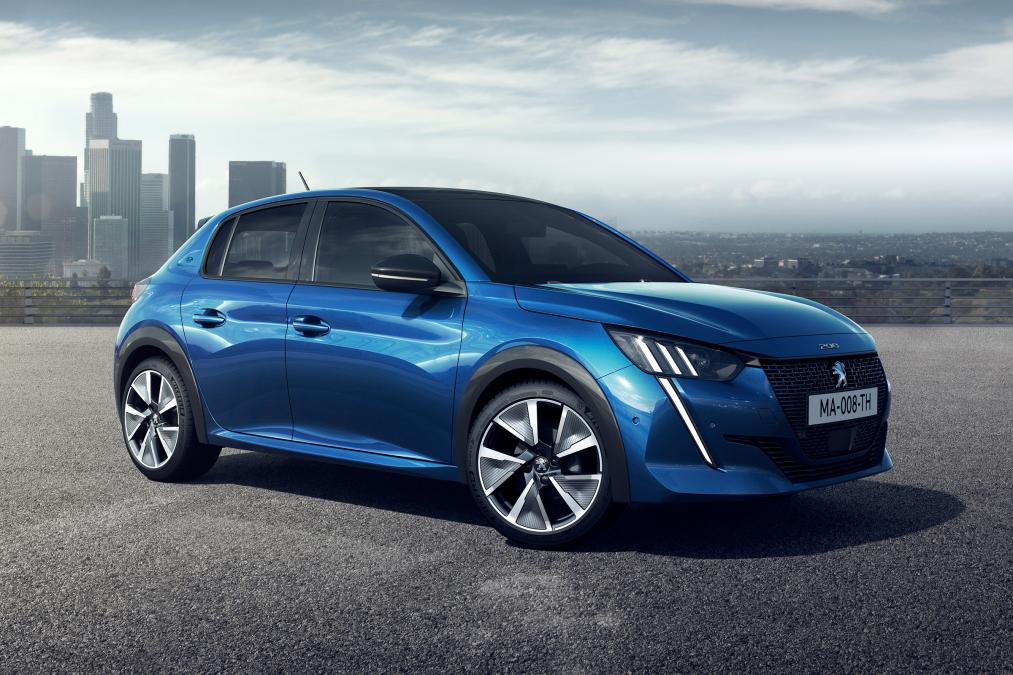
Peugeot e-208 (Image: Peugeot)

Traditional European EV Players Under Threat From Surging Peugeot

Seemingly from nowhere, French automaker PSA has assaulted a tardy Volkswagen to deliver what could be the people’s electric car.

Yes, the Renault Zoe and the Nissan Leaf, along with strong EV players from Hyundai and Kia, rule the sub-€40,000 EV roost in Europe, but the 210-year-old Peugeot has surprised the market.

Peugeot e-208 (Image: Peugeot)

PSA has already proven itself well managed to weather the Covid-19 pandemic, with a first half profit of €595 million despite its biggest markets being locked down for months.

And now figures have emerged showing its e-208, the all-electric version of its mass-volume small hatchback, stunning the market in Europe.

The e-208, which is built on the same production lines as the combustion-powered 208 models, achieved orders of 17 percent of Peugeot’s 208 model mix across its 10 biggest European markets in June.

Read more: Forbes

It’s Time to Go Green!

If you would like to know more about Solar Panels and the PowerBanx range of home battery systems, and get a free instant quote, please complete our online form:
Scottish Water Renault Kangoo electric van (Image: Renault)

Renault Set New EV Sales Record In June 2020

Renault posted an outstanding EV sales result in Europe as both ZOE and Kangoo Z.E. were selling better than ever.

Renault’s preliminary sales result for the month of June 2020 reveals a new all-time record of 12,309, which is 86% more than a year ago!

The French company hugely benefited from stronger incentives for EVs in some European countries, especially in its home market – France, and also in Germany. Demand for ZOE is booming.

Scottish Water Renault Kangoo electric van (Image: Renault)

After the first six months of 2020, the total result is over 42,600 (up 38% year-over-year).

In Europe, nearly 10% of new passenger Renaults sold in June (and over 10% YTD) were all-electric. Because Renault does not sell many EVs outside of Europe, the global share was lower: 6.5% in June and 6% YTD.

Source: Inside EVs

It’s Time to Go Green!

If you would like to know more about Solar Panels and the PowerBanx range of home battery systems, and get a free instant quote, please complete our online form:

Could the coronavirus accelerate the green transition?

Coronavirus continues to impact businesses across the globe causing uncertainty in all sectors of the economy. While lockdowns and travel restrictions have been relaxed in the UK, the drastically reduced air pollution experienced, albeit temporarily, has driven reappraisal of future mobility strategies while also highlighting a significant role and opportunity for the electric vehicle (EV) sector.

The post COVID-19 global economy will be different – bet on longer term winners

While the health threat of coronavirus will be ended by the development and distribution of a vaccine, it is increasingly clear the economic effects will be more lasting. Recovery will happen, but it will be patchy, certain sectors (travel, hospitality, office real estate) will be permanently transformed.

This altered economic landscape means short term attempts to go “back to normal” are ill advised. Instead, governments and investors will need to look at which areas have a longer-term future and back these to the hilt – and yes, this may be to the detriment of others.

In automotive terms, would anyone recommend measures to support the production of a new suite of diesel passenger vehicles while the global economy lag has depressed sales? This is the time to pivot to the development of the passenger vehicles that will be in demand once recovery is here in earnest – and those are electric.

Read more: Current News

It’s Time to Go Green!

If you would like to know more about Solar Panels and the PowerBanx range of home battery systems, and get a free instant quote, please complete our online form:

Cheap Motoring

Electric vehicles cheaper to own than petrol or diesel equivalents

Electric vehicles are cheaper to own and run compared with combustion-engined equivalents, according to new research.

Over the lifetime of a vehicle, an electric car works out at around £107 cheaper per year compared with a standard petrol or diesel car, data from Direct Line has found.

Cheap Motoring

Purchasing an electric vehicle in 2020 and running it over its lifetime would cost £52,133 compared with £53,625 for an equivalent petrol model.

“Our analysis also shows that with the ban on new non-electric cars set to come into force in less than 15 years’ time, Britons could already be saving money by switching from a traditional petrol or diesel car to an equivalent electric model”

Neil Ingram, head of motor product at Direct Line

The insurance company put the anticipated lifetime of a vehicle at around 13.9 years, with any car bought today likely needing to be replaced by the end of 2034 – just prior to the ban on petrol, diesel and hybrid cars coming into play.

Read more: Shropshire Star

It’s Time to Go Green!

If you would like to know more about Solar Panels and the PowerBanx range of home battery systems, and get a free instant quote, please complete our online form:
Renault ZOE Van (Image: Renault)

Renault Zoe van revealed as practical small EV with 245-mile range

Light modifications to the Zoe road car include a flat floor for easy loading; exterior looks largely unchanged

The Renault Zoe Van will join the firm’s fleet of electric commercial vehicles later this year.

Created by applying modest modifications to the Zoe road car – most notably opaque rear windows and the removal of the rear seats to form a flat load area – the Zoe Van will be powered by the same 52kWh battery pack and 107bhp R110 electric motor. Its range is rated at 245 miles per charge under the WLTP test cycle, allowing for a 50% payload and 75kg driver.

Renault ZOE Van (Image: Renault)

Peak charging via a 50kW DC outlet allows drivers to charge from zero to 80% in 70 minutes and a 30-minute charge is enough for a 90-mile range boost. A 22kW charger can fill the battery from empty in three hours.

Load volume is rated at one cubic metre. The load bay is 1205mm long and maximum load width is 1110mm. Maximum payload is rated at up to 387kg.

The Zoe Van is available in two trims: Business and Business+. Buyers of either can opt for rapid charging capability.

Standard equipment includes a 10.0in TFT instrument cluster, 7.0in infotainment screen with Apple CarPlay and Android Auto connectivity, manual air conditioning, electric front windows, electrically adjustable heated door mirrors, automatic headlights and wipers, full-LED headlights, 15in steel wheels and a USB socket.

Read more: Autocar

It’s Time to Go Green!

If you would like to know more about Solar Panels and the PowerBanx range of home battery systems, and get a free instant quote, please complete our online form:

Honda e Electric Car (Image: Honda.co.uk)

Honda e review: first UK test

I’m sceptical about the Honda e.

You’re not the only one – so was I. I’m using the past tense deliberately. But when it was first shown I had some issues. It didn’t look as cool and radical as the concept. I thought a base price of £26,160 was too expensive. I didn’t think 130 miles was near enough range. I thought the camera wing mirrors were a gimmick. I wasn’t sure about the car’s whole width being taken up by screens. I feared cutesy styling concealed flimsy engineering.

Honda e Electric Car (Image: Honda.co.uk)

And now you’ve spent a few days with it?

Only one of those concerns remains: the wing mirrors. Better here than in the Audi e-tron as the screens sit in a more natural place, but still a flawed solution. And I don’t get on with the electric rear view mirror in this £29,160 Advanced version, either. Makes your eyes feel funny after a while. One flick and you’re back to a normal rearwards view, trying to see past your passenger’s heads.
Other issues have cropped up, but none is remotely serious enough to prevent this being a thoroughly excellent little electric car.

Come on, let’s get those flaws out in the open.

The biggest one is boot space. The e is powered by a single electric motor driving the rear wheels alone. That means the boot floor is high and a Maxi pack of Shreddies doesn’t fit under the parcel shelf. In fact, after bag four the rest of the supermarket shop is going on the back seats. 171 litres in total when a Renault Zoe has 338 litres – almost precisely double the size. It’s not a deal breaker, but I was surprised how often things had to be twisted, laid flat or put in the rear footwells.
Speaking of rear space, you will get four adults in, but load it up with weight and that 130-mile claimed range is going to fall significantly. Especially during winter. And it’s not like you’re going to get 130 miles anyway. Reckon on 100. Probably closer to 80 with your mates on board. This is beginning to sound bad, isn’t it?

It is. What if I drive enthusiastically?

That’s not going to do you any favours either. If you want range, go for that Renault Zoe and its 50kWh battery. On the WLTP cycle it promises 238 miles range – over 100 more than the Honda with its smaller 35kWh battery. But how often do you drive 100, or even 80 miles in a day? And do you have access to another car if that’s the case? These are the key questions you need to answer, together with resolving your charging strategy. If you’ve got off-street parking, have a charger installed – it’s only a few hundred quid. It’s a wonderful feeling to arrive home and just plug in. No off-street parking? Running a cable across a pavement is probably not an option, which means you’re going to be using charge points. Minefield.

How is the Honda for nipping around town?

Possibly the best city car there is, no matter what fuel it’s powered by. It might be heavy (1,542kg) but it’s compact – mid-way between a Zoe and VW’s Up for length and width. The windscreen is nearly as upright as a Mini Electric’s, but you sit higher and have a more commanding view out over a very stubby bonnet. It’s super-simple to drive, and snaps away from lights with real vigour.
But the best thing about it is the turning circle. This side of a London Taxi, there’s nothing to touch it. It makes parking simple, multi-storeys a doddle and odd though it sounds, it’s weirdly satisfying to have something that turns as tight as a dodgem.

Read more: Top Gear

It’s Time to Go Green!

If you would like to know more about Solar Panels and the PowerBanx range of home battery systems, and get a free instant quote, please complete our online form:

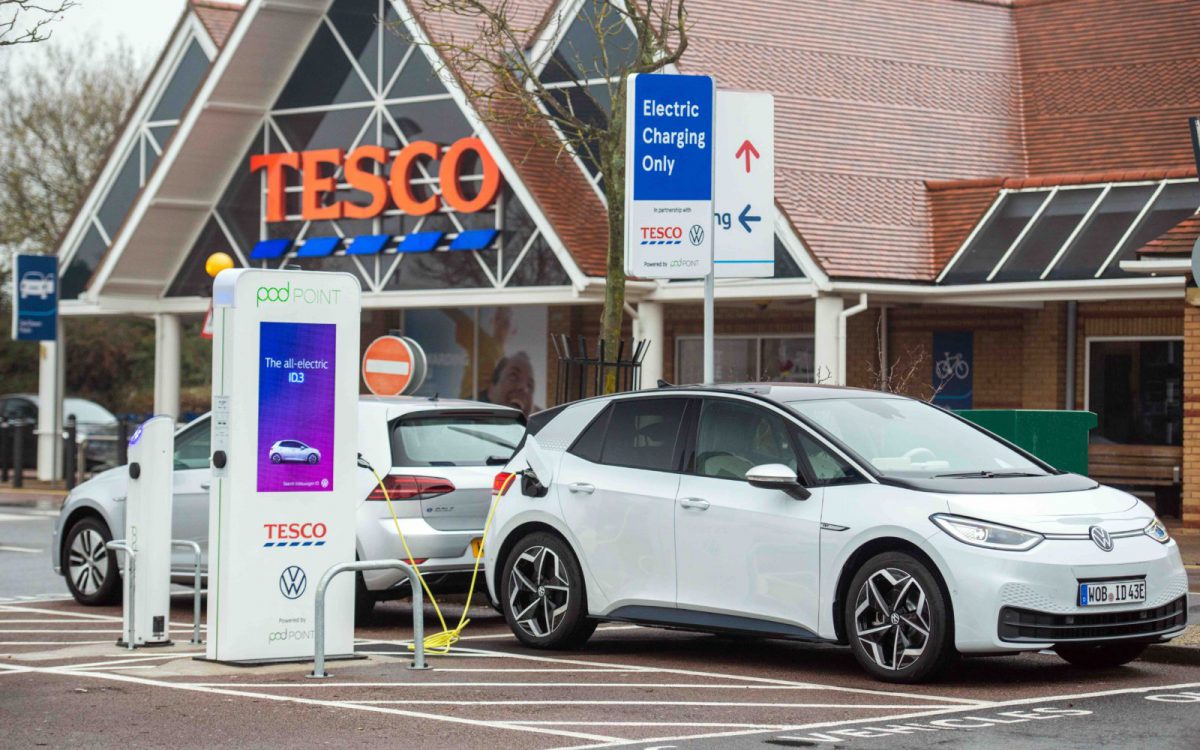
POD Point Rollout at Tesco Stores (Image: Tesco/POD Point)

Pod Point marks ‘landmark moment’ of Tesco rollout as it hits 200 stores

Electric vehicle (EV) charging company Pod Point has reached a new milestone in its rollout of chargers at Tesco stores.

Chargers have now been installed at 200 Tesco stores, with the latest – four 7kW charging bays – going in at the Chester Tesco Superstore. This takes the number of chargers installed as part of the rollout to 402, with at least two charging points installed at each location.

POD Point Rollout at Tesco Stores (Image: Tesco/POD Point)

The partnership is on track to install chargers at a further 200 stores by the end of the year, Pod Point said, with 12% of the total Tesco store footprint now having EV charging facilities.

This is set to rise to 36% following the rollout, which is being done as a partnership between Pod Point, Tesco and Volkswagen and was first announced in 2018.

It is aiming to install 2,400 charging points across 600 UK stores, with chargers first installed in 2019.

Since then, over 669MWh has been used to power customers’ vehicles, with the chargers – which are free to use – powered exclusively through renewables.

Read more: Current News

It’s Time to Go Green!

If you would like to know more about Solar Panels and the PowerBanx range of home battery systems, and get a free instant quote, please complete our online form: