All posts by Repost

Kia XCeed PHEV (Image: Kia)

This is the new Kia EV6, and the fast version will do 0-62mph in 3.5s

It’s an XC60-sized electric family car that, in GT guise, will outrun a Lamborghini Urus

This is the Kia EV6. EV presumably standing for electric vehicle, because that’s the only sort of drive it has.

Yup, Hyundai and Kia have an all-new electric platform, used in this EV6 and the Hyundai Ioniq 5. Like Volkswagen’s ID range, they’re a swerve away from doing cars where you can choose hybrid or PHEV or all-battery.

Kia in the past did a remarkably solid job of packing a long-range good-value electric drivetrain into the (admittedly pretty dreary) body of the Niro. Now imagine how good this dedicated electric car might be.

One number to get you imagining, then. Zero to 62mph in 3.5 seconds. Or another one, probably more relevant: adding 220 miles range in under 20 minutes of recharging. Both those numbers have small print attached of course, but even so this is a serious bit of kit.

The EV6 gets to UK buyers in autumn 2021. The base one is £40,895, including the bigger of two battery sizes, getting it 316 miles range. Sounds like value. More amazing, the GT, the one that does 0-62 in 3.5 seconds, is £58,295, which is an insanely cheap way to get near-supercar acceleration off the line. But it doesn’t arrive until autumn 2022.

Kia XCeed PHEV (Image: Kia)

In size, it’s somewhere between the VW ID.4 and Ford Mustang Mach-E. OK, you probably haven’t seen either of them on the road yet. So to make it more relatable let’s say Volvo XC60, but with more cabin space because of the long wheelbase and flat floor.

No-one’s going to mistake it for a car with an engine. It’s got the big-cabin-short bonnet proportions of a vehicle that needs no room under the bonnet for a bundle of reciprocating metalwork. Instead, you’ve got a front boot – froot, if you please, not frunk.

The roof teardrops away, the smoothly modelled wings bulge purposefully and the details are sharp. A slash along the lower doors sweeps upward at the rear to aim at the rear lights. The lights by the way are a loop: indicators in the lower half, brake/tail lamps in the upper half of the loop.

Kia’s new design buzzphrase is ‘opposites united’, says design director Karim Habib. He talks about soft organic volumes meeting more technical lights and jewellery.

As for the overall form, he says it’s a blend of hatch, crossover, and even rally car in the wide bulging stance with big ground clearance.

Inside, the pair of curved display screens sit behind a single glass panel. Custom shortcut keys should keep it simple to use. There’s also an augmented-reality HUD. As with most EVs, absent the transmission tunnel they could carve out bins and storage spaces below the centre screen.

More than 100 recycled plastic water bottles go into the cabin fabrics. OK, not a lot if you throw away one every day, but if you’ve stopped drinking from them (you should have) then it’s a decent deal for the planet.

The specs are a matrix of battery sizes mated to rear-only or front-and-rear motors. Base one has RWD and a 58kWh battery for about 235 miles WLTP. That gives 170bhp. Go for AWD and the extra motor boosts total power. More power too if you go for the bigger 77.4kWh battery, which gives 316 miles’ WLTP range in the RWD version. Again, adding an extra motor brings more power and quicker acceleration.

Incidentally, the related Hyundai Ioniq 5 has a smaller battery, topping out at 72kWh, and so goes slightly less far.

Big Daddy EV6 is the GT. That gets the bigger battery with punchier motors, good for 584bhp and that kidney-punch acceleration number. It’s got an electronically controlled limited-slip diff too, to help when things get bendy. But that same battery only gets this one 254 miles in the WLTP test, and of course less if you drive it like it seems to invite.

To prove its mettle, Kia filmed a 400m drag race against a Carrera 4 and Lambo Urus among others. It beat them, and was only a car length behind a McLaren 570S. Which counts as pretty stealthy, given the GT looks almost exactly the same as the base version that competes with mainstream family crossovers.

Read more: BBC Top Gear

It’s Time to Go Green!

If you would like to know more about Solar Panels and the PowerBanx range of home battery systems, and get a free instant quote, please complete our online form:

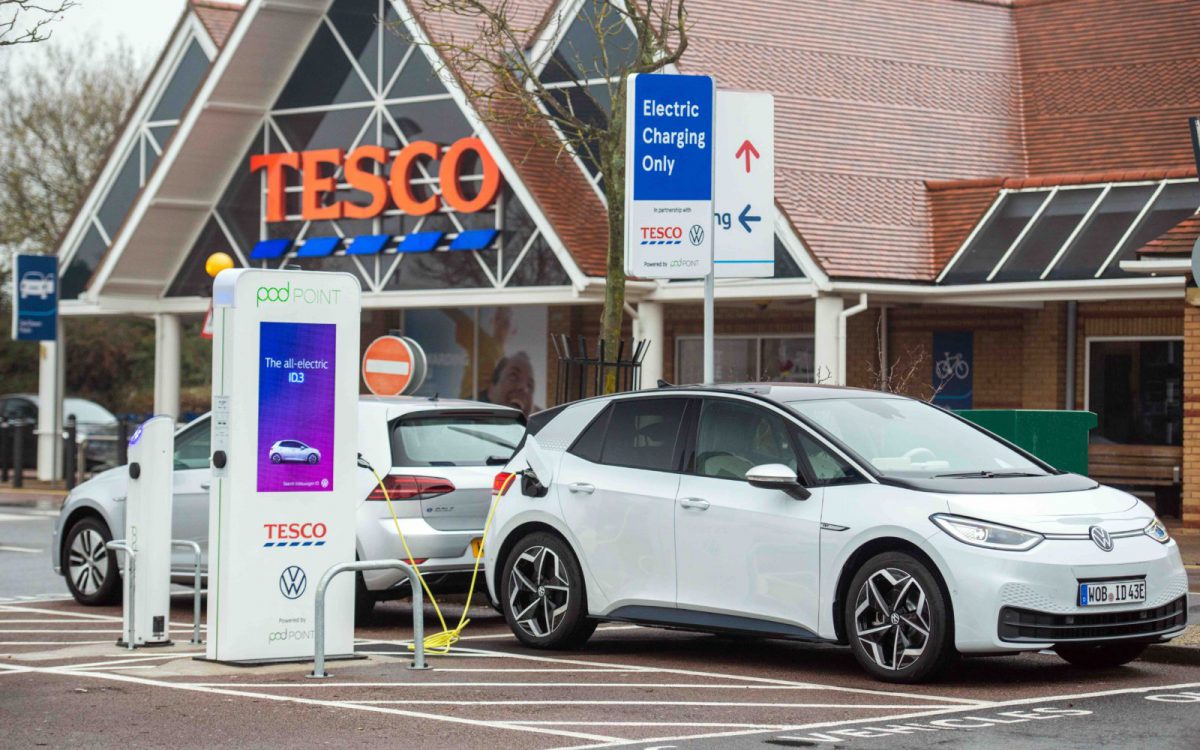
POD Point Rollout at Tesco Stores (Image: Tesco/POD Point)

IT’S ELECTRIFYING Driving an electric vehicle is cheaper than you think – costing just from 1p per mile!

We spoke to Go Ultra Low ambassador Ben Fogle all about it. In association with Go Ultra Low.

Having seen the positive impacts lockdown has had on the environment, we’re all keen to continue doing our bit – but the advice can be confusing.

From giving up meat to reducing your waste there’s so much you can do – but have you considered an electric vehicle (EV)?

Last year, we caught up with Ben Fogle, Go Ultra Low ambassador, to tell us all about his experiences with EVs.

Go Ultra Low is an industry and government campaign aiming to educate the UK about EVs.

When it comes to going green, Ben says it’s important to focus on what you can do and not what you can’t.

“I don’t think anyone is perfect and I’m the first one to put my hands up and say I’m not the perfect green citizen,” he told us. “The important thing is to realise the impact we have and work out what we CAN do.”

POD Point Rollout at Tesco Stores (Image: Tesco/POD Point)

For Ben and his family, switching to an EV seemed like a sensible and exciting decision and it wasn’t one they took lightly.

“As a family we looked at our mode of transport. We use public transport where we can – we use trains and we use buses but we also have a car and we need a car.”

“No one likes change, we’re all creatures of habit, but we’ve been an EV household for the best part of a year now – and we wouldn’t go back!”

Although switching to an EV seems like a big change, as they are at the forefront of technology, if you’re at the stage of life where you’re looking for a new car it can be an economically friendly decision as well as an ecologically friendly one.

There are now a lot of comparable price points available for EVs and plenty of leasing options, too. We’re also reaching the point where there are second hand EVs coming into circulation, so the price tag isn’t as large as you might think- and they can be cheaper to run.

When Ben used to live in London it used to cost £7 to fill the car at the chargepoint near his house, and he would combine the charge time with a dog walk. It would only take 30 minutes to fully charge and it would last them a week. Now Ben charges as home, so it’s even cheaper.

You can install a chargepoint at home or you can access one of the 38,000 public chargepoint connectors across the country. You can also get a government grant of up to £350 to help install a chargepoint in your home.

“I’d love to meet other people who get a full week’s driving from less than £7 petrol.”

Read more: The Sun

It’s Time to Go Green!

If you would like to know more about Solar Panels and the PowerBanx range of home battery systems, and get a free instant quote, please complete our online form:

Electric cars will electrify and electrocute the housing market

Of all the issues facing the broker market in 2021, possibly the biggest is staring us in the face. And yet I can find hardly any expressions of concern or advice, on line or in person.

We know now that sales of new petrol and diesel cars are to end in the UK by 2030, but do we know how this momentous decision will impact the housing market?

Certainly I have not seen any lender, estate agents or surveyor factoring the impact of electric vehicles into their pricing.

But neither does it follow that as professionals, we should not be bringing the issue to the attention of our clients – especially in such a topsy-turvy market where people in search of a home as a long term investment have never been as in need of, or receptive to, expert advice.

Brokers are faced with a genuinely unique opportunity to gen up on this dynamic subject, study local authority plans and debates and put themselves in a position of strength with which to help their clients.

This will, after all, be one of the most important development effecting house pricing over the next two decades.

The broker is still the only provider of sound and objective financial advice to whom most of us can turn when it comes to a buying a home, and right now our customers want more than just figures.

They want opinions. It’s not just about finances when societal issues are about to play such a massive part in undermining asking prices and second guessing conventional valuations.

No broker, no comment
EastEnders and Coronation Street live in a cosy parallel reality, but any broker serving an urban market is faced with a different scenario.

The fictional street scape of the 1920s bears no relation to the densification of the 2020s.

Universal charging points will see cuts to parking spaces of upwards of 60% on some residential roads.

This will have a direct effect on demand. Blocks of flats with no parking and terraced houses are the most vulnerable of all to stagnating prices.

Smart houses in leafy suburbs, where off and on street parking is plentiful, however, will enjoy an easier path to electrification, with a direct effect on price.

That said, there are no simple answers. Urban locations won’t be the only one to suffer. The hearts of many small to medium more rural towns and villages are also strangulated with parking problems.

A loss of around a quarter of local parking spaces will have a dramatic impact.

You might argue that demand for housing will rise, that the economy will prove resilient to Brexit and that valuations will maintain conventional trajectories.

But it’s by no means a stretch to suggest that the value of properties without parking or designated electric vehicle bays will suffer, while those with their own car charging or designated bays could easily increase by 15%-20% – over and above the 5-10% increase in value that having parking spaces already commands.

It’s micrographics, not just demographics
That’s why the advice you give has to be granular. For homeowners and landlords, demand will invariably fall for certain types of property. But rise for others.

In many London boroughs car ownership is already falling among younger people, motivated by electric scooters and excellent public transport.

Read more: Mortgage Introducer

It’s Time to Go Green!

If you would like to know more about Solar Panels and the PowerBanx range of home battery systems, and get a free instant quote, please complete our online form:

BP Pulse unveils UK rollout of ultra-fast EV charging hubs

BP Pulse has unveiled new plans to rollout ultra-fast charging hubs across the UK, with these to be developed in partnership with the Electric Vehicle Network (EVN).

The first of these sites – which will have 24 ultra-fast charging points – is to open later this year, with “a significant number” of rapid and ultra-fast charging locations expected to be developed.

The rollout will include “state of the art” hubs of between six to twelve chargers as well as e-forecourts with up to 24 ultra-fast 300kW chargepoints alongside on-site solar PV and battery storage systems. The e-forecourts will have both retail and convenience facilities for the drivers while they wait for the cars to be charged.

BP Pulse has signed an agreement with energy efficiency investment firm Sustainable Development Capital LLP (SEEIT) – which made a £50 million investment commitment to EVN as its development partner in EV charging infrastructure in August – for the rollout.

The EV charging locations are to be developed and constructed by EVN, contracted through a 20-year, fixed price CPI inflated Energy Service Agreement. EVN is also to manage the operation and maintenance of all the sites.

Matteo de Renzi, CEO of BP Pulse, said the new hubs will complement the company’s existing plans to launch a number of ultra-fast chargers on BP’s forecourts, adding that “it’s exciting to be launching this new additional option for drivers”.

It follows BP Pulse announcing it has made £2 million available to deliver “radical improvement” in the reliability of older UK electric vehicle (EV) charging infrastructure.

Jonathan Maxwell, CEO of SEET, said that EV sales are at an “inflection point”, adding that “this investment, in partnership with the Electric Vehicle Network, is a significant commitment to EV charging infrastructure in the UK”.

EVN is currently planning to develop a further c.400 EV charging sites, with SEEIT having the right of first refusal to provide an additional c.£150 million in the next 24-36 months.

Read more: CURRENT

It’s Time to Go Green!

If you would like to know more about Solar Panels and the PowerBanx range of home battery systems, and get a free instant quote, please complete our online form:

UK growth in EV sales driven by businesses, figures suggest

A car industry body has called on the government to support uptake among private buyers.

Two-thirds of all new electric cars bought in the UK are purchased by businesses, rather than private buyers, according to a leading industry body. The Society of Motor Manufacturers and Traders (SMMT), which records ‘official’ figures on new car sales and production, says the growth in the electric car market is being driven by the corporate sector.

According to the SMMT data, sales of electric cars rocketed in 2020, with the market up 185.9 percent compared with 2019. In total, more than 108,000 new electric cars were registered, giving the technology a total market share of 6.6 percent.

But the picture looks different when you split those sales between private consumers, who registered 34,324 electric cars in 2020, and companies, which registered 73,881 new electric cars. And battery-electric cars made up 4.6 percent of all new cars sold to private buyers last year, whereas they accounted for almost nine percent of corporate registrations.

Of course, the corporate sector has always made up a large proportion of new car sales, and these figures may not come as a great shock to industry insiders. In total, so-called ‘fleet’ sales made up 53 percent of all new car registrations last year, while private customers accounted for just 44 percent of the market.

And when it comes to electric cars, it’s companies and company car drivers that get the lion’s share of incentives. Tax rates have been cut, so electric cars now only incur Benefit-in-Kind (BiK) tax at one percent for the 2021/22 financial year. And in 2020/21, drivers didn’t have to pay a penny in company car tax.

However, both private and corporate customers will have felt the impact of changes to the government’s Plug-In Car Grant, which was slashed for cars costing £35,000 or more. The grant was also reduced, so eligible cars only saw their prices cut by £2,500, rather than the earlier £3,000.

Now, the SMMT says more must be done to help consumers into electric vehicles – particularly in light of the government’s plan to ban the sale of new petrol and diesel cars from 2030. The organisation says consumer acceptance of the technology is still low because of “concerns over affordability, charge point availability and infrastructure reliability”.

And the SMMT claims encouraging customers to make the switch will require more than just a few financial incentives; it also wants to see accelerated growth in electric vehicle charging infrastructure. In fact, the trade body says its estimates suggest the UK will need around 2.3 million public charge points in service by 2030 to provide “adequate coverage”. To achieve that figure, the country will need to install more than 700 charge points a day until the end of the decade. At the moment, the UK is installing around 42 chargers a day.

“While last year’s bumper uptake of electric vehicles is to be welcomed, it’s clear this has been an electric revolution primarily for fleets, not families,” said SMMT chief executive Mike Hawes. “Manufacturers are committed to the consumer, reducing costs and providing as wide a choice as possible of zero-emission capable vehicles with many more to come.

“To deliver an electric revolution that is affordable, achievable and accessible to all by 2030, however, government and other stakeholders must put ordinary drivers at the heart of policy and planning. We need incentives that tempt consumers, infrastructure that is robust and charging points that provide reassurance, so that zero-emission mobility will be possible for everyone, regardless of income or location.”

Read more: motor1

It’s Time to Go Green!

If you would like to know more about Solar Panels and the PowerBanx range of home battery systems, and get a free instant quote, please complete our online form:

Vauxhall Corsa-e (Image: Vauxhall.co.uk)

Vauxhall cuts electric vehicle prices so customers can still use Plug-in Car Grant

Vauxhall is the latest car maker to have tweaked pricing for its electric car range in the wake of the government’s changes to the Plug-in Car Grant.

Vauxhall’s new pure-electric Mokka-e in SE Premium trim now starts at £33,040 while the top-of-the-range Launch Edition starts at £34,995.

As for the Vivaro-e Life people mover, prices have been cut by £2,000 so the entry-level Edition model is now £34,995.

The Corsa-e supermini’s pricing remains unchanged as this model falls beneath the new £35,000 threshold.

The price cuts are in response to the government changing the Plug-in Car Grant last week.

Vauxhall Corsa-e (Image: Vauxhall.co.uk)

The grant was first introduced in 2011 as an incentive for motorists to purchase a pure-electric vehicle. But last week the price cap for eligible vehicles was reduced from £50,000 to £35,000, while the discount dropped from £3,000 to £2,500.

Paul Wilcox, Vauxhall’s recently-appointed new managing director, said: ‘At Vauxhall, we believe in making sure our vehicles are as accessible as possible to the greatest number of people, and especially so when it comes to zero emissions-in-use motoring, so I am pleased to confirm that all Corsa-e, all Mokka-e and the new Vivaro-e Life Combi are eligible for the government Plug-in Car Grant.’

The announcement of the changes to the grant came out of the blue and Vauxhall is one of a number of manufacturers who reacted quickly and changed prices for their pure-electric models.

The government’s announcement caught the car industry off guard, with Mike Hawes, SMMT chief saying it was ‘the wrong move at the wrong time’ that ‘moves the UK even further behind other markets’.

Read more: CarDealer

It’s Time to Go Green!

If you would like to know more about Solar Panels and the PowerBanx range of home battery systems, and get a free instant quote, please complete our online form:

VW e-Golf (Image: Volkswagen.co.uk)

Just How Real Is Volkswagen’s Conversion To Electric Vehicles?

In the wake of 2015’s dieselgate scandal, Volkswagen’s image was sorely in need of a makeover. The company’s brutal attack on the principles of corporate social responsibility made it for some time a pariah in the eyes of much of the public, although its sales were never affected.

So Volkswagen’s management decided to commit to electrification, based on the belief that if it didn’t it would “end up like Nokia”. In a bid to avoid fines resulting from the change in emissions standards planned for this year, Volkswagen said goodbye to hybrids in 2019, accelerated its electric vehicle manufacturing targets to one million units by the end of 2023 and 1.5 million by the end of 2025, built the largest electric vehicle factory in Europe, and carried out an ambitious investment program and reached supply agreements for batteries, which will culminate in a €35 billion investment in six battery factories and a global network of charging stations.

Unable to catch up with Tesla’s technological lead, Volkswagen’s goal is to become the number two electric vehicle manufacturer. The announcement of these plans has doubled the company’s share price over the past year, despite experiencing a 37% fall in profits due to the pandemic. The company’s electric vehicle sales tripled last year to 230,000 units: according to some analysts, Volkswagen will be able to manufacture electric vehicles for less than it now costs to make gasoline or diesel ones by 2025.

VW e-Golf (Image: Volkswagen.co.uk)

What’s missing from the German carmaker’s epiphany? Something fundamental if it really wants to be taken seriously: it must stop making diesel and petrol engines. Tesla is not the leader in electric vehicles solely because it researches and develops this technology better than anyone else, but because under no circumstances would it ever consider making cars with engines that pollute the air. That is, in addition to its quality, which also makes it a leader, in customer satisfaction. Tesla owners see themselves as fans, part of a plan, of ambitious and credible goals.

In short, what really sets a carmaker apart from the competition is that it no longer makes diesel and petrol engines. As long as Volkswagen and others that claim to have seen the light refuse to commit to going fully electric in the immediate future, it will be the same company that prefers to pay emissions fines and that prioritizes its short-term profits over the long-term common good.

Read more: Forbes

It’s Time to Go Green!

If you would like to know more about Solar Panels and the PowerBanx range of home battery systems, and get a free instant quote, please complete our online form:

Nissan Leaf (Image: Qurren/Wikipedia)

Evergreen Leafs: Celebrating 10 years of Nissan’s trailblazing EV

A decade since its creation and into its second generation, the first mass-market electric car is established and here to stay. We drive an original and a new e+ and trace its development

Ten years ago, with then all-powerful Carlos Ghosn standing in the foreground to accept plaudits, Nissan revealed its revolutionary Leaf, a Ford Focus-sized hatchback and the world’s first modern mainstream EV.

Its design and development had cost about £4 billion, Nissan insiders boasted, which was around double what they would have had to spend on a similarly sized conventional car. But, they said, their view of the future made that outlay well and truly worthwhile – and so it has proved.

Reception of the Leaf was mixed. Futurists, early adopters and the eco-minded all admired the confidence of Ghosn and co in seeing where car engineering would need to go, but industry pragmatists were much less sure. Where were the customers for this car or the market forces that would make car buyers, always conservative, take it seriously? People rarely change their habits without powerful inducements, and there were none here.

It helped that the world’s motoring journalists were encouraging. Many hadn’t driven a decent electric car until their first go in a Leaf so had laboured under the delusion that an EV would be as sluggish and unresponsive as the proverbial milk float or golf buggy. (A delusion that took longer to shift among potential customers and still lingers today.)

Nissan Leaf (Image: Qurren/Wikipedia)

They loved the Leaf’s simplicity, refinement and responsiveness, thus it was voted both Europe’s Car of the Year and World Car of the Year in 2011 – better recognition than even Ghosn and his most optimistic colleagues could have expected.

To underscore the Leaf’s decade of achievements, crowned by the fact that global sales of this UK-made car have now passed 500,000 in 59 countries (and a third of them in Europe), we decided to borrow both an original and a current model from Nissan to view and drive them – and, above all, to compare them for steadiness of concept. After all, many of Nissan’s decisions back in the 2000s, when it was deciding what EV owners would want, were essentially shots in the dark.

The early Leaf we found was a 30kWh ‘station car’ in near-perfect order because of a low mileage and a fastidious owner; the current car was an example of the recently launched Leaf e+, packing more than twice the power and range of that original, and with 0-62mph acceleration that shaved more than 3.0sec off the 2011 model’s perfectly respectable 9.9sec.

Such progress in a decade paints an interesting picture of the speed and direction of all EV development: the latest Leaf may be dynamically more capable but it also, despite growing very little in its exterior dimensions, adds handily to the original’s cabin and boot space.

In early 2011, the Leaf created immediate headlines by playing an unexpected but vital role in Japan’s recovery from a disastrous earthquake and consequent tsunami. With regular supplies knocked out, power from Leaf batteries provided much-needed electricity and light to assist Japan’s doctors to continue treating patients in some of the worst-affected areas. A total of 4.8 million households lost power; and Nissan provided 66 Leafs, grabbed back from early distribution, to power clinics and operating theatres.

This unique-to-Leaf contribution has been repeated several times since in Japan, which suffers 10% of the world’s earthquakes and experiences frequent typhoons.

Nissan has since made its EVs’ ability to ‘give something back’ a powerful selling point: working through a suitcase-sized power converter, a fully charged Leaf can power an average house for between two and four days, and when the power is expended, it can travel to an EV charger and return to do it all again. Small wonder that Nissan is a leader in efforts to portray EVs as lifesaving power sources as well as mere cars. The day is fast coming, says Nissan, when EVs will play a full-time role in powering households.

Read more: AUTOCAR

It’s Time to Go Green!

If you would like to know more about Solar Panels and the PowerBanx range of home battery systems, and get a free instant quote, please complete our online form:

Nissan Leaf (Image: Qurren/Wikipedia)

These models are are still eligible for the £2,500 electric car grant after new updates

CAR GRANTS for those purchasing brand new fully-electric road cars have been dramatically cut from £3,000 to £2,500 under a new initiative from the Government.

Campaigners have attacked the proposals with many warning it could be families and those who need to purchase larger road cars who will be the most affected. The proposals also cap the scheme to models only priced below £35,000.

This means the UK’s most popular electric car, the Tesla Model 3 will no longer qualify as part of the plug-in grant discount.

With sales of brand new petrol and diesel road cars banned from 2040, drivers must switch.

But, road users can still secure a range of vehicles under the new measures including the popular Renault Zoe and Honda E.

Nissan Leaf
The Nissan Leaf is one of the longest-running electric vehicles on the market and is a popular option for those making the switch.

The Leaf is available for just over £27,000 while the Leaf + model can be purchased for around £33,000.

The classic Leaf is capable of up to a 168 miles of range on a single charge with the premium model said to manage up to 239 miles.

Nissan claims drivers who make the switch will also benefit from no congestion charge fees or Vehicle Excise Duty (VED) rates.

Nissan also states the cars are eligible for zero percent Benefit in Kind rates meaning company car owners will pay even less.

Nissan Leaf (Image: Qurren/Wikipedia)

MG5 EV
The Government has confirmed one of the most popular electric cars the MG5 EV will still be eligible for grant payments.

The model starts from just £25,495 but is capable of up to 163 miles on electric power.

However, the car is one of the best low-budget options and even has a five star Euro NCAP crash test for extra road safety.

Honda- e
The Honda-e is one of the more quirkier electric cars on the market offering a unique, compact design.

The model is one of the only cars on the market to be fitted without traditional wing mirrors in place of camera technology beamed to the cockpit.

The car is available for just £27,000 but has a small range compared to some equivalent models with just 130 miles guaranteed.

Read more: Express

It’s Time to Go Green!

If you would like to know more about Solar Panels and the PowerBanx range of home battery systems, and get a free instant quote, please complete our online form:

Charging with an Ohme smart charging cable

Government cuts plug-in car and van grants

The Government has cut the electric car grant from £3,000 to £2,500 and excluded models that cost more than £35,000.

It says grants will no longer be available for higher-priced vehicles, “typically bought by drivers who can afford to switch without a subsidy from taxpayers”.

Tax incentives, including favourable company car tax rates, will remain in place, however.

The changes are expected to allow the funding to last longer and be available for more drivers, reflecting the growth in the number of cheaper electric cars.

Transport Minister Rachel Maclean said: “We want as many people as possible to be able to make the switch to electric vehicles as we look to reduce our carbon emissions, strive towards our net-zero ambitions and level up right across the UK.

“The increasing choice of new vehicles, growing demand from customers and rapidly rising number of charge points mean that, while the level of funding remains as high as ever, given soaring demand, we are refocusing our vehicle grants on the more affordable zero emission vehicles – where most consumers will be looking and where taxpayers’ money will make more of a difference.

“We will continue to review the grant as the market grows.”

Charging with an Ohme smart charging cable

The Government has announced a £20 million research and development competition to find solutions to the challenges associated with increasing the uptake of zero emission vehicles (ZEVs) and the necessary infrastructure

New Government legislation is also set to end the monopoly on electric car charging at motorway services, by ensuring chargers are reliable and accessible by all.

The plug-in vehicle grant scheme was renewed last year when plug-in hybrids and cars costing more than £50,000 were excluded. It was originally introduced in 2011 and has supported the purchase of 285,000 vehicles to date.

Mike Hawes, chief executive of the Society of Motor Manufacturers and Traders (SMMT), believes the decision is the wrong move to make. He said: “New battery electric technology is more expensive than conventional engines and incentives are essential in making these vehicles affordable to the customer.

“Cutting the grant and eligibility moves the UK even further behind other markets, markets which are increasing their support, making it yet more difficult for the UK to get sufficient supply.

“This sends the wrong message to the consumer, especially private customers, and to an industry challenged to meet the Government’s ambition to be a world leader in the transition to zero emission mobility.”

The number of electric cars on UK roads is expected to exceed that of diesel-powered models by 2030, research by The AA has found.

Plug-in van customers had been eligible for a 20% reduction on the vehicle purchase price, up to a maximum of £8,000. However, this has changed to 35% of the purchase price for small vans, up to a maximum of £3,000 and 20% of the purchase price for a large van, up to a maximum of £6,000.

The plug-in truck grant, which had provided funding of up to £20,000, has been cut by £4,000. The new grant covers 20% of the purchase price, up to a maximum of £16,000. It will be available for the first 250 orders placed. Grants at the £16,000 rate are also limited to 10 per customer. After the 250-order limit is reached, a maximum grant rate of £6,000 will apply.

The British Vehicle Rental and Leasing Association (BVRLA) also criticised the timing of the decision to cut the plug-in grant.

Read more: SMART TRANSPORT

It’s Time to Go Green!

If you would like to know more about Solar Panels and the PowerBanx range of home battery systems, and get a free instant quote, please complete our online form: