Sales of petrol and diesel vehicles could be phased-out by 2035 in new plans revealed by transport secretary Grant Shapps.
The intent to examine the phase-out date was announced yesterday (30 September) by Shapps at the Conservative party conference in Manchester.
“If we’re to become the world-leader in green technology, we must always be looking to expand our ambitions.
“I’d therefore like to see government look again at the 2040 target, and thoroughly explore the case for bringing this date forward,” Shapps said.
The transport secretary continued to say the government “should aim” for a new date of 2035 and will need to “test the arguments” and work with the industry to work out how to proceed.
This is a date pushed for by the Committee on Climate Change (CCC) in its net zero report, which recommended a ban of 2035 or earlier.
But Jillian Anable, co-director of the UK Energy Research Centre, University of Leeds, said the phase-out must be brought forward to at least 2032 if the transport sector is to contribute to emissions reductions.
Anable went on to say, however, that even a 2032 ban would be “nowhere near enough”.
“This phase out must include plug-in hybrid vehicles as their on-road emissions depend on how many miles are driven on the battery as opposed to the fuel tank.”
ChargePoint Services has been working alongside Torridge District Council to link them with the national GeniePoint Network. Four GeniePoint rapid chargers have been installed at strategic locations across the area, ensuring drivers living and working in Torridge, visiting the area or just passing through, have easy access to reliable, rapid electric vehicle charging facilities.
The GeniePoint Network chargers provide the latest in EV charging technology with access via the GeniePoint Network mobile web app (www.geniepoint.co.uk) or RFID card, for easy usability, payment and operation.
Torridge District Council are aiming to be carbon neutral by 2030, and encouraging residents to purchase electric vehicles is a part of enabling them to achieve this goal. The provision of easy to use, reliable charging facilities is designed to motivate the take-up of EVs in the area, both for residents and local businesses, demonstrating EVs are a cost effective, convenient and beneficial asset to their community, their business and to themselves reducing pollution and improving air quality.
Alex Bamberg, Managing Director, ChargePoint Services team, said:
“We recognise that managing the transition to electric powered transport requires investment and cooperation across multiple industries. The recent acquisition of ChargePoint Services by ENGIE gives us the strength and capability to meet the needs of the explosive EV infrastructure requirements across the UK, and we are working hard with our chosen partners to provide this facility nationally and become the number one provider of electric vehicle charging across the UK.”
Councillor Bob Hicks, Leader Member for the Economy, said:
“The Council have chosen to install this technology as we recognise and understand the importance of creating an infrastructure capable of supporting the rise in popularity in electric vehicles. The arrangements we have in place will allow us the flexibility to adapt our approach as the technology advances. The publicly accessible and popular locations mean that both visitors and residents will have a convenient option to recharge their vehicles while visiting local shops and leisure facilities at the same time. It is no secret that finances are tight in Local Government at present and partnering with ChargePoint Services helped provide a cost neutral implementation option. Being able to deploy the latest technology allowing two cars to be charged at once to 80% full in 30 minutes was also attractive.”
Drivers are offered free parking whilst using the chargers, and following the installation Torridge DC have received a plethora of positive comments from the public. The GeniePoint Network chargers have provided a physical presence to help promote the use of sustainable vehicles, and as more residents see that electric vehicles aren’t as inconvenient as they first believed, they foresee ownership of electric vehicles undoubtedly continuing to rise in the Torridge area.
As recently as 10 years ago, people laughed at the idea of an electric vehicle being a viable mode of transportation for a daily short-haul driver, let alone one who goes on long road trips.
They were mocked as unsafe, unreliable, and able to only travel very short distances before requiring a ton of time to recharge.
Fast forward to today. Technological advancements in batteries used in electric vehicles now allow you to travel long distances. Charging is quick and seamless. And electric car company manufacturers like Tesla have shown they’re a viable (even preferable) alternative for daily drivers, winning awards like MotorTrend’s Car of the Year.
Electric vehicles can also be much more economical. I personally own a Tesla Model S, and it has saved me over $500 a month on gas. Over an 8-year period of ownership, that will add up to $48,000.
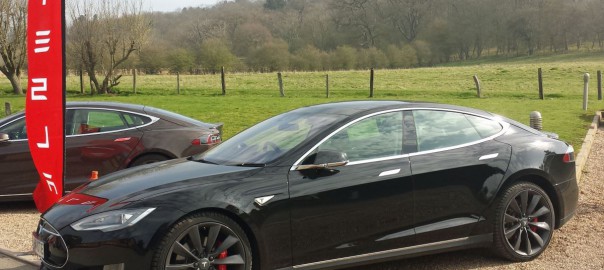
Tesla Model S (Image: T. Larkum)
To give you confidence that an electric vehicle can be used for traveling long distances, we’ll go over current trends and options, as well as some of the pros and cons compared to traditional gasoline-powered vehicles.
Electric vehicle options
If you’re thinking about going electric, you can choose between a hybrid car or a fully electric vehicle.
Hybrid vehicles use two different types of power. The most common ones combine a gasoline-powered engine with an electric motor. Some of the most efficient hybrids have a fuel efficiency rated as high as 60 mpg on the highway, according to CarsDirect. That’s a lot higher than the overall average U.S. vehicle fuel economy, which Reuters says is 24.7 mpg.
Fully electric vehicles, however, deliver the most in terms of fuel efficiency. Vehicles like the Tesla Model 3 have been rated as high as 136 mpg equivalent (the EPA energy measurement for electric vehicles), and can save you tons of money you would otherwise spend on gas.
Road trips in an electric vehicle
With technological advancements in batteries, electric vehicles can now go just as far on a charge as gasoline-powered cars can on a tank of gas.
If you would like to know more about Solar Panels and the PowerBanx range of home battery systems, and get a free instant quote, please complete our online form:
Kia Motors dealers in Spain are not allowed to sell pure battery electric cars or plug-in hybrids (PHEVs) until the first day of next year under new management instructions.
In a letter sent to the entire dealership network of Kia Motors in Spain, the director of planning and logistics, Javier Casado, urged dealers to postpone invoicing EVs and PHEVs as of 1 October and delay the registration of the same type of vehicles as from 1 November. All these ‘obligations’, the letter reads, are ‘unavoidable’ and must be observed ‘without exception’. The sales ‘restrictions will be eliminated as of 01 January 2020’.
This new evidence proves what T&E has been saying for months now: carmarkers have been delaying the sales of cleaner cars until the new CO2 standards kick in 2020. Kia is waiting until literally the last possible date, the final day of the year. The tactic by carmakers is delaying more European drivers getting electric cars in an attempt to maximise SUV-fueled profits.
Julia Poliscanova, clean vehicles director at T&E, said: ‘Carmakers have been crying wolf that demand for electric cars is not there, that customers don’t want to buy cleaner cars. The reality is that carmakers have been holding back sales of EVs in order to squeeze every last drop of petrol and diesel cars. This letter is just another proof of it.’
Maryland petrol station swaps oil for electric as statewide electric vehicle fleet climbs to 20,000
A petrol station in Maryland is the first of its kind to completely transition from traditional pumps to electric vehicle charging stations.
RS Automotives in Washington DC is the US’s first fully petrol-to-electric refuelling station, exclusively for electric vehicles, when it opened earlier this week.
It can charge up to four vehicles at once within 20 to 30 minutes.
Charging Station in Sunderland (Image: Fastned)
The conversion was supported by the Electric Vehicle Institute, which received a $786,000 Alternative Fuel Infrastructure grant from the Maryland Energy Administration in 2018.
The 2019 Frankfurt Motor Show, IAA (Internationale Automobil-Ausstellung), was a strange and different experience compared to the last time I was there.
The road trip in itself was a +1000 mile long and very satisfying experience in my Tesla Model 3, which I will dedicate another post to cover. In the following article, though, I will try to put into words the puzzling buzz of change in the realm of passenger cars from a consumer perspective.
Quick IAA 2017 Recap
I wrote about my trip to the IAA in 2017 on EVObsession, and apart from apologizing deeply that I drove in my son’s knackered 1994 VW Golf, because it would have been a nightmare to drive my own 1st-gen BMW i3 with what would have been around 30 charging stops in total, I also had this thought on the long drive home:
“When the German brands start offering a wide range of fully electric models, that are comparable to the current fossil fuel models, German EV sales will explode. The question is, will the German auto industry make the transition fast enough, and will they be able to keep up with demand? These heavyweight companies probably think they have a loyal customer base, but what if these people get tired of waiting and begin ordering Teslas? Or even Chinese models? The clock is ticking.”
Well, German auto giant Volkswagen Group may just make it in the nick of time, because what I think I saw at IAA 2019 was a whole lot of people ready to spend money on electric cars!
Pending Avalanche In The Electric Compact Segment
How was IAA 2019 different from 2017? When I entered the large exhibition hall housing VW, Porsche, Audi, Seat, and Skoda, it was very clear something had changed. I mean, there was an actual waiting line to enter the hall! And inside it was mayhem. This was Saturday, midday, and it seemed every German family, their kids included, was in that hall. Kids? Sure, it’s not unusual to see an occasional parent bring a child that has an interest in cars, but this was like Disneyland!
Slowly it dawned on me what was going on. The VW brand occupied half the hall, with all the I.D. vehicles center stage, which in itself was grand and sparkly, but not so many people were pushing to get to see the models on stage. No, because VW had cleverly placed several ID.3s all over the place and this is where the pushing and shoving was taking place, mostly by kids!
Volkswagen ID.3 electric car (Image: Volkswagen.com)
I recently had my Tesla Model 3 at a local town fair, and about 30 kids where crawling inside and out of my car, playing video games on the center screen and looking for buttons to push, all the while shouting at their father: “Buy one dad!” Father was glancing at mother, who was whistling through her teeth: “No!” (Because nobody has realized the Model 3 is considerably cheaper than the Model S). But here these ID.3s were filled with kids crawling all over and pushing all the buttons (yes, it has more buttons than the Model 3), and parents where nodding at each other and clearly thinking: “Yes, this could work!”
It was like the ketchup effect, propelled by the neighborhood effect. The last time I was here, I heard people who where looking at the prototype EVs and going: “Yeah, maybe it’s the future, but hey look, the new VW T-Roc is cool!” As if it would be embarrassing to even suggest the next family car could be electric. This time around everybody was fondling and probing the affordable compact electric vehicles, hardly noticing their internal combustion ancestors glooming in the corners.
A Labour government would take the UK’s offshore wind capacity to 52GW within the next 10 years and invest billions in EV charging infrastructure, the party has said.
Ahead of shadow energy secretary Rebecca Long Bailey’s speech at the party’s conference today, the party unveiled a raft of clean energy pledges designed at ramping up the country’s renewables portfolio and enabling a widespread adoption of electric vehicles.
Milton Keynes ‘Mushrooms’ Charging Hub (Image: T. Larkum)
The pledges feed into previously-announced plans to overhaul the UK’s power system, starting with the “immediate” renationalisation of transmission and distribution grids.
The plans also feed into a wider policy agenda, spoken of by Labour deputy leader John McDonnell yesterday, focusing on a UK equivalent of the Green New Deal to tackle climate change, which McDonnell described as the primary political question of today.
Offshore wind and a People’s Power Plan
Labour has pledged to create a ‘People’s Power Plan’, wherein the government will take a 51% stake in as many as 37 new offshore wind farms, to be built in the UK. Those offshore wind farms would swell the country’s offshore wind capacity to 52GW by 2030, marking a significant contribution towards renewable output.
It said the intent for the public to own a majority stake in new developments was designed to prevent private and foreign public firms dominating deployment of offshore wind as they are now. Last week’s offshore wind CfD results, wherein the asset class clinched record low strike prices of £39.65/MWh, saw the third round principally won by companies including SSE, Equinor, Innogy and Statkraft.
Speaking at the conference today, Long Bailey also said that the country could not “rely on the market to act fast enough”.
Labour has also committed that 80% of all profit generated from the public’s stake in new offshore wind would be redirected to new renewable generation, wider energy system improvements and to aid the “climate transition”.
Range-topping version of Porsche’s first all-electric car shows the rest of the world how it should be done
What is it?
I think this handsome thing is the world’s best electric car. I suppose it should be, because the new Porsche Taycan, in toppermost Turbo S form, costs £138,826 before options – and you’ll need to specify some of those, as we’ll come to.
Porsche Taycan Turbo S (Image: Porsche)
First, though: this electric car/Turbo combo. There’s something not quite right there, wouldn’t you say? Although Supercharger and Autopilot don’t seem to mean what I thought, either. Look, we all know Turbo is a sub-brand, not a literal thing, says Porsche. It means souped up, which is why there are Turbo versions of vacuum cleaners or already turbocharged 911s.
Figuratively, Turbo means chuffing powerful. The Taycan Turbo S figuratively and literally is that. It has 751bhp, albeit on overboost, for a few seconds, during launches, when it can hit 60mph from rest in 2.6sec. Even the regular Taycan Turbo (merely £115,828) has 670bhp in the same mode. Both, strangely, make 617bhp when you’re not launching.
Cheaper, less powerful, non-Turbo Taycans will follow, but when early adopters with heavy wallets are waiting, why offer those now?
This expensive market entry, then, is Porsche’s first pure EV, but the company has form with electricity via its hybrids, plugged in or otherwise, in road cars and motorsport. The Le Mans-winning 919 has been running an 800V electrical system since 2011 and the Panamera Turbo S E-Hybrid is the kind of car we use on a drag race video when we want to give a Tesla Model S’s Ludicrous Mode a hard time.
The Taycan will be able to fill that brief without the Panamera’s internally combusted element. It’s a five-door hatchback, marginally smaller than a Panamera, built on a new platform, with a raft of lithium ion batteries beneath the floor. They total 93.4kWh, good enough for a WLTP range of up to 280 miles in the Turbo (which has an exceptional drag coefficient of 0.22) or 256 miles in the Turbo S (Cd 0.25).
There are two motors – one front, one aft – powering all four wheels. The rear motor has a two-speed transmission, although it drives around mostly in second gear, with the low ratio reserved for the sportier of its drive modes at lower speeds. The Turbo S gets active rear steer, carbon-ceramic brakes, a different inverter to allow the overboost and bigger wheels as standard, but generally the differences over the Turbo are limited.
Scottish Fire & Rescue Service orders 45 Renault ZOEs
Renault ZOE will be used to help spread important safety messages across Scotland
Renault ZOE the first zero-emissions-in-use vehicle to be added to the Scottish Fire & Rescue Service fleet
Order represents the beginning of the organisation’s drive to have an all-electric fleet
The all-electric Renault ZOE will be helping to save lives and some of the UK’s most beautiful scenery after the Scottish Fire & Rescue Service (SFRS) ordered 45 to be used throughout Scotland in the support of its frontline operations.
Scottish Fire & Rescue ZOE (Image: Renault)
SFRS, the world’s fourth largest fire and rescue service, will use the zero-emissions-in-use Renault ZOEs as general pool vehicles, with each covering at least 10,000 miles a year. They will be used by uniformed staff, office employees and management to interact with the public in non-emergency situations, which span free home safety visits to community events, and will be spread across the whole of Scotland, including all major cities and as far as Orkney and the Shetland Islands.
Significantly, the new ZOEs are SFRS’s first pure electric vehicles and represent the beginning of a significant shift in how it will evolve its fleet of nearly 1,800 vehicles. The Renault ZOE proves that electric vehicles are now a viable business proposition, combined with the Scottish Government’s sizeable investment in charging infrastructure, SFRS is committed to moving to an entirely electric fleet.
The Renault ZOEs replace traditionally fueled hatchbacks and now account for nearly a quarter of SFRS’s pool car fleet. They will be based at strategic station locations throughout the country, with SFRS installing up to six charging points at each site. Aided by the Renault ZOE’s flexible charging options, additional charging will also be carried out via ChargePlace Scotland – the country’s government-supported public EV charging network.
SFRS chose the Renault ZOE due to its ‘real-world’ range of 186 miles, comprehensive standard specification, ease-of-use and value all contributing to the organisation’s decision.
Scott Roberts, Fleet Manager, Scottish Fire & Rescue Service, said: “The best way to deal with an emergency is to prevent it from happening, and the ZOEs will play a vital role in how we engage with communities and deliver our crucial safety messages. The Renault ZOE’s range and the vastly improved charging infrastructure means we have been able to spread them far and wide, and there’s not a nook or cranny of Scotland that one of our ZOEs isn’t able to cover.
“Introducing them has been a major step in our future direction and while we have previously adopted hybrid technology with a handful of vehicles, they felt more like a box ticking exercise and never really worked on a practical or financial basis. With the ZOE, we can see that having environmentally-compatible electric vehicles is a viable business model, allowing us to reduce our carbon footprint, preserve the country we are so passionate about and provide our team with a vehicle that is perfect for their requirements.”
The party says if it gets elected, it’ll offer loans to low income households
Labour says that it will offer 2.5 million interest-free loans to buyers of electric vehicles to accelerate the uptake of zero-emission vehicles if it is elected.
Shadow chancellor John McDonnell confirmed that the loans would be up to a value of £33,000 and be available to low income households, independent contractors and small businesses.
It says the government would cover £1,500 cost of interest and claims recipients would save up to £5,000 over the course of the loan.
However, acceptance into the scheme would require participants to take part on a mass trial of vehicle-to-grid technology, which sees electric cars used as energy storage devices that can be tapped into to take stress off the national grid.
McDonnell said:
“This will stimulate the automotive industry, it will sustain jobs in the conversion from fossil fuels to electric but actually it will create new jobs as well.”