All posts by Jo

Blades Being Installed on Turbine 5, Yelvertoft Wind Farm (Image: T. Larkum)

Britain’s wind turbines catch breeze of a rising industry

The sound made by 100 tonnes of steel and carbon fibre rotating 400 feet overhead is surprisingly understated. Each whoosh of the 260 foot blades spans an area the size of the London Eye and generates enough electricity to power the average British home for 24 hours.

Blades Being Installed on Turbine 5, Yelvertoft Wind Farm (Image: T. Larkum)
Onshore Wind Farm (Image: T. Larkum)

There are 32 of these 8MW turbines in the second phase of Dong Energy’s Burbo Bank wind farm spinning off the Merseyside coast.

They are the most powerful ever, dotting an area the size of almost 6,000 football pitches within the Irish Sea, each one a beacon of Britain’s global dominance in the booming offshore wind industry.

Benj Sykes, the UK boss for Dong Energy’s wind power business, predicts he may be cutting the ribbon on turbines with double this power capacity by 2024.

“If you wind the clock back four or five years, this scale of technology was considered very ambitious. Now, you can see them in reality, commercially deployed. It’s very difficult to say where we will ultimately get to,”

he says.

Wind turbines have already more than doubled their power capacity since Dong Energy constructed the first phase of Burbo Bank in 2007 with 3.7MW structures. By the mid-2020s turbines may double again and a capacity of 15MW could be spinning in Europe’s waters.

As the efficiency and power potential of each turbine increases, costs keep falling.

Read more: The Telegraph

100 new PHEVs to be introduced by 2021, research finds

Research from Frost & Sullivan finds that the global PHEV market is estimated to reach about 3.7 million units by 2025 with 4.8 million light vehicles in an optimistic scenario and 2.9 million light vehicles in a conservative scenario.

Mitsubishi Outlander PHEV Concept-s

The reasons behind such growth include the imminent launch of 100 new models, favourable incentives, emission target compliance, and long battery ranges.

However, factors that may impede PHEV adoption include the phasing out of electric vehicle incentives, long-range battery electric vehicles, emergence of 48V mild hybrids, and the complexity of having two powertrains in a single vehicle.

“The stringent emission norms of 95 g CO2/km can only be met by PHEV technology, while EV battery technology evolves to overcome limitations. PHEVs have a better market than BEVs due to uncertainty in charging infrastructure,”

said Frost & Sullivan Intelligent Mobility Research Analyst Pooja Bethi.

“Owing to their ability to provide internal combustion engines and EV advantages, the PHEV market is set for high demand and growth.”

Dedicated EV platforms like the Volkswagen (VW) MQB, Mercedes-Benz EVA, and BMW FSAR are major drivers, pushing PHEV growth.

Read more: Green Fleet

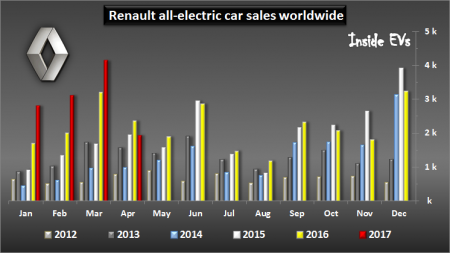
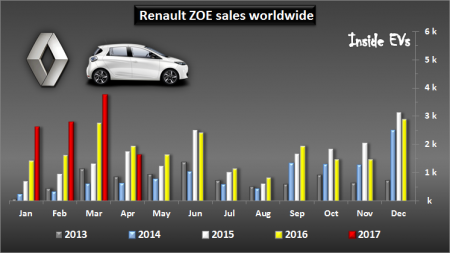
After Record Surge In Q1, Renault ZOE Sales Slow In April Due To Brake Issue

The introduction of a new longer-range Renault ZOE 40 Z.E. with 41 kWh battery and 300 km (186 miles) of real world range has translated into “higher highs” being set for sale…until this month.

April disappointed with just around 1,690 ZOE deliveries (a drop of 14.5% year-over-year).

In general, overall Renault electric car – mostly relied on ZOE – also decreased to 1,931 (down 18%).

Thankfully, sources indicate that April’s hiccup was not demand-related, but rather build-related.

And while we don’t ever wish for production flaws, or recalls, deliveries during the month where muted thanks to a defective part installed on cars produced before April 19th.

The repair (to do with locking the vehicle in parking mode using the handbrake) apparently isn’t the most simple fix, reportedly taking from 6-8 hours to rectify, and the company says it will likely take until the end of June to work all the issues out of the system.

New vehicles now coming of Renault’s Flins assembly line are not effected, but it may take another month to see sales rebound and return to previous trajectories.

With that said, and after four months, Renault has still sold nearly 12,000 electric cars (excluding Twizy), which is 29% more than year ago.

Source: Inside EVs

Half the Great Barrier Reef may have died in last two years

AS MUCH as half the Great Barrier Reef may have died in the back-to-back bleachings over the past two years.

Bleaching on a coral reef in Great Barrier Reef. Picture: ARC Centre of Excellence for Coral Reef Studies/AFP

But the head of the authority in charge of the reef says the actual extent of damage is tricky to calculate because some parts are growing well.

The Great Barrier Reef Marine Park Authority believes about 30 per cent of coral, in the reef’s northern part, died last year in bleaching caused by warmer ocean waters, chairman Russell Reichelt told a Senate committee on Monday.

Surveys after this year’s bleaching are still being done but initial observations suggest 20 per cent of coral — mainly in the central area of the 344,000 sq km reef — is dead.

“Don’t think of these figures as the net amount of coral on the Barrier Reef because there are quite big movements upwards as well as downward,”

Dr Reichelt told the senators at an estimates hearing in Canberra.

The southern part of the reef had grown by about 40 per cent in recent years because it hadn’t been hit by cyclones or bleaching — but it was likely it would suffer from those in the future.

A diver examines bleaching on a coral reef on Orpheus Island. Picture: Greg Torda/AFPSource:AFP

Dr Reichelt said the bigger picture question was the coral’s resilience in the face of bleachings, tropical storms and other threats such as the crown of thorns invasions.

“It depends on the frequency of these major impacts and the concern is the frequency could well be increasing and the recovery time will be insufficient,”

he said.

“If the recovery time is very short, there won’t be a lot of coral.”

Read more: News.com.au

JLR and UK government announce national EV battery hub plans

As part of the UK’s ambitions to become a leading hub for the development of electric vehicles (EVs), Britain’s biggest carmaker Jaguar Land Rover (JLR) and the UK government have announced plans for the establishment of the core UK hub for EV battery production and development.

Joined by academics and business leaders for the announcement on Tuesday, the central UK players aim to create the National Battery Prototyping Centre (NBPC) in Coventry, which will become the home for EV development and testing in the UK.

UK automotive aims for the national test centre acting as a catapult for large-scale battery production at the historic centre of the UK auto industry. The city of Coventry is already home to the main London Taxi Company EV factory and major JLR research facilities at Warwick University. It also forms part of the key connected and autonomous vehicle (CAV) cluster in the country, which stretches from Birmingham and Oxford to London.

JLR CEO Ralf Speth said the founding of the national battery centre would help JLR to commit to building electric vehicles in the UK, as is wishes to do. Its all-electric I-PACE SUV, which is set to beat rivals to market launching in 2018, will be made in Austria, and JLR has also gone overseas to Slovakia for a new production plant for its conventional vehicles. Speth says that in order for it to springboard major production in the UK, it requires considerable improvements to UK-based capabilities, including in pilot testing, support from science (often through universities) and in the UK’s energy supply (with UK energy being some of the most expensive in the world). At least in the first two areas, the UK government now looks set to deliver.

Read more: Autovista Group

Miles of ice collapsing into the sea

[The NY Times] went to Antarctica to understand how changes to its vast ice sheet might affect the world.

Ice sheets flow downhill, seemingly in slow motion. Mountains funnel the ice into glaciers. And ice flowing from the land into the sea can form a floating ice shelf.

Glaciers in certain areas have been undercut by warmer ocean waters, and the flow of ice is getting faster and faster.

The acceleration is making some scientists fear that Antarctica’s ice sheet may have entered the early stages of an unstoppable disintegration.

Because the collapse of vulnerable parts of the ice sheet could raise the sea level dramatically, the continued existence of the world’s great coastal cities — Miami, New York, Shanghai and many more — is tied to Antarctica’s fate.

Four New York Times journalists joined a Columbia University team in Antarctica late last year to fly across the world’s largest chunk of floating ice in an American military cargo plane loaded with the latest scientific gear.
Inside the cargo hold, an engineer with a shock of white hair directed younger scientists as they threw switches. Gravity meters jumped to life. Radar pulses and laser beams fired toward the ice below.

On computer screens inside the plane, in ghostly traces of data, the broad white surface of the Ross Ice Shelf began to yield the secrets hiding beneath.

“We are 9,000 miles from New York. But we are connected by the ocean.”

said the white-haired engineer, Nicholas Frearson of Columbia.

Nicholas Frearson, at left, in the cargo hold of an LC-130 Hercules.

A rapid disintegration of Antarctica might, in the worst case, cause the sea to rise so fast that tens of millions of coastal refugees would have to flee inland, potentially straining societies to the breaking point. Climate scientists used to regard that scenario as fit only for Hollywood disaster scripts. But these days, they cannot rule it out with any great confidence.

Yet as they try to determine how serious the situation is, the scientists confront a frustrating lack of information.

Recent computer forecasts suggest that if greenhouse gas emissions continue at a high level, parts of Antarctica could break up rapidly, causing the ocean to rise six feet or more by the end of this century. That is double the maximum increase that an international climate panel projected only four years ago.

Read more: NY Times

Renault Kangoo Z.E. 2017 review

The Kangoo Z.E. is the all-electric, zero emissions version of Renault’s smallest van

The Renault Kangoo ZE is the electric version of the Kangoo, Renault’s smallest van. Like the diesel version, it’s available in standard, Maxi and Maxi Crew body styles. In reality the only difference between the diesel and ZE (Zero Emissions) version is the fact there’s an electric motor under the bonnet instead of an engine, and a battery pack under the load area where the fuel tank would normally be.

Renault Kangoo ZE

The Kangoo ZE has a payload of 650kg, which is the same for the Maxi ZE, while the two versions have a load volume of 3.4 and 4 cubic metres respectively. This pair are two-seaters, while the Maxi Crew ZE has five seats.

Prices start from around £16,500, thanks to a Government Plug-In Car Grant of up to £8,000, while Renault offers two purchase options; you can either buy the Kangoo ZE outright, or buy the van and hire the batteries to help keep costs in check and eliminate any concerns about the batteries losing their longevity.

Power for the Kangoo ZE comes from a 44kW electric motor, which is the equivalent of 60bhp from a conventional engine. While that means the ZE has less power than any of the conventional Kangoo range (and 0-62mph takes a laborious 20.3 seconds), it doesn’t feel slow, thanks to a healthy 226Nm of torque (only the more powerful dCi 110 does better), and this torque is available as soon as you put your foot on the accelerator, so it really does nip away from the traffic lights.

Renault claims a range of 106 miles for the Kangoo ZE – it’s the same for the Kangoo Maxi, and is the same quoted for the Kangoo’s main rival, the Nissan e-NV200 – but in the real-world you can expect a range of around 75 miles on a full charge.

Read more: Auto Express

Severe Flooding, Against a Background of Wind Turbines: November 2012, Tyringham, Bucks. (Image: T. Larkum)

Arctic stronghold of world’s seeds flooded after permafrost melts

No seeds were lost but the ability of the rock vault to provide failsafe protection against all disasters is now threatened by climate change

Severe Flooding, Against a Background of Wind Turbines: November 2012, Tyringham, Bucks. (Image: T. Larkum)

It was designed as an impregnable deep-freeze to protect the world’s most precious seeds from any global disaster and ensure humanity’s food supply forever. But the Global Seed Vault, buried in a mountain deep inside the Arctic circle, has been breached after global warming produced extraordinary temperatures over the winter, sending meltwater gushing into the entrance tunnel.

The vault is on the Norwegian island of Spitsbergen and contains almost a million packets of seeds, each a variety of an important food crop. When it was opened in 2008, the deep permafrost through which the vault was sunk was expected to provide

“failsafe” protection against “the challenge of natural or man-made disasters”.

But soaring temperatures in the Arctic at the end of the world’s hottest ever recorded year led to melting and heavy rain, when light snow should have been falling.

“It was not in our plans to think that the permafrost would not be there and that it would experience extreme weather like that,”

said Hege Njaa Aschim, from the Norwegian government, which owns the vault.

“A lot of water went into the start of the tunnel and then it froze to ice, so it was like a glacier when you went in,”

she told the Guardian. Fortunately, the meltwater did not reach the vault itself, the ice has been hacked out, and the precious seeds remain safe for now at the required storage temperature of -18C.

Read more: The Guardian

Electric Cars Are the Story Now, but Battery Power Is the Future for Tesla Inc.

You know Tesla (NASDAQ: TSLA) as a builder of electric cars. But that’s not necessarily what the company is about in the long run.

The electric car thing has become a temporary stop on a longer and much more ambitious journey, as Tesla’s mission has since expanded beyond just sustainable transportation. Tesla CEO Elon Musk wants to change the world, and that includes getting people used to replacing gas-powered vehicles with electric cars.

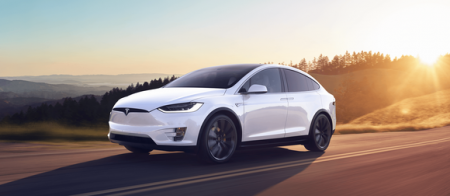
Tesla Model X

The Model X car is a good example of Tesla’s public image so far. .

Secrets and speculation?

This is not speculation on my part, or even a closely guarded secret. Musk laid out his master plan in some detail 11 years ago, and doubled down on the same theme last year.

In short, Tesla was always meant to develop and promote sustainable energy sources for everyone and everything. The expensive Tesla Roadster sports car only aimed at raining the capital to develop more affordable electric cars for a larger mass-market demographic — and even the Tesla Model S and Model X are just cash-generating stepping stones on the road to a clean-energy revolution.

Along the way, Musk is using Tesla’s capital platform and wide-ranging media reach to introduce and popularize other technologies for the good of humanity. Self-driving cars will make the road a safer place, while saving even more energy. Taking emotions and human error out of the driving experience can do both of those things.

Tesla’s early forays into electric vehicles and self-driving cars got the ball rolling. Now, Detroit and Japan are falling all over themselves to beat Tesla at its own game.

Read more: Madison.com

Consumer Reports Runs The Numbers On Tesla’s Solar Roof

Consumer Reports, which six months ago was skeptical about the viability of Tesla’s Solar Roof product, has once again “done the math” using newly announced pricing estimations.

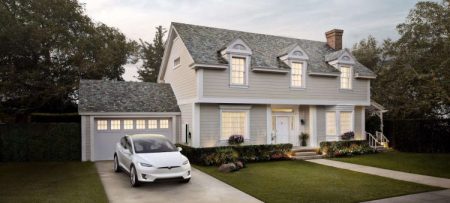
Tesla Solar Roof in Slate, Due for Release in 2018

According to CR, it’s not easy to weigh value of the offer, as company’s online calculator

“relies upon some important assumptions and predictions that delve deep into the economy of residential solar power in the U.S.”

In its first analysis, CR said that costs need to be below $24.50 per square foot to match costs of conventional roofs (including the cost of Powerwall batteries, but excluding solar incentives or rebates). A 3,000-square-foot Solar Roof would then cost $73,500.

Tesla announced an estimated cost at $21.85 per square foot, which would be $65,550 for the same example house.

After using Tesla calculator for example homes in New York, Texas and California and a 30 years period, CR found out that in some cases Tesla offers a good savings opportunity, although in other cases, it doesn’t look so good.

However, even if one’s first calculations seem tempting, CR advises to answer some questions before placing deposit.

Read more: Inside EV’s