New laws to extend the High Speed 2 line will be announced in tomorrow’s Queen’s Speech as part of a drive on key infrastructure projects.
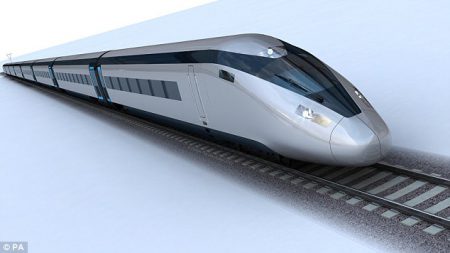
A computer generated image of artist impression issued by HS2 of the proposed HS2 station at Euston.
Legislation to encourage space rockets to be launched from UK soil and to spread the use of electric cars will also be included in the two-year programme, which will otherwise be dominated by Brexit.
A Bill that will allow the extension of the HS2 rail project from Birmingham to Manchester will be announced in the Queen’s Speech. Officials say that as well as providing quick trains to London, the development will expand capacity on commuter lines.
Phase one of HS2 London to Birmingham has been approved by Parliament but even by the most optimistic estimates will not be completed for another decade.
The total budget for HS2 is £56billion but critics say the eventual bill could top £100billion
Ministers said they want to establish spaceports in ‘regions across the UK’, to allow satellites to be sent into space for the first time from UK soil, and to allow spacecraft to fly to the edge of the atmosphere. Satellites cannot currently be launched from the UK.
The new law will allow ministers to licence various space-related activities including rockets, ‘space planes’, and satellite operation. Other powers will make it easier for drivers of electric cars to register to use charging points. There are an estimated 100,000 electric cars and vans on Britain’s roads.
Being faced with any issue on a standard petrol car is bad enough, we have been used to these mechanics for years, but what happens when your car is electric and something goes wrong?
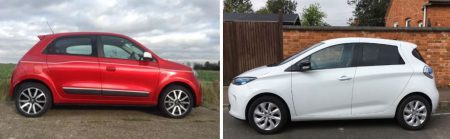
Arranging a time for repair is the same as any car, and I found Renault Customer Services to be very helpful, they acted straight away getting me a courtesy hire car with no delay. However I was disappointed that it wasn’t an electric car, I was given a Petrol Renault Twingo.
I must say, it felt like I was driving something much older than 2 years, it felt archaic and awkward. While there was nothing actually wrong with this little car, I soon realised that the Renault ZOE is much more than a regular car.
Renault Twingo & Renault ZOE
The benefits alone are undeniable, with this petrol car I was now paying parking at almost £5 per day, using a petrol station felt grubby and the cost of fuel (£32.55 for one tank) was twice as much as a month’s worth of ‘electric fuel’ in my ZOE. Luckily Renault Customer Services were understanding and agreed to pick up all of these expenses that I’d otherwise have not incurred. Aside from the running costs I must say, I really missed the serenity and ease of driving the ZOE, with its automatic driving (there are no gears), reversing camera and quick acceleration to name but a few features I really like in the ZOE.
After what felt like an age, I was finally reunited with my ZOE. I won’t miss the Renault Twingo but if nothing else the time spent with this little petrol car made me realise that I had made the right decision going electric and I won’t be looking back.
Soon Tesla owners will be able to check solar roof and powerwall status, as well as manage settings via an in-car app.
Elon musk went on a bit of a Tweetstorm again recently, and out of it came some new information. Being that Musk believes that eventually most customers will also go solar, and invest in a Powerwall, the company has already taken steps to further integrate the products.
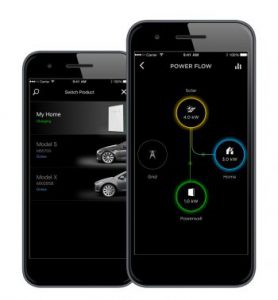
The updated mobile app allows those with solar roofs and Powerwalls to check power status and adjust settings via their devices. This is simply on par with many of the new home management systems in which users can mobily adjust their thermostat, engage or disengage alarms, monitor energy usage, etc.
Basically, with access to the app, Tesla owners can check how their home system is using power. Is the power coming from the Powerwall, or the solar system, or from the local grid? This way, you can see exactly what is happening at any given time.
We recently reported about YouTuber, DeRage, tapping into Tesla’s API to create a program that shows vehicle and home data all in once place. He used a program called Splunk to design dashboards for such information.
Mobile App now shows Powerwall and Solar energy flow
Soon, if you own a Tesla vehicle and a home solar system, you will be able to do this yourself, using the car’s touch screen. Being able to see vehicle energy consumption, along with home energy consumption, and especially being able to tie them together, will be a helpful tool. If you happen to have a non-Tesla home system, something like DeRage designed would be the next best thing.
This is just another way for Tesla and Musk to further tie all products together, in hopes that consumers will come to Tesla for all their needs, instead of a third party.
DETROIT — Autonomous vehicles with no human backup will be put to the test on publicly traveled roads as early as next year in what may be the first attempt at unassisted autonomous piloting.
Two on-demand Renault Zoe autonomous taxis will be deployed in Rouen, Normandy. Pictured is the standard version of the 2016 Renault Zoe. (Renault)
Automotive electronics and parts maker Delphi and French transport company Transdev plan to use autonomous taxis and a shuttle van to carry passengers on roadways in France.
The companies on Wednesday said they plan to combine Delphi’s self-driving technology with Transdev’s knowledge of mobility operations. Transdev operates trains, buses, ferries and other transportation services in 19 countries, including the U.S.
Two on-demand Renault Zoe autonomous taxis will be deployed in Rouen, Normandy, and a shuttle van will run between a rail station and campus in the university district of Paris-Saclay. Both will start with humans on board later this year, with the intent of going fully autonomous sometime in 2018. From the start, the shuttle van won’t have a steering wheel or pedals, and humans will be inside solely to communicate with passengers, said Leriche, chief performance officer at Transdev Group.
But humans at a central dispatch center would still be able to take control of the vehicles, said Glen De Vos, Delphi Corp.’s chief technology officer.
“We’re confident that in the event they would need to intervene, they can,”
he said.
The companies also plan a similar test in North America and are scouting locations, De Vos said.
He believes they’ll go through several iterations of self-driving software and systems before the French vehicles are fully operational sometime in 2019.
Transdev plans to gradually spread the technology throughout Paris and other cities that it serves, so the autonomous vehicles will be on roads along with human drivers.
It may take a while for people to trust the vehicles enough to use them, but Leriche said acceptance may not be that hard to get. Transdev has surveyed users in autonomous shuttle tests about the service and quality, and more than 90 percent were excited about the service.
“They were not afraid of the fact that there was no driver,”
he said.
The partnership comes less than a month after U.K.-based Delphi joined with BMW, Intel and Mobileye to develop autonomous vehicles. Delphi, which has U.S. operations just outside of Detroit, makes the computing platform that brings together information from the car’s sensors, cameras and computers.
The company CEO gives more details on the incident.
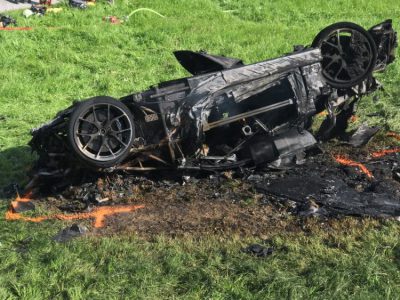
Hammond escaped the crash under his own power before the Rimac Concept One caught fire
Richard Hammond was involved in a serious accident last weekend while behind the wheel of a Rimac Concept_One electric supercar. It took place at the Hemburg Hill Climb event just after the finish line, and saw the car tumble down a cliff before bursting into flames. Thankfully, “Hamster” walked away mostly unharmed, apart from a fractured knee. Unfortunately, the same can’t be said about the car.
In an effort to detail the incident more fully, Rimac founder and CEO, Mate Rimac, has released more information in a statement delivered to the website Vidi Auto. In it, Rimac says that the car flew
“300 meters (328 yards) horizontally and tumbled from a 100-meter (109 yards) height.”
Continuing on, the CEO also made it a point to debunk previous reports citing false facts.
“After the first flight it fell on asphalt road 10 meters (11 yards) below the place where the fire started. I am not able to tell at which speed it was driven, but I cannot believe what nonsense has been written by people who have no idea, or are blind, or just mischievous.”
https://youtu.be/oOQL7hyFXtc
What we do know, apart from the details mentioned above, is that the accident will delay work on the Grand Tour season 2, according to Jeremy Clarkson. Clarkson and May will fill in for Hammond during upcoming shoots, and though he didn’t say when the new season would return, it likely won’t be ready in time for the proposed October premiere date.
The car in question, a 2018 Rimac Concept_One, produces 1,224 horsepower (900 kilowatts) and can reach 62 miles per hour (100 kilometers per hour) in just 2.5 seconds. The electric supercar has claimed top speed of 221 mph (355 kmh) and a driving range of 217 miles (350 km).
Renault has launched a smart energy system, which looks to make use of second-life EV batteries for domestic and commercial energy storage.
Partnering with Powervault, the system will undergo trials with customers who already have solar panels installed. A total of 50 units will be involved in the trial, which will involve eligible M&S Energy customers along with social housing tenants and schools in the South East.
The system stores energy generated by the solar panels for use when the demand is greatest. It also allows owners to charge from the grid at off-peak rates, for use during peak times.
Powervault will use batteries that have come to the end of their usable EV life from Renault, as the French manufacturer enters the home energy storage market like its group partner Nissan, and other plug-in manufacturers Tesla, BMW, and Mercedes Benz.
Nicolas Schottey, Program Director, EV batteries and infrastructures at Renault, said:
“Thanks to this home energy storage partnership with Powervault, Renault is adding a new element into its global strategy for second life batteries, which already covers a large number of usages from industrial to residential building and districts.
“The second life use not only gives additional life to electric vehicle batteries before they are recycled, but also allow consumers to save money. It’s a win-win-win: for EV owners, home-owners and the planet.”
Chief executive Elon Musk shows off image of new car and semi-truck, and gets ready for mass-market electric vehicles
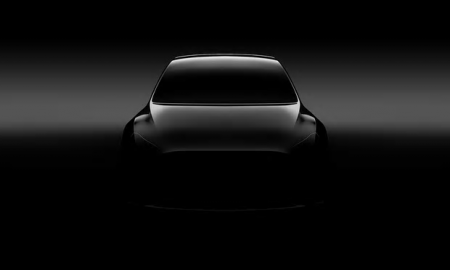
Tesla’s new Model Y electric SUV teaser image sparked controversy over its wing mirror-free appearance. Photograph: Tesla
Tesla’s chief executive Elon Musk has given preview of its upcoming Model Y small SUV and a so far nameless electric truck, as it prepares to deliver its first cheaper Model 3 electric saloons.
During the company’s annual shareholders’ meeting, Musk released a teaser image of the Model Y, which will be available in the 2019-2020 time frame and follow on from its larger SUV, the Model X. Musk said the Model Y would use a new platform building on the improvements made to existing models.
One of the new models to benefit from improvements since the original release of the Model S in 2012 is the more affordable Model 3, Tesla’s attempt at mass-market electric car. The Model 3 is expected to cost from $35,000 in the US, putting it in the same bracket as the BMW 3 series.
Musk said that Model 3 production is on track to start next month, and that vehicles should be delivered to those first in line for the pre-orders soon after. Tesla is aiming to make 5,000 Model 3s per week by the end of this year and 10,000 per week in 2018. The company hasn’t said how many people have put down $1,000 refundable deposits for the Model 3, but Musk said people who put down a deposit now won’t get a car until the end of 2018, indicating it could be close to 500,000.
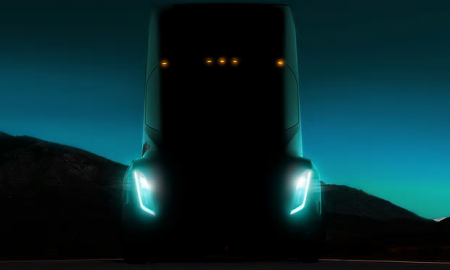
Tesla’s teaser image for its prototype all-electric semi-truck. Photograph: Tesla
The biggest challenge for Tesla will be around meeting mass-market production. It has faced manufacturing delays with previous models, including the latest Model X SUV which was nearly 18 months late. Musk said it was “crazy hard” to make cars and that Tesla had learned a lesson from the complexity of previous models. The Model 3 would be much simpler to make, not least because only the colour of the car and the size of the wheels would be customisable from the beginning rather than having a plethora of customisation options that would increase the time required to make the cars.
The 14-year-old Tesla has no experience producing and selling vehicles in high volumes, making just 84,000 cars last year compared with rivals such as GM, Volkswagen and Toyota, which routinely sell more than 10m per year.
Once the Model 3 is on the road in quantity, Tesla will also face servicing and charging troubles. The company said that it would increase the number of stores and service centres by 30% this year, but at the start of 2017 it had just 250 worldwide
Musk says a new fleet of mobile service trucks will be deployed and that Tesla plans to double its global high-speed “Supercharger” power points to 10,000 by the end of this year and increase them by another 50-100% in 2018.
Tesla is also seeking to break into freight transportation with a new all-electric semi truck, which is due to be unveiled at the end of September. Musk said that Tesla was currently shopping designs around to large freight firms with positive reactions and that the firm would have more than just truck news to share later this year.
Technology company Intel has released a study into the creation of a new ‘passenger economy’ when autonomous vehicles become commonplace on roads around the world.
The company believes that this new opportunity will be more than twice the size of the ‘sharing economy’, and will develop to support the idle time when drivers become passengers as they no longer have control of the vehicle themselves. Intel values this market at $7 trillion (€6.2 trillion) as autonomous technology grows by 2050.
Brian Krzanich, CEO of Intel, comments:
‘Companies should start thinking about their autonomous strategy now. Less than a decade ago, no one was talking about the potential of a soon-to-emerge app or sharing economy because no one saw it coming. This is why we started the conversation around the Passenger Economy early, to wake people up to the opportunity streams that will emerge when cars become the most powerful mobile data generating devices we use and people swap driving for riding.’
The report states that business use of Mobility-as-a-Service (MaaS) is expected to generate $3 trillion (€2.7 trillion) in revenues, or 43% of the total passenger economy, while consumer use of MaaS offerings is expected to account for $3.7 trillion (€3.3 trillion) in revenue, or nearly 55%.
Intel believes that this future mobility will see drivers moving away from traditional car ownership, with shared vehicles operating in towns and cities, a strategy that manufacturers in Europe also believe will aid infrastructure and improve both safety and pollution. In the report, the company states that self-driving vehicles are expected to free more than 250 million hours of consumers’ commuting time per year in the most congested cities in the world.
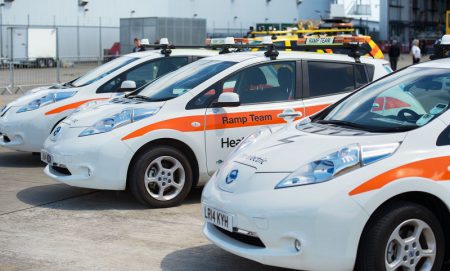
Heathrow airport has added 17 Nissan Leafs to its fleet to inspire a new culture of electric car usage.
The airport has allocated 12 vehicles to airside teams such as security and baggage while another five are to be used as pool cars.
Heathrow is committed to making the cars and small vans within its fleet electric or plug-in hybrids by the end of 2020.
Sales director at Nissan Motor (GB), Darren Payne, said:
“I’m sure this initiative will inspire other businesses to follow Heathrow’s lead by using Nissan’s electric vehicles to both reduce their emissions and cut their running costs.”
It is hoped that the visibility of the airside vehicles will encourage third parties operating at the airport to follow suit.
Head of operational strategy at Heathrow, Peter Leeming, said:
“We trialled the Nissan Leaf and found it was the perfect fit for many of our teams and the types of journeys they make. The trial went seamlessly, and within months we placed our order and put the Leaf into full time service.”
A video has been released detailing how the airport intends to implement the conversion and the trial process.
OAKLAND, CA (May 31, 2017)—Everywhere in the US, driving electric is cleaner than driving a typical gasoline-powered car. That’s truer now than ever before, and the advantage electric vehicles have over comparable gasoline cars is only continuing to increase.
New analysis by the Union of Concerned Scientists (UCS) shows that in 70 percent of the country, driving electric produces fewer emissions than driving a traditional gasoline car that gets 50 miles to the gallon. On average, today’s electric vehicles are as clean as gasoline cars that get 73 miles to the gallon. That’s thanks in large part to significant improvements in power generation, with more regions cutting their use of coal and increasing investment in renewable energy sources like wind and solar.
“Driving electric is one of the best choices a consumer can make to reduce emissions in their own lives,”
said David Reichmuth, senior vehicles engineer at UCS.
“As the electric vehicle market has emerged over the last five years, electric vehicles are better than a 50 mpg gasoline car for 70 percent of Americans, up from 50 percent. It’s been remarkable to see the improvements.”
Over their whole life cycle—from manufacturing to driving to disposal—electric vehicles produce half the emissions of a comparable gasoline vehicle. By far the largest share of emissions comes from driving, which is where electric vehicles have a big and growing advantage.
The new analysis is based on updated numbers on power generation from the U.S. Environmental Protection Agency, which show reduced greenhouse gas emissions from power generation in most of the country over the past five years.
“The future of driving is electric,” said Reichmuth. “We need to keep working to make sure these cars are accessible to more drivers, that we have the infrastructure to charge them, and that we continue to replace old dirty sources of power with new renewable technology.”
UCS has also updated an interactive online tool that drivers can use to learn how much cleaner different models of electric vehicles are where they live, as well as a map showing how electric vehicle emissions compare across the country.