Monthly Archives: June 2023

Porsche Taycan Turbo S (Image: Porsche)

The best 300-mile+ electric cars

Range anxiety is still one of the biggest barriers to electric car ownership, but these models can all cover more than 300 miles on a charge – and some can go a lot farther than that…

Best 300-mile electric cars

300-mile electric cars

Tempted by an electric car but think range might be an issue? Well, thanks to advances in technology, it really isn’t with many of the latest models. Right now, 33 cars in all shapes and sizes, from small SUVs to luxury saloons, offer a range of 300 miles or more, according to official tests. And some can even go beyond 400 miles.

We should point out that few electric cars can match their official ranges in real-world use; even the weather can affect performance. However, the cars on this list should still cover most longer trips without the need to pause for a battery top-up.

Hyundai Kona Electric (Image: Hyundai)

As well as naming the models with the longest official ranges, we’ll include the results of our real-world range tests (where applicable). We’ll also highlight each car’s usable battery capacity and tell you how long it takes them to be charged from 10-80% at their peak charging rate. They are ranked in order of range, from lowest to highest.

Read more: WhatCar

It’s Time to Go Green!

If you would like to know more about Solar Panels and the PowerBanx range of home battery systems, and get a free instant quote, please complete our online form:

ENERGY SAVER I’m a car expert – here’s the top five used EVs you can buy for less than £15k

ONE of the biggest gripes about switching to an electric car is the hefty price of battery-powered models.

With more low emission zones appearing all over the UK, many motorists are finding that they need a cleaner car like an EV or a hybrid – but the problem is they just can’t afford to make the change from their petrol or diesel motor.

Recent research by carwow, the online platform for buying and selling cars, found that cost is a significant barrier to EV adoption – with 56% of consumers saying that the purchase price of an electric car is too high.

Handily, carwow’s automotive expert and YouTube star Mat Watson has shared his top picks for used EVs you can get your hands on for under £15k right now.

Nissan Leaf – £14,500

One of the original electric cars for the masses, the Nissan Leaf is a smart EV that comes with an impressive safety kit, a comfortable interior and a big, practical boot.

At this price you’ll probably only find the lower-range models, but an official 168 miles between charges should be enough for most.


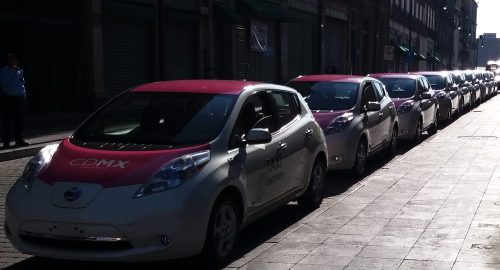
Electric Taxi Rank in Mexico City

The interior can feel a bit cheap in places, but a good driving position and good visibility make the Leaf easy to drive in town – the punchy electric motors certainly help here, too.

Read more: TheSun

It’s Time to Go Green!

If you would like to know more about Solar Panels and the PowerBanx range of home battery systems, and get a free instant quote, please complete our online form:

How safe are electric cars?

The combination of high-voltage electrical systems and reports of batteries catching fire might give you cause for concern. So, how safe are electric cars really?…

Electric cars are increasingly popular, with more than one million now on UK roads. However, as is so often the case with cutting-edge technology, there are some concerns around safety.

These fears include whether they become dangerous when exposed to water and how flammable the batteries might be in a crash. So, here we reveal everything you need to know about the safety of electric cars.

How safe are electric cars in an accident?

Electric vehicles (EVs) have to be built to the same safety standards as internal combustion engined (ICE) cars, meaning that they are actually just as safe in the event of a collision.

Most manufacturers allow their cars to be crashed and assessed by independent safety body Euro NCAP, which awards an overall safety rating for each car it tests, allowing drivers to identify the safest choice for their needs.

In fact, the fully electric Tesla Model Y is the highest-scoring car tested by Euro NCAP since the latest standards were introduced in 2020, which is part of the reason why it won our Safety Award at the 2023 What Car? Awards.

True, electric cars are built differently from ICE cars due to the absence of an engine.

Read more: WhatCar

It’s Time to Go Green!

If you would like to know more about Solar Panels and the PowerBanx range of home battery systems, and get a free instant quote, please complete our online form:

Mr. Bean says ‘our honeymoon with electric cars is coming to an end.’ It’s just the beginning.

Mr. Bean loves cars.


Over the weekend, the respected British comedian Rowan Atkinson, famous for his portrayal of a clueless social misfit in his eponymous British series, wrote about “feeling duped” for buying an electric car.

“Our honeymoon with electric cars is coming to an end,” he lamented in an opinion piece in the Guardian. “Sadly, keeping your old petrol car may be better than buying an EV.”

I can see why Mr. Bean might suggest that. I’ve been driving a 2010 Honda Fit for quite a while, and I’m sure it will keep chugging well after my odometer’s recent lap of the 100,000-mile mark.

But Atkinson, who says he has a “lifelong passion for the motorcar” and an undergraduate degree in electrical engineering, argues that people should consider keeping their internal combustion engines as long as possible, while we develop hydrogen and synthetic fuel alternatives.

On one front, Atkinson is right. EVs are not perfect. The industry, for example, has a lot of room to improve on how it sources battery materials, whose mining has ravaged communities and ecosystems around the world. Prices are high. Charging infrastructure is spotty. Supplies are tight. He points out some real problems in the current market.

But based on what we know about emissions and automobile engineering, EVs are the better choice for millions of people right now.

Read more: WashingtonPost

It’s Time to Go Green!

If you would like to know more about Solar Panels and the PowerBanx range of home battery systems, and get a free instant quote, please complete our online form:
Tesla Model Y (Image: Tesla.com)

An electric car is the world’s best-selling car

An electric car has toppled the Toyota Corolla from the top spot.

We have previously reported that an electric car became Sweden’s best-selling car during the first quarter of 2023. And that an electric car became Europe’s best-selling car during the same period.

New data shows that an electric car also became the world’s best-selling car in the first three months of this year.

New number one: Tesla Model Y

The electric car in question is Tesla’s Model Y.

According to Jato Dynamics, 267,200 Model Y were sold in the first quarter, ahead of Toyota’s Corolla with 256,400. Third place went to another Toyota, the Hilux, with 214,700.

Tesla Model Y (Image: Tesla.com)

Elon Musk was almost completely correct

In 2021, Tesla’s founder, Elon Musk, said that he believed that Model Y would soon become the world’s best-selling car:

“We think Model Y will be the best selling car or vehicle of any kind in the world. Probably next year. I’m not 100 percent certain next year, but I think it’s quite likely… more likely than not, that 2022 Model Y is best selling car or truck… in the world.”

He missed by one quarter. For the full year 2022, the Model Y came in third place. (Of course, it remains to be seen whether Model Y can hold first place for the whole year 2023.)

Read more: warppnews

It’s Time to Go Green!

If you would like to know more about Solar Panels and the PowerBanx range of home battery systems, and get a free instant quote, please complete our online form:

Electric Car Line-up (Image: Go Ultra Low)

Osprey Charging opens ‘South West’s largest EV charging hub’

Osprey Charging has opened the “South West’s largest [electric vehicle] EV charging hub” consisting of 16 ultra-rapid chargepoints.

The EV charging hub is located on the A38 Devon Expressway at Salmon’s Leap in Buckfastleigh and designed to support EVs of all types.

Each charger is capable of providing 300kW charging for vehicles able to accept this high power without wasting power on lower-capability cars, Osprey said. This allows customers of the hub to add 100 miles of range in 15 to 25 minutes.

Osprey also stated that it will provide local residents, businesses and visitors with reliable EV infrastructure, help improve air quality, reduce noise pollution and support local decarbonisation efforts.


An extra stop at Sedgemoor (Image: T. Larkum)

“I’m incredibly proud of what we’ve created at Salmon’s Leap. We purchased the land so have been able to precisely design the space and install hardware that maximises availability and ease of use of chargers for all types of vehicles and drivers,” said Ian Johnston, CEO of Osprey Charging.

“Our largest site yet, it is a significant milestone for the Osprey team as we work tirelessly to ensure that our nationwide infrastructure deployment of rapid EV charging stations continues at an unprecedented pace.”

Osprey was amongst a number of founding members of the new trade association ChargeUK. Revealed in April 2023, the association is aiming to invest £6 billion by 2030 in EV charging and double the size of the UK EV charging network in 2023.

Read more: Current+

It’s Time to Go Green!

If you would like to know more about Solar Panels and the PowerBanx range of home battery systems, and get a free instant quote, please complete our online form:

BMW, V2X, And The Death Of The Gasmobile

BMW is stepping up from vehicle-to-grid EV charging to kick vehicle-to-everything (V2X) into gear, with an assist from the California utility PG&E

The bad news just keeps on coming for fossil energy stakeholders. In the latest development, BMW is working with the leading California utility, PG&E, to demonstrate how EV batteries can contribute to grid stability instead of placing new burdens on the nation’s electricity infrastructure. The secret sauce is V2X, the Vehicle-to-Everything model for using an EV battery to power all sorts of electric devices.

Nobody Expects V2X

The infrastructure argument against widespread EV adoption has been neatly summed up by former Fox News host Tucker Carlson, who called zero emission vehicles a “new way to overburden California’s already collapsing energy grid” in a segment last September.

Whoa if true. However, not true according to professionals who actually know a thing or two about electricity.

The leading utility National Grid, for example, does caution that grid issues could arise from a piecemeal approach to fleet electrification, when too many fleets are clustered in one area. Its main point, though, was to advocate for proactive, collaborative planning and infrastructure investment to foster a smooth transition to EVs.

On a broader scope, EV stakeholders are already engaged with “smart charging” strategies that take advantage of low-demand periods along with the availability of renewable energy.

Read more: CleanTechnica

It’s Time to Go Green!

If you would like to know more about Solar Panels and the PowerBanx range of home battery systems, and get a free instant quote, please complete our online form:

Mazda MX-30 EV (Image: Mazda)

The biggest myths about electric cars, debunked

  • Electric vehicles are gaining momentum.
  • But drivers still have a lot of misconceptions about going electric.
  • From range to charging challenges, here are some of the biggest EV myths, debunked.

Electric cars are gaining traction, bolstered by efforts from the federal government, billions of dollars of investment from the auto industry, and momentum from sustainability advocates all over the globe.

But the US’ transition to electric has been slower than other parts of the world, hitting just about 6% EV adoption in 2022.

Some of that can be attributed to real hurdles, with infrastructure, cost, and more. But more people than might think can probably go electric, so long as some major myths are demystified and their questions answered.

Here are 8 of the biggest myths about EVs, debunked:

Myth 1. All EVs are expensive.

Most consumers who aren’t very familiar with electric vehicles or weren’t early adopters have the perception that all of them are costly.


Honda E 2021 (Image: honda.co.uk)

It’s true that the average price paid for a new EV hit $55,089 in April — higher than the average for a new gas-powered vehicle of $48,275, per Kelley Blue Book. Most US consumers have indicated they don’t want to spend more than $50,000 on one if they opt to electrify. It’s also true that EVs haven’t yet hit scale (at least in the US), and EV batteries are generally a really costly component. Plus, most of the EVs that have hit the market so far have been luxury products and bigger vehicles.

Read more: Insider

It’s Time to Go Green!

If you would like to know more about Solar Panels and the PowerBanx range of home battery systems, and get a free instant quote, please complete our online form:

Citroen Ami (Source: uk-mediacitroen.com)

Every PHEV on sale in the UK

Welcome to Autocar’s exhaustive list of PHEVs you can buy today, from Audi to Volvo

As we hurtle towards an electrified future and the UK’s 2030 ban on ICE (Internal Combustion Engine) new car sales, the need for alternatives is more pressing than ever.

BEVs (Battery Electric Vehicles) are the ultimate goal for many governments and manufacturers, but they still remain a controversial option for many buyers. Not only are they costly to buy, mainly because of their expensive batteries, they are at the mercy of public charging infrastructure that’s still not widespread and reliable enough to


On paper, the PHEV (Plug-in Hybrid Electric Vehicle) looks to be the ideal stepping stone. Combining the pure electric running for anything between 15 and nearly 100 miles, they’ve got more than enough battery power for everyday commutes and running around. However, they combine this zero emissions at the tailpipe progress with the confidence-inspiring addition of traditional petrol or diesel engines for longer journeys.

Effectively, these machines promise to offer ‘best of both worlds’ experience for those still uncertain about taking the plunge with a full EV. Even better, there’s a wide choice of models to choose from, with most manufacturers having at least one PHEV on their books.

Read more: Autocar

It’s Time to Go Green!

If you would like to know more about Solar Panels and the PowerBanx range of home battery systems, and get a free instant quote, please complete our online form:

Volkswagen ID.3 electric car (Image: Volkswagen.com)

Tesla (TSLA) Model 3 dominates reliability study, outperforming ICE counterparts

Tesla’s (NASDAQ: TSLA) participated in a new reliability study by the Allgemeiner Deutscher Automobil-Club (ADAC) in Germany where their electric Model 3 crushed its internal combustion engine (ICE) counterparts.

It should come as no surprise that electric vehicles (EVs) are generally more reliable than their fossil-fuel-powered counterparts, given their remarkable mechanical simplicity. The superiority of EVs in terms of reliability has been emphasized in a recent study conducted by the ADAC, a German vehicle analysis firm. The study found that the Tesla Model 3 outperforms a large majority of gas-powered vehicles, further solidifying the reliability advantage of electric cars.

Tesla Model 3 Unveil (Image: Tesla)

The ADAC study is an annual analysis that primarily examines vehicles that are older than three years. The group’s latest study encompassed four electric vehicles available in the German market: the Tesla Model 3, BMW i3, Volkswagen ID.3, and Renault Zoe. According to the findings from the ADAC’s data, electric vehicles not only outperform their gasoline counterparts on average, but the Tesla Model 3 exhibits a significantly higher level of reliability compared to both gasoline vehicles and other electric cars.

The study found that only 1.1 out of 1,000 2020 model-year Tesla Model 3s broke down annually, which is, surprisingly, a slight increase from the 2019 Model 3, which only had 0.9 breakdowns per 1,000 units. Comparatively, the average gas vehicle had 6.9 breakdowns per 1,000 units, and the average EV had 4.9 breakdowns per 1,000 units.

Read more: StreetInsider

It’s Time to Go Green!

If you would like to know more about Solar Panels and the PowerBanx range of home battery systems, and get a free instant quote, please complete our online form: