Monthly Archives: November 2020

IONITY rapid charge points at Leeds Skelton Lake Services (Image: IONITY)

Electric vehicles: How are they charged, are they cheap to run and what will happen to road tax?

With a 10-point plan for a “green industrial revolution” announced, Boris Johnson has announced that sales of new petrol and diesel cars and vans will be phased out by 2030.

It aims to accelerate the transition to electric vehicles to cut climate emissions and local air pollution, as part of the 10-point plan.

The plan aims to boost green jobs and drive the shift towards cutting emissions to net zero by 2050, the prime minister says, but what will it mean for motorists and how are electric vehicles different? ITV News has found out.

How do electric cars work?

Pure electric cars are powered by an electric motor using energy stored in batteries, and do not produce emissions from the tailpipe.

How are they charged?

You simply plug the vehicle into a source of electricity, the battery charges up and you’re good to go, according to Erin Baker, Editorial Director at Auto Trader.
She told ITV News: “While you can charge an electric car from a regular three-pin domestic plug socket it’s not really recommended, from either safety or convenience perspectives.
“Safety because electric cars draw a lot of current and can overload regular cables and it’s not really sensible to have long extension leads trailing across the pavement or your driveway. And convenience because it will take you a really, really long time to fully charge a modern electric vehicle (or EV) on a domestic supply.”

IONITY rapid charge points at Leeds Skelton Lake Services (Image: IONITY)

How long does it take?

According to the AA, it depends on what kind of charger you are using. A rapid charger can give you 80% range within half an hour, whereas a slow charge – which is the kind you’d get at home – will be eight hours for 80% range.
Charging power is usually measured in kW and EV batteries in kW hours, or kWh.
Ms Baker said: “You can do the basic maths – a 20kWh battery would take around four hours to charge with a 5kW supply, two hours on 10kW and so on – and most EVs use batteries ranging from 30kWh all the way to 100kWh.”

How far will a full charged electric vehicle take you?

This will vary on a number of factors, and from car to car, according to AutoTrader.
A small battery makes a car a lot cheaper but will mean less range, a bigger battery can mean more range, more performance, or both.
Ms Baker said: “While some claim a range in excess of 350 miles, at the moment, the average single-charge range is around 180-200 miles. But they are improving with every new EV rolling off the factory floor so expect this to improve within the next 12-24 months.
“Manufacturers will publish an officially calculated range for comparison purposes but small electric cars like the Mini Electric or Honda e may do little more than 100 miles on a full charge in real-world driving, while battery powered versions of popular superminis like the Vauxhall Corsa may achieve double that.
“Premium models like Teslas use bigger batteries and may, meanwhile, be capable of 300 miles or more on a charge.”

How much do they cost to run? Do they save money in comparison to petrol or diesel cars?

Currently, the government offers a £3,000 grant for buying an EV – but even with this incentive, the cost is higher than a petrol car.
Jack Cousens , head of roads policy at The AA, said: “An entry level Ford Focus is around £21,000, whereas the entry level Nissan Leaf is around £26,500 with the grant already applied.
“However, once you get past that hurdle, EVs are cheaper to run and maintain.
“A petrol car costs £50 a tank whereas it could cost you around £5 to charge an EV at home.
“EV’s also pay no VED (Vehicle Excise Duty), but a new petrol/diesel car currently pays £150 a year.”
AutoTrader recommend shopping around and being smart about how and when you charge up at home.
“Charging in public can be a lot more expensive and you pay a premium for the convenience of using fast chargers,” Ms Baker said, “but it will likely still cost less than petrol or diesel on a pence per mile basis and, for most EV drivers, this will be the exception rather than the rule.”
“They are still more expensive – not least because most are bought new at present – but this is changing fast,” according to Erik Fairbairn, Founder & CEO, Pod Point.
He added: “EVs are likely to be cheaper to manufacture than equivalent petrol cars by the mid 2020s, due to rapidly falling battery manufacturing costs.”

Read more: itv news

It’s Time to Go Green!

If you would like to know more about Solar Panels and the PowerBanx range of home battery systems, and get a free instant quote, please complete our online form:

The Weekly Planet: What Donald Trump Taught the Electric-Car Industry

Tesla, Uber, and utilities are consolidating their power in Washington.

One of the stranger things that has happened during the Trump administration—a category with no small amount of competition—is that the car industry and the oil industry have grown to resent each other.

This is more significant than it might seem. For decades, Detroit and Houston had a great, if unconventional, friendship: Car companies were well liked and well unionized, the makers of mechanized chariots that took Americans wherever they wanted to go, while oil companies were the grimier, greedier dealers of the magic juice that made those chariots run.

Automakers and oil companies grew up together, they hung out together, and they fought environmental and efficiency rules together. Their interests aligned: The more cars sold, the more oil burned; and the beefier the car, the more everyone made. Everyone benefited—except drivers, pedestrians, asthmatics, and future inhabitants of the Earth’s climate system, but where were those guys on the S&P?

But under President Donald Trump’s influence, the oil-and-gas industry has turned on car companies. First, it engineered a repeal of car-pollution rules that was so revanchist, so pro-carbon, the auto industry refused to support it. Then the White House killed a bipartisan deal to extend a tax credit for electric-car buyers, hurting Tesla, General Motors, and electrical utilities to the benefit of foreign automakers and the oil companies. American automakers were also walloped by Trump’s trade war with China.

Some of this drama originated from plain old oil-company rapacity. But much of it arose from the coalition-splintering effects of electric vehicles, or EVs. For decades, oil-and-gas companies, automakers, and electric utilities have had a tight and mostly united set of interests in Washington. But EVs ruin that harmony: They pose an existential threat to oil majors, because each additional EV on the road depresses gasoline demand. But to automakers and utilities, they represent the next great market.

Now, as the administration turns over, this new dispensation is being formalized. The electric-car industry is getting a lobbying group.

Today, more than two dozen automakers, electric utilities, EV-charging firms, and lithium companies are forming a new advocacy group devoted to pushing for electric cars on Capitol Hill. It’s called the Zero Emission Transportation Association, or ZETA.

“Our goal is to change politics so that every new vehicle sold by 2030 is an EV,” Joseph Britton, ZETA’s founder and director, told me. ZETA won’t look for regulation that requires anyone to buy an EV, he said. Instead, it will push for policy changes that make EVs irresistible to consumers.

In other words, ZETA will lobby Congress to build EV chargers, subsidize EV purchases, and help companies that make electric cars rapidly achieve scale. ZETA wants Congress to toss EVs virtually every kind of investment in its toolbox: A future stimulus bill, infrastructure package, and round of tax cuts could all be made to help nourish the EV industry.

Such help is necessary, Britton said, for more than climatic reasons. China, as I wrote last week, has poured billions into its EV industry, with hopes of taking a greater share of the global auto market from the U.S. and Europe. And the early pandemic shortages of tests and protective gear showed the drawbacks of a denuded industrial base. A vigorous EV industry can reestablish the power of American manufacturing—and offer the one thing that no lawmaker can turn down, Britton said: “We can create jobs in every congressional district in the country.”

Tesla and Uber are among the 28 inaugural members of ZETA. So are the electric-truck start-ups Rivian and Lordstown Motors, and the utilities Southern Company, PG&E, Duke Energy, Con Edison, and Salt River Project.

Read more: The Atlantic

It’s Time to Go Green!

If you would like to know more about Solar Panels and the PowerBanx range of home battery systems, and get a free instant quote, please complete our online form:

Tesla Model 3 (Image: Tesla.com)

BEST 10 PURE-ELECTRIC CARS WITH A RANGE OF 300 MILES OR MORE TO BUY FROM 2021

WHICH ELECTRIC cars can be driven 300 miles or more between charges? When buying a new battery-electric vehicle, a long range is one of the first things a customer will look for.

At the time of the original Nissan Leaf’s launch 10 years ago, the car makers dabbling with pure-electric models were trying to convince us that its official range of 109 miles between charges (less than that in the real world) was more than enough for most drivers.

In a way, it was true — research from 2008, published in the Society of Motor Manufacturers and Traders’ 2011 Electric Car Guide, showed that the average individual journey length in the UK was 8.6 miles and the average total daily distance travelled was 25 miles, while more than 80% of motorists across Europe drove less than 63 miles in a typical day.

And yet “range anxiety” (the fear of running out of charge) was still a major talking point, with many commentators asking, “But what happens if I want to drive from London to Scotland”. Although journeys of that distance aren’t common, a long road trip — say for a family holiday — once or twice a year isn’t out of the question for many households — especially with the coronavirus pandemic forcing us away from air travel.

Elon Musk, the founder of Tesla, was one of the few pure-electric car advocates arguing that drivers shouldn’t just put up with a range of 100 miles or less. He knew that if the tech was going to take off, drivers would need electric cars capable of travelling at least three times as far as the Leaf. He had introduced the Roadster in 2008, which could travel 244 miles according to the American test cycle, and then the Model S (more than 300 miles) in 2012.

Now it seems, the rest of the car industry is catching up. Cars that can go at least 300 miles per charge are becoming the norm rather than the exception, and they’re becoming more affordable, too.

Tesla Model 3 (Image: Tesla.com)

Here are 10 of longest-range electric cars available to buy in 2020/2021.

1. Long range electric cars: Tesla Model S Plaid — 520 miles
The most powerful and quickest-accelerating Model S yet certainly packs some impressive stats, ahead of its production beginning in late 2021.
A teaser video released by Tesla as part of its Battery Day celebrations in September claimed 0-62mph in under two seconds, a 200mph top speed, the ability to cover a quarter mile in nine seconds and 1100hp (1085bhp), intermingled with shots of the much-awaited model sprinting around the Laguna Seca racetrack in 1:30.3 minutes, 6 seconds quicker than a model that the car maker sent round in 2019.
In the era of electric hypercars like the Lotus Evija or the Pininfarina Battista, however, stats like this are nothing new. What is, is an estimated range of 520 miles, which leaves even the Tesla Model S Long Range, second in this list, in its dust. At a price of £130,980 it’s not what you’d call cheap, but it’s a fraction of the price of an Evija or Battista.

2. Long range electric cars: Tesla Model S Long Range Plus — 405 miles
This version of the Model S is already available to buy. It’s the cheapest version of the electric saloon — although, at £74,980, “cheap” might not be an apt descriptor — meaning the Model S is still the standard-bearer when it comes to how far an electric car can go on a single charge.

3. BMW iX — 373 miles
The announcement of the BMW iX was overshadowed somewhat by the red-blooded anger about its looks, which have proved, to put it mildly, polarising. However, beneath the skin is a seriously impressive drivetrain, packing what BMW claims will be a range of 373 miles.
That’s considerably more than any of the electric SUV’s current competitors, including the Jaguar I-Pace, Mercedes EQC and Tesla Model X. How far ahead of its rivals it will be when it goes into production at the end of next year remains to be seen.

4. BMW i4 — 373 miles
The i4 electric coupé represents another step in BMW’s desire to diversify the drivetrain options in its current lineup, as part of what it is calling its “power of choice” mantra. It will share the same electric setup as the aforementioned iX, with the same range.

Read more: The Sunday Times: Driving

It’s Time to Go Green!

If you would like to know more about Solar Panels and the PowerBanx range of home battery systems, and get a free instant quote, please complete our online form:

Charging Station in Sunderland (Image: Fastned)

Boris Johnson’s green plan brings ban on petrol cars forward to 2030 and promises UK’s first hydrogen-powered town

Boris Johnson has set out plans for green investment over the coming decade, including a target to generate enough offshore wind to power every home in the UK and a ban on new petrol and diesel cars and vans from 2030.

The prime minister’s long-awaited 10-point plan for a “green industrial revolution” also promised the UK’s first hydrogen-powered town, four carbon capture “clusters” to suck 10 megatons of carbon dioxide out of the atmosphere and a new generation of advanced nuclear reactors.

But green campaigners warned that the £12bn in public funding promised by Mr Johnson fell well short of the scale of ambition needed, while there was dismay at his inclusion of “pie-in-the-sky” plans for zero-emission jet planes.

The decision to bring forward by five years the phase-out date for polluting cars and vans – with new hybrids granted a stay of execution until 2035 – is designed to kick-start the electric vehicle (EV) market, which despite recent growth still accounts for just 7 per cent of the sector in the UK.

It was backed by new investment of £1.3bn to instal charge points in homes, streets and motorways across England in a bid to overcome consumer reluctance to adopt the cleaner technology.

Charging Station in Sunderland (Image: Fastned)

Environmentalists hailed the move as a breakthrough which Greenpeace said could “put the government back on track to meeting its climate commitment” of net-zero carbon emissions by 2050.

It puts pressure on other countries to follow suit ahead of the COP26 UN climate change summit hosted by the UK in Glasgow next year, and will send a signal to manufacturers to invest in production of greener models.

But the CBI warned the new target date was “undoubtedly challenging” and would require support for the automotive sector to adapt.

Coming as the PM attempts to “reset” his government following the fractious departure of aide Dominic Cummings, Mr Johnson’s plan aimed to target investment at former industrial heartlands in the Midlands, north of England, Scotland and Wales which he has promised to “level up” with the prosperous south.

The PM claimed the programme could create and support up to 250,000 high-skilled green jobs and leverage in more than £36bn in private sector investment over the next 10 years. He said: “Although this year has taken a very different path to the one we expected, I haven’t lost sight of our ambitious plans to level up across the country. My 10-point plan will create, support and protect hundreds of thousands of green jobs, whilst making strides towards net zero by 2050.

“Our green industrial revolution will be powered by the wind turbines of Scotland and the northeast, propelled by the electric vehicles made in the Midlands and advanced by the latest technologies developed in Wales, so we can look ahead to a more prosperous, greener future.”
But shadow business secretary Ed Miliband warned that the funding announced “doesn’t remotely meet the scale of what is needed to tackle the unemployment emergency and climate emergency we are facing”, paling in comparison to the tens of billions committed by France and Germany or the £30bn of capital investment in low-carbon sectors demanded by Labour over the next 18 months.

“Only a fraction of the funding announced today is new,” said Mr Miliband. “We don’t need rebadged funding pots and reheated pledges, but an ambitious plan that meets the scale of the task we are facing and – crucially – creates jobs now.”

And Green Party co-leader Jonathan Bartley said Mr Johnson should be aiming for billions more investment and millions of green jobs.

“Any action to address climate change is welcome, but this is nowhere near the scale or speed of what is needed,” he said. “This 10-point plan is essentially business as usual, with a few half-hearted measures and some wishful thinking about pie-in-the-sky technologies such as Jet Zero which don’t even exist yet.”

Read more: Independent

It’s Time to Go Green!

If you would like to know more about Solar Panels and the PowerBanx range of home battery systems, and get a free instant quote, please complete our online form:

2020 Renault Zoe (Image: Renault)

New petrol and diesel cars banned from sale after 2030 under government’s green plan

The plan also includes developing the first town heated entirely by hydrogen by the end of the decade.

New petrol and diesel cars will be banned from sale after 2030, the government has announced.
The ban had been planned for 2040 but has been brought forward under Boris Johnson’s 10-point plan to tackle climate change.

The plan also includes producing enough offshore wind to power every home, developing the first town heated entirely by hydrogen by the end of the decade, and developing the next generation of small and advanced nuclear reactors.

Currently fewer than 1% of cars on UK roads are powered entirely by electricity, so the prime minister’s plan to end the sale of new petrol and diesel cars will require an enormous investment in the infrastructure needed for electric vehicles.
Edmund King, president of the Automobile Association, told Sky News only about 6% of local authorities have installed on-street charging facilities in residential areas.
Without a commitment to developing the right infrastructure, the plan was “optimistic”, he said.

“Everyone wants to move to electric vehicles but you can’t just pick a date out of the air. We need better infrastructure particularly for the third of people who can’t charge at home.
“We also need a better supply of cars and they need to be affordable.”

2020 Renault Zoe (Image: Renault)

The prime minister claims that his plan for a green industrial revolution will create and support up to 250,000 British jobs.
The government says it will spend £12bn on the plan but analysts have told Sky News only £4bn of that is new money.
It includes £1.3bn to accelerate the roll-out of charge points for electric vehicles in homes, streets and on motorways across England.

Some £582m will help people afford zero or ultra-low emission vehicles and nearly £500m is to be spent in the next four years on the development and mass production of electric vehicle batteries.
The prime minister said: “Our green industrial revolution will be powered by the wind turbines of Scotland and the North East, propelled by the electric vehicles made in the Midlands and advanced by the latest technologies developed in Wales, so we can look ahead to a more prosperous, greener future.”
And Business Secretary Alok Sharma told Sky News’ Kay Burley: “This is a package which is part of turbocharging the green industrial revolution, levelling up across our country.
“It is £12bn of public money which will then leverage in three times as much from the private sector and, of course, support and create high-value added jobs – around 250,000 jobs by 2030.
“If you look at the UK, we are a leader when it comes to green growth.
“Since 1990 we have managed to grow our economy by 75% and at the same time cut our emissions by 43%, so we are world-leading in this area.”

Labour said the announcement fell short of what is required, but the independent Committee on Climate Change, which advises the government how to get to net zero, has welcomed the plan.
Chris Stark, chief executive of the Committee on Climate Change, said the prime minister’s plan was “a bold statement of ambition” but added: “What’s missing is the road map to achieving it.”

Read more: Sky News

It’s Time to Go Green!

If you would like to know more about Solar Panels and the PowerBanx range of home battery systems, and get a free instant quote, please complete our online form:

Charging with an Ohme smart charging cable

What you need to know about charging an EV without a drive

A third of households in England do not have off-street parking at their homes
This means drivers are forced to run cables and extension leads across footpaths. We investigate who is liable if a pedestrian trips and falls on one of these cables. Is it safe to use extension leads? And what schemes are available to EV owners without off-street parking?

Electric car sales are booming in 2020 and, with the ban on petrol and diesel cars due in the next decade or so, an increasing number of people are going to own battery-powered vehicle in the coming years.
But while there might be plenty of benefits of EV ownership, charging one of these cars is not ideal if you live in a flat, terraced house or any property that has no off-street parking.
Already, many owners in this scenario use a variety of ingenious methods to plug zero-emission vehicles parked on the road into the mains inside their homes, which usually means running a cable across a footpath.
What are the legal implications of doing this? Would you be liable if someone injured themselves tripping over the charging cable? Can you safely charge a plug-in model with extension cables and would a insurer pay out if you it caused damage to your vehicle?

Charging with an Ohme smart charging cable

Is it illegal to run a charging cable across a footpath?
Four in five EV owners charge their cars at home – the rest using public devices or facilities at work places, industry figures show.
However, data also shows that a third of English households have no dedicated off-street parking provisions available.
This has meant that many early adopters of electric cars – especially those living in cities – have found themselves in a real ‘needs must’ situation, with drivers having to run cables across footpaths to span from the sockets inside their properties.

As well as increasing the risk of others tampering with their vehicle’s charging, it also creates a potential hazard for pedestrians who could trip and fall on leads across the pavement.
While there is obvious risk, the Local Government Association told us there is ‘no legislation that it is aware of’ that would make the inconsiderate placing of a charging cable illegal.
A spokesman told This is Money that if someone was to injure themselves tripping over a charging cable across a pavement, the owner could potentially be liable – though a personal injury lawyer and motor insurer claims this might not be the case (read more below).
A cable should only be placed over the footway when the vehicle is charging and should always be removed when not in use.
Though it is suggested for those living on particularly busy streets to use raised plastic cable protector, which are usually used on construction sites.
A protector, up to three metres in length, usually costs around £20.
The LGA adds that drivers should consult their local authority’s website when considering how best to charge their electric vehicle.

A personal injury lawyer’s perspective on trips and falls caused by charging cables in the street
This is Money spoke to Kathryn Hart, a partner at personal injury law experts Lime Solicitors, to better understand what the process would be for an individual who suffers injury after tripping on a charging lead across the footpath.
‘Your accident probably happened on a public highway so you cannot claim the negligent person is the occupier of that highway,’ she explains.
‘You will need to argue that in common law negligence they owed you a duty of care, that they have breached that duty and that it was reasonably foreseeable that the injury would occur and that you have been injured.’

Read more: This Is Money

It’s Time to Go Green!

If you would like to know more about Solar Panels and the PowerBanx range of home battery systems, and get a free instant quote, please complete our online form:

MINI Electric

15 cheap electric cars 2020: best low-cost EVs you can buy in the UK

Our run down of the lowest-priced EVs currently available to order in the UK

2020 has been a big year for electric cars.

Despite the various difficulties faced by the car industry and buyers, sales this October were almost double what they were in October 2019 and there have been in the region of 20 new models launched or announced since the start of the year.

And with news the Government plans to ban all new petrol and diesel cars within a decade, there’s never been a better time to consider switching to an EV.

Some models, such as the Porsche Taycan remain out of the reach of most drivers and there’s no doubt EVs are more expensive than a petrol or diesel equivalent but a growing number are within reach of the average motorists.

Here we run down the cheapest new electric cars available to buy or order right now. We’ve discounted the £10,000 Renault Twizy on the grounds that it’s actually a quadricycle and unlikely to be anyone’s main means of transport.

MINI Electric
MINI Electric

The situation has been confused by the 2020 Budget, where the Government cut the plug-in car grant from £3,500 to £3,000. At the time, some manufacturers said they would make up the £500 shortfall while others altered their prices, so for ease of comparison we’ve given prices excluding the grant.

Smart EQ fortwo, £22,495
Smart’s unique two-seater city car has been reinvented for the electric age. The shape is instantly recognisable but the tiny petrol motor has been replaced by a single 80bhp electric motor. A 17kWh battery offers between 75 and 80 miles of range, and charging at a domestic 7kW wallbox takes just under three and a half hours. If the tiny two-door isn’t big enough, there’s always its big brother (see below).

Seat Mii, £22,800
This is the first of Seat’s electrified range, available to order now with first customer deliveries imminent. An all-electric version of Seat’s existing compact five-door city car, the Mii offers 82bhp and a massive 156lb/ft from its single electric motor, meaning it can reach 31mph from a standstill in only 3.9 seconds. The car’s 36.8kWh battery provides up to 160 miles of range from a single charge, based on the WLTP test cycle and allows for rapid charging to 80 per cent capacity in an hour.

Smart EQ forfour, £22,980
A four-door, four-seat alternative to the diminutive fortwo. The forfour uses the same electric drivetrain as the fortwo with the same power, battery capacity and charging time. The added weight of the larger car means it’s a second slower to 60 and will only do between 71 and 81 miles on a charge.

MG5 EV, £27,495
MG’s second all-electric model is also Europe’s first all-electric estate car. Having already launched an electric SUV (see below), the budget brand has expanded its line-up with this Ford Focus-sized option. With a 578-litre boot, it’s a practical family vehicle and its 52.5kWh battery is enough for a range of 214 miles.

Read more: The Scotsman

It’s Time to Go Green!

If you would like to know more about Solar Panels and the PowerBanx range of home battery systems, and get a free instant quote, please complete our online form:

Ubitricity Electric Avenue project lamppost charging (Image: Siemens)

Electric car jargon buster:

Do you know your mild hybrid from your PHEV ahead of the accelerated ban on sale of new petrol and diesel motors from 2030?

Boris Johnson has confirmed a new deadline for the ban on sale of new petrol, diesel and hybrid cars in 2030
Some hybrids will be on sale longer, with a later ban on new models from 2035
We outline the differences between electric and hybrids cars and when they will likely disappear from showrooms

The ban on the sale of petrol, diesel and hybrid cars has been accelerated.

All new cars with internal combustion engines will be prohibited from sale in 2030, while new hybrid vehicles than can, in the words of Boris Johnson, ‘drive a significant distance without emitting carbon’ will be removed from showrooms five years later in 2035.

With many different types of hybrid cars and a swirling of acronyms being used across the sector, here’s an easy guide and jargon buster to help you through the minefield of electric vehicle terms and which motors will be banned and when…

Ubitricity Electric Avenue project lamppost charging (Image: Siemens)

Battery Electric Vehicle (BEV)
Also referred to as: Electric Vehicle (EV), pure electric, fully electric
Banned in: Never
Example models: Tesla Model 3, Volkswagen ID.3, Nissan Leaf, Jaguar I-Pace, Audi e-tron.
Battery Electric Vehicles are those that are entirely powered by a battery and electric motors 100 per cent of time.
The vehicle itself produces zero emissions, has no fuel tank, no exhaust pipe and no internal combustion engine whatsoever.

All BEVs need to be plugged in to have the batteries replenished, which in most modern examples are packs built into the car’s floor.
Recharging takes considerably longer than refuelling a conventional vehicle, though improvements to infrastructure means you can get up to 80 per cent charge in around half an hour in the best-performing models.
There are considered the greenest type of car, though many question the environmental impact of battery sourcing and manufacturing as well as the production of electricity.
MPs want to encourage drivers to use BEVs, which is why it has scheduled a ban on sale of other car types to speed up the transition to electric vehicles.

Plug-in Hybrid Electric Vehicle (PHEV)
Also referred to as: Plug-in hybrids
Banned in: 2035
Example models: Ford Kuga PHEV, Mitsubishi Outlander PHEV, Volkswagen Golf GTE, BMW 330e, Peugeot 508 PHEV.

Plug-in Hybrids are seen as the stepping stone between petrol and diesel cars we’ve always known and battery electric vehicles.
They use an internal combustion engine – usually petrol – and an onboard battery and electric motor(s).
The battery can be charged to full capacity by plugging the vehicle into the mains or a charging device, though these cars also have energy regenerating brakes and systems that help to trickle a little extra capacity to the battery on the move.
The battery pack is not as large as that in a BEV, though when fully charged can provide anywhere between 25 and 55 miles of range using just electric power and the petrol or diesel engine not having to be used.
When the Prime Minister says ‘hybrid vehicles than can drive a significant distance without emitting carbon’ will be on sale until 2035, these are the models he is most likely referring to.
Charging times are shorter than BEVs, too.

Read more: This Is Money

It’s Time to Go Green!

If you would like to know more about Solar Panels and the PowerBanx range of home battery systems, and get a free instant quote, please complete our online form:
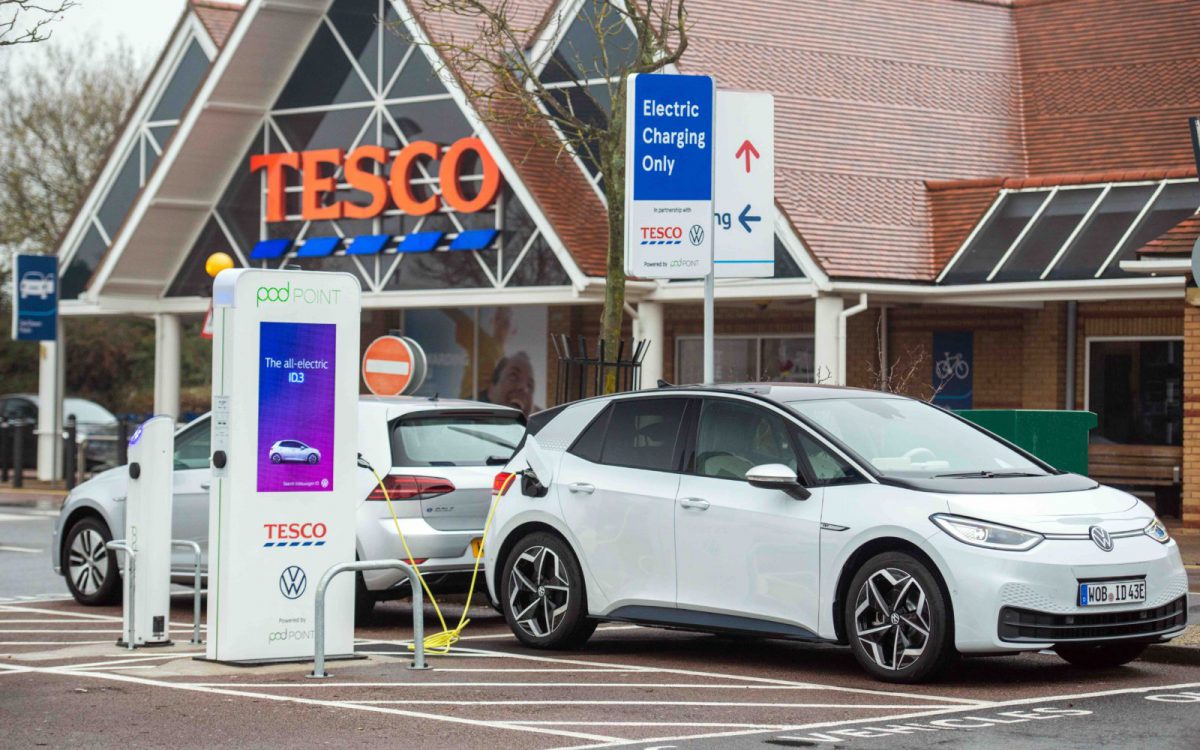
POD Point Rollout at Tesco Stores (Image: Tesco/POD Point)

What Biden’s environmental plans mean for electric vehicles

The Green New Deal has received a lot of attention since it was introduced in the U.S. House of Representatives in early 2019. But how many people have actually read it and know what’s in it?

The bill isn’t long, as bills go, but it’s dense. I’ve tried to pull out the main points below. You can read the complete text of the bill here.

President-elect Joe Biden has a lengthy description of his ambitious climate plan on his website. It’s based on the Green New Deal and contains many specific proposals. I walk you through it below.

In the interests of space and clarity, I am using an outline format with bullet points in some parts of this post.

The Green New Deal
The Green New Deal, H.RES.109, is not a law—It’s a framework for dealing with the climate crisis while also boosting job creation and addressing systemic racism and discrimination. It was named in the spirit of President Roosevelt’s New Deal, which helped pull America out of the Great Depression in the 1930s. It also is meant to reflect the efforts and sacrifices that the United States made during World War II.

On February 7, 2019, Representative Alexandria Ocasio-Cortez, the bill’s sponsor, introduced the Green New Deal in the U.S. House of Representatives of the 116th Congress, 1st Session, along with 68 other cosigners.

To back up its climate change proposals, the bill references the October 2018 Special Report on Global Warming of 1.5 degrees by the UN’s Intergovernmental Panel on Climate Change and the November 2018 Fourth National Climate Assessment Report.

POD Point Rollout at Tesco Stores (Image: Tesco/POD Point)

The reasons given for presenting the bill were:

Human activity is the dominant cause of climate change.
Climate change leads to many catastrophic results, including sea level rise, wildfires, storms, droughts.
Global warming more than two degrees Celsius will create even greater issues, such as mass migrations, lost economic output, destruction of coral reefs and damage to infrastructure.
The stated climate goal is to keep global temperature rise below 1.5 degrees C. This means reducing greenhouse gases by 40 to 60 percent by 2030 with the longer-term goal of net zero global emissions by 2050. These numbers reflect the latest scientific consensus and commitments now being made by large corporations and other nations, as built into the Paris Climate Accord of 2015. The United States is officially out of the Paris Agreement as of November 4, 2020, but will presumably re-enter it next year under a Biden presidency.

The actions described in the Green New Deal would commit the United States, a major emitter, to taking a leading role in fighting climate change. It lays out a 10-year plan to achieve net-zero greenhouse gas emissions through a “fair and just” transition, creating millions of good new jobs building a sustainable infrastructure and industries, as well as securing clean air and water, climate resiliency, healthy food, access to nature and a sustainable environment.

The Green New Deal also promotes justice and equity for people of colour, indigenous communities, migrant communities, deindustrialize communities, depopulated rural communities, the poor, low-income communities, women, the elderly, the unhoused, disabled and youth.

Climate action goals
The bill contains a long menu of goals and tasks, but the main ones for climate action include:

Building climate change resiliency against disasters
Repairing U.S infrastructure
Moving to 100 percent clean, renewable, zero-emission power, including smart power grids
Upgrading existing buildings
Growing clean manufacturing
Working with farmers and ranchers to remove pollution and greenhouse gases
Overhauling transportation systems to remove pollution and greenhouse gases
Mitigating and managing the effects of climate change
Removing greenhouse gases from the atmosphere and restoring natural ecosystems
Cleaning up hazardous waste
Sharing technology, products, and services with other countries
Protecting public lands, water and oceans

Read more: The Next Web

It’s Time to Go Green!

If you would like to know more about Solar Panels and the PowerBanx range of home battery systems, and get a free instant quote, please complete our online form:

Electric milestone reached as trail-blazing Nissan Leaf turns 10

Nissan is celebrating a decade-long history of the all-electric Leaf, which hit the streets in late 2010 becoming the world’s first mass-market electric vehicle.

The milestone anniversary has caused the company to take a moment to reflect upon the impact that the modest electric hatch has had upon the transition to zero emissions transport, as well as the upgrades the Japanese car makers has made to the Leaf during its 10 years.

“Over the past decade the journey of transformation with the Nissan Leaf represents the true innovation and advancements of EV development at Nissan,” said Helen Perry, head of electric vehicles at Nissan Europe.

With 500,000 Leafs now sold worldwide as of September, the unassuming electric hatch became a “debunker of myths and conceptions” that “kick-started” electric mobility, said Nissan.

Nissan has highlighted the increase in battery size and driving range, now up 160% and 120% respectively from the first year of release.

When the Leaf was first introduced in 2010, its 24kWh was rated for 117km driving range by the US-based EPA. Known as “ZE0”, the first generation Leaf had various system upgrades in 2014-2015 to achieve a slightly higher 135km driving range.

Nissan has since then greatly improved the battery size and hence also driving range. The “ZE1” second generation Leaf was the first to upgrade to a 40kWh battery with up to 240km driving range in 2018.

In 2019, Nissan announced it would also release a “long range” Leaf with 62kWh battery that could drive up to 364km on a single charge according to EPA “real world” figures.

“These increases have ultimately boosted customers’ confidence on the road,” says Nissan.

The company is also celebrating the Leaf’s claim as the first all-electric vehicle to win “World Car of the Year” title in the 47-year history of the prestigious awards.

In Australia, the Leaf made a return in 2019 after being pulled from the market in 2015, with then Nissan Australia managing director Richard Emery lamenting the lack of federal government support for EVs in Australia to help make electric vehicles more affordable.

While Australia is still waiting for a federal strategy on the adoption of electric vehicles, Nissan decided to re-introduce the new 40kWh Leaf in mid-2019 when it became one of few EVs on the local market priced under $50,000 before on-roads.

More recently, Nissan finally promised the long-range 62kWh Leaf e+ would be introduced locally in 2021 – but not before one couple imported their own privately under new grey import rules.

The Leaf is singular on the market in that it has bidirectional charging capabilities, and 51 Leafs are now being used in an ANU trial to assess their potential as mobile batteries to help smooth grid peaks and troughs.

It has been used in Japan to help provide power after natural disasters, and was recently re-imagined as an emergency vehicle by Nissan.

Read more: The Driven

It’s Time to Go Green!

If you would like to know more about Solar Panels and the PowerBanx range of home battery systems, and get a free instant quote, please complete our online form: